Introduction
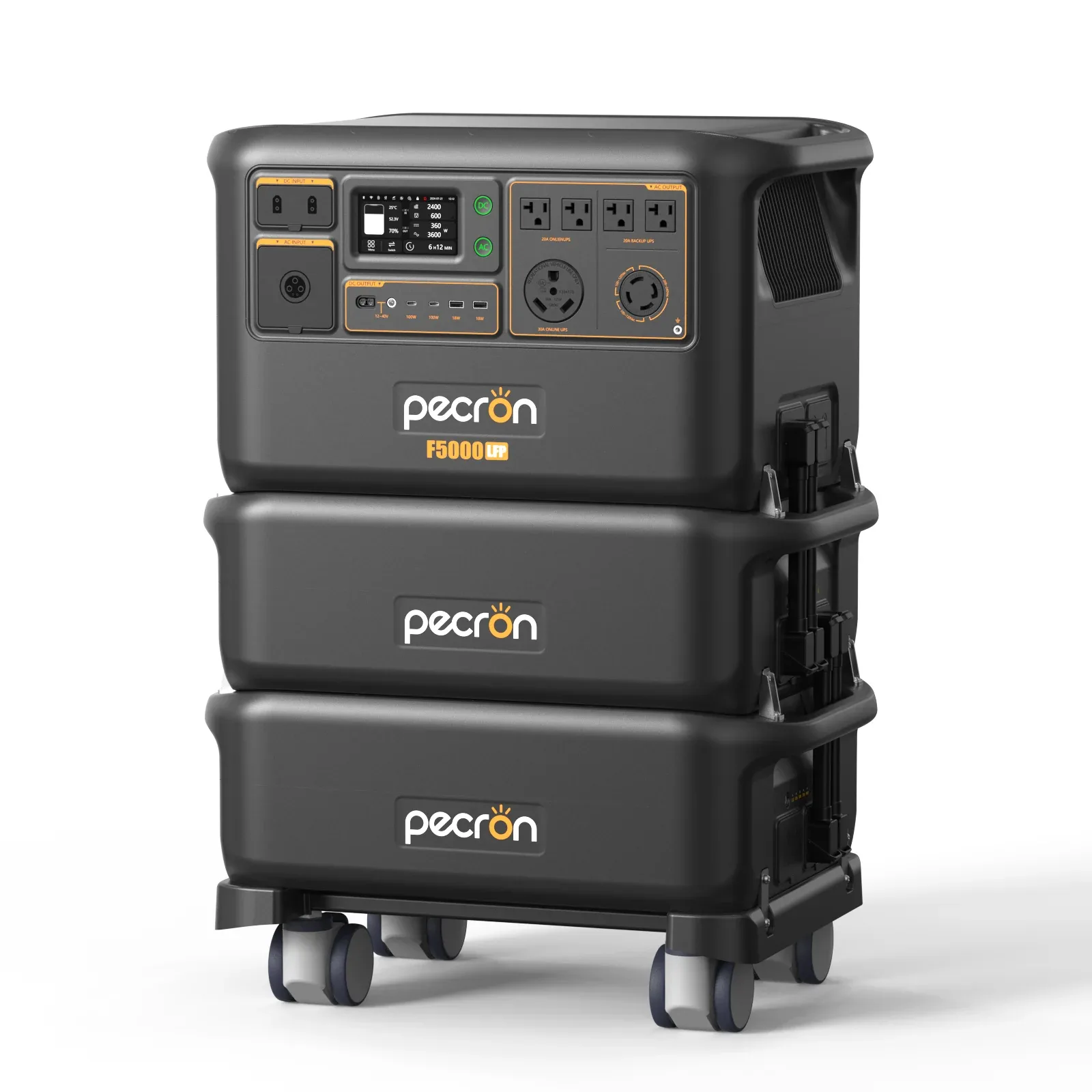
The Pecron F5000LFP is not a scaled-up camping battery pretending to be home backup equipment. Its 5,120Wh LiFePO4 pack, 3,600W 120V inverter, and 7,200W split-phase output are designed for the buyer who wants to run serious loads from one system. Add the two 3,200W solar inputs, 3,600W AC charging, and support for six expansion batteries, and the F5000LFP starts to look more like a compact energy system than a conventional portable power station.
That capability comes with a blunt trade-off: the F5000LFP is enormous, noisy under load, and wasteful when left idling. The Solar Lab measured 52W with the AC inverter enabled and no load, its highest idle result at the time of testing. This is a station to deploy deliberately, not a box to leave switched on indefinitely while waiting for an outage.
Pecron's official Shopify product record lists the F5000LFP as published on January 6, 2026. That is the launch date used here, not the publication date of the discovery review. It is a new 2026 model at this review's publication date, although the hardware is already being judged against mature systems from EcoFlow, Anker, and BLUETTI. Pecron's official store lists the base unit at $2,199 on September 19, 2026, before expansion batteries or a larger solar array.
The F5000LFP's central proposition is persuasive: it offers the kind of voltage flexibility and solar headroom normally associated with much more expensive backup systems. It is a good buy for a technically confident owner who needs that headroom. It is the wrong buy for anyone who mainly wants a light, quiet, maintenance-free battery for occasional camping.
Design, Controls, and Setup
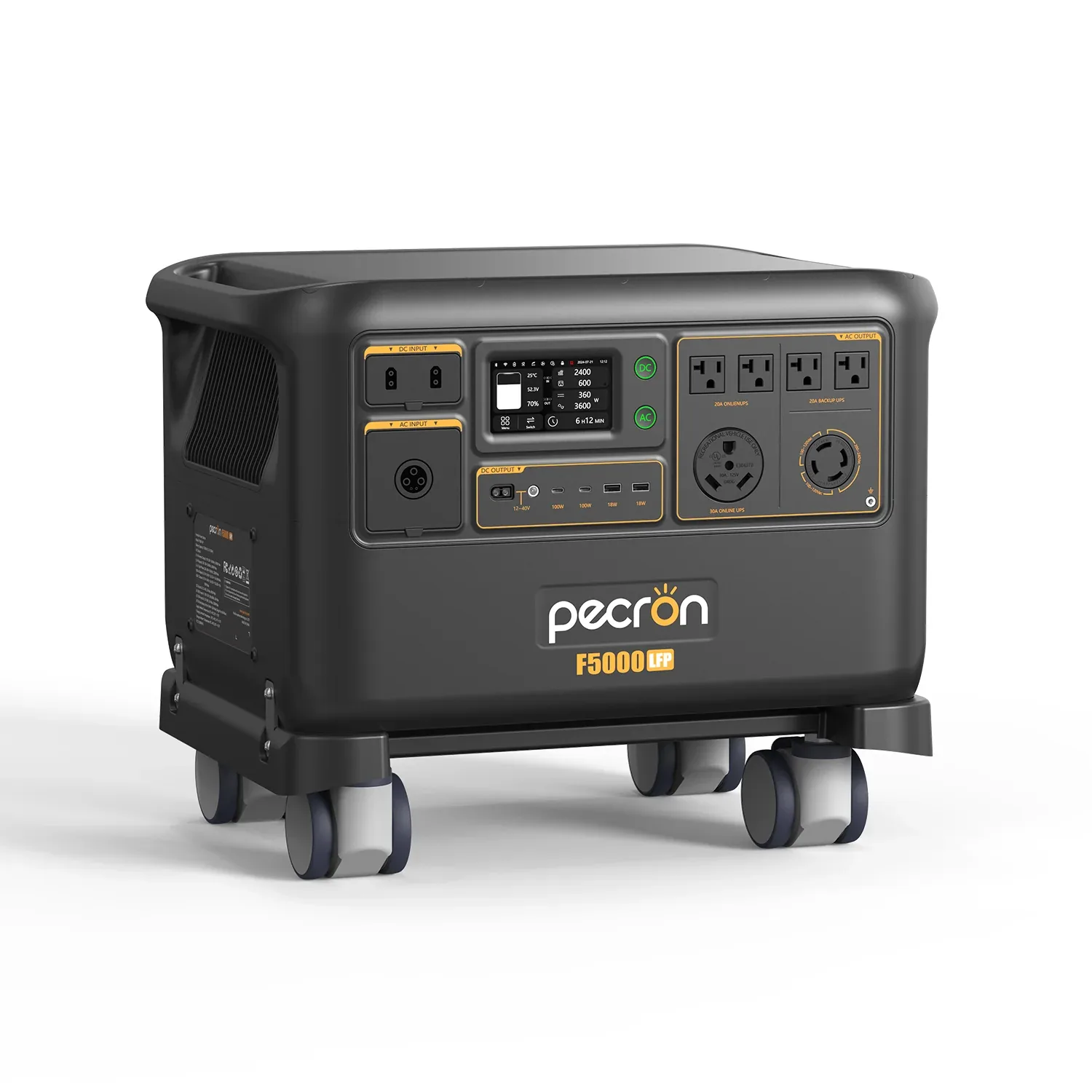
At 124 lb, the F5000LFP is not meaningfully portable without its included or optional wheeled trolley. The trolley is more than a nice accessory here; it is part of the ownership plan. Moving this unit across a garage or driveway is realistic, while lifting it into a vehicle or carrying it down stairs is a two-person job. Buyers should choose its permanent operating location before they buy the expansion path.
Pecron product page (Manufacturer product image)
The F-series enclosure is cleaner and more modern than Pecron's older E-series units. Its touchscreen is a meaningful upgrade because it exposes settings and automation controls on the machine rather than making the app the only practical interface. The official feature list also includes OTA updates, operation-log inquiry, and charging statistics. Those features make the F5000LFP easier to monitor as a backup system, even though Pecron's software ecosystem is not as mature as EcoFlow's.
The port selection is aimed squarely at backup and jobsite use. Four 120V outlets cover ordinary appliances, a 30A RV receptacle supports the common trailer connection, and a 240V twist-lock outlet enables split-phase equipment from one unit. USB-C ports rated at 100W handle laptops and other demanding personal electronics, while the USB-A ports retain compatibility with older cables. There is one odd omission: Pecron leaves out a conventional 12V car socket, despite including the larger RV output.
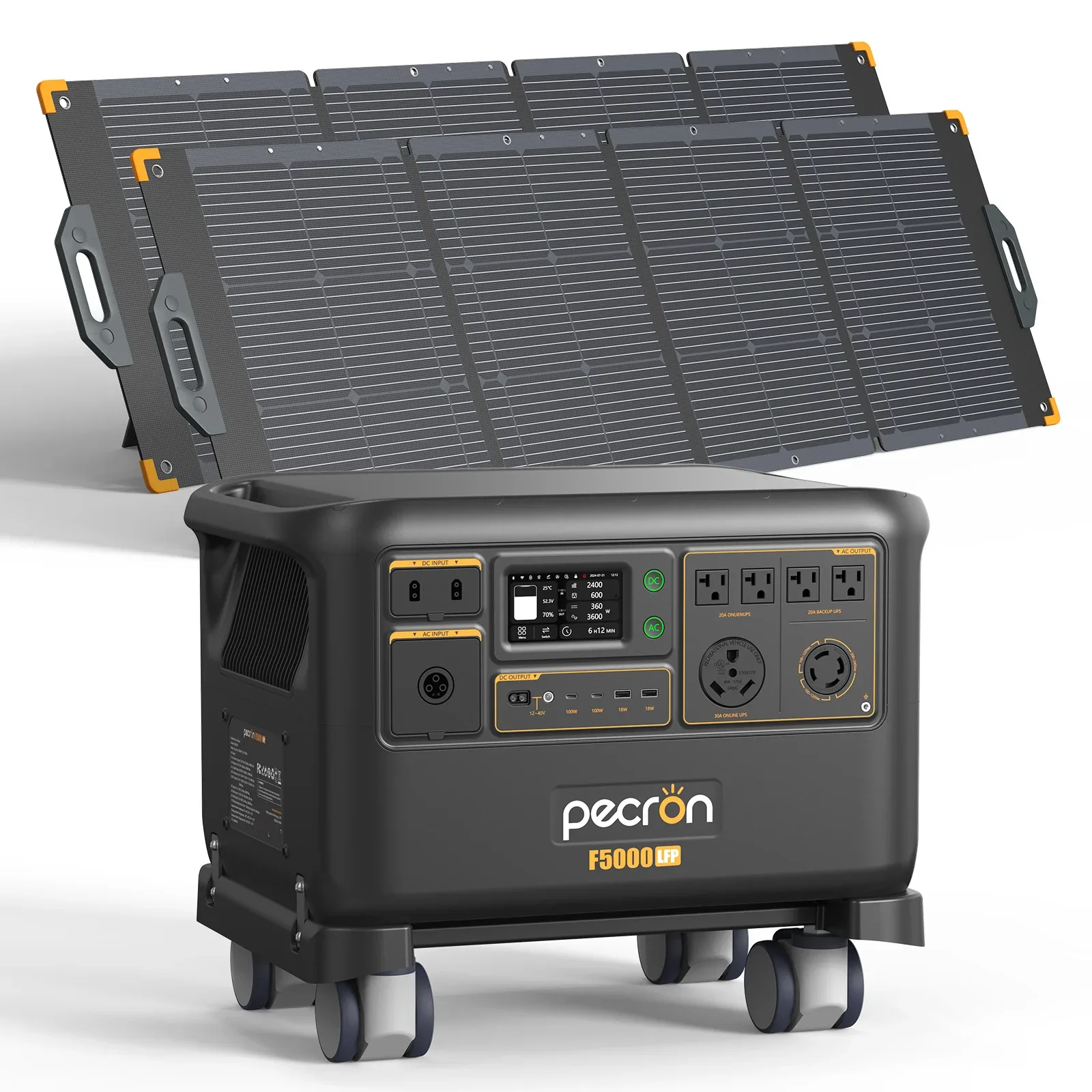
Setup is more involved than plugging in a compact station. A 240V load needs appropriate wiring and a compatible transfer or connection arrangement; the F5000LFP is not permission to improvise with household circuits. Solar input also requires a deliberate panel design because the two XT60 inputs each accept a high-power array. That complexity is justified for an owner building a system, but it is unnecessary for someone who only wants occasional USB charging.
Battery, Charging, and Solar Input
The 5,120Wh LiFePO4 battery gives the F5000LFP enough reserve to matter during a long outage. It can cover a refrigerator, communications gear, lights, computers, and selected tools for a meaningful period, although no 5kWh station should be treated as unlimited whole-home power. Runtime still depends on inverter losses and the combined load.
Pecron product page (Manufacturer product image)
Pecron claims more than 4,000 cycles before the battery falls to 80% of its original capacity. That is a manufacturer claim rather than an independent longevity result, but it is the right chemistry and an encouraging rating for a station intended to cycle frequently. The product also includes battery heating and temperature management, a useful feature for cabins, garages, and winter work areas where cold charging needs more care.
AC charging is rated at 3,600W through a 30A cable. The Solar Lab charged from empty to full in about 3.5 hours from a normal 120V outlet and about 1 hour 40 minutes using the 30A input. Those independent results make the capacity more usable: a large battery is less frustrating when it can recover during the same day.
Solar charging is the F5000LFP's most extravagant specification. Pecron lists 6,400W maximum through two 3,200W XT60 inputs, with a 30V-to-180V range and 25A maximum per input. The official page says a single unit can accept up to 5,800W and fully charge in about 70 minutes, while the 6,400W ceiling is available with an extra battery unit. This is not a reason to buy a pile of panels blindly. It is a reason to consider the F5000LFP if you are designing a substantial solar array and want the charge controller to remain useful as the system grows.
The important limitation is that Pecron does not provide a 240V charging input. Even though the unit can output 7,200W at 240V, the fastest AC route remains 3,600W. That is still fast, but buyers building a large 240V installation should understand the asymmetry before assuming every part of the system scales equally.
Performance and Real-World Use
The F5000LFP's headline performance is unusually credible. The Solar Lab measured 84% efficiency, a respectable result for a high-capacity station, and found that the 120V and 240V outputs handled heavy startup surges well. Pecron does not publish a prominent surge figure for the unit, so those observations are more useful than an optimistic maximum printed on a box. They suggest the F5000LFP can start demanding appliances, pumps, and tools without treating its continuous rating as a fragile ceiling.
Pecron product page (Manufacturer product image)
The 240V output is the feature that most changes the buying decision. Earlier Pecron systems required two stations and a 240V Connect Box for this class of output. The F5000LFP puts dual-voltage capability in one enclosure, which can simplify a transfer-switch or workshop setup. It can also charge from 120V wall power while delivering 240V output, a practical advantage when the available charging circuit is ordinary household power.
The downside is noise. The Solar Lab found the cooling fans noticeably loud under heavy load, and the F5000LFP is a poor choice for a bedroom, a quiet office, or a CPAP setup next to the bed. The 52W idle consumption is an even more consequential problem. Over a day, that is roughly 1.25kWh consumed before the connected appliance uses anything. The big battery masks the loss for a while, but it does not make the energy free.
UPS behavior is promising on paper, with Pecron listing 10ms bypass switching and 0ms UPS mode. Treat those labels as a compatibility starting point rather than a universal guarantee for every computer or medical device. Test sensitive equipment in the intended setup before relying on it during an outage.
Pecron F5000LFP vs. the Alternatives
EcoFlow DELTA Pro Ultra. EcoFlow remains the stronger choice for buyers who want a mature app, a broad accessory ecosystem, and a more established home-backup path. The F5000LFP is more compelling when the buyer wants comparable system ambition at a lower entry price and is comfortable doing more of the electrical planning themselves.
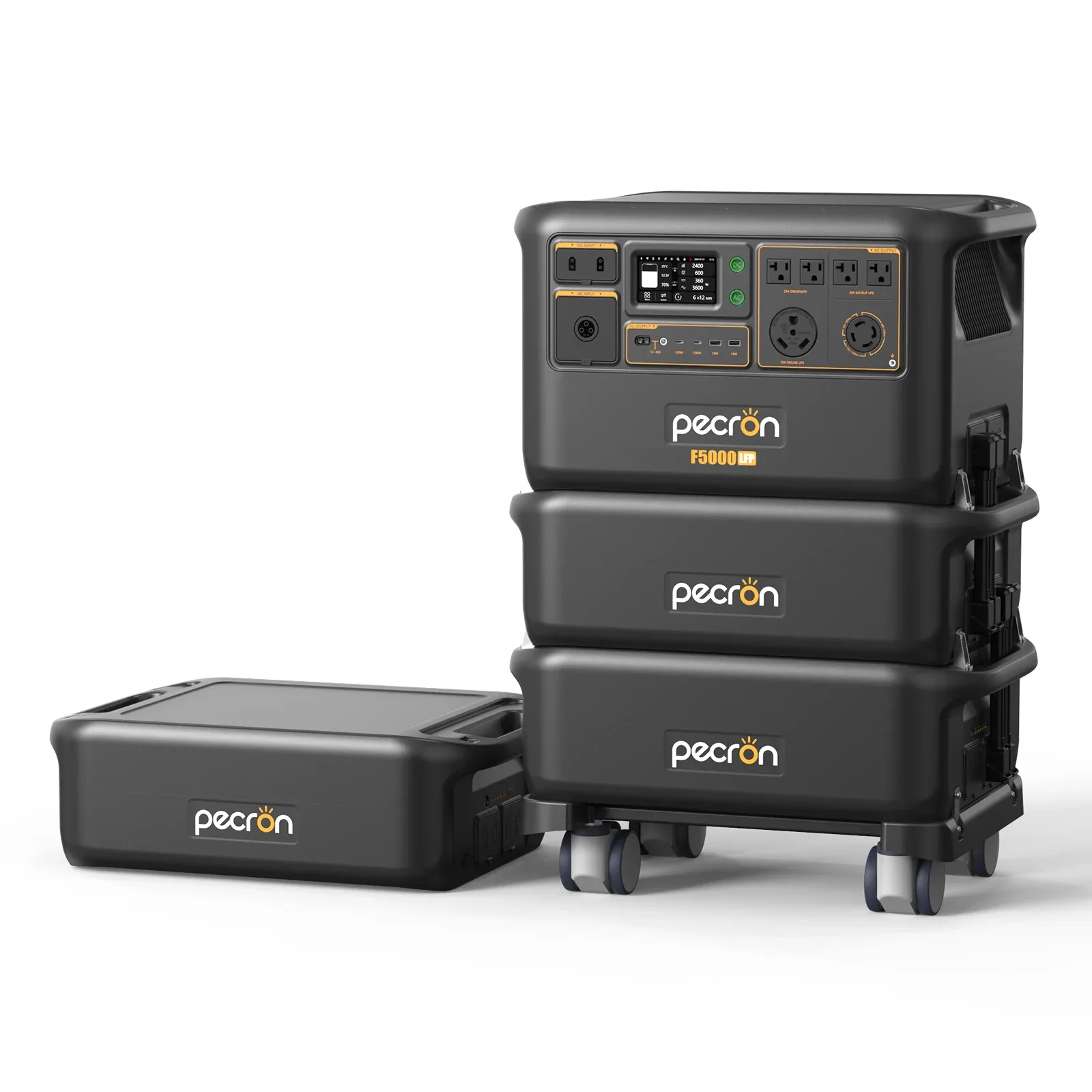
Pecron product page (Manufacturer product image)
Anker SOLIX F3800 Plus. Anker offers a polished 240V-capable platform with a stronger consumer support story. Pecron counters with a larger 5,120Wh base battery and a much higher claimed solar ceiling. Choose Anker for refinement and ecosystem confidence; choose Pecron when input capacity and raw value are the priorities.
BLUETTI AC500 with B300S batteries. BLUETTI's modular approach is better for a buyer who wants to size the battery bank around a known installation and add capacity incrementally. The F5000LFP is simpler as a single starting unit, with 240V output already integrated, but its 124lb chassis is less flexible to reposition once installed.
Pecron F3000LFP. The smaller Pecron is the more sensible value choice for 120V loads, RV use, and buyers who do not need split-phase output. The F5000LFP earns its premium through the 5,120Wh battery, 240V capability, and much larger solar input. If those three features are not part of the plan, the F3000LFP is easier to justify.
Who Should Buy It?
Buy the F5000LFP if you are building a serious outage, cabin, workshop, or off-grid system and can provide a fixed operating location. It is especially attractive for someone who wants 240V capability from one unit, expects to use solar as a primary charging source, or plans to expand storage over time. The touchscreen, battery heater, statistics, and trolley make a complex system easier to operate, but they do not turn it into a lightweight appliance.
It is also a strong fit for technically confident buyers who will manage the inverter deliberately. Turn it on when the load is active, use the solar and AC charging headroom, and turn it off when the system is not needed. In that pattern, the F5000LFP's biggest weakness is manageable.
Skip it if you want a quiet weekend-camping battery, a built-in flashlight, a normal 12V socket, or an always-on backup that wastes very little energy. The F5000LFP is too heavy and too hungry at idle for those jobs. Buyers who value polished support and a deep smart-home ecosystem should also compare EcoFlow and Anker before trading those benefits for Pecron's lower price.
Verdict
The Pecron F5000LFP is a serious energy system wearing a portable-power-station label. Its 5,120Wh LiFePO4 battery, integrated 120V/240V output, 6,400W solar ceiling, and 3,600W AC input deliver capabilities that are difficult to match at the $2,199 base price. Independent testing backs up the important parts: 84% efficiency, fast charging, and strong surge behavior.
The ownership compromises are not minor. At 124 lb, it needs a trolley and a permanent plan. Under load it is loud, it lacks a light and car socket, it cannot accept 240V charging, and the measured 52W idle draw makes unattended standby expensive. Those weaknesses narrow the recommendation rather than invalidate it.
Buy the F5000LFP if you need a single-unit 240V-capable platform and will actively manage its charging and idle state. For ordinary camping or simple 120V emergency power, buy a smaller and quieter station. For a polished home-backup ecosystem, pay more for EcoFlow or Anker. For a technically capable owner building around solar, Pecron has made an unusually ambitious and compelling value proposition.
FAQ
When did the Pecron F5000LFP launch?
Pecron's official product record lists a publication date of January 6, 2026. That primary-source date is the launch context used here; the discovery review's publication date is not evidence of when Pecron introduced the model.
How much battery capacity does it have?
The F5000LFP has a 5,120Wh LiFePO4 battery. That is enough storage for meaningful essential-load backup, workshop use, or off-grid power, but actual runtime depends on the load and inverter losses.
Can one unit provide 240V power?
Yes. Pecron lists 7,200W maximum split-phase output at 240V from one F5000LFP, alongside 3,600W at 120V. A suitable installation and compatible wiring are still required.
How much solar can it accept?
Pecron lists up to 6,400W through two 3,200W XT60 inputs. Its official description says a single unit supports up to 5,800W and reaches the 6,400W maximum with an extra battery unit. Panel voltage, current, wiring, and sunlight all matter.
How fast does it charge from AC?
The maximum AC input is 3,600W with a 30A cable. The Solar Lab reported about 3.5 hours from empty to full on a regular 120V outlet and about 1 hour 40 minutes using the 30A input.
Can it charge while producing 240V output?
Pecron says the F5000LFP can charge from ordinary 120V wall power while outputting 240V. That is useful in an outage setup where a 240V load is active but the available charging circuit is still 120V.
How many expansion batteries can it use?
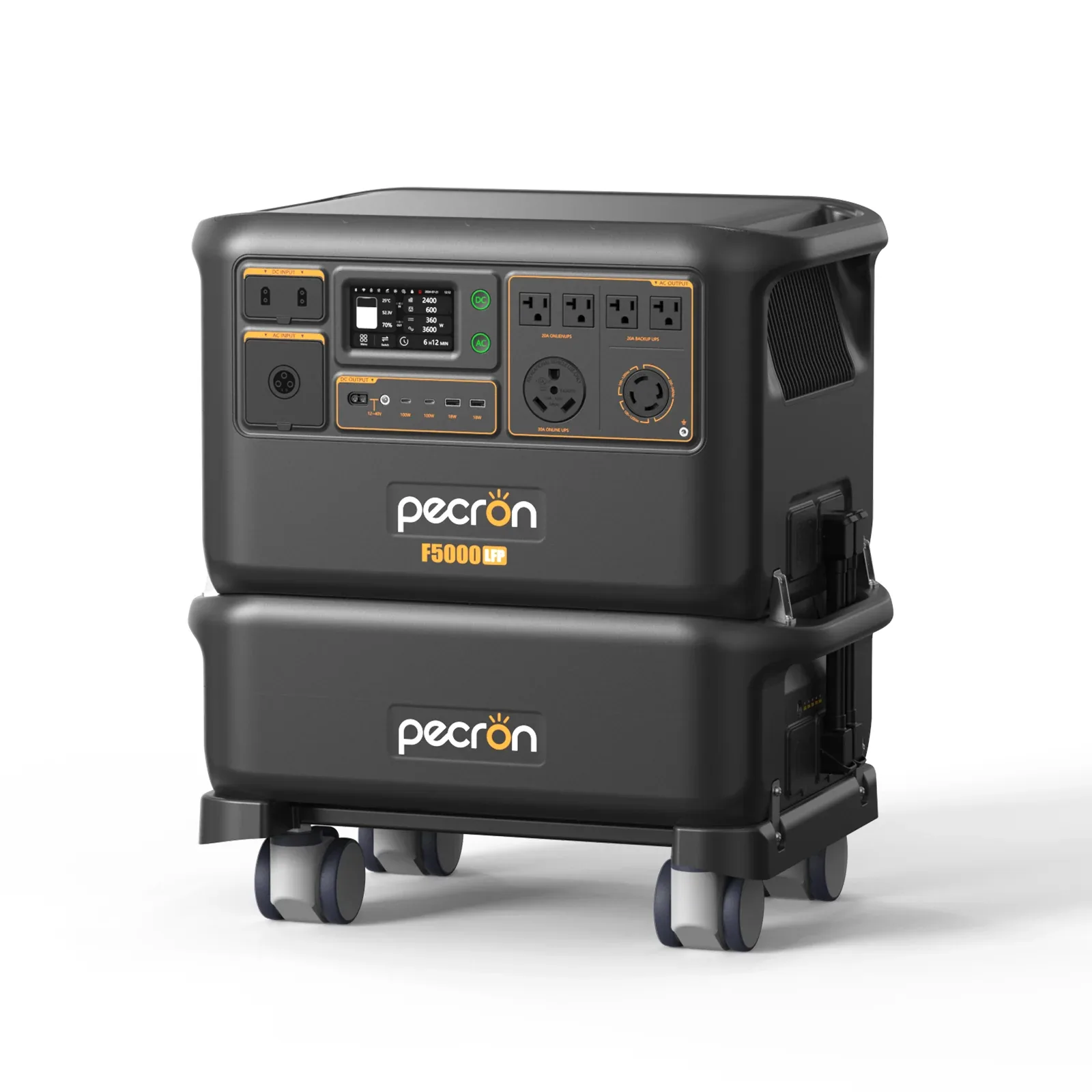
Pecron lists support for up to six FP5000-48V expansion batteries and total capacity up to 35.8kWh. Expansion hardware is a substantial additional purchase and should be planned as a complete system.
Is the 52W idle draw a problem?
Yes, if the inverter is left on for long periods without a load. It amounts to roughly 1.25kWh per day before the connected device consumes anything. Switch the inverter off when the station is not actively doing work.
Is it portable enough for camping?
Not in the casual sense. The F5000LFP weighs 124lb, so it is best moved with a trolley and used from a fixed campsite, vehicle, garage, or cabin position. It is not a grab-and-go battery.
Does it have a 12V car outlet?
No conventional 12V car socket is listed. It does include a 30A RV outlet and other DC connections, but buyers with common 12V camping accessories should plan for an adapter or a different station.
Is it quiet enough for a bedroom?
No. The Solar Lab reported noticeable fan noise under heavy load. Put it away from sleeping areas if you expect it to run hard.
Does it have a built-in light?
No built-in light is listed for the F5000LFP. Keep a separate lantern or headlamp with the outage kit.
Is it a good UPS?
Pecron lists 10ms bypass switching and 0ms UPS mode, which is promising for electronics. Verify compatibility with the specific computers, networking equipment, or medical devices you plan to protect before relying on it.
Is it better than the Pecron F3000LFP?
Only if you need its extra capacity, integrated 240V output, or much larger solar input. The F3000LFP is easier to move and more appropriate for ordinary 120V, RV, and camping loads.
Who should skip the F5000LFP?
Skip it if you want a quiet, lightweight station for occasional camping, very low standby consumption, a built-in light, or a mature app-and-support ecosystem. Its strengths matter most in a planned, high-capacity installation.