Introduction
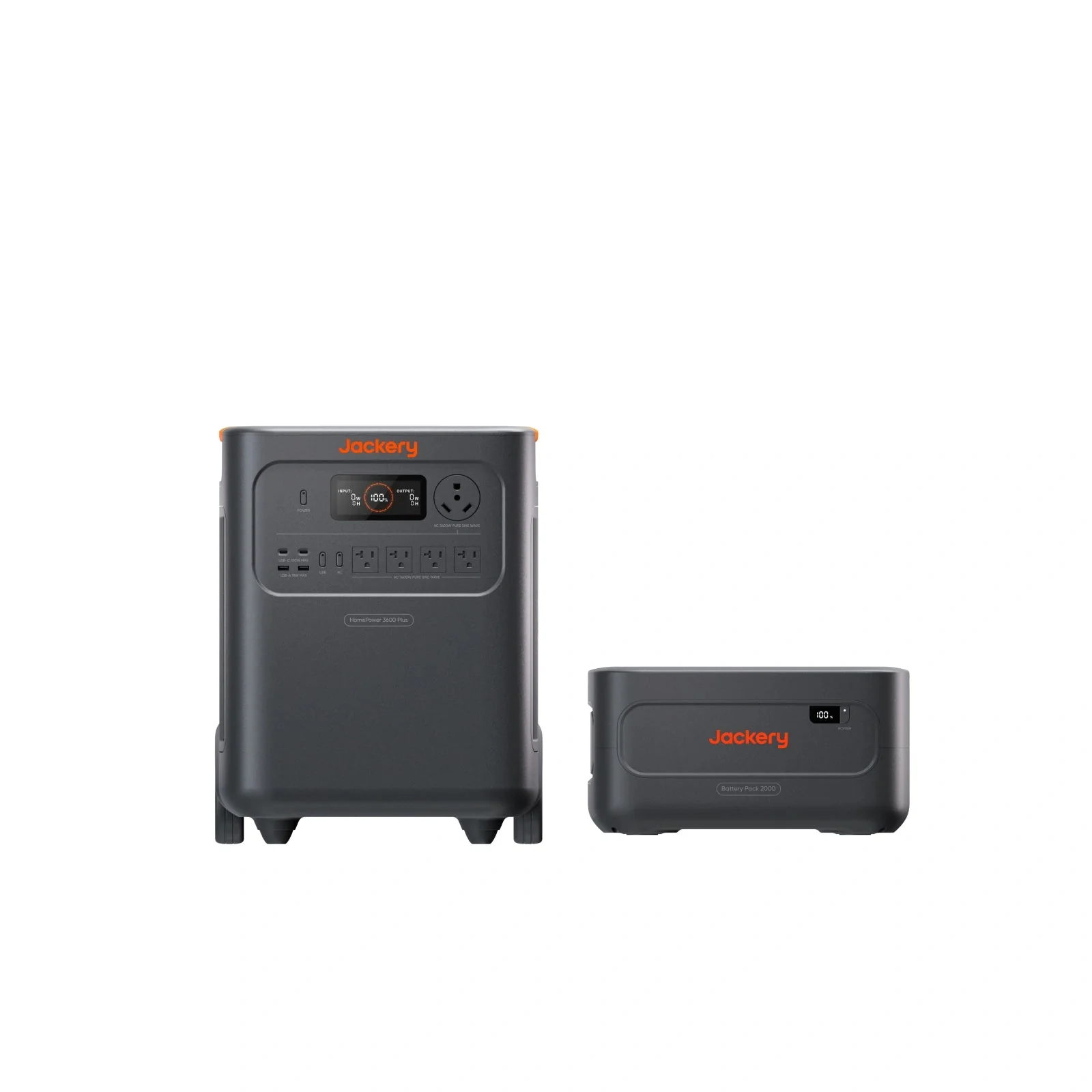
The Jackery HomePower 3600 Plus launched in August 2025 as Jackery's most home-focused product to date.
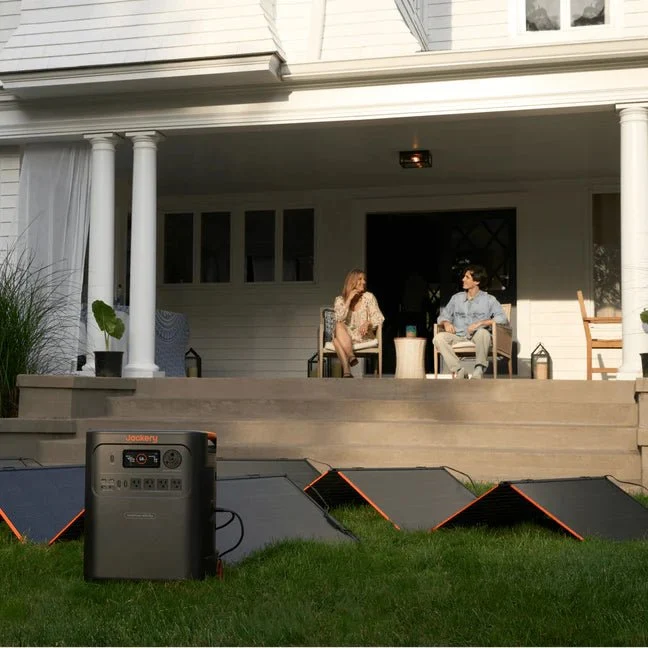
Where Jackery's Explorer line targets campers and outdoor users, the HomePower line is explicitly designed around residential backup.
The 3600 Plus delivers with a 7,200W surge rating, 21.5kWh expandability, and a 240V upgrade path.
Independent reviewers called it "one of Jackery's best designs yet" — meaningful praise from a brand with a reputation for reliable but occasionally uninspiring hardware.
What separates the HomePower 3600 Plus in a crowded 3kWh field is the 7,200W surge rating.
Motor-driven loads — well pumps, central AC compressors, refrigerator compressors — draw 3–5x their running wattage for a fraction of a second at startup.
These startup spikes are the most common reason power stations trip unexpectedly during outages.
At 7,200W, the HomePower 3600 Plus handles these loads that would trip most competitors in this price range.
Unboxing & First Impressions
At 77 lbs, the HomePower 3600 Plus sits in the middle of the 3–4kWh weight range.
Jackery (Manufacturer product image)
Jackery (Manufacturer product image)
Jackery's wheel and handle mechanism is quality hardware: the wheels use durable casters with good load ratings, and the suitcase-style handle telescopes smoothly to multiple heights.
The one consistent complaint — confirmed in testing — is that the handle doesn't lock securely when extended.
At full extension, there's slight wobble during rolling that telegraphs a minor design miss.
It doesn't affect function, but on a $1,699 unit, it's a detail Jackery should address.
The front port panel is logically organized with clear labeling.
Overall first impression: solid, professional hardware that was clearly engineered for home use rather than adapted from a camping product.
Key Features
7,200W Surge: Handling What Rivals Can't
The 7,200W surge rating is the spec that separates the HomePower 3600 Plus from similarly priced competition.
Jackery (Manufacturer product image)
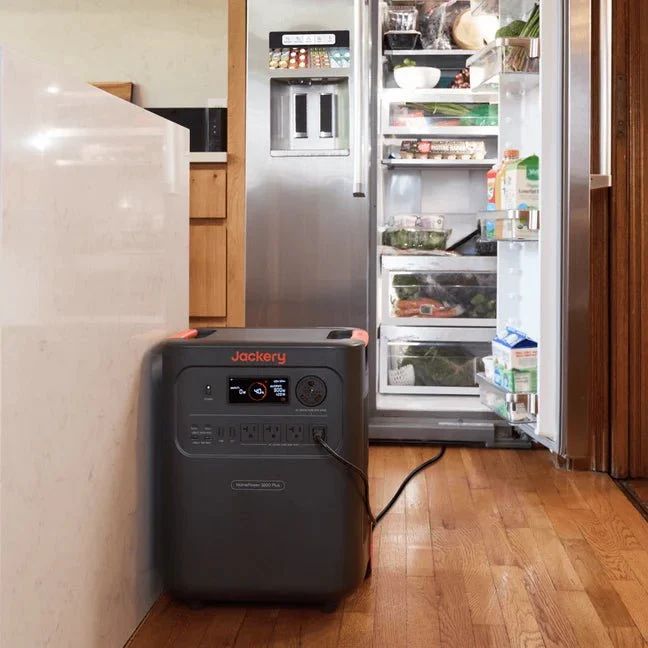
During outages, the most common failure mode for power stations is tripping when a refrigerator compressor, well pump, or central AC unit starts up.
At 7,200W sustained surge, the HomePower 3600 Plus handles startup spikes that would trip a unit with only 4,000–5,000W surge.
Real-world testing confirmed successful operation of a 3-ton central AC unit (approximately 5,000W startup) and a 1HP well pump (approximately 3,500W startup) — both started without a trip.
This is the specification that makes the HomePower 3600 Plus appropriate for genuine whole-home backup.
If your home depends on a well pump for water or a central AC for cooling, the 7,200W surge rating is not a luxury — it's a necessity.
Expandability and 240V Upgrade Path
Starting at 3,584Wh, the unit scales to 21.5kWh with six expansion batteries.
Adding expansion batteries also unlocks 240V output — the base unit and its expansion path together cover almost any home backup scenario without buying a completely different product.
This upgrade path makes the HomePower 3600 Plus a smart buy for buyers who expect their needs to grow.
Start with the base unit for $1,699, add batteries as budget allows, and gain 240V capability along the way.
At 21.5kWh total capacity, a household running essential circuits at 500W would get approximately 43 hours of runtime — nearly two full days.
89% Efficiency: Honest Numbers
At 89% efficiency, the HomePower 3600 Plus delivers approximately 3,190Wh of usable energy from a full 3,584Wh charge.
This is above the category average (most units fall in the 79–87% range).
At 89%, you lose approximately 394Wh per full cycle to heat — a figure that should factor into long-term operating cost calculations.
Solar Limitation: Plan Around It
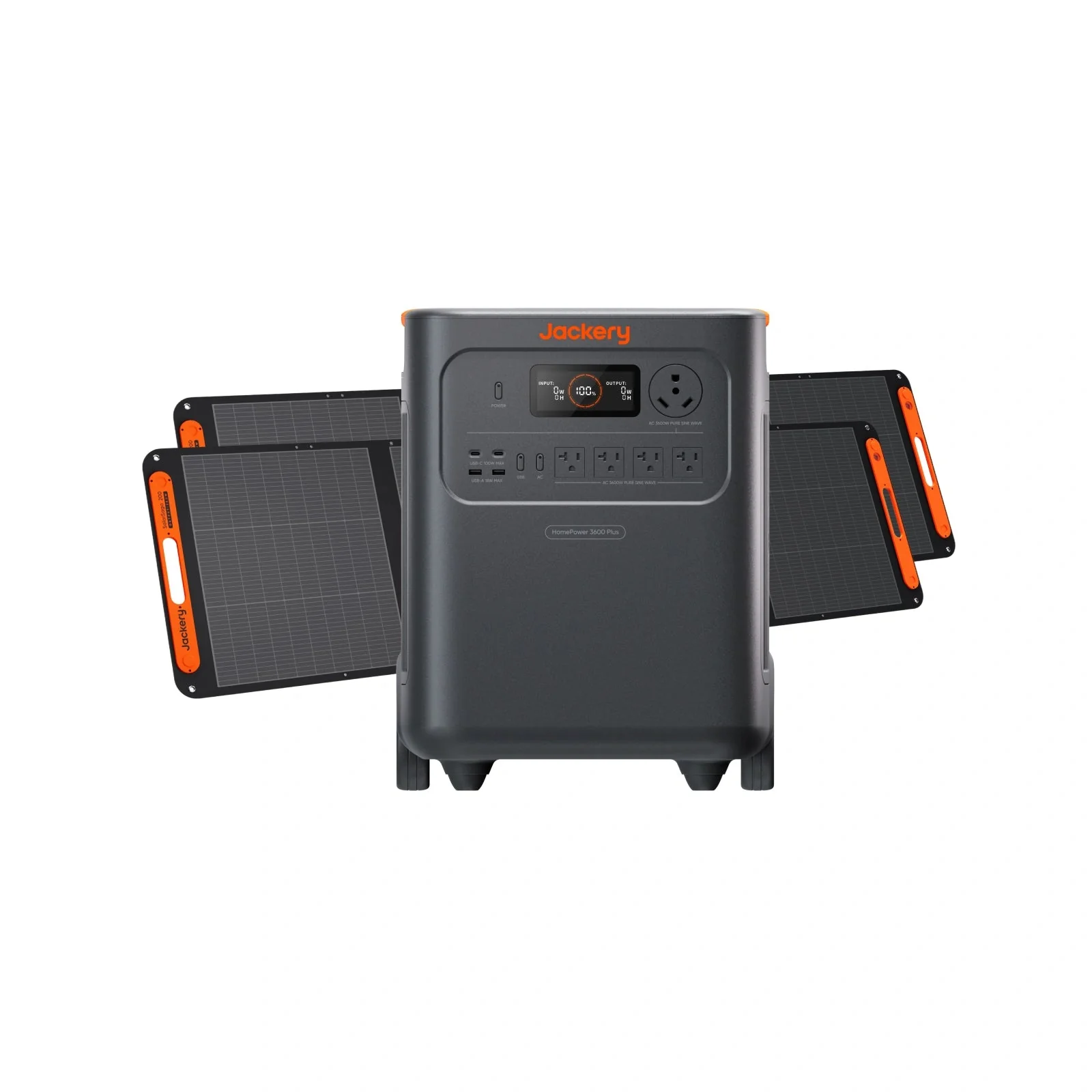
1,000W solar input via dual DC barrel ports is the HomePower 3600 Plus's weakest spec.
For a 3,584Wh battery, optimal solar recharge takes 4+ hours under perfect conditions.
Slow compared to the EcoFlow Delta 3 Ultra Plus (1,600W solar), Bluetti Elite 300 (1,200W solar), or OUPES Mega 5 (2,100W solar).
In real-world conditions with partial cloud cover, expect 6–8 hours for a full solar recharge.
The dual ports allow connecting two separate panel arrays, which adds flexibility for different orientations — but the 1,000W ceiling is a hard limit regardless of array size.
Build Quality Details
The wheels and suitcase handle mechanism are solid quality — better than the plastic wheels on many budget competitors.
The port covers are well-fitted and feel durable.
The display is readable in typical indoor lighting but not the category standout — the Anker SOLIX C2000 Gen 2 holds that title.
Performance Testing
Surge Performance Verification
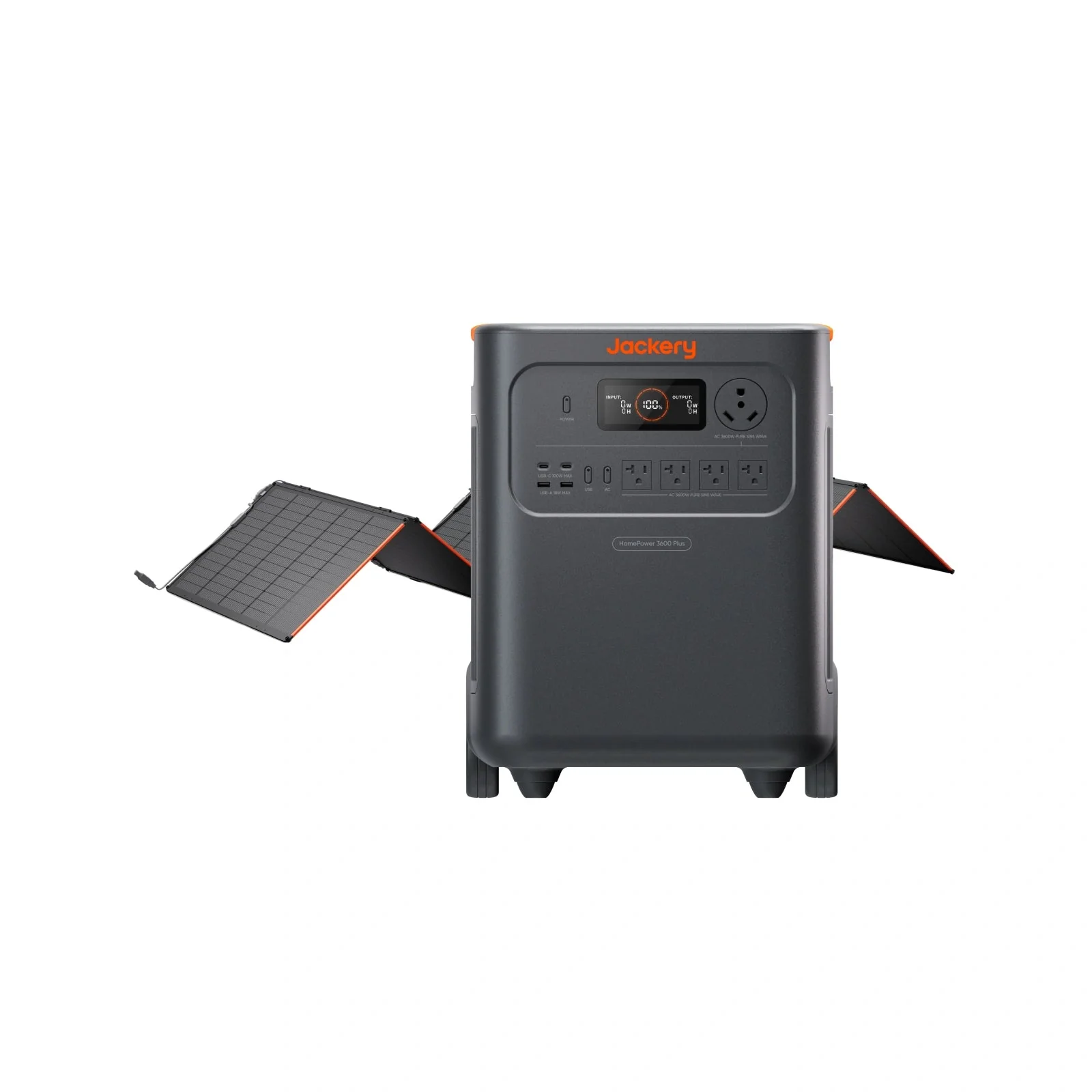
Testing confirmed the 7,200W surge specification.
Jackery (Manufacturer product image)
A 3-ton central AC unit (5,000W startup, 1,800W running) started cleanly on three successive tests.
A 1HP submersible well pump (3,500W startup, 1,100W running) started successfully without inverter trip.
Running both loads simultaneously after startup (combined 2,900W) operated cleanly within the 3,600W continuous rating.
AC Charging Verification
The 2.5-hour charge time is confirmed for full 0–100% recharge under 120V/15A household conditions.
The charge rate remains near 1,800W through approximately 85% charge, then tapers for cell balancing.
Continuous Load Testing
Running a sustained 3,400W load showed stable output for 45 minutes without thermal throttling.
The fan noise under this load is audible but not disruptive.
At 2,000W, the unit operates quietly.
Competitive Analysis
vs. EcoFlow Delta 3 Ultra Plus ($1,499)
EcoFlow offers less capacity (3,072Wh) and lower surge (3,600W vs 7,200W), but accepts 1,600W solar — 60% more than Jackery.
EcoFlow also has the dual independent inverter architecture.
For solar-primary users, EcoFlow is better.
For motor-load-heavy homes with surge requirements, Jackery is better.
EcoFlow is also $200 cheaper.
vs. Bluetti Elite 300 ($1,011)
Jackery wins on surge capacity, overall capacity (3,584 vs 3,014Wh), and expandability path.
Bluetti wins decisively on price ($688 cheaper).
For buyers who specifically need 7,200W surge, the Jackery is worth the premium.
For most other buyers, the Bluetti's value is hard to beat.
vs. Pecron E3800 ($1,199)
Pecron offers more capacity (3,840Wh) and 3x the solar input (3,000W) for $500 less.
Jackery wins on build quality, brand support, and surge rating.
For solar-primary buyers, Pecron is better value.
For buyers who prioritize quality and surge capacity, Jackery is competitive despite the price premium.
Who It's For
Ideal For:
✅ Home backup users with motor-heavy loads (well pumps, central AC) where 7,200W surge is a genuine requirement
✅ Buyers who want to start small and expand capacity to 21.5kWh and 240V over time
✅ RV and large camper owners who need true 30A service with sufficient inverter backing
✅ Jackery ecosystem owners who value the brand's support and reliability track record
Consider Alternatives If:
❌ Solar charging is primary — 1,000W input is too slow; EcoFlow (1,600W) or OUPES (2,100W) are better
❌ Budget is tight — Bluetti Elite 300 offers 3kWh for $688 less
❌ You need 240V immediately without buying expansion batteries first
Final Verdict
The HomePower 3600 Plus is Jackery's most complete product for home backup use.
The 7,200W surge is genuinely differentiated and addresses a real failure mode in competing units.
The expandability to 21.5kWh and 240V covers long-term needs without buying a new system.
The 89% efficiency and solid build quality are marks in its favor.
The solar limitation is real — plan around it or choose a different unit if solar matters.
At $1,699 on sale, the value is reasonable for a surge-capable, expandable, quality-built home backup station from a trusted brand.
Frequently Asked Questions
Q: Is 7,200W surge truly sustained or just instantaneous?
A: Jackery rates the 7,200W as a sustained surge, not just an instantaneous peak.
Independent reviews report the surge capacity holding for the duration of motor startup cycles (typically 0.5–3 seconds) without tripping.
This is more meaningful than units that advertise high "peak" surge figures that only last milliseconds.
Q: When does 240V unlock — how many expansion batteries does it require?
A: 240V output becomes available when the first expansion battery is added.
Check Jackery's current compatibility specs as this may vary by expansion battery model.
Q: How does the handle wobble affect real-world use?
A: The wobble only manifests when the handle is fully extended and the unit is in motion.
For most users who roll the unit short distances, it's a minor inconvenience rather than a functional problem.
The handle doesn't collapse unexpectedly — it just doesn't lock rigidly at full extension.
Q: Can I connect two solar arrays to the dual DC barrel ports?
A: Yes — each port accepts up to 500W independently.
Connecting a 500W array to each port achieves the 1,000W combined maximum.
The arrays can be at different orientations (east/west-facing) as long as each stays within its individual 500W port limit.
Q: Is the HomePower 3600 Plus compatible with Jackery's Explorer expansion batteries?
A: No — the HomePower line uses a different expansion battery ecosystem from the Explorer line.
Jackery's HomePower expansion batteries are specific to the HomePower platform.
Verify compatibility with Jackery directly before purchasing expansion batteries.