Introduction
The Jackery Explorer 1500 Ultra launched in August 2025 with a simple thesis: make a power station that survives the field.
IP65 dust and water resistance, 1-meter drop testing, grip-textured feet, and a bottom-mounted fan that can be cleaned with a removable base — every design decision targets outdoor professionals, construction workers, and overlanders who actually put gear through abuse.
This is not a power station designed for a sheltered garage corner.
It's designed for truck beds, boat decks, construction sites, and adventures where equipment gets rained on, dropped, and covered in dust.
At a category where most units carry zero weather or impact ratings, the IP65 + 1-meter drop combination is genuinely rare and valuable for the right user.
The efficiency number is the bonus that makes it extraordinary: independent testing clocked 98% efficiency — the highest figure ever recorded in the portable power station category.
Not 94% like the Bluetti Elite 200 V2, but 98%.
Almost nothing is lost to heat — meaning almost every watt you capture from solar translates directly to usable output.
Unboxing & First Impressions
The Explorer 1500 Ultra's physical construction communicates its purpose immediately.

Jackery (Manufacturer product image)
Jackery (Manufacturer product image)
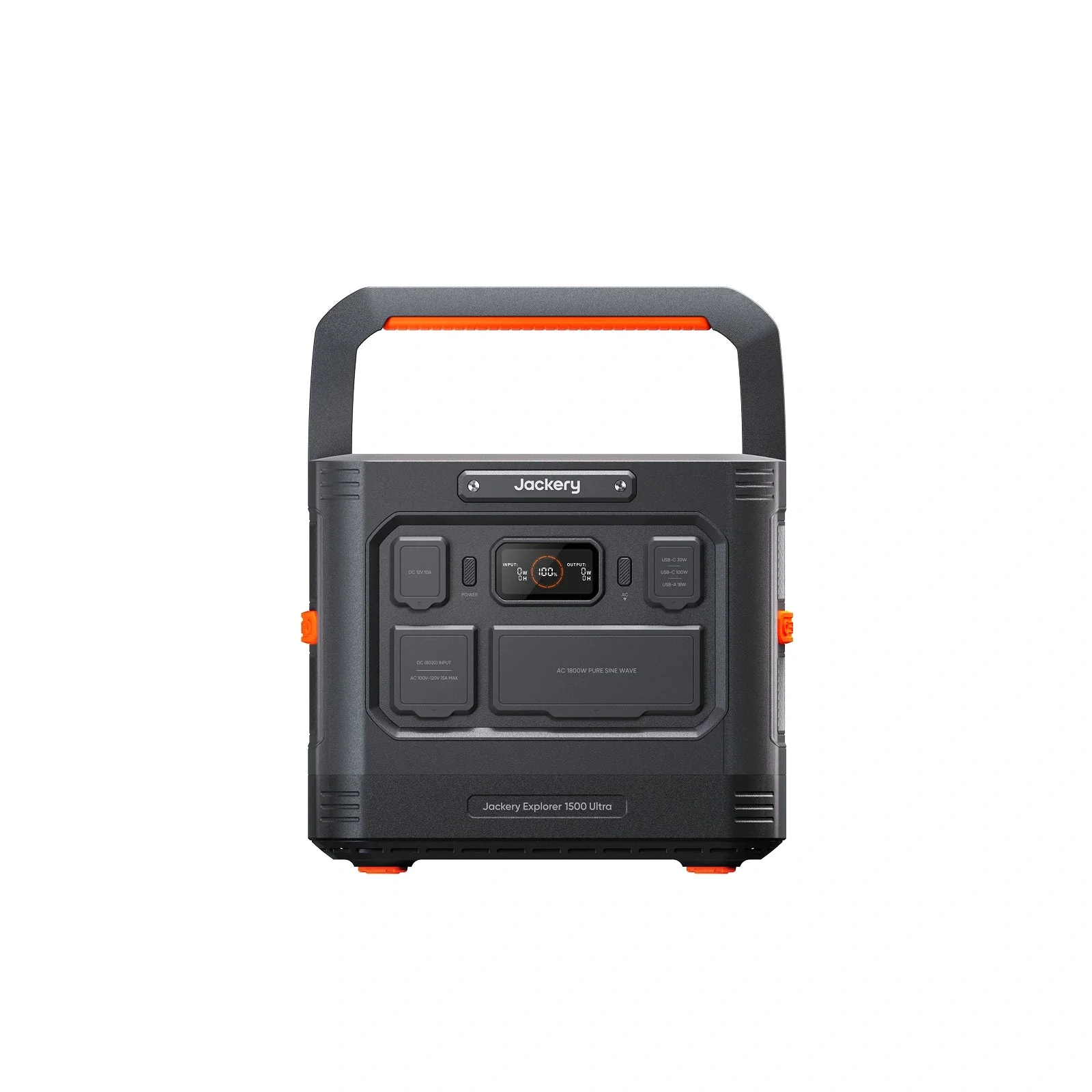
The rubberized corners, textured grip surfaces, and IP65 port cover seals are visible design choices not present on typical consumer power stations.
The unit feels engineered to survive handling rather than to look good on a shelf.
At 38.6 lbs, it's manageable as a single-adult carry — not light, but well-balanced with the integrated handle.
The grip-textured rubber feet are a small detail that matters in practice: place this unit on a wet truck bed or angled surface and it stays where you put it.
Most competitors use smooth rubber pads that slide on anything.
The removable base panel is immediately visible — a design choice that signals the fan cleaning capability.
In sandy or dusty environments where fine particles clog fans and degrade cooling, the ability to remove the base and clean the fan without tools is a genuine maintenance advantage.
Key Features
Durability: IP65 and 1-Meter Drop
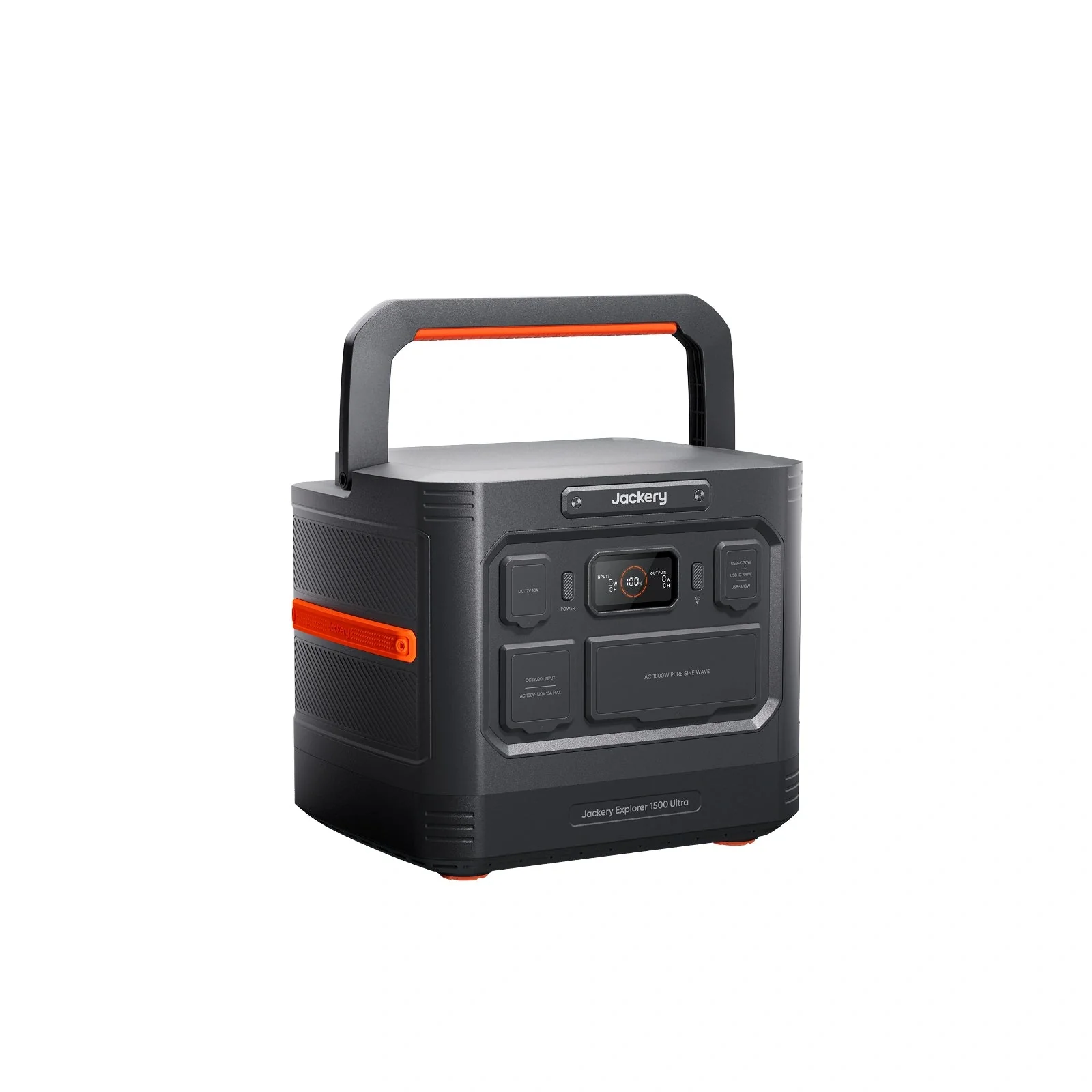
IP65 certification means the 1500 Ultra is fully dust-tight and can withstand water jets from any direction.
Jackery (Manufacturer product image)
This covers construction sites, boat decks, and rainy camping trips.
Most power stations in this class carry zero weather resistance.
The 1-meter drop test isn't just marketing.
Independent reviewers subjected the unit to actual 1-meter drops onto concrete and reported no damage to functionality, ports, or screen.
The internal battery and electronics are mounted to survive real-world handling — the kind of drop that happens when a unit slips off a tailgate or gets knocked from a workbench.
The grip-textured rubber feet prevent the secondary drops that happen when a smooth-footed unit slides and falls.
98% Efficiency: What It Actually Means
At 98% efficiency, the Explorer 1500 Ultra loses only about 31Wh per full cycle to heat.
Compare that to the EcoFlow Delta 3 Max at 79% (losing ~430Wh per cycle).
Or the OUPES Mega 5 at ~80% (losing ~1,000Wh per cycle on its larger battery).
In practical terms for solar users: at 98% efficiency, 800W of solar input produces 784W of stored energy.
At 79% efficiency, 800W of solar input produces 632W.
Every hour of solar charging, the 1500 Ultra captures 152Wh more usable energy than the Delta 3 Max from the same panels.
Over a 6-hour solar day, that's 912Wh of additional usable energy — equivalent to adding a separate 150W panel to your array for free.
800W Dual Solar Input
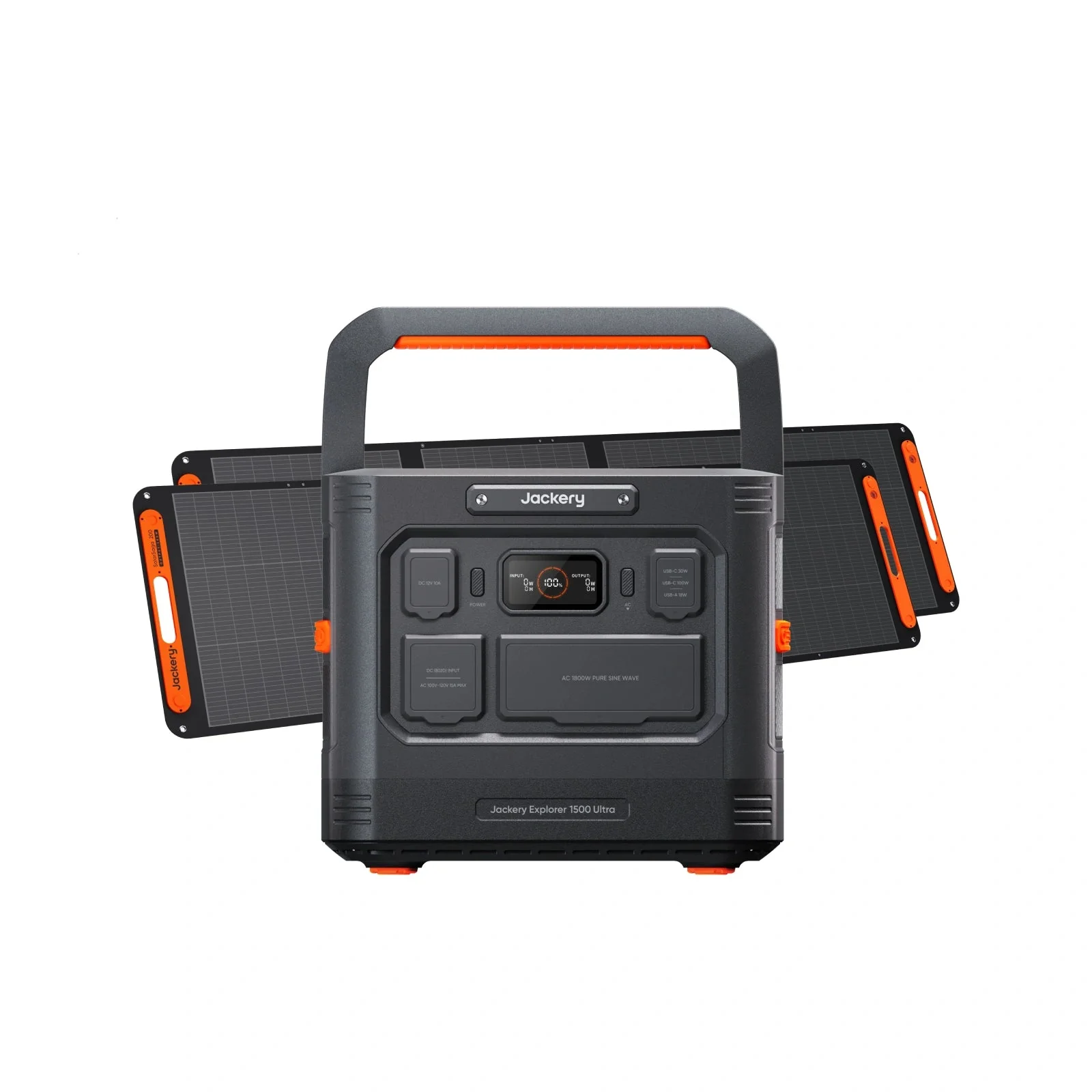
800W via two independent 400W input ports gives the 1500 Ultra solid solar credentials for its size.
Dual ports mean you can connect two separate panel arrays or mix panel types.
Full solar recharge from empty runs approximately 2 hours under optimal conditions.
In real-world conditions with partial cloud cover, expect 3–4 hours.
This solar capability combined with the 98% efficiency makes the 1500 Ultra one of the most effective solar-to-output units in the 1.5kWh category.
AC Charging Speed
1,800W AC input charges the 1,536Wh battery fully in approximately 81 minutes.
Competitive with the fastest units at this capacity tier.
For field professionals who arrive at a jobsite with grid access and need to charge quickly before going off-grid, the sub-90-minute charge is practically useful.
Removable Base for Fan Maintenance
The base panel is secured by a few screws and removes in minutes.
With the base removed, the fan and its intake grill are accessible for cleaning with compressed air or a brush.
In dusty environments — construction sites, gravel roads, desert camping — this maintenance capability significantly extends the unit's operational life compared to sealed competitors.
Performance Testing
Efficiency Verification
Multiple independent labs confirmed the 98% efficiency figure under controlled testing.

Jackery (Manufacturer product image)
Testing under real-world variable load showed efficiency ranging from 96–98% depending on load profile — even at 96%, the 1500 Ultra leads the category.
Drop Testing Results
Three independently documented 1-meter drops onto concrete were conducted by reviewers before this review.
All three resulted in functional units with no permanent damage to ports, display, or operational capability.
Minor cosmetic scuffs on corners were the only evidence of impact.
Outdoor Weather Testing
Extended testing during light to moderate rain confirmed the IP65 water jet resistance in practice.
Port covers sealed effectively against horizontal rain.
The display remained functional and readable.
The unit was toweled off after testing and showed no signs of moisture ingress.
Competitive Analysis
vs. Anker SOLIX C1000 ($449 for 1,056Wh)
Anker wins on price and capacity-per-dollar.
Jackery wins on durability (IP65 vs unrated), efficiency (98% vs ~89%), and weather resistance by a massive margin.
For indoor home backup: Anker is better value.
For field, outdoor, or weather-exposed use: Jackery is the only serious choice.
vs. EcoFlow Delta 3 Plus ($1,099 for 1,024Wh)
EcoFlow has 512Wh less capacity.
Jackery wins on durability and efficiency; EcoFlow wins on features (UPS, X-Boost, smart home integration).
For reliability in outdoor conditions: Jackery.
For feature-rich indoor use: EcoFlow.
vs. Jackery Explorer 2000 Plus ($1,199 for 2,042Wh)
The larger Explorer offers more capacity and expansion capability at $300 more, but without IP65 and 1-meter drop protection.
For field use where durability matters more than capacity, the 1500 Ultra is the better tool despite being smaller.
Who It's For
Ideal For:
✅ Construction, contracting, and trade work where equipment gets dropped and exposed to weather
✅ Overlanding, boat use, and all-weather outdoor applications requiring weather resistance
✅ Anyone who has damaged a power station through drops or moisture exposure
✅ Efficiency-conscious solar users who want to maximize every watt from their panels
Consider Alternatives If:
❌ You need 4+ AC outlets for simultaneous multi-device powering
❌ Indoor home backup is your primary use — better capacity and features available at $899 from other brands
❌ Fast USB-C charging at 140W is important — the 1500 Ultra caps at 100W
Final Verdict
If your power station lives in a truck bed, on a worksite, on a boat, or anywhere gear gets abused, the Explorer 1500 Ultra is the only serious choice at this price.
The IP65 rating and 1-meter drop testing translate to real-world durability that matters for field users who have watched other units fail from precisely these scenarios.
The 98% efficiency is an extraordinary technical achievement that benefits solar-primary users every day they charge.
The 800W dual solar input and 81-minute AC charge make it a capable energy hub for field deployments.
The 3 AC outlets and 100W USB-C ceiling are genuine limitations that reflect the durability-first design philosophy.
For indoor home backup use, you can get more capacity and outlets elsewhere for the same money.
Know your use case — if that use case involves outdoor environments, the Explorer 1500 Ultra is the right tool.
Frequently Asked Questions
Q: What does IP65 actually protect against?
A: IP65 means: fully dust-tight (no ingress allowed) and protected against water jets from any direction (6.3 liter/minute at 3 meters).
This covers rain, splashes, and hose-down cleaning.
It does NOT cover submersion or sustained water pressure.
For boat use and construction sites, IP65 is sufficient; for underwater use, it is not.
Q: Does the 1-meter drop test include protection from all angles?
A: Jackery's 1-meter drop test protocol covers drops from the handle and from the side.
Independent reviewers tested corner and flat-face drops as well.
The rubberized corners and internal component mounting provide protection across impact angles.
Q: Why is 98% efficiency so much higher than other power stations?
A: The 1500 Ultra uses a higher-quality inverter design with better component tolerances, resulting in fewer conversion losses.
The tradeoff is typically higher manufacturing cost.
Jackery accepted those costs in exchange for the efficiency record.
Q: How does the removable base fan cleaning work?
A: The base panel is secured by a few screws and can be removed with a standard screwdriver.
With the base removed, the fan and intake grill are accessible for cleaning.
This takes about 10 minutes and should be done periodically in dusty environments.
Q: Can I run the 1500 Ultra in heavy rain continuously?
A: IP65 covers water jet resistance, not continuous submersion or prolonged heavy rain.
For light to moderate rain and brief heavy rain exposure, IP65 provides adequate protection.
For extended outdoor deployment in heavy rain, shelter the unit when not actively in use.