Introduction: Still Relevant, But No Longer New
The EcoFlow DELTA 2 Max launched on May 25, 2023, at 11:30 a.m. EDT, according to the launch terms on EcoFlow's own US product page. That makes it an older model in a market that changes quickly, but age is not automatically a liability here. The DELTA 2 Max still combines the capacity, ports, charging inputs, and app support that many newer mid-size stations are trying to balance.
EcoFlow product page (Manufacturer product image)
The useful thesis is narrower than “this is a powerful battery.” It is a good fit for a buyer who wants one substantial station for car camping, refrigerator-and-networking backup, or a modular system that can grow later. It is a poor fit for someone who expects to carry 2kWh of power far from a vehicle, or who reads EcoFlow's 3,400W X-Boost figure as if it were a larger inverter.
EcoFlow rates the station at 2,048Wh and 2,400W of continuous pure-sine output. Solar Lab's later independent review found that it sustained its rated output, measured 86% inverter efficiency, and drew about 13.6W with the AC inverter on and no load. Those are meaningful ownership numbers: the DELTA 2 Max is not merely a large battery on a spec sheet, but it is also not a magic replacement for a higher-output system.
Design, Ports, and Setup
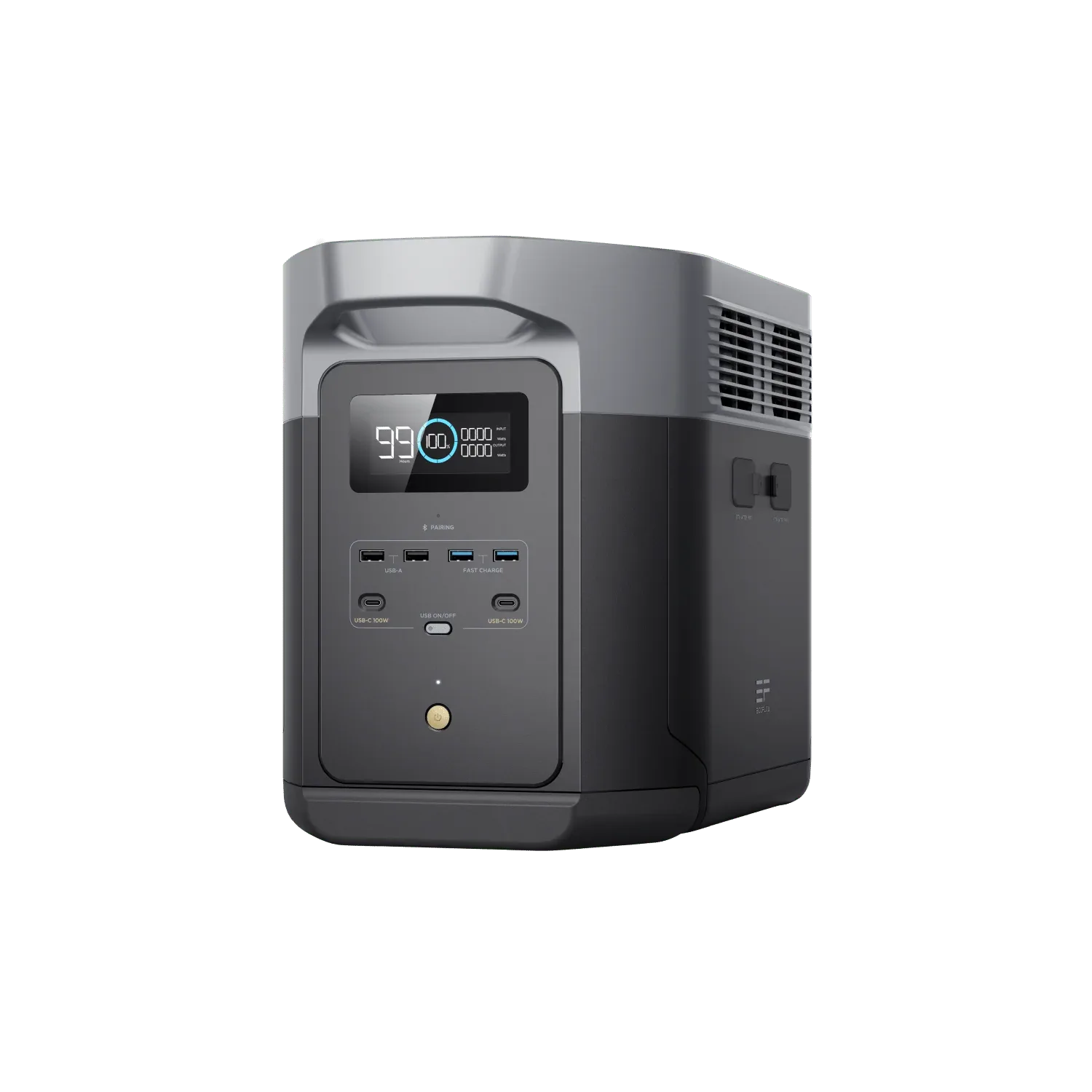
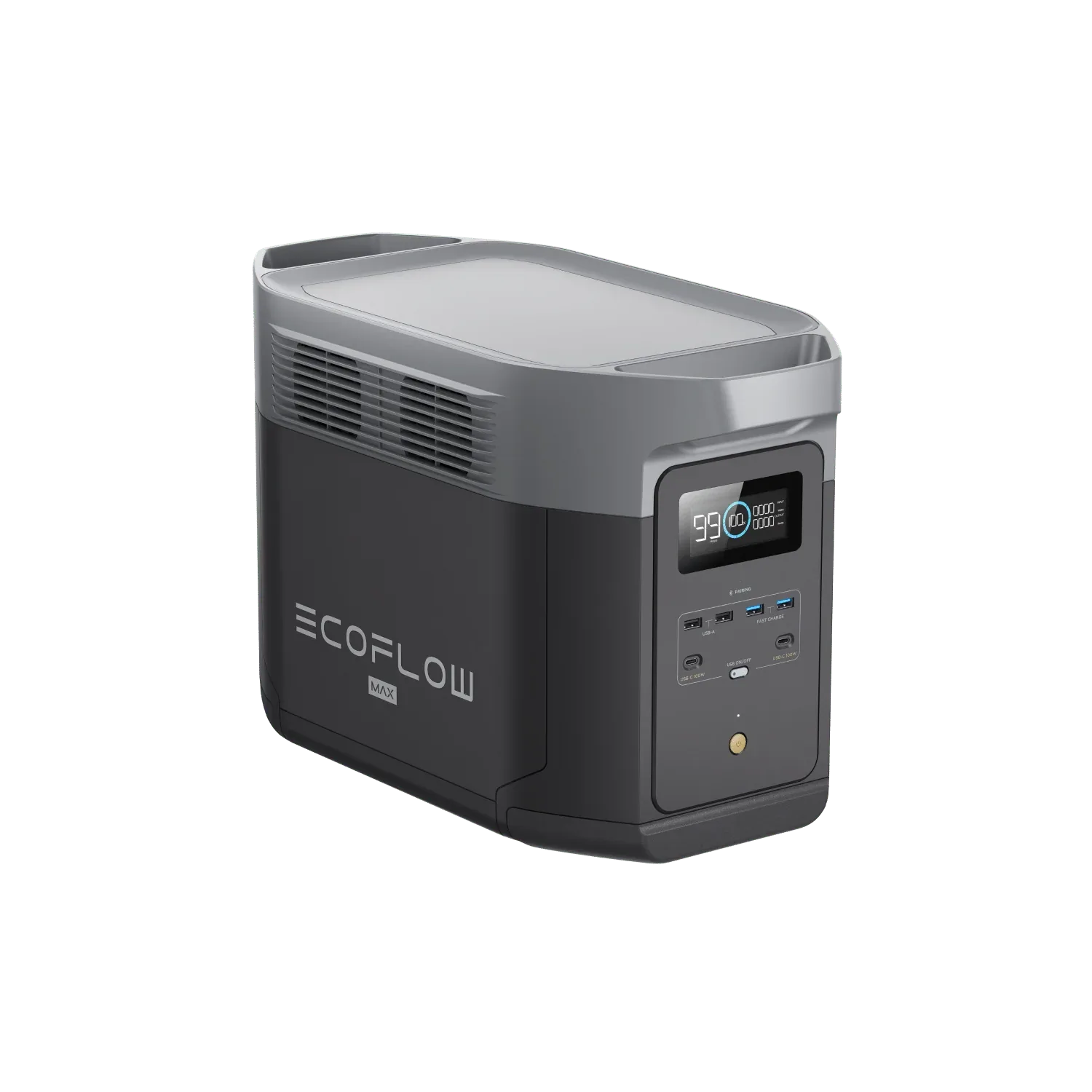
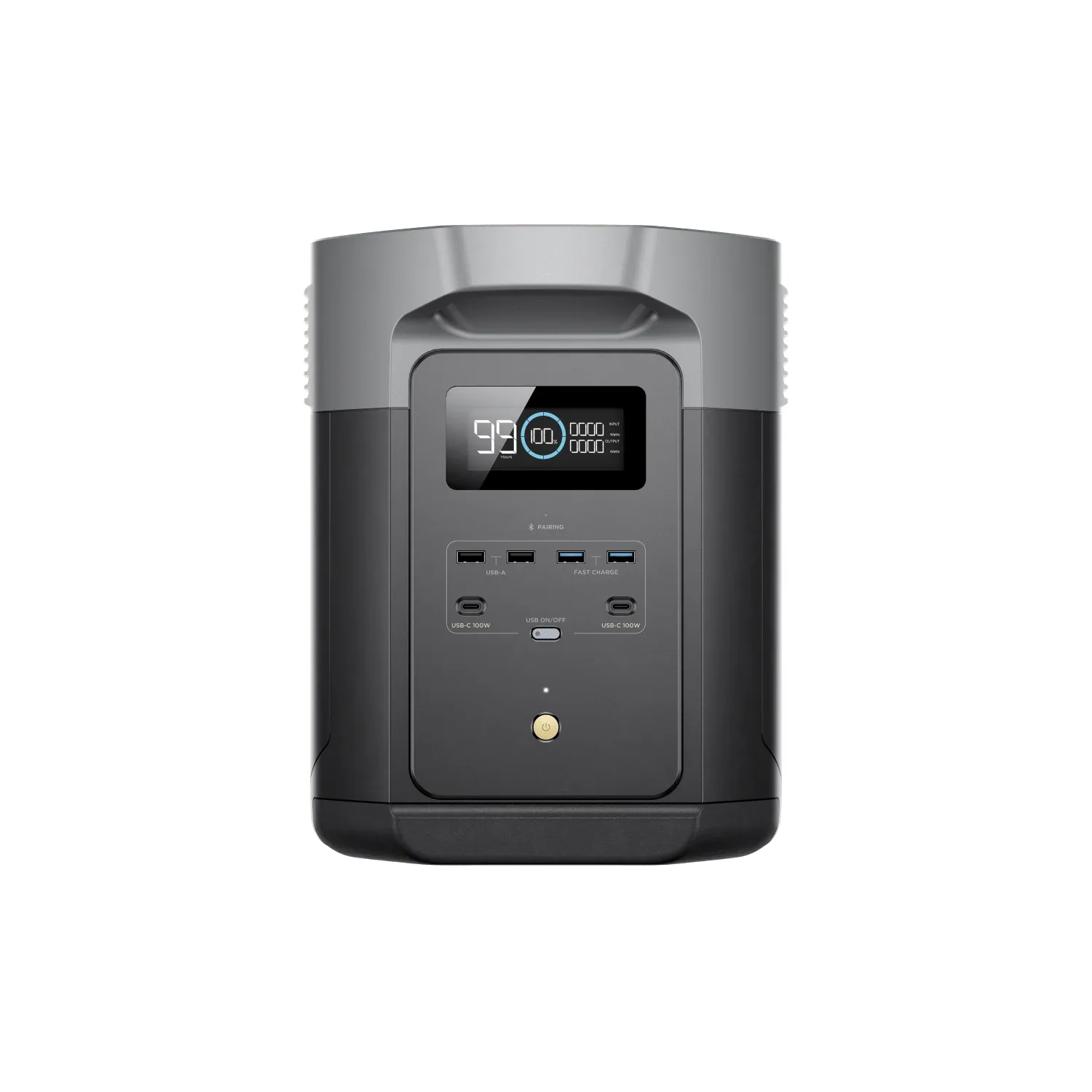
At approximately 50lb, the DELTA 2 Max belongs in a vehicle, garage, or utility room more than on a backpacking checklist. The weight buys a useful layout. There are six 120V AC outlets, four USB-A ports, two 100W USB-C ports, a 12V car socket, and two DC5521 outputs. That is enough connectivity for a refrigerator, lights, laptops, camera batteries, and small appliances without immediately reaching for a power strip.
EcoFlow product page (Manufacturer product image)
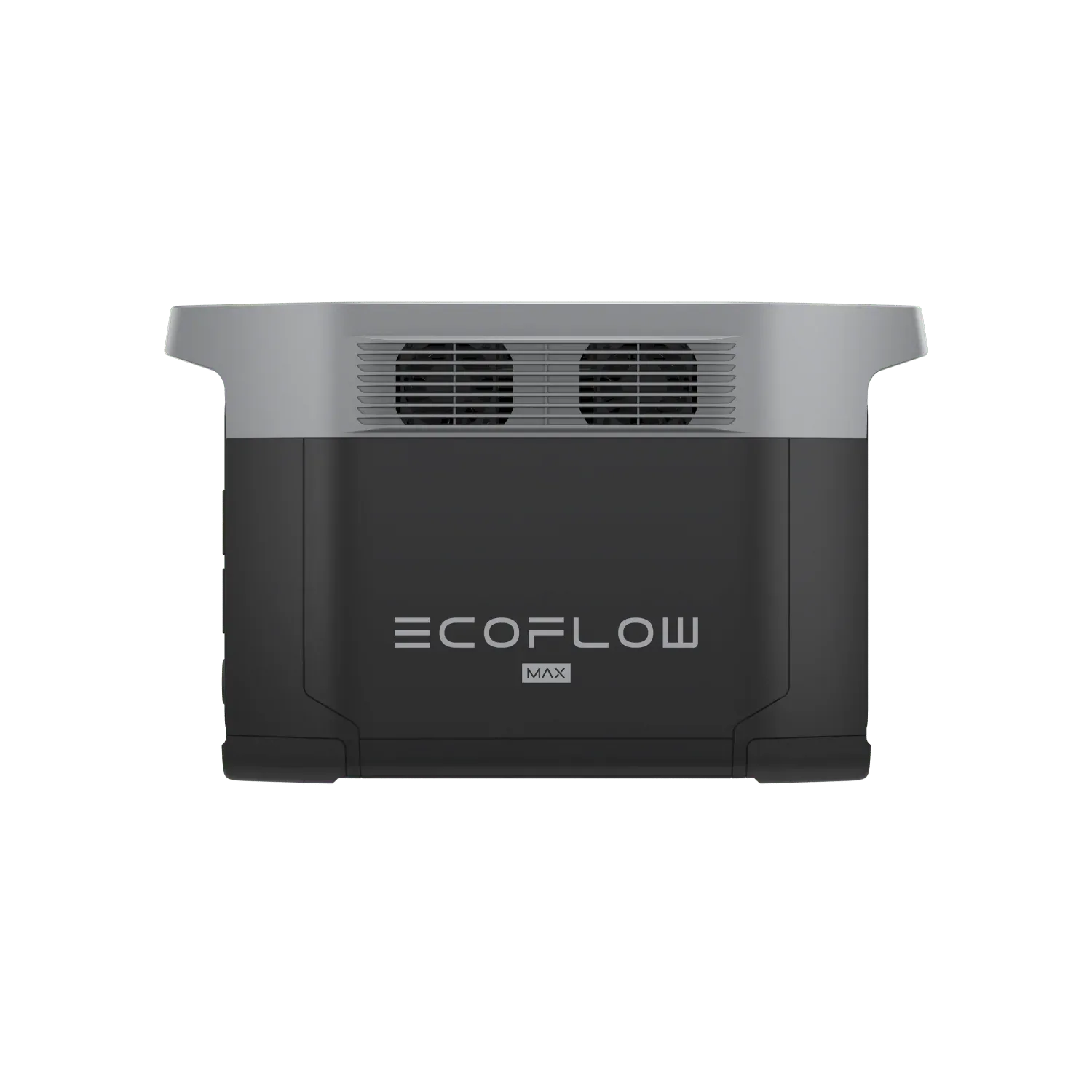
The physical arrangement is practical for stationary use. Solar Lab notes that the USB ports are on the front while the AC outlets sit on the rear, which lets the unit sit against a wall or at the back of a vehicle while keeping the frequently used low-power ports accessible. The display is clear, the EcoFlow app pairs over Bluetooth, and the app adds controls and readings that are not available from the front panel alone.
There is no built-in light. That omission matters more on a 50lb station than it would on a small battery bank: this is exactly the kind of device people keep for blackouts and take car camping, when a light would be useful. It is not a deal-breaker, but it means adding a headlamp or lantern to the emergency kit.
Setup is otherwise straightforward. The app handles monitoring, remote switching, and settings, while the station can be used without an account for basic local operation. EcoFlow's ecosystem also includes expansion batteries, solar panels, and an 800W alternator charger. Those accessories make the DELTA 2 Max more flexible, but they also make the eventual system cost higher than the station's headline price.
Battery and Charging Performance
The 2,048Wh LiFePO4 pack is the DELTA 2 Max's most durable advantage. LiFePO4 chemistry is better suited to repeated cycling than the older lithium-ion packs found in many early power stations, and EcoFlow positions the battery for a long service life. The capacity is large enough to cover a weekend of modest camping loads or to keep a refrigerator, router, lights, and device chargers running during a shorter outage, depending on the actual draw.
EcoFlow product page (Manufacturer product image)
Charging is unusually flexible for this size class. EcoFlow specifies up to 1,800W from AC and up to 1,000W from solar. Solar Lab measured roughly 1.2 to 1.5 hours for a full AC charge and about 2 hours from a 1,000W panel setup in strong sun. Those results are not promises for every home: panel orientation, temperature, shading, and the final balancing phase all change the clock. They do show that the station can be replenished quickly when the input is available.
The low idle draw is equally important. Solar Lab measured approximately 13.6W with the AC inverter enabled and no load. That is modest for a station of this size and makes it less painful to leave ready for an outage. The 86% inverter-efficiency measurement also compares favorably with the waste many buyers encounter when converting stored DC power to AC. It is still wise to turn off unused output sections, because every conversion loss reduces the energy available to the devices that matter.
The DELTA 2 Max can accept solar while powering devices, which is valuable for longer stays away from the grid. In ideal conditions, a 1,000W array can make a 2,048Wh recharge a same-day proposition. In clouds, shade, or winter sun, that estimate stretches quickly. Treat the solar input as a ceiling, not a daily guarantee.
Real-World Use and the X-Boost Caveat
The rated 2,400W inverter is the number to plan around. Solar Lab's load testing found stable operation at that continuous rating and no excessive fan noise or cut-outs under steady resistive loads. That is enough for the ordinary combination of a microwave, lights, a medium refrigerator, and device charging, provided the combined demand stays within the inverter's limits.
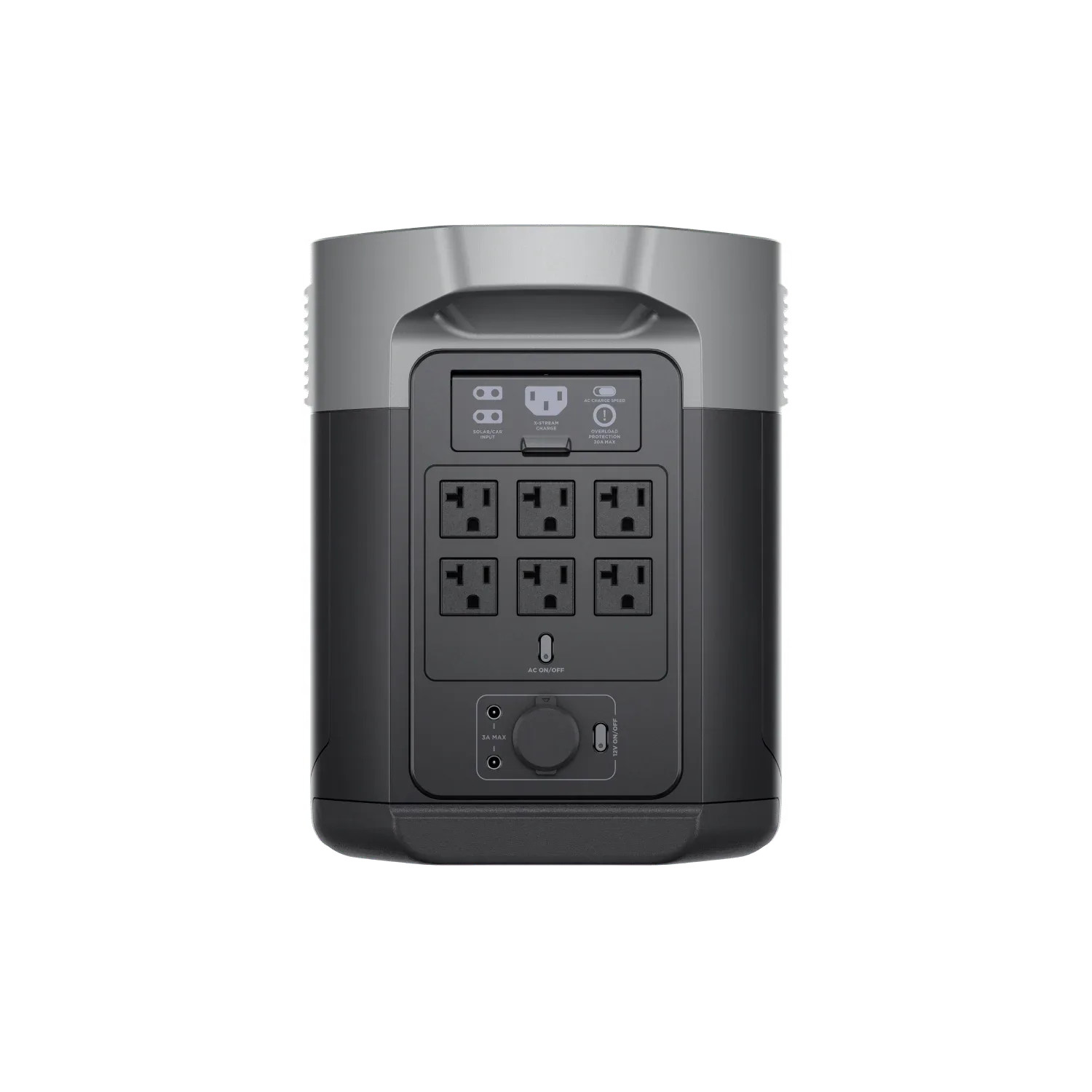
EcoFlow product page (Manufacturer product image)
EcoFlow advertises X-Boost up to 3,400W and says it can run many high-wattage household appliances. The feature can be useful with compatible resistive loads, but it does not create the surge headroom of a genuinely larger inverter. Solar Lab found that the unit struggled when a load exceeded 2,400W, even with X-Boost enabled. Motors, compressors, air conditioners, well pumps, and demanding power tools are the wrong reason to buy this station.
That distinction is the difference between a reliable purchase and an expensive surprise. Use the DELTA 2 Max for its real inverter rating, not the best-case X-Boost headline. If an appliance has a difficult startup surge, check its measured running and starting wattage against the 2,400W ceiling and leave margin.
For camping, the profile is stronger. Solar Lab's two-night car-camping test used it for LED lighting, phones, cameras, and a small griddle, and reported quiet operation with substantial charge remaining. That is a believable use case for this design: the station stays in the car or campsite, solar can extend the stay, and the app makes it easy to see whether a load is consuming more than expected.
The 20ms UPS mode also gives the DELTA 2 Max a useful home-backup role. EcoFlow says it can keep devices such as a refrigerator or CPAP running through a blackout, but a 20ms transfer is not the same as a dedicated medical-grade UPS. Test the exact equipment you depend on, and never treat a portable station as the only safeguard for life-support equipment.
EcoFlow DELTA 2 Max vs. the Alternatives
The EcoFlow DELTA 2 is the obvious cheaper alternative. It is smaller and easier to move, but the DELTA 2 Max adds much more capacity, six AC outlets instead of the smaller model's more limited outlet layout, higher solar input, and expansion headroom. Choose the DELTA 2 when portability and lower cost matter more than long runtimes.
The EcoFlow DELTA 3 Max is the newer in-family choice. It brings a newer platform and faster AC charging, but the DELTA 2 Max remains attractive when its 1,000W solar input and discounted pricing are more important than buying the latest generation. Existing EcoFlow owners should compare expansion-battery compatibility before assuming the ecosystems are interchangeable.
The BLUETTI AC200L is a strong alternative for buyers who prioritize high solar input and a straightforward high-capacity system. Its appeal is less about EcoFlow's app polish and more about how much solar and inverter capacity the hardware offers. The DELTA 2 Max is the better fit when remote monitoring and EcoFlow accessories are central to the setup.
The Anker SOLIX F2000 is another sensible comparison for home backup and camping. Anker's software and hardware layout appeal to buyers who prefer that ecosystem, while EcoFlow's advantages here are the mature app, six AC outlets, and unusually broad accessory path. At this capacity, compare the exact bundle price and warranty rather than assuming a brand name settles the choice.
Who Should Buy It?
Buy the DELTA 2 Max if you want a substantial station that can remain in a vehicle or home, accept meaningful solar input, and run several ordinary appliances at once. It is especially compelling for car campers, outage-prepared households, and EcoFlow users who may later add batteries or an alternator charger.
Skip it if you need to carry the station any real distance, require a built-in light, or need dependable motor-starting headroom above 2,400W. Also skip it if your main goal is the newest, smallest 2kWh chassis; newer models have improved packaging even when their input/output trade-offs are different.
Verdict
The EcoFlow DELTA 2 Max has aged better than its 2023 launch date suggests. Its 2,048Wh LiFePO4 battery, 2,400W inverter, 1,000W solar input, six AC outlets, low measured idle draw, and expandable architecture still form a coherent ownership proposition. The app and accessory ecosystem remain meaningful advantages rather than decorative extras.
The decisive caveat is X-Boost. Plan around 2,400W, not 3,400W, and this is a dependable mid-size power station. Plan around the larger number and the first compressor or high-surge tool may expose the wrong assumption. At a good current price, the DELTA 2 Max is a recommendation for stationary portable power and car camping—not for lightweight travel or oversized startup loads.
FAQ
Is the EcoFlow DELTA 2 Max still worth buying in 2026?
Yes, when the price reflects its age and your priorities are capacity, solar input, ports, and expandability. It is less compelling if a newer model offers the same capacity at a similar price with better portability.
When did the EcoFlow DELTA 2 Max launch?
EcoFlow's US product page lists the official launch as May 25, 2023, at 11:30 a.m. EDT. The pre-launch campaign began May 18, 2023.
Can it really output 3,400W?
EcoFlow's X-Boost mode is advertised up to 3,400W, but that is not equivalent to a 3,400W inverter. Independent testing found the unit struggled beyond its 2,400W rated output, so use 2,400W as the planning limit.
How long does it take to charge?
EcoFlow specifies up to 1,800W AC input and 1,000W solar input. Solar Lab measured about 1.2 to 1.5 hours for a full AC charge and about 2 hours from a 1,000W solar setup in strong sunlight.
Can it power a refrigerator during an outage?
Usually, yes, provided the refrigerator's startup surge stays within the inverter's capability. Test the exact refrigerator if it is critical, and keep a second backup plan for long outages.
Can it run an air conditioner?
Do not assume it can. Air conditioners often have demanding compressor startup surges, and independent testing found little useful surge headroom beyond 2,400W. A larger inverter is the safer choice.
How heavy is the DELTA 2 Max?
It weighs approximately 50lb, or about 22kg. That is manageable for moving between a car and a campsite, but awkward for frequent long-distance carrying.
Can the battery be expanded?
Yes. EcoFlow states that the system can reach 6,144Wh with two compatible expansion batteries. Confirm the exact battery model and firmware compatibility before buying used or older accessories.
Does it work as an uninterruptible power supply?
It has a 20ms automatic UPS mode. That is useful for many household electronics, but it is not a guarantee for every computer, network device, or medical device. Test the specific equipment.
Does it include a built-in flashlight?
No. Plan to keep a separate lantern or headlamp with the station, especially if it is part of an emergency kit.
Is the EcoFlow app required?
No for basic operation, but the app is useful for monitoring, remote switching, and settings. The DELTA 2 Max can still provide power from its local controls if you do not want to manage it from a phone.