Introduction
The Pecron F3000LFP is a value-focused power station that gets the important hardware right. It combines a 3,072Wh LiFePO4 battery with a 3,600W bidirectional inverter, a dedicated 30A output, and 1,600W of solar input. That is enough capability to make it relevant for RVs, serious camping, job sites, and outage backup rather than just phones and laptops. The trade-off is less glamorous: the inverter consumes 37W at idle in independent testing, the outlets are crowded, and the unit still feels like a practical tool rather than a polished home appliance.
Pecron's official product record lists a publication date of May 13, 2025. That is the launch context used here; the discovery review's publication date is not evidence of when the product launched. The F3000LFP is therefore an older 2025 model being judged on its current value in 2026. Pecron's official storefront lists the base configuration at $899 without a cart on September 19, 2026, which makes its capacity and output unusually aggressive for the money.
The central question is not whether the F3000LFP has an impressive specification sheet. It does. The useful question is whether you want maximum energy and inverter headroom at a low price, or whether you would rather pay more for a lower-maintenance ecosystem and better standby behavior.
Design, Ports, and Setup
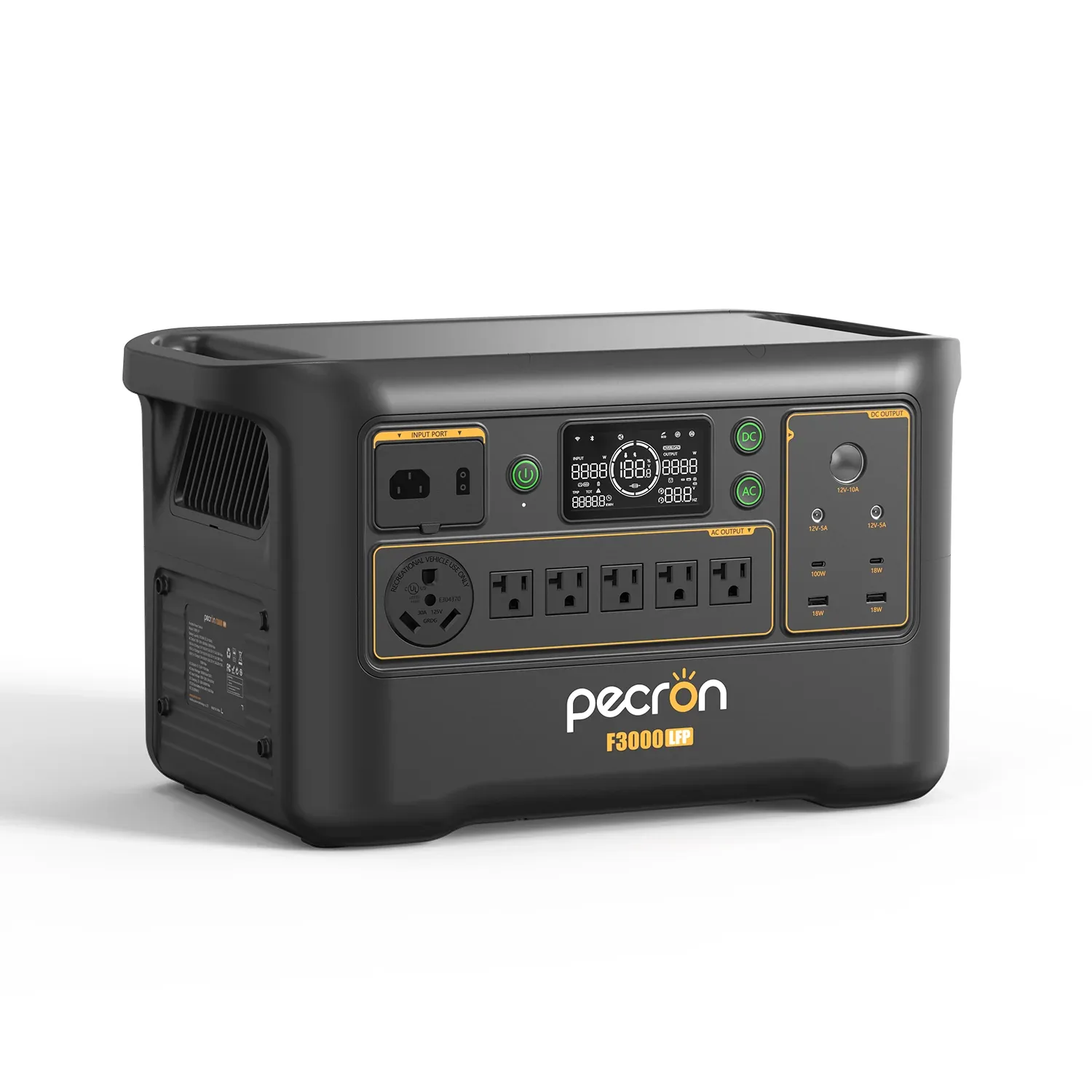
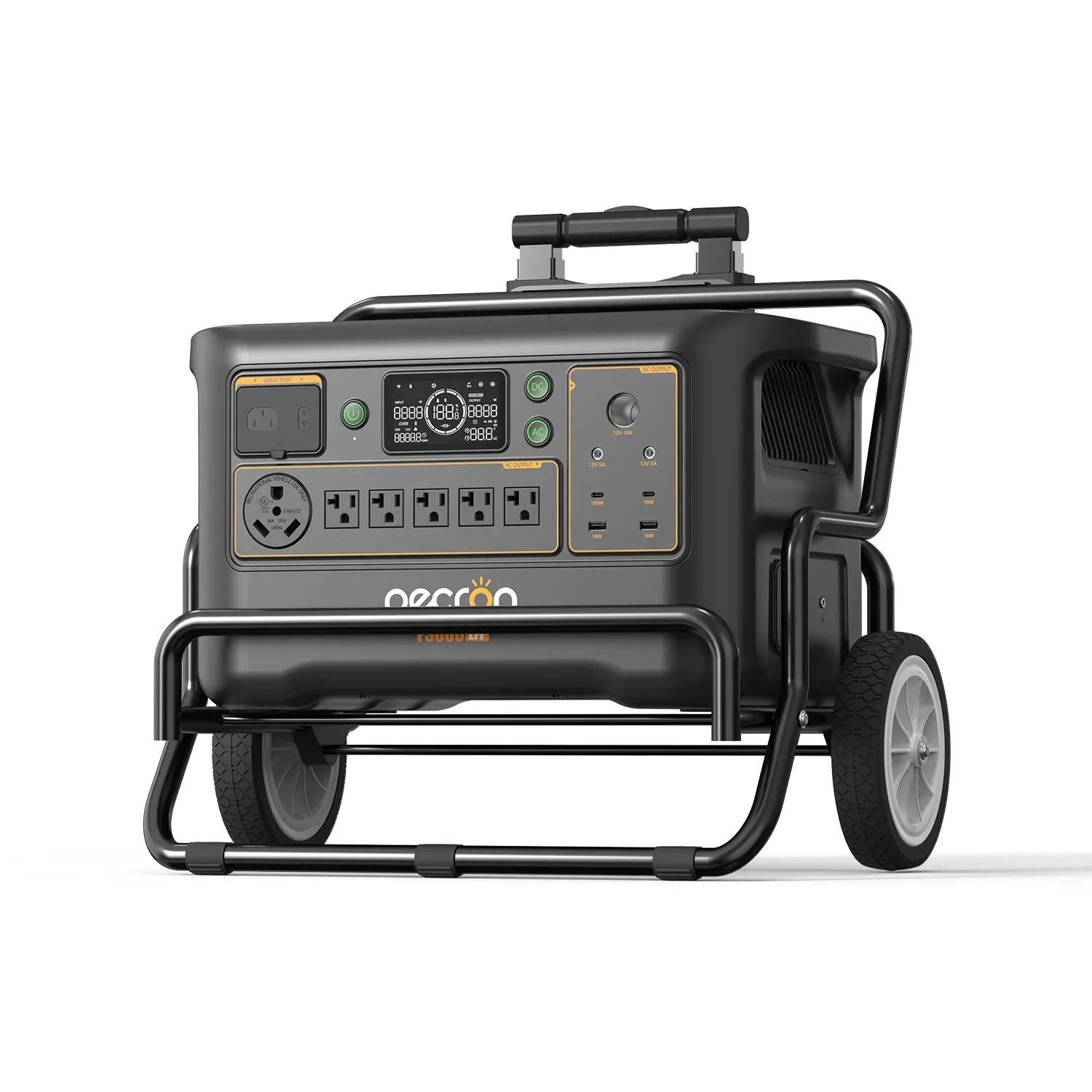
The F3000LFP is a large, horizontal box with a more modern appearance than Pecron's older, visibly utilitarian stations. At about 63 lb, it is portable in the car-camping and garage sense, not the backpacking sense. One person can reposition it carefully, but frequent stairs, vehicle loading, and rough ground are good reasons to add the optional cart or plan for a second person.
Pecron product page (Manufacturer product image)
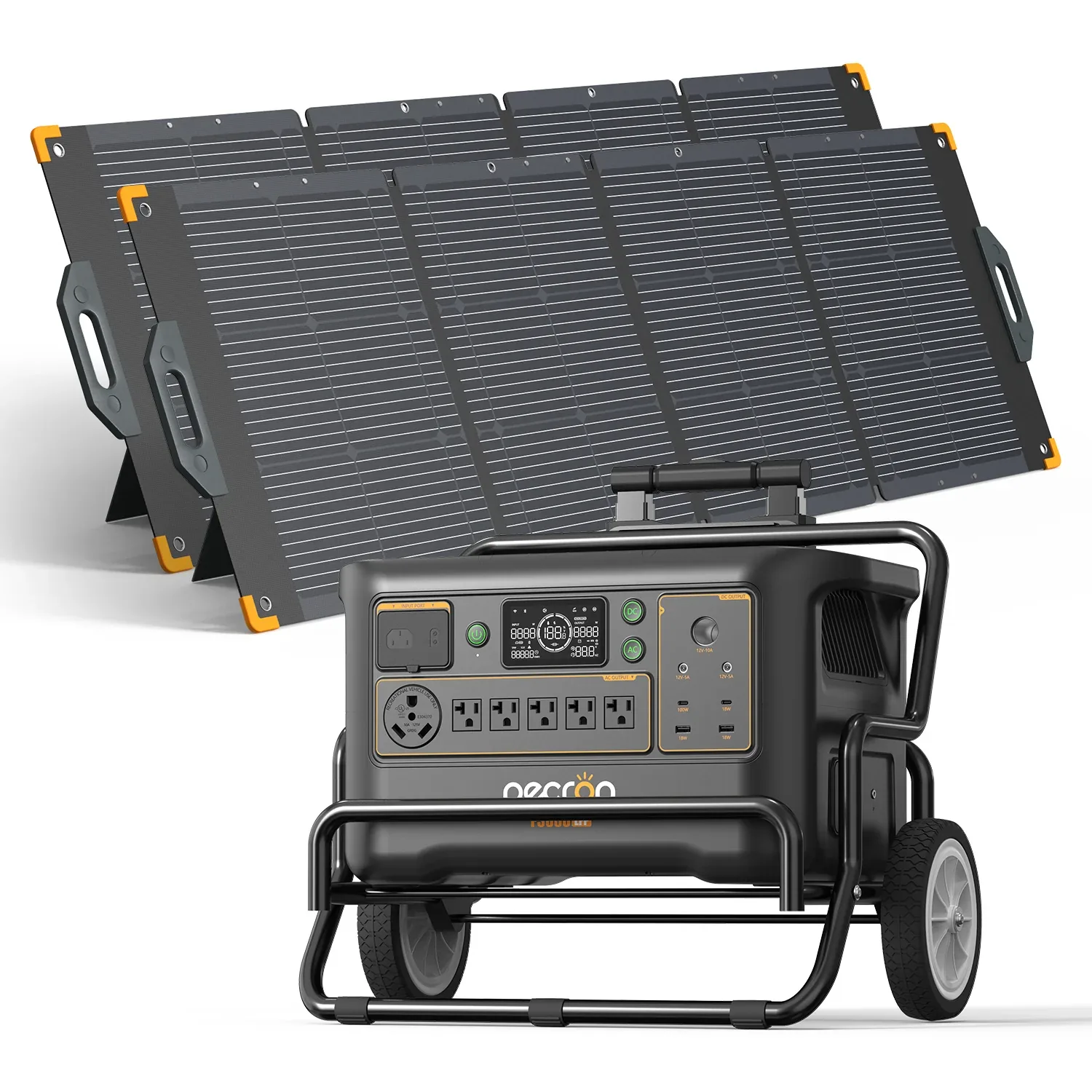
The port layout is the product's most practical design decision. Pecron puts five 120V AC outlets, the 30A output, the 12V car socket, two barrel connectors, and the USB ports on the front. That makes the F3000LFP easier to use in the back of a vehicle or against a wall than a station that hides critical outputs around the sides. It also makes the unit easier to inspect during an outage because the active connections are visible from one position.
The selection covers the likely use cases. Two USB-A ports handle older cables, while two USB-C ports include a 100W PD connection for a laptop or other high-draw device. The 30A receptacle is particularly useful for an RV or a single appliance that needs more than a normal household outlet. The weakness is spacing: five outlets sound generous, but bulky laptop chargers, camera power supplies, and appliance plugs can block neighboring sockets. A short power strip may still be necessary.
Pecron also includes removable fan dust covers, a thoughtful detail for a sandy campsite or dusty work area. The screen provides real-time input and output information, and the app supports Wi-Fi and Bluetooth control. Those are useful conveniences, but the F3000LFP remains hardware-first. Its interface is not the reason to choose it over a larger brand.
Battery, Charging, and Solar Input
The 3,072Wh LiFePO4 battery is the foundation of the F3000LFP's value. That is enough stored energy for meaningful refrigerator, lighting, communications, and device-charging backup, provided those loads are managed rather than treated as a whole-house supply. LiFePO4 chemistry is also the appropriate choice for a station expected to be cycled regularly. Pecron claims more than 3,500 cycles before the battery reaches 80% of its original capacity; that is a manufacturer claim, not an independent lifespan guarantee, but it is a reassuring specification.
Pecron product page (Manufacturer product image)
AC charging is rated at 1,800W, and Pecron says the combined AC-and-solar ceiling reaches 2,800W. The Solar Lab measured a full AC charge in just over two hours, close to the product's stated charging behavior. That speed changes how useful a large station feels: after a short outage or a day of heavy use, it can return to service without occupying an entire night.
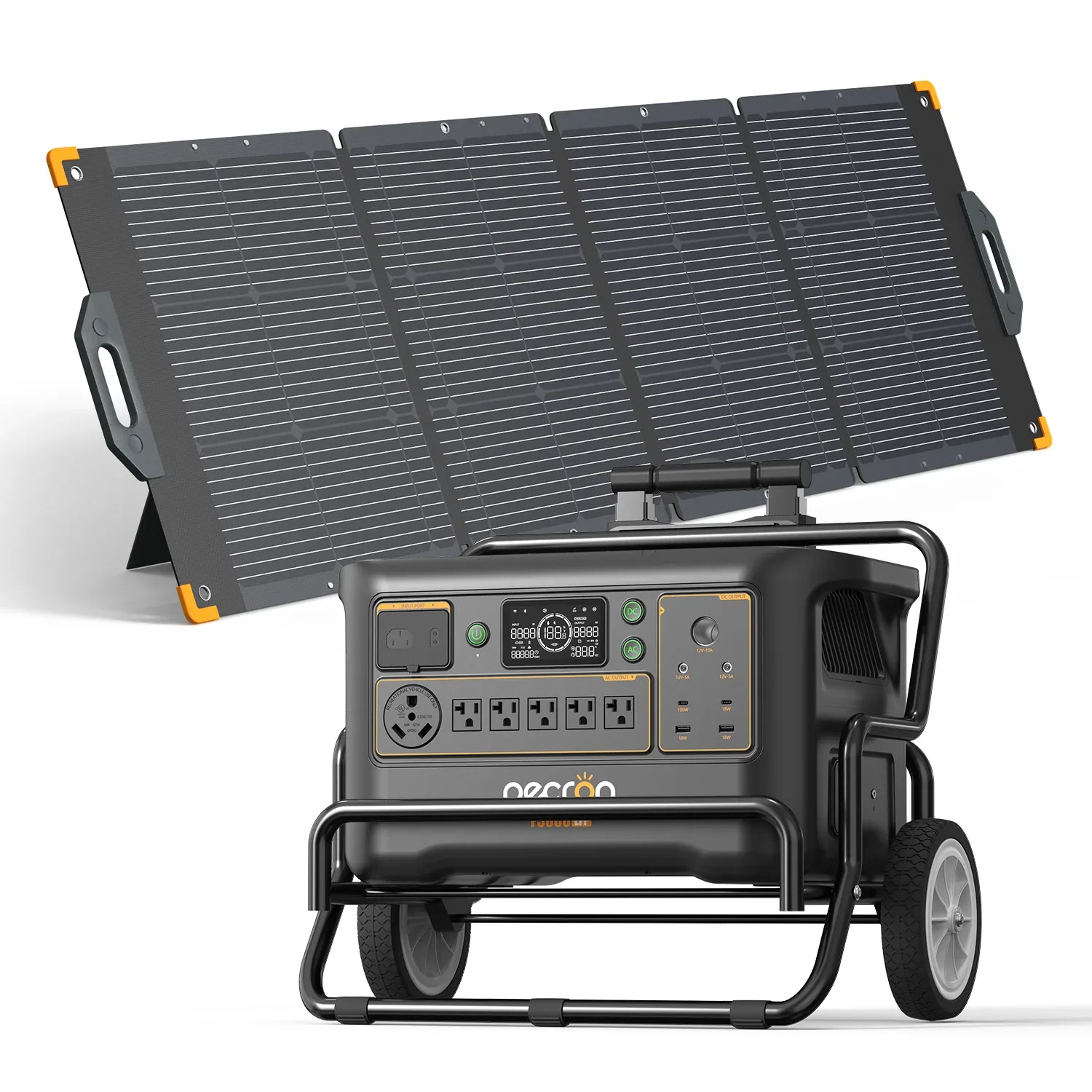
Solar input is even more distinctive. Pecron rates the XT60 input at up to 1,600W, with an input range of 25V to 120V and a 25A maximum. The Solar Lab reached 1,600W from a roughly 2,000W array in sunny conditions and fully recharged the station in a little over two hours. That result belongs to the reviewer's test conditions, not every installation, but it shows that the F3000LFP is designed for solar to be a primary charging method rather than a token emergency feature.
The limits still matter. A 1,600W ceiling requires enough panel capacity, suitable wiring, and favorable sun. The voltage window also means a buyer needs to configure panels deliberately rather than connect any arbitrary array. For someone who wants a simple wall-charge-only station, the solar hardware is extra complexity. For an RV owner, cabin user, or outage planner who wants daytime replenishment, it is one of the best reasons to consider this model.
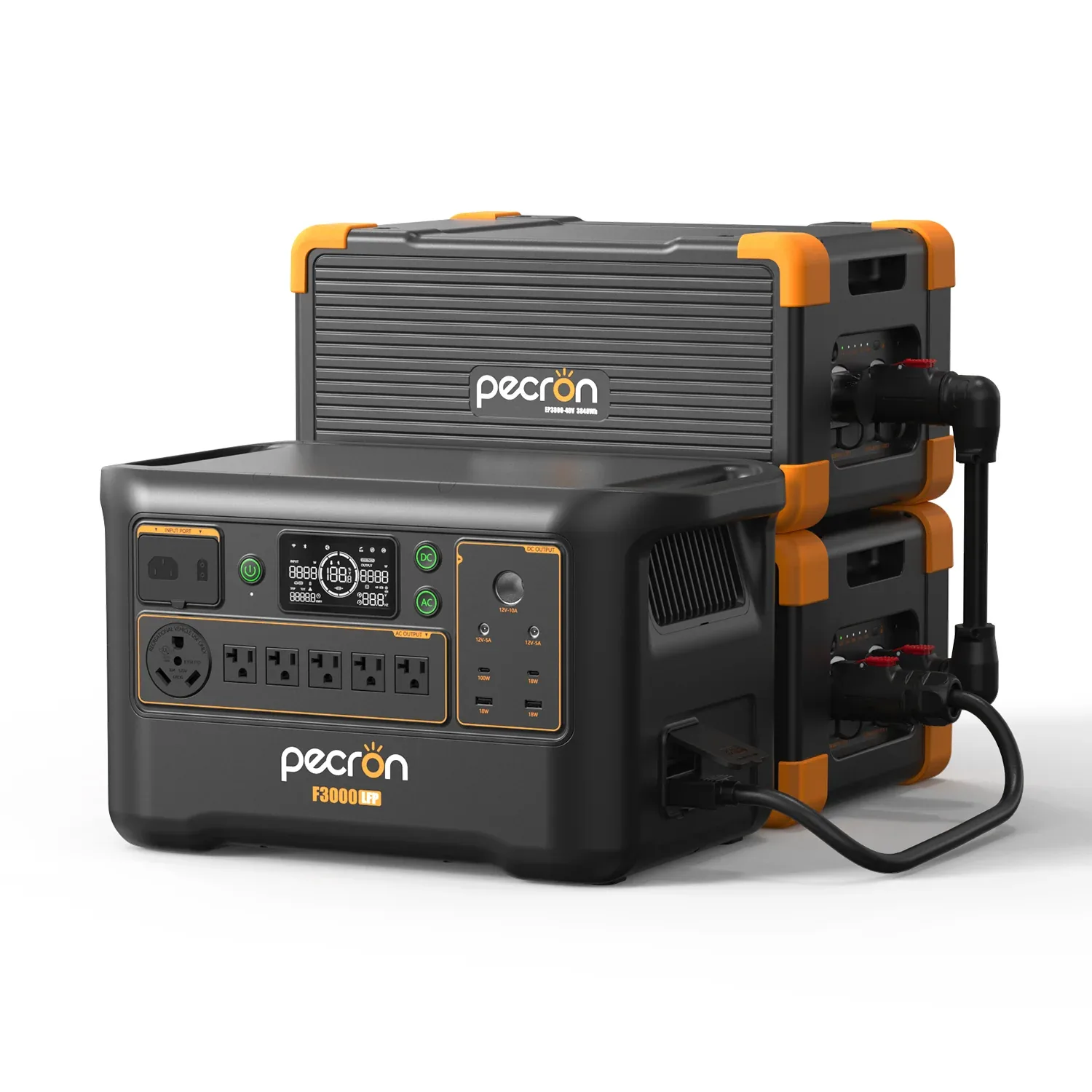
The expansion path is credible but should be priced as a system. Pecron lists support for two EP3000-48V batteries, taking total storage to 9,216Wh. Expansion lets a buyer start with one station and add capacity later, but the batteries, cascading cables, and any cart or solar hardware are separate purchases. The F3000LFP is a good base for a growing setup; it is not a cheap route to 9kWh once every accessory is included.
Performance and Real-World Use
The F3000LFP's 3,600W continuous pure-sine inverter is the headline feature that most clearly separates it from smaller budget stations. It can run demanding combinations of appliances, tools, and electronics that would overwhelm a 1,000W or 2,000W unit. The dedicated 30A output also makes the rating more useful for an RV or a single high-draw load than a headline number spread across a handful of ordinary outlets.
Pecron product page (Manufacturer product image)
Pecron claims a 4,500W surge for five seconds. The Solar Lab managed a 4,500W load for about 10 seconds before the unit tripped and needed a restart. That is unusually strong behavior for a budget station, but it should still be treated as tested headroom under one reviewer's conditions rather than a promise that every compressor, pump, or motor will start without hesitation.
The same independent review measured 83% efficiency while running the station from full to empty at a sustained 3,600W output. Efficiency varies with load and test method, so the figure is not a universal runtime multiplier, but it is a respectable result for this class. The F3000LFP is not simply advertising a big inverter that becomes unusable at the top of its range.
Standby behavior is less impressive. The Solar Lab measured a 37W idle draw with the inverter enabled and no meaningful load. That is not a crisis when the station is powering something, but it becomes a serious ownership cost if the F3000LFP is left on for days waiting for a refrigerator cycle, sump pump, or occasional outage load. A 3,072Wh battery can lose a noticeable portion of its usable energy to the inverter before the appliance needs it.
That distinction defines the right use. The F3000LFP is excellent as an active battery: charge it, use it for a planned load, recharge it from solar, and turn the inverter off when the job is done. It is less attractive as a permanently enabled silent backup box. Buyers who need a low-idle standby system should compare measured no-load consumption, not just battery size.
Pecron F3000LFP vs. the Alternatives
Anker SOLIX F3000. Anker's similarly named F3000 is the more polished platform, with a stronger app and a broader home-backup ecosystem. Pecron counters with a lower base price, a lighter chassis, a higher 3,600W continuous inverter rating, and a strong 1,600W solar ceiling. Choose Anker when support, ecosystem depth, and a more refined ownership experience justify the premium; choose Pecron when output per dollar matters more.
Pecron product page (Manufacturer product image)
EcoFlow DELTA Pro 3. EcoFlow is the better-known choice for buyers building around a mature app and a larger accessory ecosystem. The DELTA Pro 3 is the safer recommendation when a buyer wants a polished system and expects to add home-integration hardware. The F3000LFP is more compelling when the initial purchase price and included 30A output are the decisive factors.
Jackery Explorer 2000 v2. Jackery's smaller station is easier to move and simpler to understand, but it belongs to a lower capacity and output class. The F3000LFP costs more than a compact unit, yet it also provides substantially more storage, more inverter headroom, and much stronger solar input. Buyers who only need electronics and light camping loads may prefer Jackery's portability; buyers planning appliances should look at Pecron's extra margin.
Pecron E3600LFP. The E3600LFP is the closest in-brand alternative, with similar large-format capacity and output. The F3000LFP is the better fit when front-facing ports, modern styling, and a 30A output matter. The E3600LFP remains relevant for buyers who want its particular expansion and charging configuration or find it at a lower price. The two models are close enough that existing Pecron owners should compare connector and battery compatibility before switching.
Who Should Buy It?
Buy the Pecron F3000LFP if you want a serious portable battery for an RV, base camp, workshop, cabin, or planned outage kit. Its 3,072Wh battery, 3,600W inverter, 30A output, and 1,600W solar ceiling all solve problems that smaller stations cannot. It is especially attractive if you expect to use solar regularly or want the option to add expansion batteries later.
It is also a good fit for a buyer who understands utility-first ownership. The unit does not need to look luxurious if it is living in a garage, van, or equipment area, and the front ports and dust covers are more useful than decorative details.
Skip it if you want a lightweight grab-and-go battery, a built-in emergency light, or a station that can sit with its inverter enabled for days without wasting much energy. The 37W idle draw is the most important reason not to treat this as an always-on appliance. Buyers who prioritize app polish, support, and a mature home-integration ecosystem should also spend more time with Anker and EcoFlow.
Verdict
The Pecron F3000LFP is one of the stronger value plays in the large portable power-station category. At the current $899 base price, its 3,072Wh LiFePO4 battery, 3,600W inverter, true 30A output, and 1,600W solar input are difficult to dismiss. Independent testing reinforces the case: 83% sustained-load efficiency and successful 4,500W surge testing show that the impressive numbers are not purely decorative.
The compromise is equally clear. A 37W idle draw makes long standby periods wasteful, the outlet spacing is awkward, there is no built-in light, and Pecron does not offer the same ecosystem confidence as the biggest brands. Those are not reasons to reject the station outright. They are reasons to buy it for active, planned power use rather than as an always-on whole-home appliance.
My recommendation is straightforward: buy the F3000LFP if you need maximum output, solar input, and storage flexibility for the money, and you are willing to turn the inverter off when it is not working. If you want the smoothest app, the lowest standby consumption, or the simplest path into a polished home-backup ecosystem, pay more for a competitor.
FAQ
When did the Pecron F3000LFP launch?
Pecron's official product record lists May 13, 2025 as its publication date. That is the primary-source launch context used here, rather than the discovery review's publication date.
How much battery capacity does it have?
The F3000LFP has a 3,072Wh LiFePO4 battery. That is enough for substantial outage, RV, workshop, and camping use, although the actual runtime depends on the load and inverter losses.
Can it really deliver 3,600W?
Pecron rates the inverter at 3,600W continuous. The Solar Lab reported that the unit supported a sustained 3,600W load during testing, while also recording 83% average efficiency in that run.
What is the surge rating?
Pecron claims 4,500W for five seconds. The Solar Lab reached a 4,500W load for about 10 seconds before the unit tripped and needed a restart. Treat that as useful tested headroom, not a guarantee for every motor-start event.
How fast does it charge from AC?
The AC input is rated at 1,800W. The Solar Lab reported a full charge in just over two hours, though charging time varies with battery reserve, temperature, and the selected charging rate.
How much solar input can it accept?
Pecron specifies up to 1,600W through the XT60 solar input, with a 25V-to-120V range and a 25A maximum. The Solar Lab reached 1,600W from a larger array in sunny conditions.
Can it power an RV?
Yes. The dedicated 30A output is designed for that kind of connection and is more useful for RV owners than a station that only offers standard household outlets.
How much can the battery expand?
Pecron says the F3000LFP can use two EP3000-48V expansion batteries for up to 9,216Wh total storage. Confirm the current battery and cable compatibility before buying expansion hardware.
Is the 37W idle draw a problem?
It is a problem when the inverter remains enabled for long periods without a load. It is much less important when the station is turned on for a planned session and switched off afterward. This is the F3000LFP's most meaningful ownership caveat.
Does it have a built-in light?
No built-in light is listed in Pecron's product specifications. Bring a separate lantern or headlamp for outages and nighttime camping.
Is it easy to carry?
At about 63 lb, it is manageable for occasional repositioning but not an easy hand-carry station. The optional cart is worth considering if it will move often across a garage, campsite, or driveway.
Is it better than the Anker SOLIX F3000?
It is better for upfront value, inverter output, and a lighter large-capacity package. Anker is the stronger choice for buyers who prioritize app polish, support, and a broader home-backup ecosystem.
Is it a good whole-home backup?
It can cover selected essential loads, but one F3000LFP is not a substitute for a professionally designed whole-home electrical system. Its high idle draw also makes it less attractive as a permanently enabled standby battery.
Who should skip it?
Skip it if you need a lightweight station, extremely low standby consumption, or a mature smart-home ecosystem. The F3000LFP is strongest as a high-output, solar-capable battery that you actively manage.