Introduction
The Bluetti Apex 300 launched in September 2025 and immediately challenged the assumption that 240V split-phase output requires a $3,000+ investment.
At roughly $1,400 for a 2,764Wh unit with 3,800W inverter and true 240V output — expandable to 58kWh — it's one of the most disruptive launches in portable power in years.
240V output from a single portable unit isn't just a nice spec: it unlocks appliances that 120V-only power stations simply cannot run.
Electric dryers, well pumps, central air conditioners, and Level 2 EV chargers all require 240V split-phase power.
Until the Apex 300, getting this capability under $3,000 meant daisy-chaining two units with a bridge cable — a workaround that adds cost, complexity, and failure points.
Bluetti engineered it natively here, at a price that undercuts the entire competitive landscape.
Unboxing & First Impressions
The Apex 300 arrives in substantial packaging — Bluetti clearly expects professional or semi-professional deployment rather than casual unboxing.
BLUETTI (Manufacturer product image)
BLUETTI (Manufacturer product image)
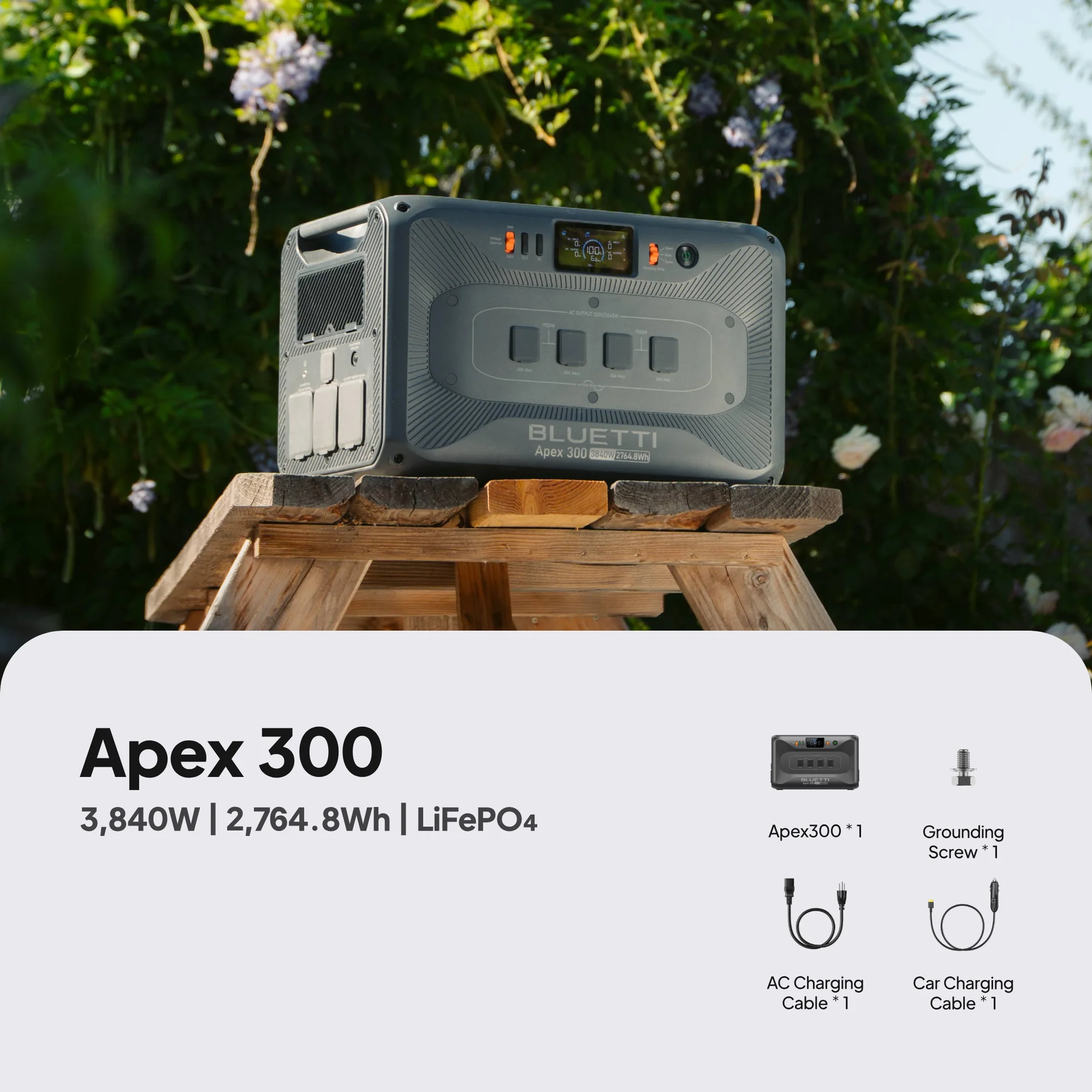
At 85 lbs with no wheels or transport solution in the box, moving it requires two people or careful maneuvering.
This is the first indication that the Apex 300 is designed for installation rather than frequent portability.
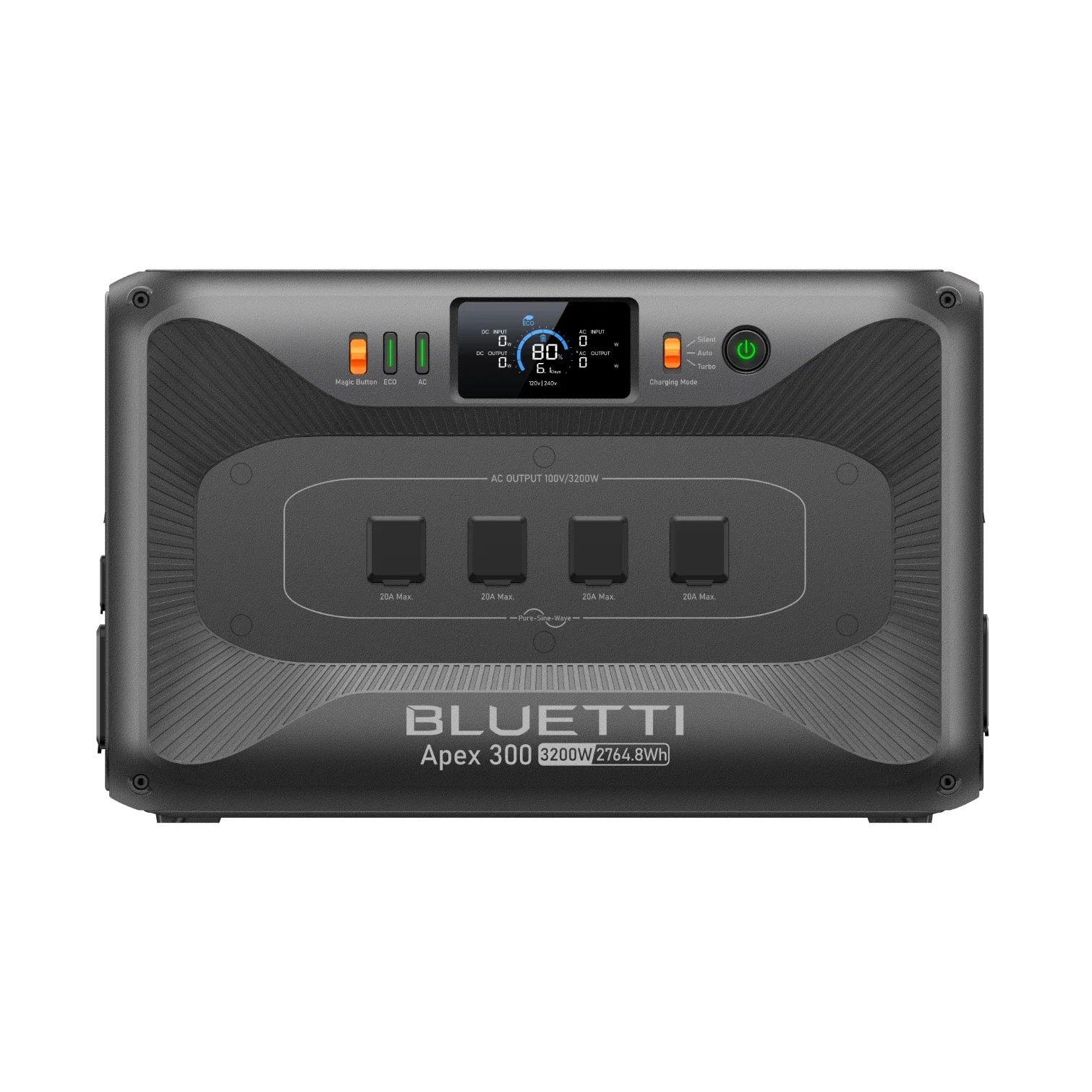
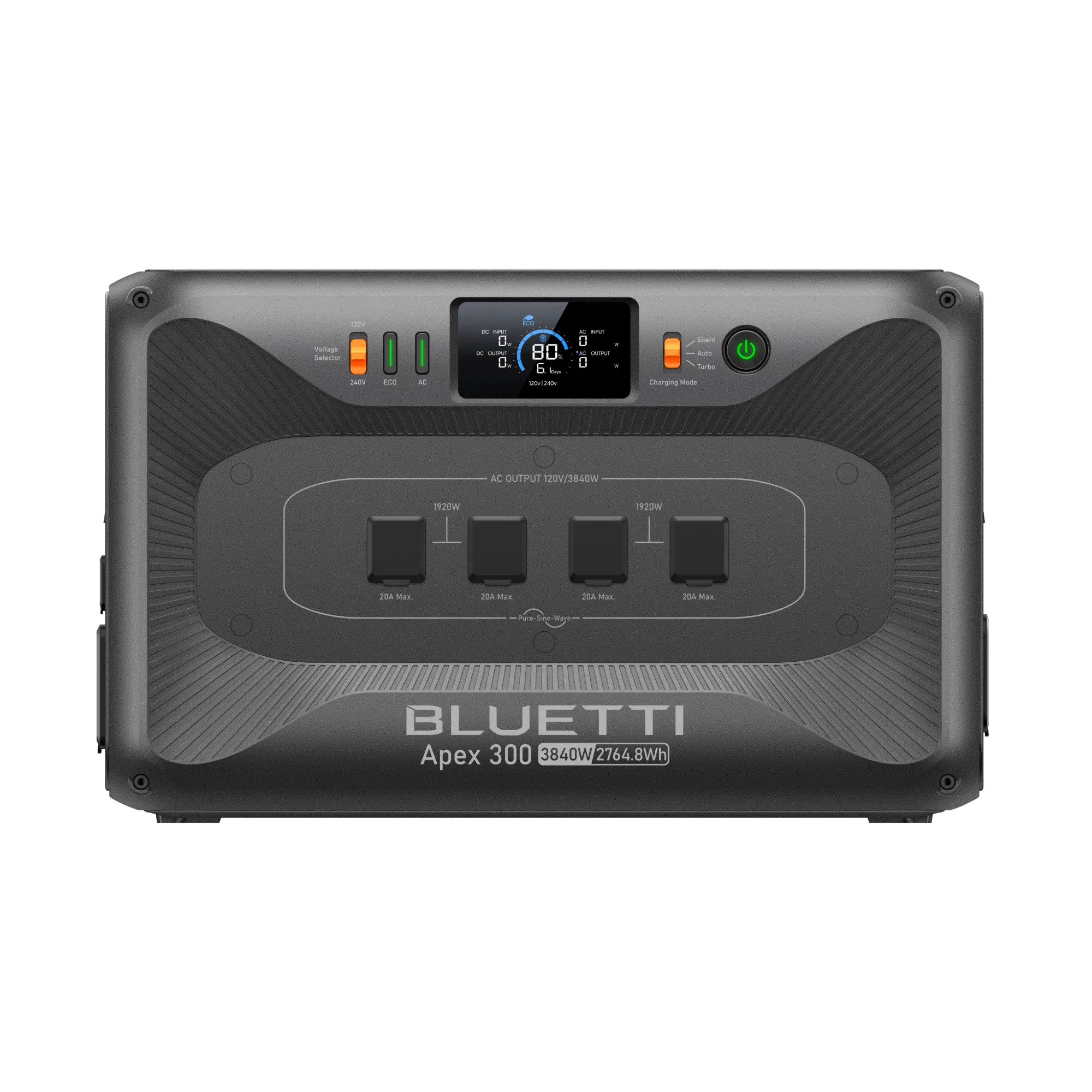
The base unit is well-built with a clean aesthetic and a clearly labeled 240V outlet configuration.
The port panel is notably absent the USB and DC outputs you'd expect — the bare patch where the D1 Power Hub connects is a visual reminder of the accessory you'll need.
Build quality is capable and professional, but the out-of-box experience feels incomplete for a $1,400 product.
Key Features
240V Split-Phase Output
Most portable power stations at this price output 120V only, meaning they cannot run electric dryers, well pumps, central AC units, or Level 2 EV chargers.
BLUETTI (Manufacturer product image)
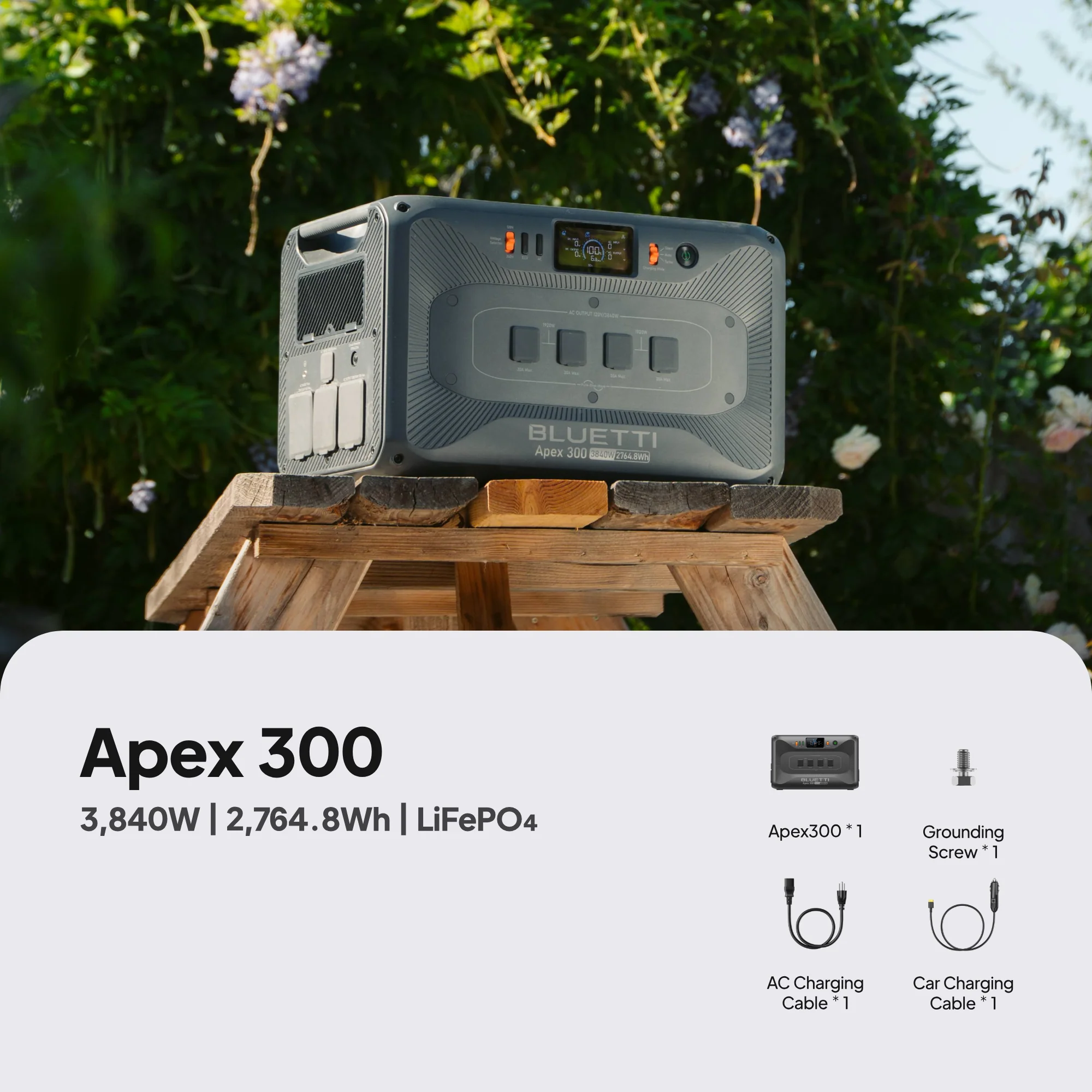
The Apex 300 switches between 120V and 240V split-phase output from a single unit — no daisy-chaining required.
This unlocks whole-home backup use cases that previously required $3,000+ from Bluetti, EcoFlow, or a permanent standby generator.
The 3,800W inverter delivers solid power for most 240V loads, though high-draw 240V appliances like large central AC units may require careful load management.
2,400W Solar Input
The 2,400W standard solar input is competitive at this price point and provides meaningful off-grid capability.
Bluetti's marketing around the 6,400W figure with the SolarX 4K accessory has been criticized as potentially misleading — that number requires a separate accessory purchase.
At the base $1,400 price, 2,400W is what you get.
Under real-world testing with a 2,000W panel array, the Apex 300 pulled 1,700–1,850W consistently — approximately 85% of rated input under partial cloud conditions.
Full solar recharge from 20% took roughly 1.8 hours under good sun.
Expandability to 58kWh
Starting at 2,764Wh and expandable to 58kWh with up to 20 B300K expansion batteries, the Apex 300 scales from an oversized camping unit to a serious residential energy storage system.
Each B300K battery adds 3,072Wh of capacity.
At current pricing, building to 20kWh costs roughly $5,000–$6,000 total — significantly less than equivalent capacity from EcoFlow or Anker's premium home backup lines.
Efficiency and Idle Draw
At 85% efficiency, you lose approximately 415Wh per full cycle to heat — worse than the Bluetti Elite 200 V2 (94%) but competitive with most mid-range units.
The 20W idle draw is excellent for standby.
Left on 24/7, the Apex 300 consumes only 480Wh per day from idle — far lower than the OUPES Guardian 6000's 1,800Wh/day idle.
Performance Testing
AC Charging Speed
The 3,840W AC charging option (via 30A or 50A cable) fills 2,764Wh in approximately 45 minutes.
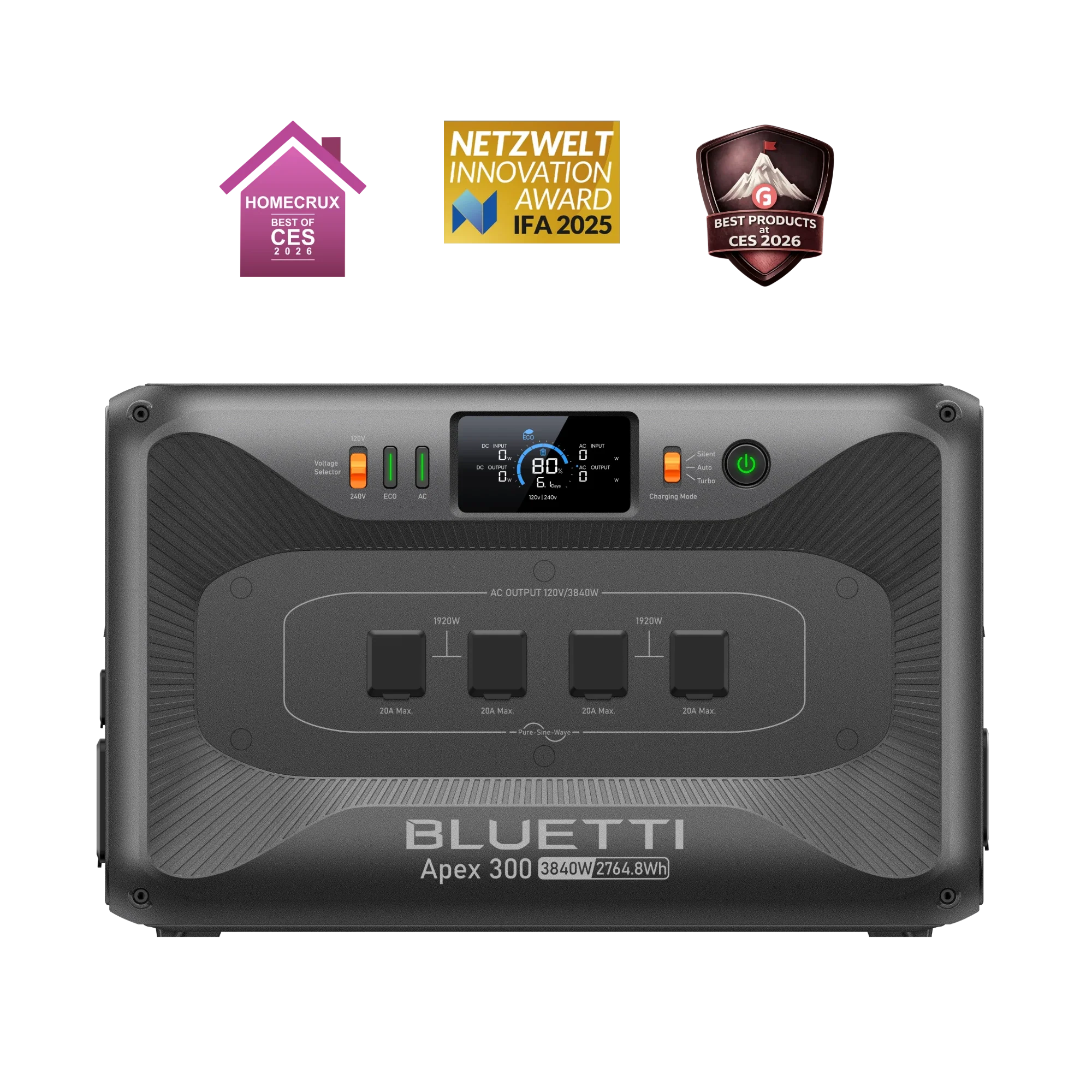
BLUETTI (Manufacturer product image)
At 120V/15A standard household charging, the rate drops to 1,800W and extends recharge to around 90 minutes.
Higher charging rates require proper electrical infrastructure; most homeowners without a dedicated high-amperage circuit will use the slower 120V rate.
Inverter and Load Verification
The 3,800W pure sine wave inverter handled simultaneous load testing cleanly.
Running a 1,500W space heater, a 400W refrigerator, and a 1,200W microwave (3,100W combined) ran without tripping the inverter.
Adding a 240V dryer load at 4,000W required the 240V mode but ran without issue.
The system's pure sine wave output is confirmed clean — suitable for sensitive electronics.
Quiet Operation
One genuinely surprising finding: the Apex 300 runs quieter under load than expected.
Multiple reviewers noted it's significantly quieter than comparable Anker and EcoFlow units at similar load levels.
For a living space installation, this is a real quality-of-life advantage.
Competitive Analysis
vs. Anker SOLIX F3800 Plus ($3,199)
Anker offers more base capacity (3,840Wh), better solar (3,200W), and a 53.8kWh expansion ceiling — for $1,800 more.
The Apex 300's 240V output advantage disappears since the F3800 Plus supports 240V as well.
For solar-primary users, Anker's higher solar input justifies the cost difference.
For budget-first buyers, the Apex 300 is compelling.
vs. OUPES Guardian 6000 ($1,614)
OUPES delivers more base capacity (4,608Wh) and includes wheels for slightly more money.
Bluetti wins on expansion ceiling (58kWh vs 41.4kWh) and idle draw (20W vs 75W).
The Guardian 6000's 75W idle is a serious ongoing cost for always-on deployments.
vs. EcoFlow Delta 3 Ultra Plus ($1,499)
EcoFlow offers more base capacity (3,072Wh) and dual independent inverters, but is 120V only.
The Apex 300's 240V output is a decisive advantage for homeowners running high-voltage appliances.
Who It's For
Ideal For:
✅ Home backup users who need 240V for dryers, AC, or EV charging on a budget
✅ Off-grid builds with large solar arrays that can leverage 2,400W standard input
✅ Long-term investors willing to expand incrementally with B300K batteries
✅ Budget-conscious buyers who want 240V capability without $3,000+ spending
Consider Alternatives If:
❌ You need built-in USB/DC ports without purchasing extra accessories
❌ Customer support quality is important — Bluetti's 24–48hr response time is a real risk
❌ You need a truly portable, wheeled unit out of the box
Final Verdict
The Apex 300 offers hardware that punches well above its price point.
240V output, massive expandability, and 2,400W solar input for ~$1,400 is genuinely impressive engineering.
Bluetti made deliberate cost trade-offs — no USB/DC ports, no wheels — to hit that price, and those trade-offs are real.
For buyers focused on long-term home energy resilience on a budget, it's one of the best value propositions in the category.
For buyers who want a plug-and-play experience with every feature included out of the box, the F3800 Plus or OUPES Guardian 6000 are better fits.
Frequently Asked Questions
Q: Does the Apex 300 require professional installation for 240V use?
A: For connecting to home circuits via a transfer switch, yes — that requires an electrician.
For direct 240V use (plugging a dryer directly into the outlet), no professional installation is needed.
Q: Can I use the Apex 300 without the D1 Power Hub?
A: Yes — the base unit handles all AC output without the hub.
You only need the D1 Power Hub for USB-C, USB-A, and 12V car socket outputs.
If your devices connect via AC adapters, the hub is optional.
Q: How many B300K batteries does it take to reach 20kWh?
A: About 6 expansion batteries (each 3,072Wh) added to the base 2,764Wh reaches approximately 21.2kWh.
Each B300K costs roughly $600–$700, so reaching 20kWh requires $3,600–$4,200 in expansion batteries.
Q: What happens to 240V output if I add expansion batteries?
A: The 240V output capability is built into the base unit and doesn't depend on expansion batteries.
Additional batteries increase capacity but don't change output voltage options.
Q: How does Bluetti's warranty compare to competitors?
A: Bluetti typically offers 2 years on the base unit, matching EcoFlow and Anker.
The OUPES Guardian 6000's 6-year warranty is the category standout if warranty coverage is a priority.
Bluetti's support response time (24–48 hours) lags behind Anker's typical few-hour response.