Introduction
Three kilowatt-hours has quietly become the sweet spot for people who want a single
box to carry a home through a day or two without power. It is enough to keep a
refrigerator, a router, some lights and a few devices alive through an overnight
outage, and enough headroom on the inverter to run a microwave or a coffee maker while
it does. Jackery's HomePower 3000 lands squarely in that bracket with 3,072Wh of
lithium iron phosphate storage, a 3,600W inverter and a $1,499 sticker.
The price is the first thing worth noticing, because it is genuinely low for the
capacity. A 3,072Wh LiFePO4 unit from a recognised brand for under fifteen hundred
dollars is a competitive number, and Jackery reaches it partly by leaving out the one
feature that its more expensive siblings make a selling point: expandability. The
HomePower 3000 belongs to Jackery's Standard line, not its Expandable line. What you
buy is the whole system. There is no second battery, no stacking, no growing it into a
larger reserve later.
That single decision defines the product. For a household that wants a capable,
self-contained backup appliance and knows its needs are bounded, the HomePower 3000 is
a lot of energy for the money. For anyone who suspects they will want more capacity in
two years, it is the wrong end of Jackery's own catalogue, and the 240V-capable
HomePower 3600 Pro Max or the modular Explorer 5000 Plus are the honest places to look.
Design and Build
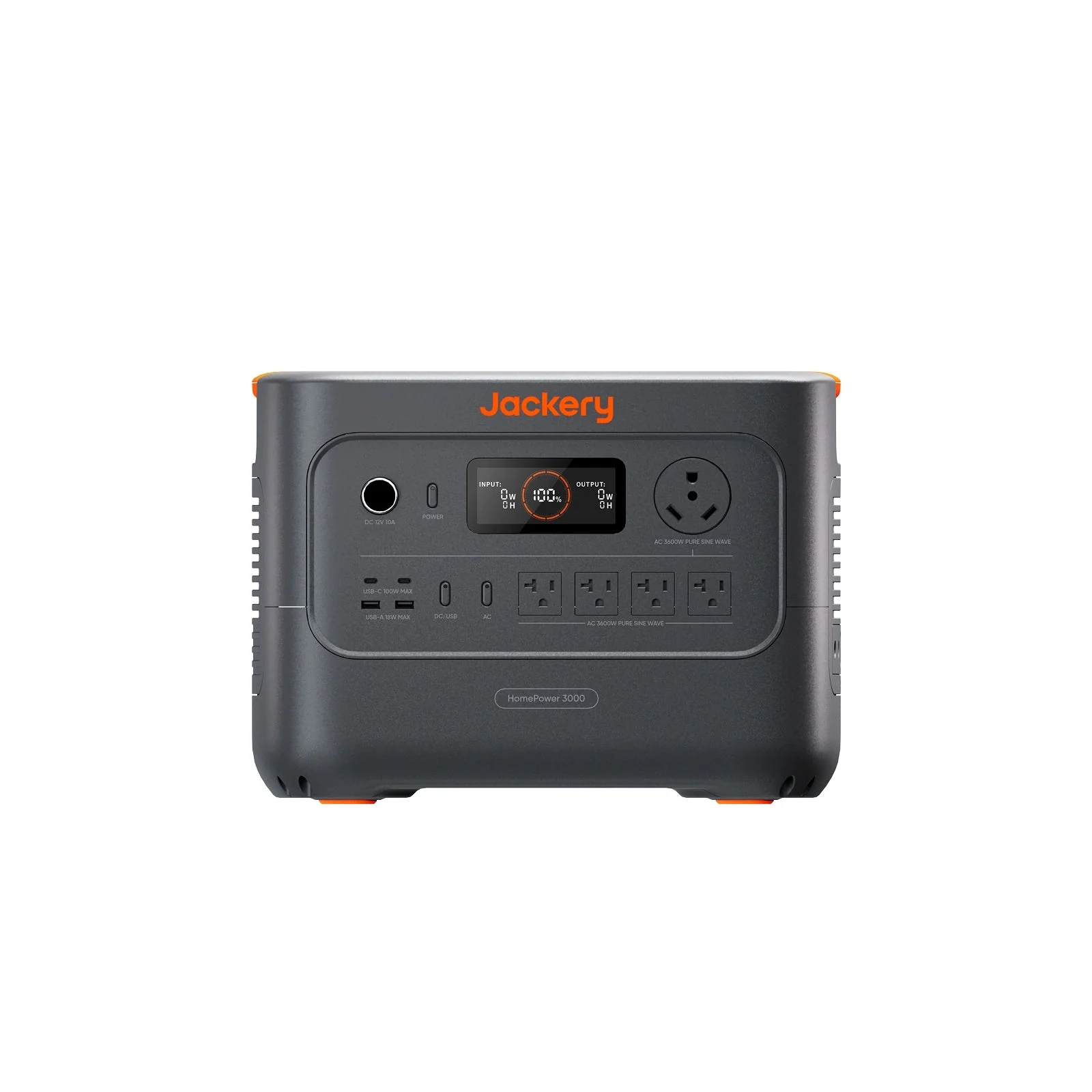
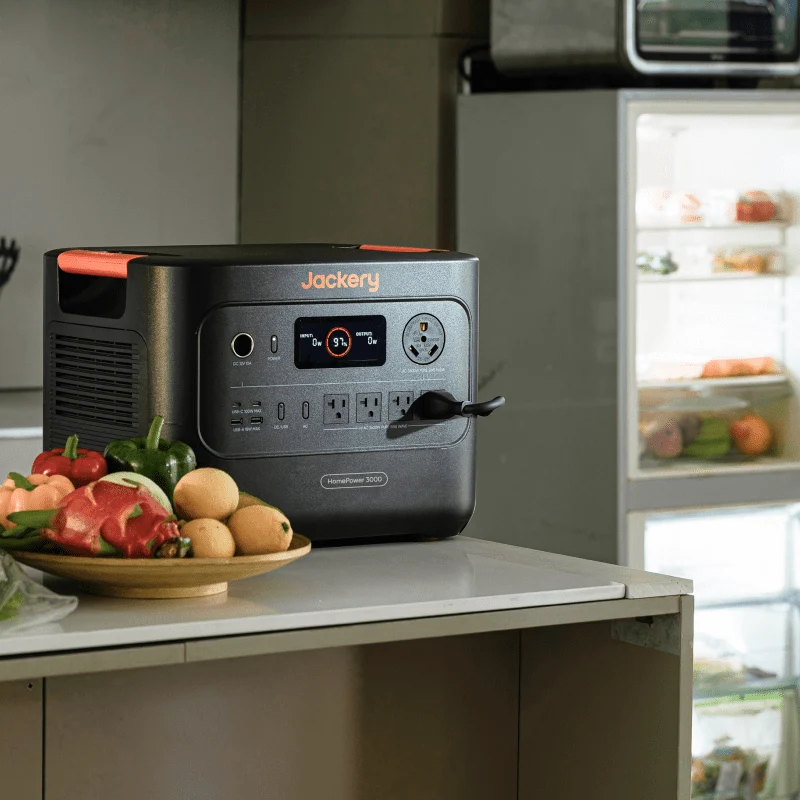
Jackery describes the HomePower 3000 as the smallest and lightest 3kWh station it has
built, credited to a cell-to-body construction that packs the LiFePO4 cells directly
into the chassis rather than into a separate module inside it. The dimensions bear the
first half of that claim out: at 16.4 by 12.8 by 12 inches it is a compact cube for the
energy inside it, small enough to tuck into a closet or under a desk.
Jackery (Manufacturer product image)
Jackery (Manufacturer product image)
The weight claim deserves more scepticism. At 59.52 pounds, the HomePower 3000 is light
relative to the roughly 3,994Wh, 115-pound Goal Zero Yeti PRO 4000, but it is not light
in any absolute sense. This is a two-handed, plant-your-feet lift, and for many buyers
it will be a two-person job to move up a flight of stairs. Treat the "world's lightest"
framing as a comparison against other 3kWh units, not as a promise that you will sling
it into a truck bed one-handed. If genuine carryability matters more than capacity,
Jackery's own 39.5-pound Explorer 2000 v2 is the more honest answer, at the cost of a
kilowatt-hour.
Port provision is a strength. There are four 120V/20A outlets rated at 2,400W plus a
single 120V/30A outlet that can deliver the unit's full 3,600W — a genuinely useful
inclusion that covers a 30A RV shore-power inlet or a heavy single appliance. USB
provision is generous by the standard of the class: two 100W USB-C ports, enough to
fast-charge two laptops at once, alongside two 18W USB-A ports and a 12V/10A car socket.
The pack itself is LiFePO4 rated for 4,000 cycles to 70% capacity, the chemistry that
makes indoor storage sensible and gives the unit a realistic decade-plus of service
under weekly use.
Charging and Runtime Performance
The HomePower 3000's charging story comes with an asterisk that buyers should note.
Jackery's marketing bullet advertises a recharge "in as fast as ~1.7 hours," but the
company's own technical specification table lists the AC adapter charging time as 2.2
hours. That is not a catastrophic gap, but it is Jackery contradicting Jackery on the
same product page, and the conservative 2.2-hour figure is the one to plan around. Wall
input is capped at 15A on a standard 120V circuit.
Jackery (Manufacturer product image)
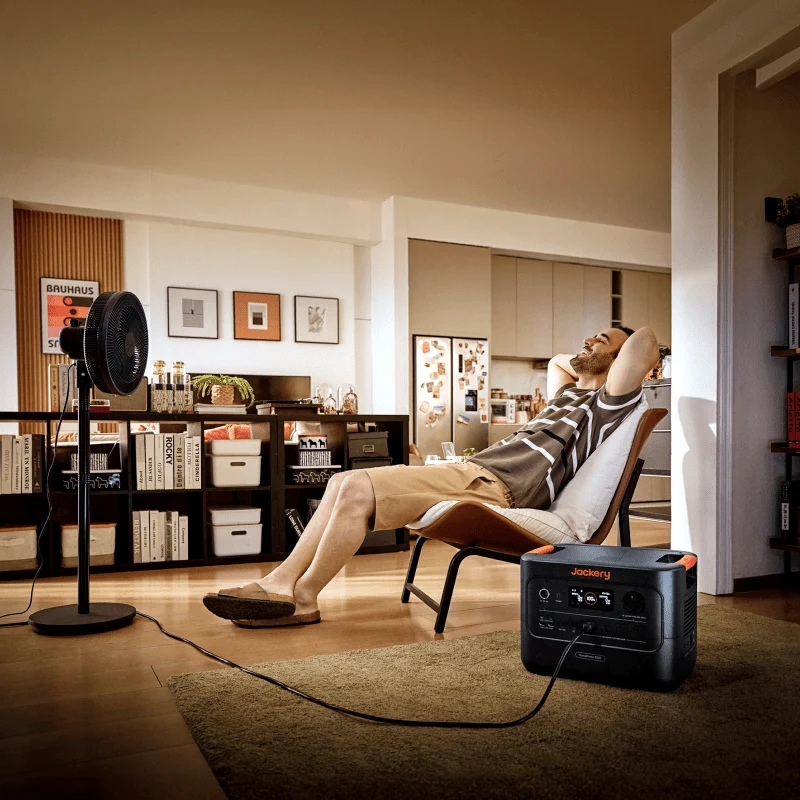
Jackery (Manufacturer product image)
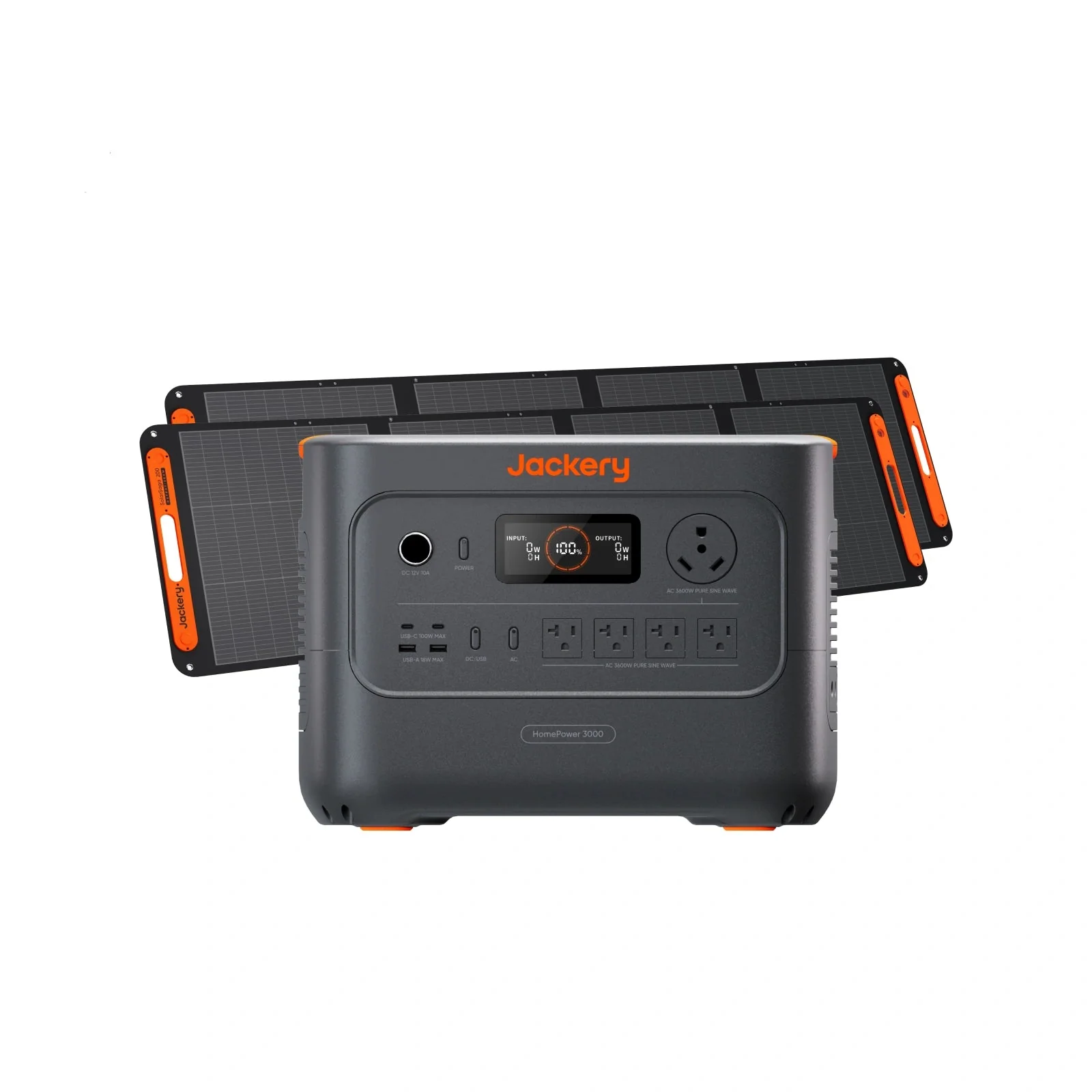
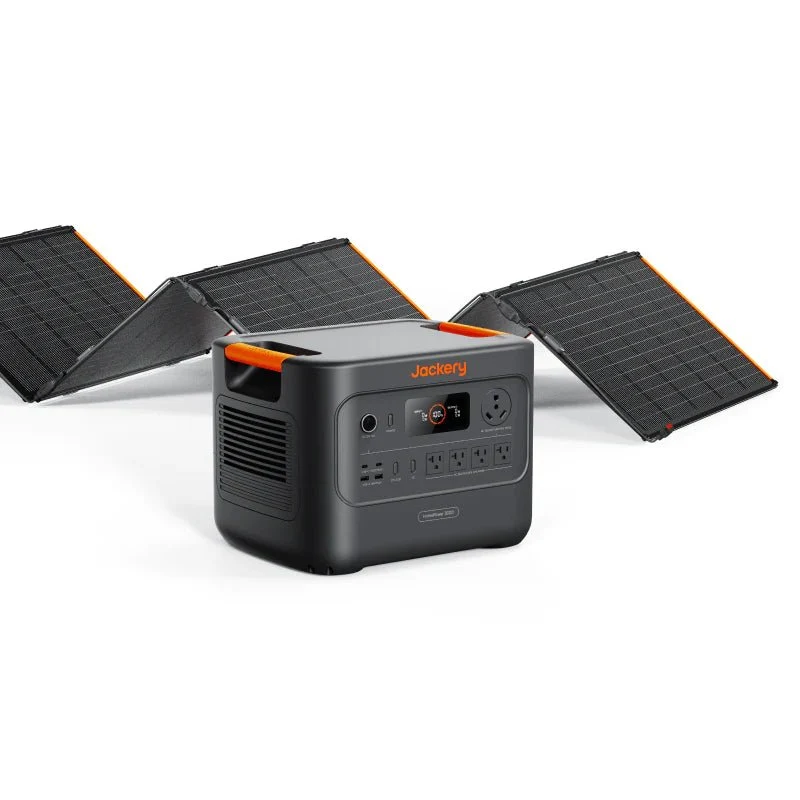
Solar is the weaker input path. The HomePower 3000 accepts DC through two DC8020 ports,
combining to a maximum of 24A and 1,000W. Against a 3,072Wh battery, 1,000W of solar is
roughly a three-hour refill in perfect, panel-square-to-sun conditions, and realistically
most of a daylight cycle once you account for angle, temperature and cloud. That is a
modest ceiling for a 3kWh unit, and it means solar should be treated as a top-up or a
multi-day trickle rather than a same-day recovery method. If PV recharging is central to
how you plan to live with the unit, this specification is the one that should give you
pause.
Output is where the HomePower 3000 earns its keep. The 3,600W continuous inverter, with
a 7,200W surge ceiling, is enough to run essentially any common household load short of
central air conditioning or an electric dryer: a 1,500W space heater, a 1,000W
microwave, a full-size refrigerator and a coffee maker can coexist within that envelope.
The 30A outlet in particular unlocks the full 3,600W to a single connection, which is
what makes the unit viable as RV shore power or for a demanding tool.
Switchover is specified at approximately 20 milliseconds, which qualifies the HomePower
3000 as a working uninterruptible supply for everyday electronics — a fridge, a router,
lights, a desktop. Jackery is refreshingly candid about the limit here: its own guidance
notes that ~20ms switching is not recommended for sensitive devices such as data servers.
For a CPAP machine or a home-office desktop it is fine; for equipment that cannot tolerate
even a brief interruption, it is not a true online UPS, and buyers with that requirement
should look at units with 0ms transfer.
The last performance note is a genuine convenience: ZeroDrain retention. Jackery rates
the pack to hold roughly 95% of its charge after twelve months of storage. Backup power
that has quietly drained to nothing by the time an emergency arrives is a familiar
failure mode, and a unit you can charge and forget for a year addresses it directly.
Paired with a manual transfer switch, the HomePower 3000 can also feed up to six
essential home circuits, moving it from a plug-in appliance toward a semi-permanent
backup fixture.
Competitive Comparison
vs. EcoFlow DELTA 3 Ultra ($1,399, 3,072Wh). This is the most direct rival, and it
is a strong one. EcoFlow matches the HomePower 3000's exact 3,072Wh capacity and its
3,600W/7,200W inverter figures, costs $100 less, adds an X-Boost mode rated to 4,600W,
switches in about 10ms rather than 20ms, and — decisively — is expandable where the
Jackery is not. On paper the DELTA 3 Ultra is the more future-proof purchase; the
HomePower 3000's counter is Jackery's five-year direct warranty and its standout 30A
outlet.
vs. Jackery HomePower 3600 Pro Max ($2,099, 3,584Wh). The in-house step up is
instructive. For $600 more the Pro Max adds native 240V output, expansion to 21.5kWh in
a single unit, a 6,000-cycle pack, a faster ~10ms transfer and UL 9540 certification.
The HomePower 3000 is the cheaper, 120V-only, fixed-capacity product. Buyers weighing
whole-home ambitions against a bounded budget are really choosing between these two, and
the naming does not make the gulf between them obvious.
vs. Goal Zero Yeti PRO 4000 ($3,999.95, 3,994Wh). The Goal Zero holds about 30% more
energy and expands to 20kWh, but it weighs 115.7 pounds and costs more than two and a
half times as much. For a buyer whose need is a day or two of essentials rather than a
solar-home foundation, the HomePower 3000 delivers most of the useful capacity at a
fraction of the price and half the mass.
vs. Jackery Explorer 2000 v2 ($999, 2,042Wh). For buyers who do not need the full
three kilowatt-hours, Jackery's own lighter unit is worth a look: 39.5 pounds against
59.52, at $500 less, with a 2,200W inverter. It stores a third less energy and drops the
30A outlet, but it is the one you can actually carry alone.
Who It's For
Buy the HomePower 3000 if you want a large, capable, self-contained backup with a hard
budget ceiling and a firm sense that your needs will not grow. An apartment or a small
house that wants to keep a refrigerator, network gear, lights and a CPAP running through
an overnight outage — with enough inverter headroom to microwave dinner — is exactly the
brief this unit was built for, and $1,499 for 3,072Wh is a strong answer to it.
The 30A outlet widens the appeal to RV owners who want a drop-in 3,600W shore-power
source, and the six-circuit transfer-switch compatibility makes it a reasonable
semi-permanent fixture for a household that wants panel-level backup without the cost of
a full home battery.
Look elsewhere if expansion is on your horizon. The fixed 3,072Wh pack is the defining
limitation, and no amount of value compensates for it if you may want more reserve later
— the EcoFlow DELTA 3 Ultra and Jackery's own HomePower 3600 Pro Max both grow, and the
Pro Max adds the 240V output the HomePower 3000 lacks entirely. Solar-first users should
also weigh the 1,000W input ceiling carefully before committing.
Final Verdict
The HomePower 3000 is a focused, keenly priced backup appliance that does the core job
of a 3kWh station well and asks you to give up flexibility to hit its price. The 3,600W
inverter with a 7,200W surge covers real household loads, the 30A outlet is a smart and
uncommon inclusion, the LiFePO4 pack's 4,000-cycle rating promises long service, and at
$1,499 the cost-per-watt-hour is among the better numbers a major brand offers.
The reservations are concrete rather than vague. Capacity is permanently fixed at
3,072Wh. Jackery's own spec sheet undercuts its 1.7-hour charging headline with a
2.2-hour figure. Output is 120V only, so a 240V well pump or dryer is out of scope. The
~20ms switchover is not, by Jackery's own admission, suitable for the most sensitive
electronics. And at 59.52 pounds the "lightest 3kWh" framing oversells what is still a
two-person carry.
Judged as what it is — an affordable, self-contained, indoor-friendly reserve for a
household with bounded needs — the HomePower 3000 is a good buy. Judged as the seed of a
growing home-energy system, it was never designed to be one. Decide which you are
purchasing before the price does the deciding for you.
Frequently Asked Questions
How long will the HomePower 3000 run my refrigerator?
its duty cycle. Against 3,072Wh of nameplate capacity — expect somewhat less usable after
inverter losses — that works out to roughly fifteen to thirty hours of fridge-only
runtime, comfortably covering an overnight or full-day outage with headroom for lights
and a router.
Can I expand the HomePower 3000 with a second battery?
capability; its 3,072Wh capacity is fixed. If you need a system that grows, look at the
EcoFlow DELTA 3 Ultra, Jackery's own HomePower 3600 Pro Max, or the Explorer 5000 Plus,
all of which accept additional batteries.
Does it really charge in 1.7 hours?
specification table on the same product page lists the AC adapter charging time as 2.2
hours. Plan around the 2.2-hour figure, which is Jackery's own conservative number.
Will it keep my computer running during a power cut?
enough that everyday electronics ride through an outage. Jackery notes, however, that
~20ms switching is not recommended for sensitive equipment such as data servers, so it
is not a substitute for a true 0ms online UPS in a server context.
Can it output 240V for a well pump or dryer?
Loads that require split-phase 240V — many well pumps, electric dryers and Level 2 EV
charging — are outside its capability. Jackery's HomePower 3600 Pro Max is the 240V-capable
option in the range.
How much solar can I connect?
combined. That is enough for a slow full recharge across a good day, but it is a modest
ceiling for a 3kWh battery, so treat solar as a top-up rather than a same-day recovery
method.
What is the 30A outlet for?
makes it well suited to RV shore-power inlets or a single high-draw appliance. The four
standard outlets are limited to 20A and 2,400W each by comparison.
How long will the battery last before it degrades?
full cycle a week — heavier use than most backup owners will impose — that rating implies
well over a decade of service before meaningful degradation, with calendar ageing likely
to matter more than cycle count in practice.
What happens if I store it for a year without charging?
after twelve months in storage. It is still sensible to top it up occasionally, but this
is a unit you can reasonably leave in a closet between emergencies and expect to find
usable.
Can it back up my home's circuits directly?
essential home circuits, moving it beyond a plug-in appliance toward a semi-permanent
backup. It does not switch over automatically at the panel the way a 240V automatic-transfer
system does, so you operate the transfer switch yourself when the grid goes down.