Introduction: A 2023 Station That Still Has a Clear Job
The Jackery Explorer 1000 Plus launched on August 24, 2023, the publication date recorded in Jackery's official product record. That makes it an older model in a category where new stations appear constantly, but the age is not the main question. The more useful question is whether its combination of a 1,264.64Wh LiFePO4 battery, 2,000W inverter, 800W solar input, and expandable architecture still earns its space in 2026.
The answer is yes for a specific buyer: someone who wants a substantial station that can live in a car, garage, or emergency cupboard and still be carried to a campsite when needed. The Explorer 1000 Plus is less convincing as a frequently carried battery, and its three AC outlets and basic display are reminders that this is a practical 2023 design rather than a no-compromise flagship.
Jackery's official specifications provide the capacity, output, ports, dimensions, charging inputs, and cycle rating. Independent SolarLab testing found that the unit handled a 45W portable fridge, pulled up to 180W from two SolarSaga 100 panels in less-than-ideal conditions, and reached a full wall charge in under two hours. Those observations make the station more credible than a spec sheet alone, while still leaving room for the caveats that matter in real ownership.
Design, Ports, and Setup
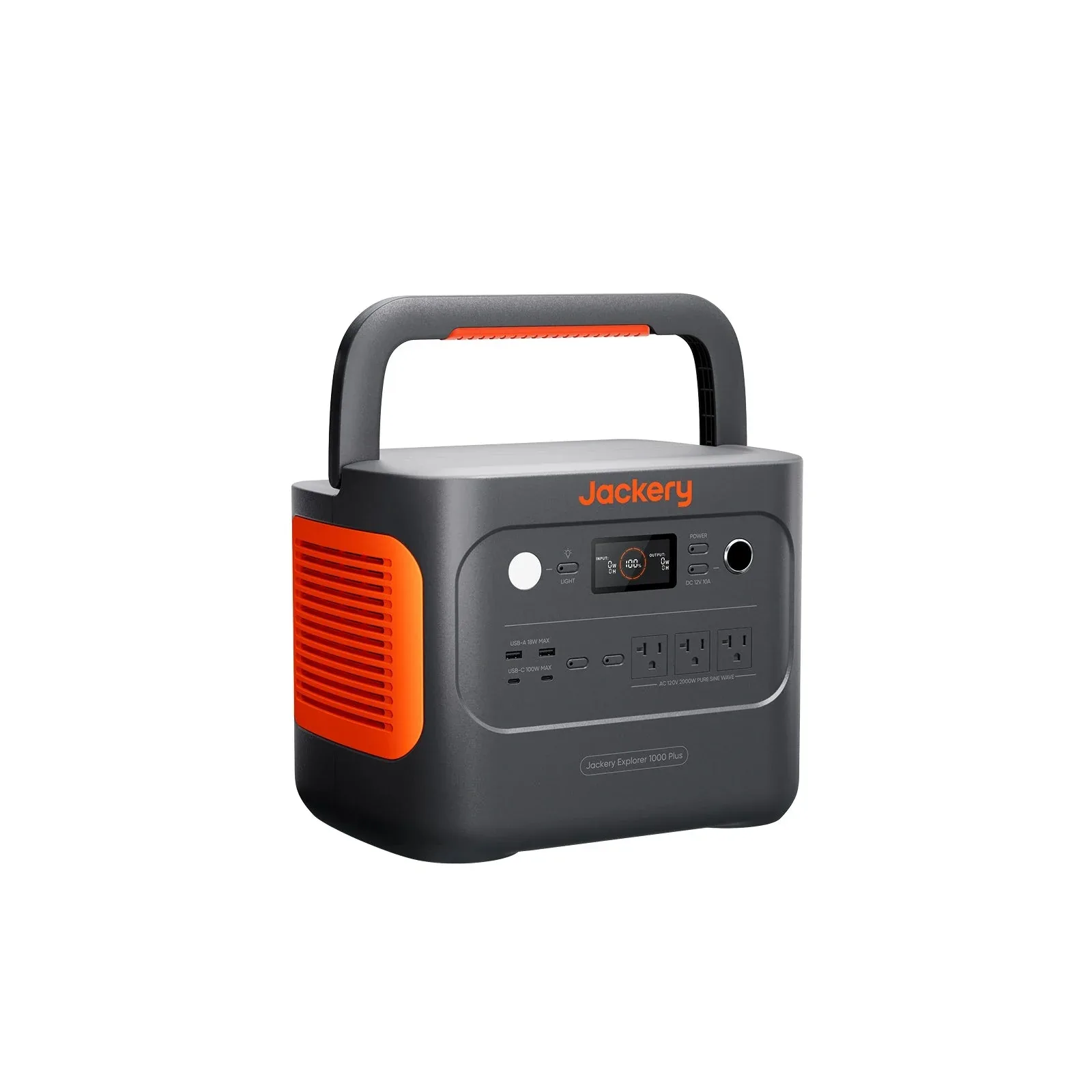
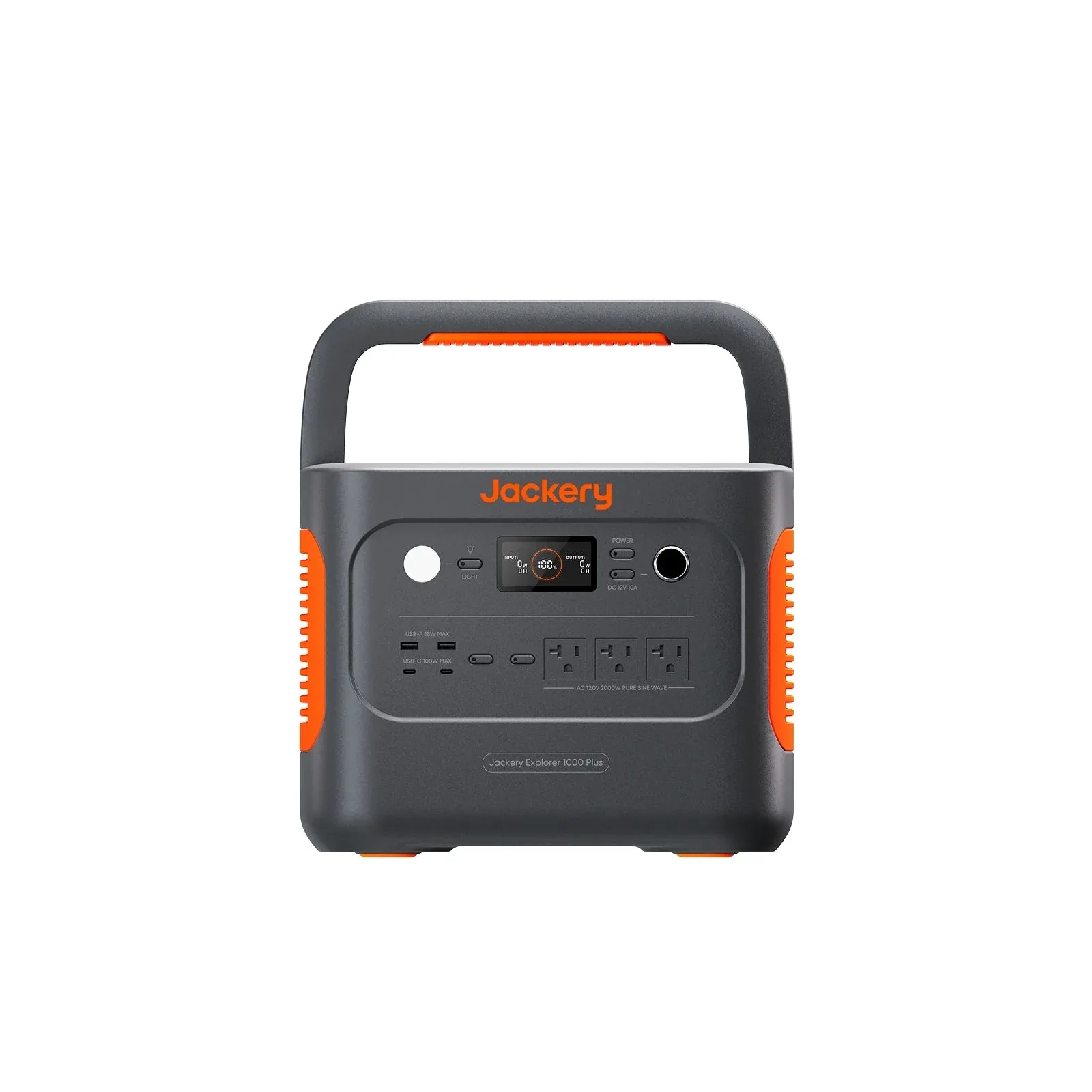
At 32lb (14.5kg), the Explorer 1000 Plus is manageable rather than light. The weight is reasonable for moving from a trunk to a campsite or from a closet to a refrigerator during an outage, but it is not a comfortable choice for carrying deep into the backcountry. Its 14 x 10.24 x 11.14-inch footprint is compact enough for a vehicle or shelf, and the integrated handle gives the unit a clear carrying point.
Jackery product page (Manufacturer product image)
The physical layout is straightforward. There are three 120V AC outlets, two USB-C ports rated up to 100W each, two USB-A ports rated up to 18W, and a 12V/10A car port. Three AC sockets are enough for a refrigerator, charger, and light, but a family running several small appliances will quickly want a power strip. The two high-output USB-C ports are more useful than a collection of low-wattage phone ports: they can charge modern laptops and other USB-C equipment without immediately occupying an AC outlet.
SolarLab describes the handle as comfortable and the enclosure as sturdy, while also finding the display limited to the essentials. That is a fair trade for a station intended to be approachable. You can see the basic state of the battery and input/output activity, but buyers who want detailed historical consumption, estimated runtime, or extensive configuration will spend more time in the Jackery app.
Setup does not require a complicated system. The station can be operated locally, while Wi-Fi or Bluetooth app control adds remote monitoring and settings. SolarLab found the app responsive and noted controls for fast or quiet charging plus display brightness and timeout. The app is useful, not a reason by itself to choose the Jackery over every competing station.
Battery and Charging Performance
The 1,264.64Wh battery uses LiFePO4 chemistry, and Jackery rates it for 4,000 cycles to 70% or more of its original capacity. That is a meaningful ownership advantage over older stations that used shorter-lived lithium-ion packs. It does not mean the battery will deliver its original capacity for 4,000 cycles, and it does not remove the effects of heat, storage, or unusually deep cycling. It does mean the Explorer 1000 Plus is designed for repeated use rather than only occasional emergency deployment.
Jackery product page (Manufacturer product image)
The 2,000W rated pure-sine inverter is the station's second major strength. Jackery lists a 4,000W surge peak, which provides starting headroom for some motors and compressors, but the surge figure is not a promise that every high-startup appliance will work. Check both running and starting wattage for a refrigerator, pump, or power tool before treating the unit as an outage solution.
AC charging takes 1.7 hours according to Jackery's specification. SolarLab's independent review likewise reported a full wall charge in less than two hours. That is quick enough for ordinary turnaround between trips, though not as dramatic as the fastest newer stations that advertise sub-hour charging. The Explorer 1000 Plus is better understood as a capable all-rounder than a charging-speed specialist.
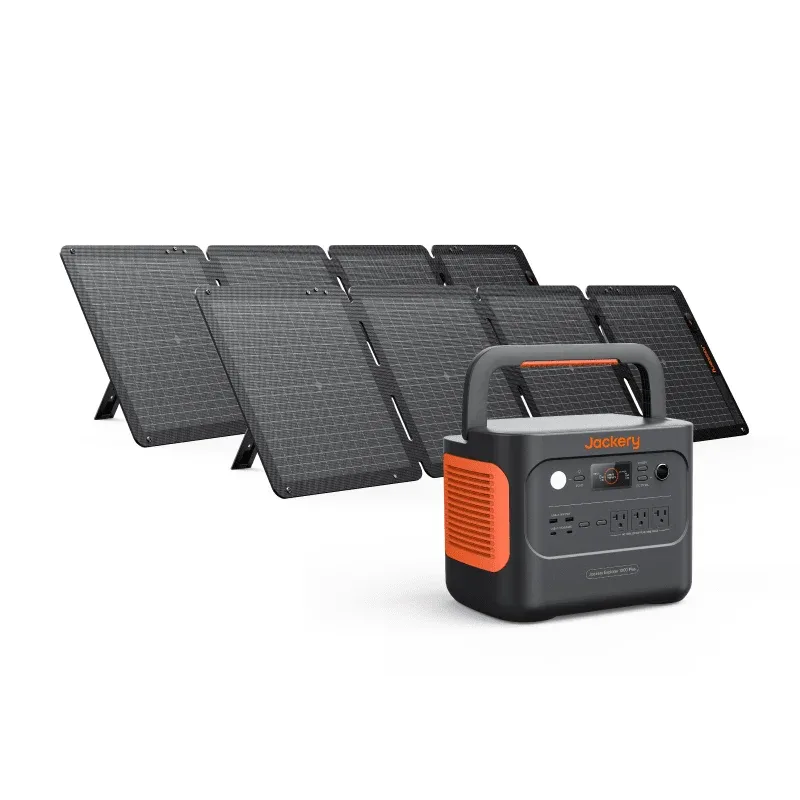
The 800W maximum solar input gives the station a useful off-grid ceiling. SolarLab's paired 100W panels produced 180W in conditions the publication described as less than ideal, which is an encouraging result but not a forecast for every roof, campsite, or season. Panel angle, cloud cover, shade, cable losses, and the final charging phase all change the result. Treat 800W as the input limit, not as a daily energy guarantee.
Real-World Use: Camping, Fridges, and Backup Loads
SolarLab's 45W ICECO portable-fridge test is a believable use case. A load in that range is exactly the sort of thing a car camper may want to run without ice, and it stays far below the Jackery's inverter ceiling. SolarLab also reported more than 10 hours of LED-light use in its testing. Those are third-party observations from that review, not a universal runtime promise: a fridge cycles, lights vary in wattage, and inverter losses reduce the energy available at the outlet.
For a campsite, the Explorer 1000 Plus has the right balance of capacity and output. It can run lights, cameras, laptops, a fridge, and modest countertop appliances without making every user calculate whether a small power bank will survive the weekend. The tradeoff is that 32lb is still a serious piece of kit, so the station belongs near the vehicle or base camp.
For outage backup, the 2,000W inverter is useful for ordinary critical loads such as refrigeration, networking gear, lights, and device charging. It is not a whole-home battery, and adding three expansion packs to reach the advertised 5,000Wh maximum changes the system's cost and handling. Medical equipment deserves separate confirmation from the equipment maker; neither a product page nor a general review can guarantee compatibility for life-support use.
Jackery also lists a bypass mode with 100V-120V input/output at up to 12A. That is not the same thing as a dedicated, zero-compromise UPS for every computer or network device. If uninterrupted power is the reason for buying, test the exact device and understand how the station behaves at low loads before trusting it unattended.
Expansion Changes the Value Proposition
The Explorer 1000 Plus can accept up to three battery packs, taking the system to 5,000Wh. That makes this model more adaptable than a sealed 1kWh station. A weekend camper can start with the base unit, while an outage-prepared household can add storage later instead of replacing the entire power station.
Expansion is also where the product's apparent simplicity becomes less simple. Extra batteries add cost, weight, charging decisions, and storage space. A 5,000Wh setup is no longer a grab-and-go product; it is a small home energy system assembled around a portable inverter. Buyers should price the complete configuration they actually need rather than treating the expansion maximum as free future capacity.
Jackery Explorer 1000 Plus vs. the Alternatives
The Jackery Explorer 1000 v2 is the closest in-brand comparison. It is a sensible alternative for buyers who want a newer Jackery unit with a similar capacity class but do not need the Plus model's expansion path. The 1000 Plus makes more sense when additional storage or the higher 2,000W inverter is central to the plan.
The Anker SOLIX C1000 is a strong rival for buyers who care about charging speed, app features, and a dense port selection. Its appeal is a more feature-forward ownership experience; the Jackery answers with a higher expansion ceiling and a simpler, familiar interface. Compare the exact sale bundle rather than assuming the older Jackery is automatically the bargain.
The EcoFlow DELTA 2 is the better fit when EcoFlow's app and accessory ecosystem matter more than Jackery's layout. It is a natural alternative for buyers who want a mature platform with broad monitoring and expansion options. The Explorer 1000 Plus remains attractive when its 800W solar input, three-battery expansion, and current discount are the deciding factors.
The BLUETTI AC180 deserves consideration for shoppers who want high output in this general capacity class and are comfortable with a different software and accessory ecosystem. The Jackery's advantage is not that it wins every specification contest; it is that the combination of manageable size, app control, and optional expansion is coherent for camping and emergency use.
Who Should Buy It?
Buy the Explorer 1000 Plus if you want one station for car camping, refrigerator-and-networking backup, and occasional outdoor work, with the option to add storage later. It is particularly well suited to buyers who value a large inverter and long cycle rating more than the lightest possible chassis.
Skip it if you need a station for long-distance carrying, expect a rich front-panel dashboard, or require more than three AC outlets without using a power strip. Also skip it if the current price is close to a newer station with the same capacity and better charging or display hardware; the 2023 launch date makes the deal, not the logo, the deciding factor.
Verdict
The Jackery Explorer 1000 Plus is still a useful mid-size power station because its strengths reinforce one another. The 1,264.64Wh LiFePO4 pack, 2,000W inverter, 800W solar ceiling, 100W USB-C charging, and three-battery expansion option cover real camping and outage needs without demanding a full home-backup installation.
Its weaknesses are equally clear. Thirty-two pounds limits portability, three AC outlets can be cramped, and the display is less informative than the best newer competitors. The station launched in 2023, so it should be bought at a current-market price rather than at an unquestioned launch-era premium. At the current official unit-only listing, it remains a recommendation for car campers and practical backup buyers who want expansion headroom—not for backpackers or buyers chasing the newest interface.
FAQ
When did the Jackery Explorer 1000 Plus launch?
Jackery's official product record lists the Explorer 1000 Plus as published on August 24, 2023. This review uses that primary-source date rather than the discovery article's publication date.
How much usable power does it have?
Jackery lists a 1,264.64Wh battery. Actual output at AC outlets will be lower because the inverter and connected devices consume energy. Runtime depends on the load, temperature, and whether AC, DC, or USB outputs are used.
Can it power a refrigerator?
It can be a good fit for a compatible refrigerator, and SolarLab reported successfully powering a 45W portable fridge. Check the refrigerator's startup demand and test the exact model if it is essential during an outage.
Can it run a microwave?
The 2,000W rated inverter gives it a reasonable chance with many countertop microwaves, but microwave input ratings and startup behavior vary. Compare the appliance's real draw with the Jackery's continuous rating and leave headroom.
How long does AC charging take?
Jackery specifies 1.7 hours for AC charging. SolarLab independently reported a full wall charge in under two hours, which is consistent with the official figure.
How useful is the 800W solar input?
It gives the station a strong replenishment ceiling for a 1kWh-class unit. SolarLab's two 100W panels produced 180W in less-than-ideal conditions, but real-world input varies with sun, shade, temperature, panel orientation, and wiring.
Can the capacity really reach 5,000Wh?
Jackery says the system can expand to 5,000Wh with up to three battery packs. That maximum requires buying and storing the extra hardware; it is not the capacity of the base station.
Does it work as a UPS?
Jackery lists a bypass mode, but bypass operation is not automatically equivalent to a dedicated UPS for every device. Test your computer, router, or other critical load before relying on it during an outage.
Is the Jackery app required?
No. Local controls provide basic operation, while Wi-Fi or Bluetooth app access adds remote monitoring and settings. SolarLab found the app responsive and useful for charging-mode and display controls.
Is 32lb too heavy for camping?
It is reasonable for car camping and moving between a vehicle and a campsite. It is too heavy for most situations where the station must be carried a long distance, especially alongside tents, food, and other gear.
Does the display show detailed energy history?
No. SolarLab characterized the display as basic, showing essential input and output information rather than the detailed readouts offered by some app-heavy competitors. The phone app provides more control.
Should I buy the 1000 Plus in 2026?
Buy it when the price is meaningfully below newer alternatives and you value expansion, solar input, and a 2,000W inverter. Choose a newer model instead if its faster charging, richer display, or lighter body matters more than the Jackery's expandable design.