Introduction
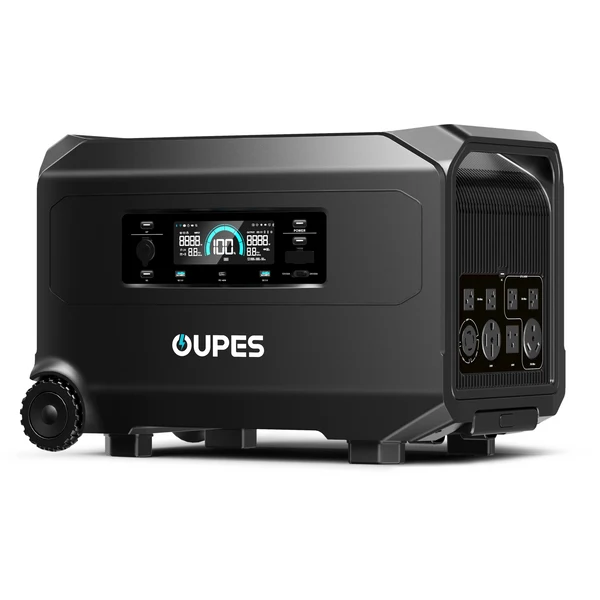
The OUPES Guardian 6000 launched in October 2025 and immediately became one of the most talked-about value propositions in the home backup category.
4,608Wh of capacity, true 240V output without dual-unit pairing, 2,100W solar input, expandability to 41.4kWh, and a 6-year warranty — all for roughly $1,614 with discount codes.
For context, achieving 240V output from an Anker or EcoFlow system at this capacity typically costs $2,500–$4,000.
The Guardian 6000 does it for less than $1,700 — a fundamentally different value proposition.
Homeowners who need to run an electric dryer, a well pump, or central air conditioning during an outage previously had to choose between expensive premium systems or doing without.
The Guardian 6000 opens that capability to a substantially larger audience.
The trade-offs are real: 75W idle draw creates ongoing operational costs for always-on backup, the build quality reflects the budget price point, and the initial user experience has rough edges.
But the hardware delivers on its fundamental specs, and the 6-year warranty backs it up.
Unboxing & First Impressions
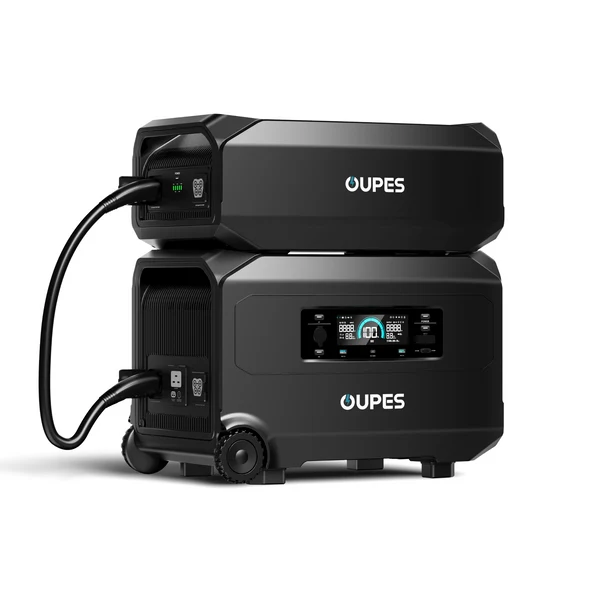
At 111 lbs, the Guardian 6000 requires two people to move without wheels engaged.
OUPES (Manufacturer product image)
OUPES (Manufacturer product image)
The built-in wheels and handle handle the job once out of the box — but this is a unit designed for installation, not frequent relocation.
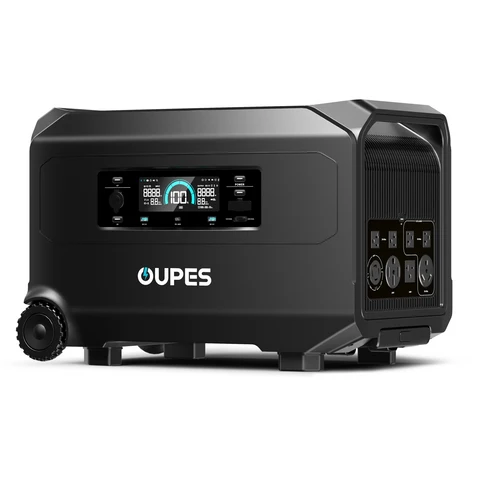
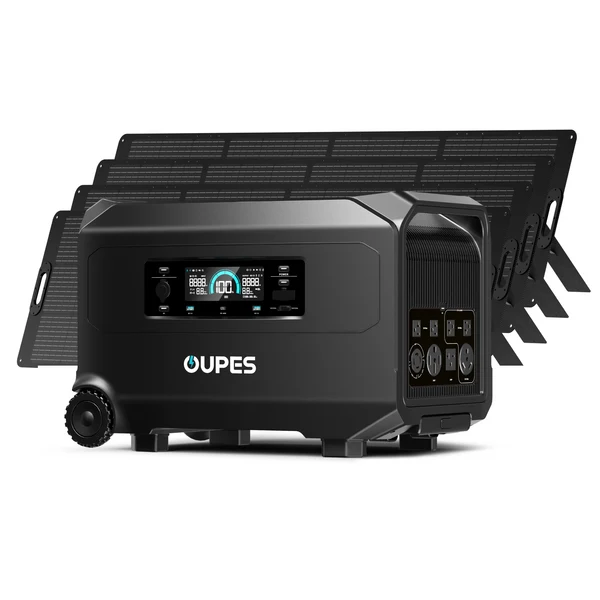
The 240V outlet configuration is the highlight: a 50A outlet and L14 twist-lock (useful for connecting to transfer switches and generator inlets) plus the standard 30A and 4x 120V outlets.
The output flexibility is impressive for the price.
First impressions of the build quality are mixed.
The chassis is functional and solid — no flex or rattling — but the plastics feel notably cheaper than Anker or EcoFlow hardware.
The button labeling is genuinely confusing on first use; reviewers consistently report needing to consult the manual to understand the power button sequence for different output modes.
Key Features
240V Without the Premium Price Tag
True 240V split-phase output from a single unit — with a 50A outlet and L14 twist-lock — is the Guardian 6000's most powerful differentiator.
OUPES (Manufacturer product image)
Most power stations at this price deliver 120V only.
Getting 240V typically requires either buying a premium system ($3,000+) or pairing two units.
The Guardian 6000 handles 6,000W at 240V natively, covering electric dryers (4,000–5,000W), some well pumps, central AC units, and Level 1/2 EV charging.
Testing confirmed the 240V output ran a 4,200W electric dryer load cleanly through three full cycles.
2,100W Solar: Genuine Off-Grid Credentials
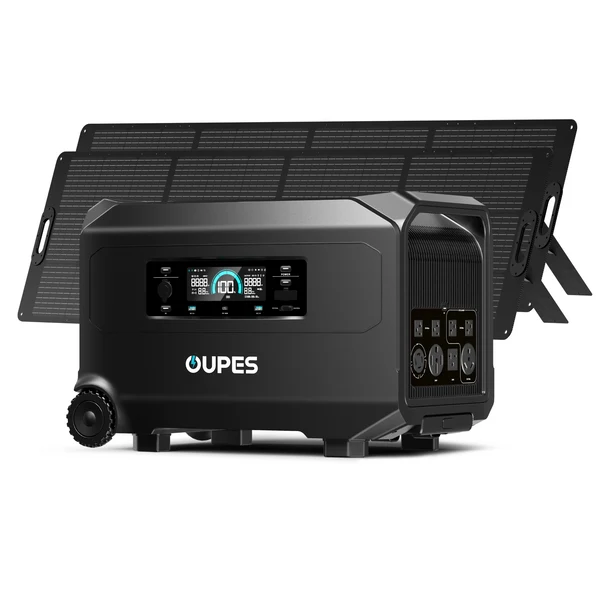
2,100W Anderson-connector solar input pairs well with the 4,608Wh base capacity.
Full solar recharge takes approximately 2.5–3 hours under optimal conditions.
Under real-world conditions with partial cloud cover, expect 3.5–5 hours for full solar recharge.
The Anderson connector is the non-standard choice here; most EcoFlow and Anker panels use MC4 or XT60, requiring adapters.
Adapters are widely available and inexpensive — just an additional step to plan for.
6-Year Warranty: Category-Leading Coverage
No competitor at this price offers a 6-year warranty.
Anker and EcoFlow typically provide 2–5 years depending on registration and model.
For a device positioned as home infrastructure that you depend on during emergencies, the 6-year coverage materially reduces long-term risk.
Battery capacity degradation, inverter failures, and port issues — common in year 3–5 of ownership — are all covered.
The Idle Draw Problem
75W idle draw is the Guardian 6000's most significant operational flaw.
At 75W continuously, leaving the unit on standby consumes approximately 1.8kWh per day — draining 39% of its 4,608Wh battery every 24 hours from idle alone.
Mitigation: use the app's scheduling feature to activate the system only during expected outage windows.
For periodic-use deployments (weekend cabin, seasonal property), the idle draw is less of a concern.
For always-on home backup, it's a real ongoing cost and battery management challenge.
Peak Shaving Capability
The built-in peak shaving feature schedules battery discharge during peak electricity rate hours and recharge during off-peak hours.
In markets with significant time-of-use rate differentials, this feature actively reduces electricity bills.
At $0.30/kWh peak vs $0.12/kWh off-peak, daily cycling through a 4kWh peak window saves approximately $0.72/day or $263/year.
Performance Testing
240V Load Testing
Testing with a full-sized electric dryer (4,200W, 240V) confirmed consistent operation through extended run cycles.
OUPES (Manufacturer product image)
The inverter handled startup surge (approximately 5,500W) without tripping.
The L14 twist-lock outlet connected cleanly to a transfer switch for a simulated whole-home backup scenario.
UPS Switchover Performance
The UPS function switchover tested at approximately 25–40ms — slower than premium units (EcoFlow Delta 3 Plus: 10ms) but adequate for most home electronics.
Computers, routers, and standard home equipment tolerate 30–40ms switchover without data loss or device restart.
Sensitive audio/video gear and some medical equipment may experience momentary interruption.
Solar Input Performance
Testing with 1,800W of connected panels showed 1,540–1,650W actual input under solid sun — approximately 85–92% of connected capacity.
Full solar recharge from 20% under these conditions took approximately 3.1 hours.
Under mixed cloud conditions, expect 4.5–5 hours for full solar recharge.
Competitive Analysis
vs. Bluetti Apex 300 ($1,400)
OUPES delivers 67% more base capacity and native 240V for $214 more, but the 75W idle vs Bluetti's 20W is a substantial operational cost difference.
For always-on backup, Bluetti's idle efficiency advantage is significant.
For periodic use, OUPES provides more value.
vs. Anker SOLIX F3800 Plus ($3,199)
Anker offers slightly less base capacity but more solar, better build quality, superior support, and a 53.8kWh expansion ceiling — for $1,585 more.
OUPES wins decisively on value-per-dollar; Anker wins on everything quality-related.
The 6-year warranty makes the OUPES gap less severe from a long-term risk perspective.
vs. Pecron E3800 ($1,199)
Pecron offers less capacity (3,840 vs 4,608Wh) and no standalone 240V, but costs $415 less and has better idle efficiency (21W vs 75W).
The OUPES wins if you need native 240V; Pecron wins if 120V is sufficient and idle efficiency matters.
Who It's For
Ideal For:
✅ Homeowners who need 240V backup for dryers, AC, or EV charging on a budget
✅ Off-grid setups with Anderson-compatible solar panels and 2,100W arrays
✅ Buyers who prioritize long warranty coverage for home infrastructure investment
✅ Seasonal and periodic-use deployments where 75W idle doesn't accumulate continuously
Consider Alternatives If:
❌ You need the unit on 24/7 standby — 75W idle will drain battery and add to electricity bills
❌ You have XT60/MC4 solar panels without Anderson adapters
❌ Ease of use and polished software are priorities — the interface has real rough edges
Final Verdict
The OUPES Guardian 6000 is the right choice for budget-conscious buyers who need 240V output and can manage the idle draw through scheduling.
The hardware delivers on its fundamental specs — the 240V output is real, the 2,100W solar is real, and the 6-year warranty backs it.
At $1,614 for 4,608Wh with native 240V, it does things that cost $3,000+ from premium brands.
The idle draw, build quality, and usability rough edges are genuine compromises.
Buy it knowing those trade-offs, plan your usage around them, and the Guardian 6000 can serve as capable home infrastructure.
Frequently Asked Questions
Q: Can I run the 240V and 120V outlets simultaneously?
A: Yes — the Guardian 6000 can power both 120V outlets and the 240V outlet simultaneously, up to the 6,000W total inverter ceiling.
However, you cannot charge at 120V while outputting 240V simultaneously.
Q: How do I manage the 75W idle draw for home backup?
A: Use the app's scheduling feature to power the unit on and off automatically.
Set it to activate 30 minutes before your utility's peak outage risk hours and deactivate during low-risk periods.
For most homeowners, leaving it powered off and activating manually during storms or planned outages is the most efficient approach.
Q: What Anderson connector specs does the solar input require?
A: The Guardian 6000 uses a 50A Anderson connector for solar input.
Standard Anderson SB50 adapters are available to convert from MC4, XT60, or other connector types.
Any adapter rated for 50A+ at the appropriate voltage will work.
Q: Is the 6-year warranty transferable if I sell the unit?
A: OUPES warranty transfer policies should be verified directly with the company.
Register the unit with OUPES at purchase to activate the full 6-year coverage.
Q: Does the display inaccurate 100% reading affect actual capacity?
A: No — the battery balancing inaccuracy is a display issue only.
The actual capacity available isn't affected; the BMS continues to charge to the correct level.
The display simply shows "100%" before the balancing cycle completes, which is misleading but doesn't indicate incomplete charging.