Introduction
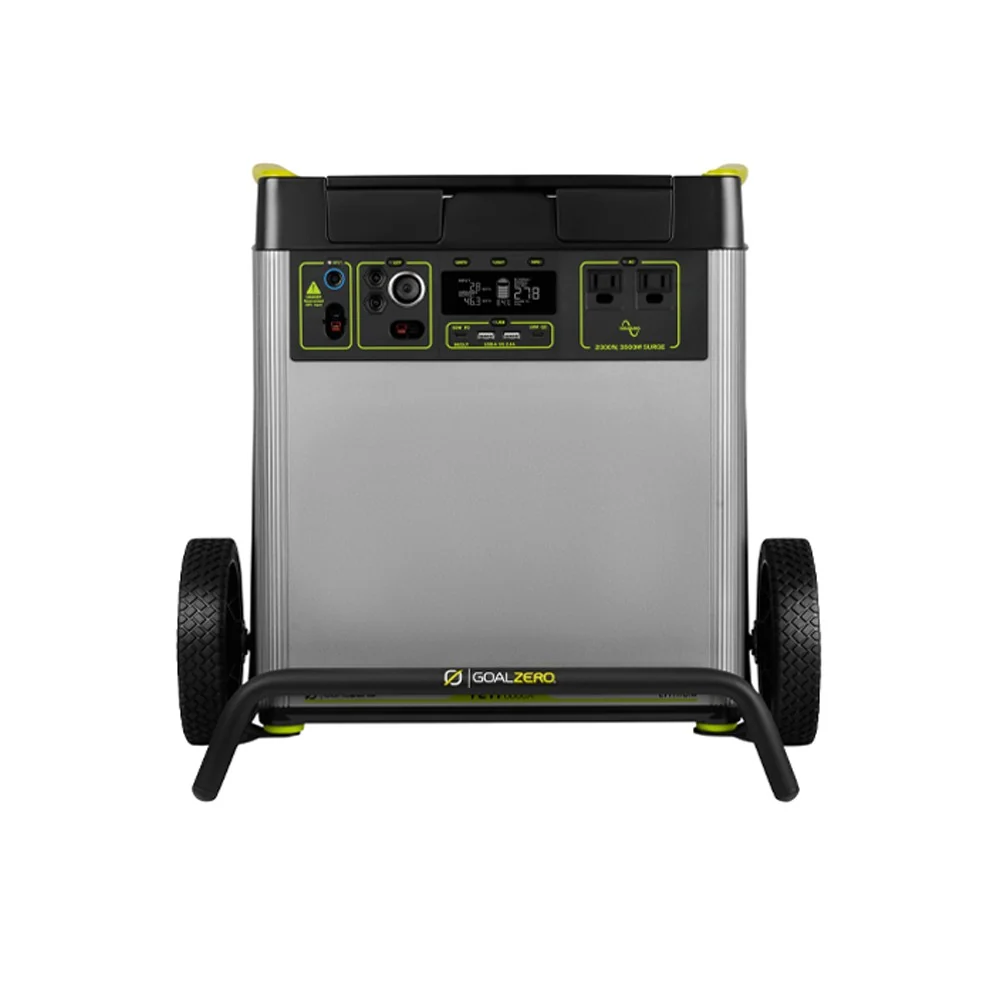
The Goal Zero Yeti 6000X has the biggest battery in this comparison — 6,071 watt-hours — and it is the hardest of the four to recommend. That tension runs through the entire review. The capacity is genuinely large, the app and build are fine, and for someone who only ever powers lights and electronics it will run for days. But the specification sheet hides three problems that a $4,999 purchase should not carry: nickel-based lithium cells that wear out far sooner than the LiFePO4 competition, a 2,000W inverter that is small for a pack this size, and 106 pounds of weight with no split-phase output to show for it.
Put plainly, this is a premium price for the shortest-lived chemistry in its class and an output rating that keeps it from doing the heavy jobs its size implies. There is a real use case buried in here — quiet, long-duration power for low-draw loads — but at this money the Yeti 6000X is outclassed by units that cost less and do more. The rest of this review explains exactly why, and who the narrow remaining audience is.
The Chemistry Problem You're Paying For
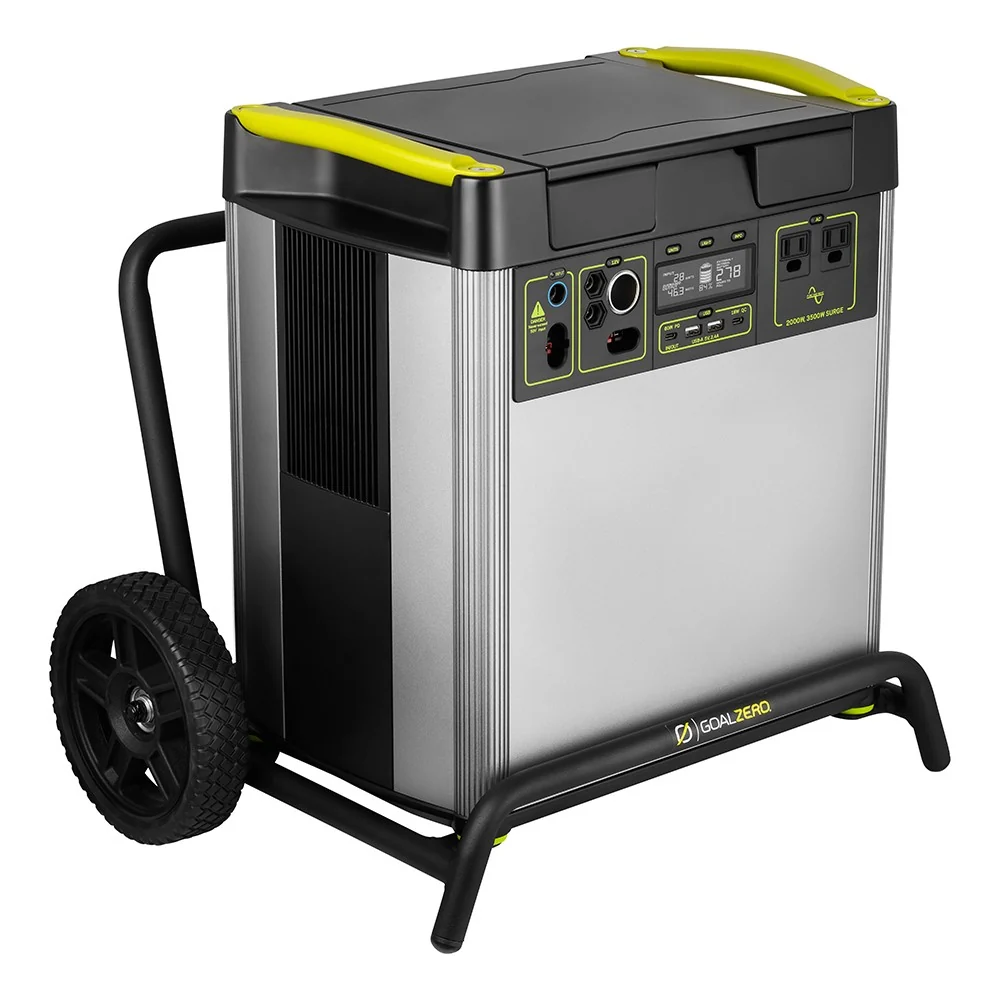
This is the single most important thing to understand before spending $4,999, and it is the thing the spec sheet's "Li-ion" label quietly glosses over. The Yeti 6000X uses nickel-based lithium (NMC) cells. Those cells are typically rated for on the order of 500 full charge cycles before they fade toward 80% of their original capacity. The LiFePO4 packs in competing stations are generally rated for thousands of cycles — often 3,000 or more — to reach the same point. That is not a rounding difference; it is a six-fold gap in usable lifespan.
Goal Zero (Manufacturer product image)
Translate it into ownership. Cycle an NMC pack heavily and you can wear through its rated life in a couple of years; a LiFePO4 rival cycled the same way keeps going for the better part of a decade. Calendar aging affects both, but the cycle math alone means the most expensive station in this group is also the one most likely to need replacement first. When a LiFePO4 competitor costs a thousand dollars less and lasts several times longer, the Yeti's chemistry is not a footnote — it is the review.
Output That Doesn't Match the Battery
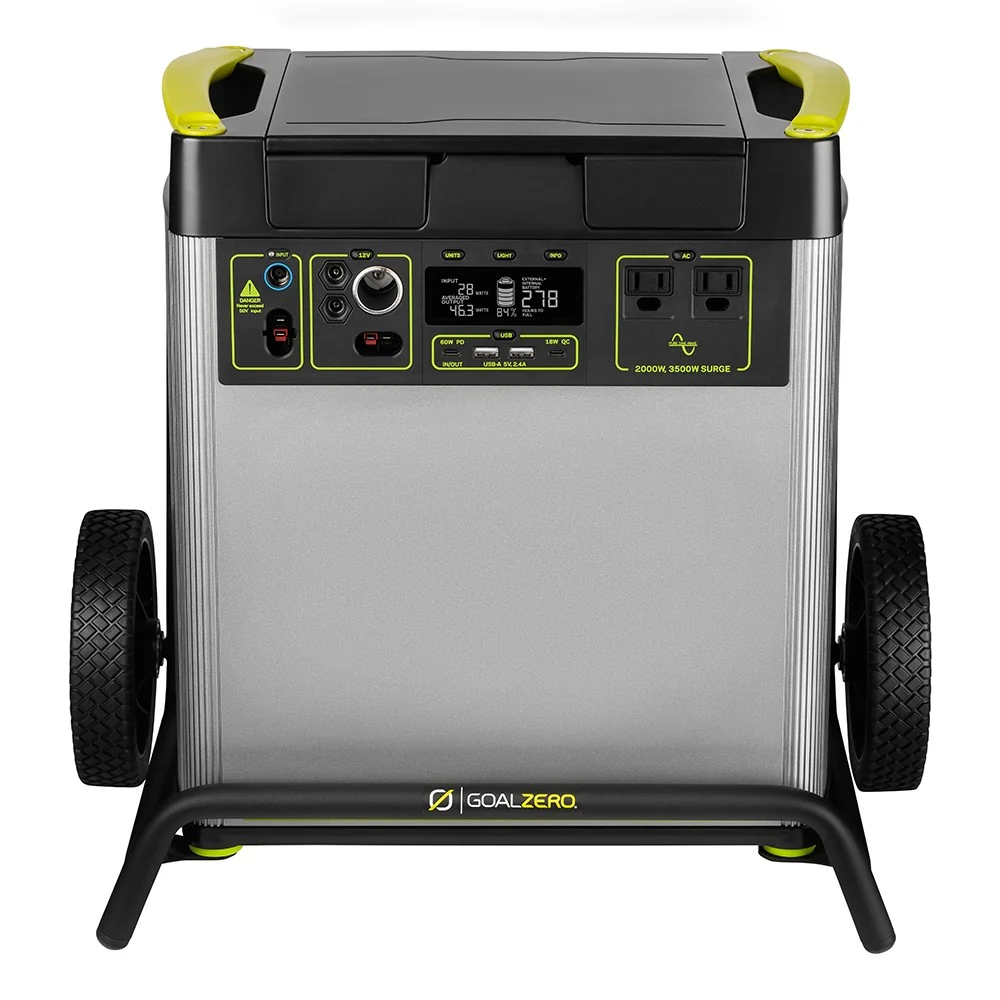
The second problem is proportion. A 6,071Wh battery paired with only a 2,000W inverter is a giant tank feeding a narrow spout. Two thousand watts is enough for electronics, lighting, a fridge, a coffee maker in a pinch, and small appliances, but it cannot start the heavy motor loads that define serious home backup. A large well pump, a central-air compressor, many 1,500W-plus power tools at startup — these are out of reach. And because the unit produces only 120V, there is no split-phase 240V output at all, which rules out 240V appliances and standard whole-home panel backup.
Goal Zero (Manufacturer product image)
So you have a station with the endurance for a multi-day outage but not the muscle to run the demanding loads a multi-day outage often involves. If your plan is to keep a fridge, lights, and devices alive for a long time, that mismatch may not bother you. If you imagined this big battery running your pump or your air conditioning, it will not.
Real-World Runtime
To be fair, the one place the Yeti 6000X delivers is raw endurance for light loads. After inverter conversion losses of roughly 10–15%, plan on about 5,400–5,500Wh reaching your outlets. Apply that to a refrigerator, which cycles its compressor rather than running it constantly: a fridge drawing 150W while running averages closer to 50W over a full hour. Divide 50W into about 5,460 usable watt-hours and you get on the order of 105 to 110 hours of fridge operation — roughly four and a half days on a single charge. That is a real strength, and no one should pretend otherwise.
Goal Zero (Manufacturer product image)
Broaden to a light essentials load — fridge, Wi-Fi, phones, LED lighting, a fan — averaging perhaps 150–200W, and the pack still carries you somewhere in the range of 27 to 36 hours, well over a day. For the specific job of quietly powering low-draw gear for a long stretch, the capacity does exactly what the number promises.
Design, Weight and Handling
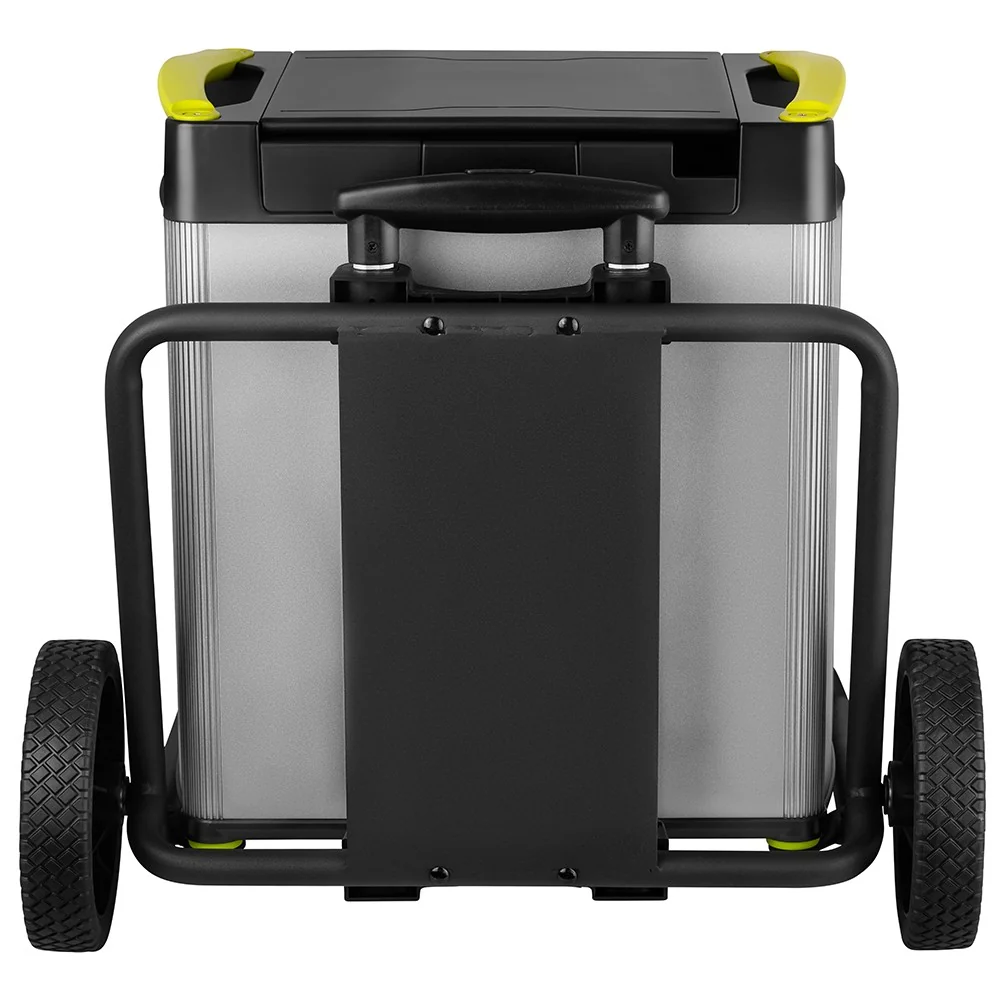
At 106 pounds the Yeti 6000X is not portable in any everyday sense. Goal Zero offers a wheeled cart accessory, and with it you can move the unit across a flat floor; without it, relocating the thing is a two-person struggle. Realistically this is a stationary unit that lives in a garage or basement and gets rolled a short distance when needed. The build quality is solid and the case feels durable, but weight this high with no split-phase payoff is a poor trade — the F3800 weighs more because it is delivering triple the output and 240V, whereas the Yeti's mass mostly reflects a very large, dense NMC pack.
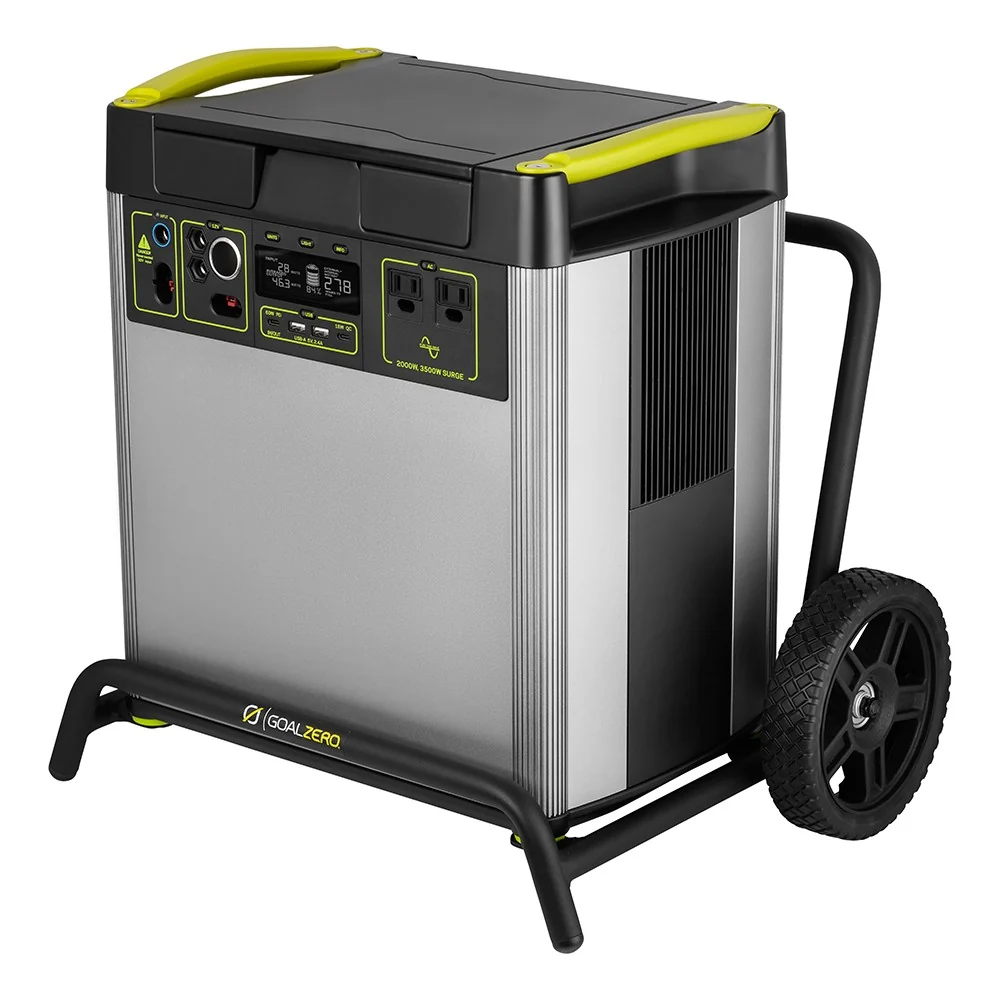
Goal Zero (Manufacturer product image)
The app is a bright spot. Over Bluetooth and Wi-Fi it reports state of charge, input and output, and lets you manage the unit remotely, which suits a station that mostly sits in one place. The system also expands with Goal Zero's Tank battery modules if you want even more capacity, though adding storage to a platform with these chemistry and output limits is a questionable place to keep investing.
How It Compares — and Why It Loses
The comparison that matters most is against the Anker SOLIX F3800, and it is not close on the metrics that govern long-term value. The F3800 costs a thousand dollars less at $3,999, delivers a 6,000W inverter against the Yeti's 2,000W, adds native 240V split-phase the Yeti cannot do at all, and uses LiFePO4 cells that outlast the Yeti's nickel-based chemistry several times over. The one column where the Yeti wins is base stored energy — 6,071Wh versus 3,840Wh — but the F3800 can be expanded past that figure while doing far more with every watt-hour and lasting far longer.
Bluetti's AC300 + B300 tells a similar story from a different angle: modular LiFePO4 capacity with a 3,000W inverter and surge headroom to start motors, at a lower entry price. EcoFlow's Delta Pro line likewise pairs LiFePO4 longevity with output the Yeti cannot match. Across the board, the Yeti 6000X asks for the most money and returns the shortest-lived chemistry and the weakest output. Its enormous battery is a genuine asset, but it is bolted to the wrong supporting specs at the wrong price.
Who Should Buy It, Who Should Skip
There is a narrow buyer for whom this makes sense: someone deep in the Goal Zero ecosystem who already owns Tank modules and Goal Zero solar gear, who only ever runs low-draw electronics and lighting, and who values a long single-charge runtime above output, longevity, and price. For that person the 6000X slots into an existing system cleanly.
Everyone else should skip it. If you care about how long the battery lasts, how much it can start, or how far your dollar goes, the LiFePO4 competition beats it decisively. Buyers who need to run heavy loads or want 240V should look at the F3800; buyers who want modular value should look at Bluetti's system; buyers who simply want long runtime for light loads can get LiFePO4 longevity for less elsewhere.
Verdict
The Goal Zero Yeti 6000X is a big battery attached to disappointing specifications at a premium price. Its capacity is real and its long-runtime, light-load endurance is legitimately good. But the NMC chemistry gives it a fraction of the lifespan of its LiFePO4 rivals, the 2,000W inverter cannot start the heavy loads its size suggests, it offers no split-phase, and at $4,999 it costs more than better-equipped, longer-lasting competitors. Unless you are already committed to the Goal Zero ecosystem and your needs are genuinely light, this is not the station to buy.
FAQ
Why is the chemistry such a big deal?
Because it determines how long your $4,999 investment survives. The Yeti 6000X uses nickel-based lithium cells rated for roughly 500 charge cycles before meaningful capacity loss, while LiFePO4 rivals are rated for thousands. Cycled regularly, the Yeti can wear out years before a competitor that costs less.
Can it run my well pump or air conditioner?
Generally no for the demanding cases. The 2,000W inverter cannot start large well pumps or most central-air compressors, whose startup surge exceeds what it can supply. It handles a fridge, electronics, lighting, and small appliances, but it is not the unit for heavy motor loads.
Can it back up my whole house through the panel?
Not in the way split-phase units can. It produces only 120V, so it cannot feed a standard 240V split-phase panel or run 240V appliances. You can power individual 120V circuits through a transfer switch, but true whole-home backup is outside its capability.
How long will it actually power a refrigerator?
A long time — this is its strength. Accounting for conversion losses and a compressor that cycles rather than runs constantly, expect roughly 105–110 hours, about four and a half days, on a single charge for a typical fridge.
Is it worth $4,999?
For most buyers, no. Competing LiFePO4 stations deliver more output, longer lifespan, and in some cases split-phase for less money. The Yeti's price is only defensible if you are locked into the Goal Zero ecosystem and value long light-load runtime above everything else.
Can one person move it?
Not by lifting. At 106 pounds it needs the wheeled cart accessory to move at all, and even then only across flat surfaces. Treat it as a stationary unit; carrying it or loading it into a vehicle is a two-person job.
Can I expand its capacity?
Yes, through Goal Zero's Tank battery modules. That said, adding storage to a platform with short-cycle chemistry and a 2,000W output ceiling means investing more money into the same limitations, so consider whether a different platform serves you better before committing.
How should I care for the battery to make it last?
With NMC cells, avoid leaving it at a full 100% charge for long periods, keep it out of extreme heat, and avoid deep discharges when you can. These habits slow degradation, but they do not close the fundamental lifespan gap with LiFePO4 chemistry.
How does it recharge?
It accepts AC wall power, solar, and car charging. AC recharge on a pack this large takes a while, solar depends on how much panel you add and the available sun, and car charging is slow enough to be a maintenance top-up only.
What's the warranty like, and does it offset the chemistry concern?
Confirm the current warranty terms at purchase, as they change over time. Even generous coverage does not erase the cycle-life gap — a warranty replaces defects, not the normal wear that shorter-lived NMC cells accumulate faster than LiFePO4 alternatives.
Does it work as a UPS for sensitive electronics?
It offers battery-backup switchover for connected gear, and for most computers and networking equipment the transfer is quick enough to avoid a reboot. As with any standby-style unit, test anything unusually sensitive on your own hardware before trusting it in an outage rather than assuming it will ride through cleanly.
If I already own Goal Zero solar panels and Tank modules, is it still a bad buy?
That is the one scenario where it makes more sense. Existing ecosystem investments — compatible solar, Tank expansion batteries, and cabling — lower the effective cost and remove the friction of switching platforms. If you only run light loads and value long runtime, staying in the system can be reasonable even though a fresh buyer would get more for less elsewhere.