Introduction
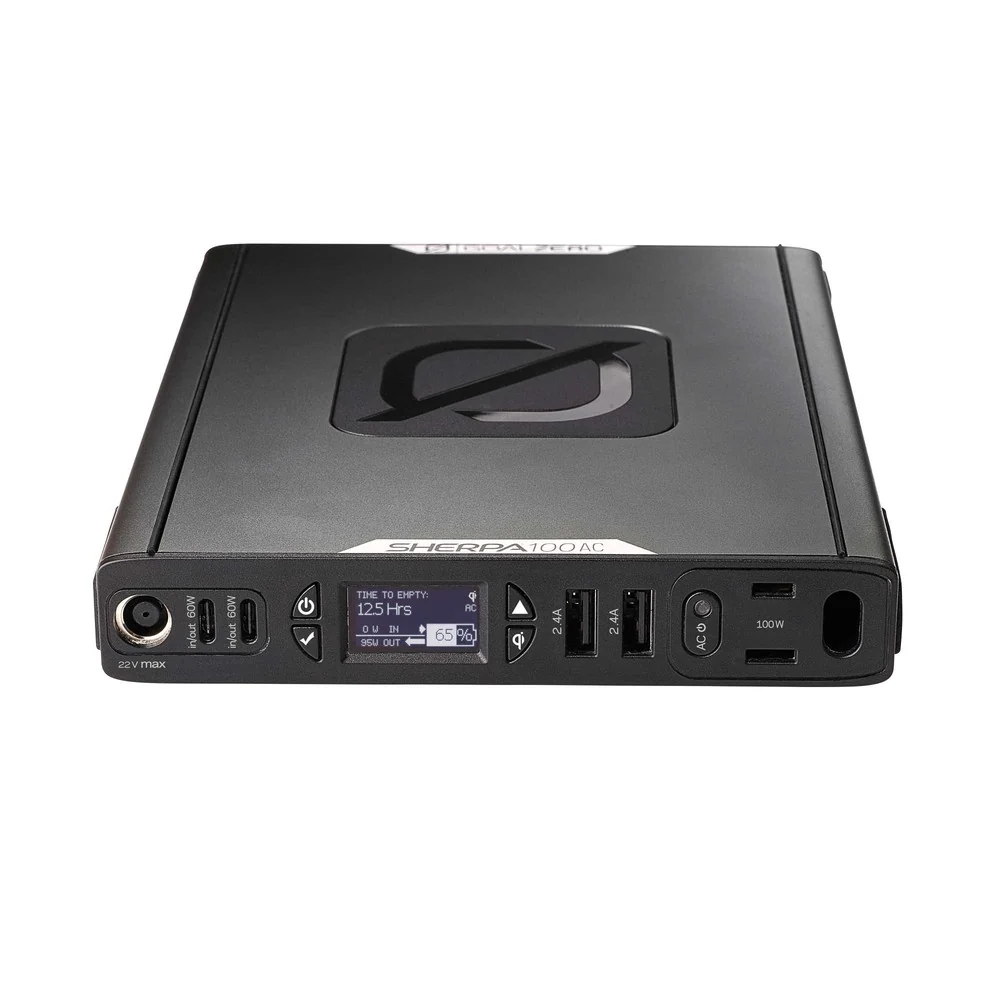
The Sherpa 100AC asks $299 for 94.7 watt-hours of battery. Sit that number next to almost anything else with a lithium cell inside and the sticker gets hard to defend. What you are paying for is not capacity. It is a small, carefully built travel charger: a 2.0-pound aluminum slab with a pure sine wave AC outlet, USB-C Power Delivery, a couple of USB-A ports, and a wireless charging pad molded into the top.
Call it what it is and it makes sense. Call it a "power solution" and you will be disappointed within a day. The Sherpa 100AC will not run a fridge. It will not keep the lights on during an outage. Its 100-watt inverter cannot even spin up a compressor, because the surge draw of a fridge motor is several times that ceiling. This is a charger for phones, tablets, cameras, and thin-and-light laptops — nothing with a heating element or a motor.
There is one genuinely useful thing the marketing around this unit tends to bury: at 94.7Wh it slips under the 100Wh limit that airlines set for lithium batteries in carry-on luggage. That single fact is the strongest reason to consider it. If you fly often and want mains-quality AC power in a departure lounge or an airplane seat, that matters. If you never fly, most of the premium here simply evaporates, and cheaper packs do the same job.
Design and Build
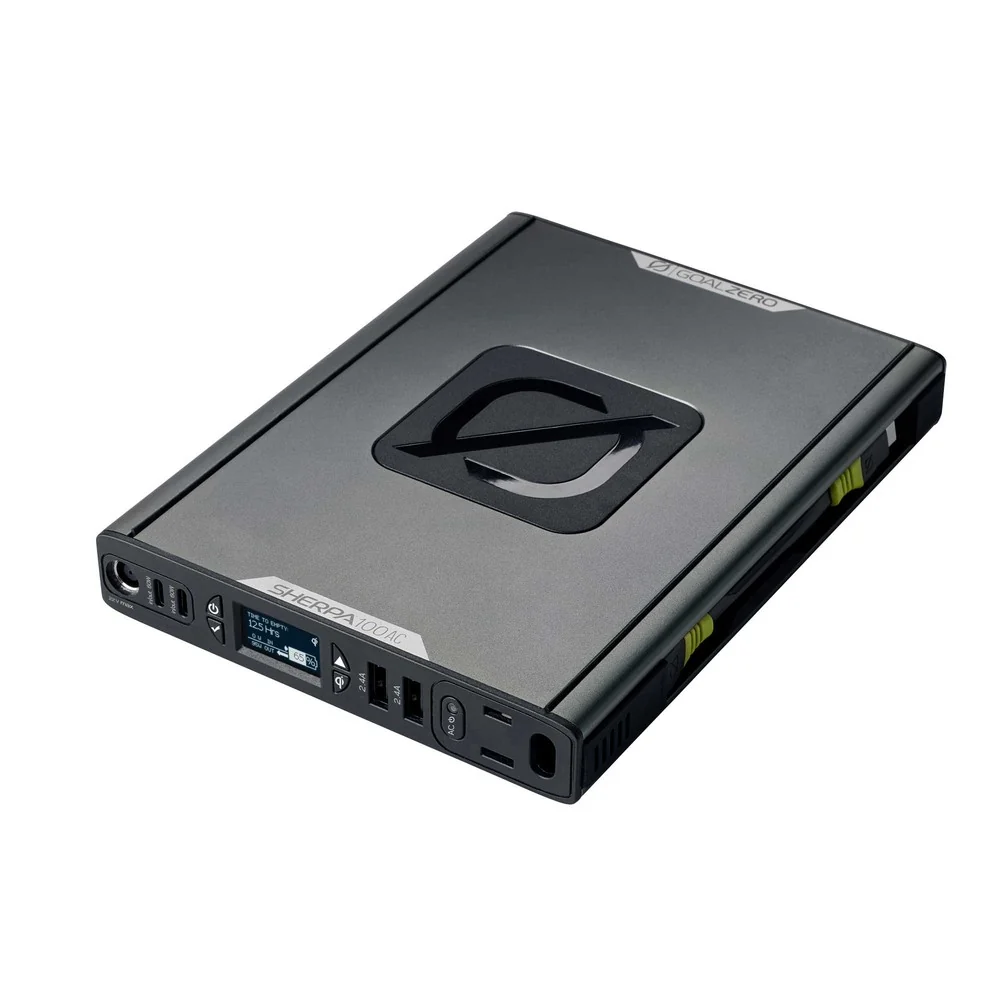
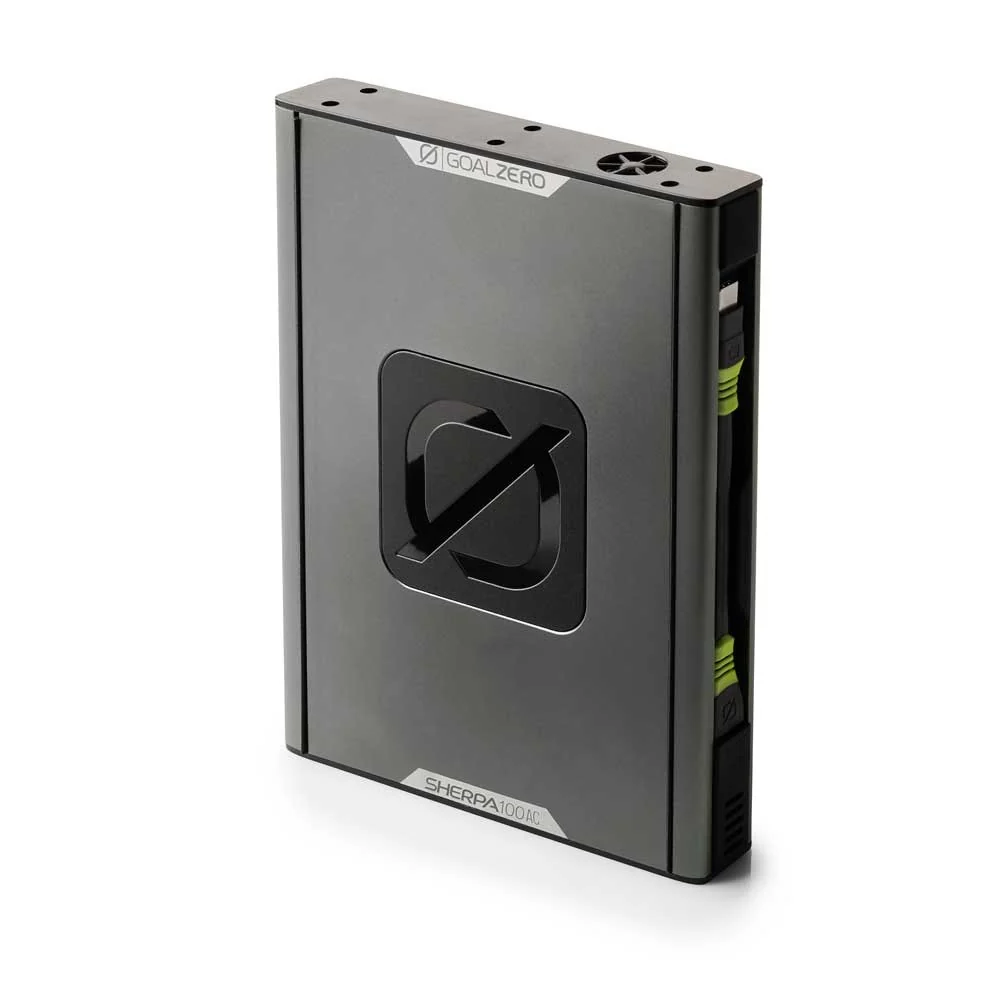
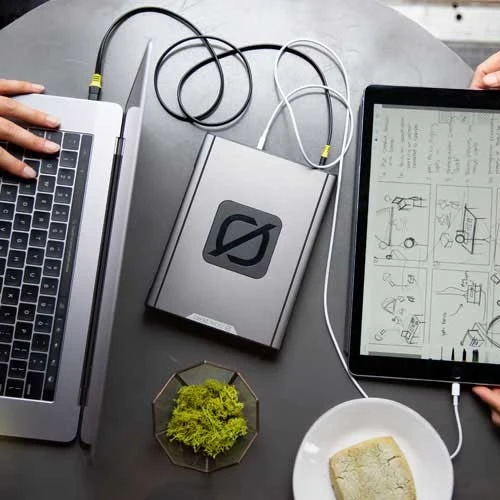
Goal Zero builds solid hardware, and the Sherpa 100AC is no exception. The chassis is anodized aluminum over a soft-touch base, and at 2.0 pounds it drops into a jacket pocket or the top pouch of a daypack without weighing you down. The front carries a small monochrome display that reports charge percentage and live input and output wattage — more feedback than the pile-of-cables approach most travelers default to.
Goal Zero (Manufacturer product image)
The port layout is the entire reason to buy this thing. You get one AC outlet fed by a pure sine wave inverter rated to 100 watts, USB-C Power Delivery for laptops and quick phone charging, USB-A for older accessories, and the Qi pad on top for a phone or an earbuds case with no cable at all. Pure sine wave output deserves a callout: budget inverters emit a blocky, "modified" waveform that some laptop bricks, camera chargers, and finicky adapters dislike, and Goal Zero avoids that here. Devices see power that looks like the wall.
The tradeoff is density. Anker and EcoFlow have shifted to lithium iron phosphate cells and stronger inverters in packs this size, and they simply get more done per dollar. The Sherpa's older lithium-ion chemistry and 100-watt cap mean you are paying for fit, finish, and brand rather than headroom. Nothing here feels cheap; it just does not feel generous, either.
What It Actually Powers
Here is the honest arithmetic, because the number on the box is the whole story with a pack this small. Start with 94.7Wh. Push it through an inverter that runs at roughly 85 percent efficiency and you are left with about 80Wh at the AC outlet. That figure is the ceiling on everything below it.
Goal Zero (Manufacturer product image)
Charging a phone: a current handset battery holds somewhere between 12 and 19 watt-hours. After conversion losses, plan on five to six full charges from empty. That is a long weekend of top-ups for one person, or a single busy day shared across a couple of devices.
Topping up a laptop: a thin ultrabook battery runs around 50Wh. The Sherpa can refill it roughly one and a half times over USB-C before it is done. Plug a 60-watt laptop into the AC outlet and actually draw the full 60 watts and you get a little over an hour of runtime — but most ultrabooks average well below their peak, so a real writing-and-browsing session stretches noticeably longer than that worst case.
Camera work: a mirrorless battery holds around 16Wh, so a photographer can expect four to five recharges, which is a genuine day in the field with margin to spare. Drone batteries and cine rigs pull far more and will drain the Sherpa quickly.
What it flatly cannot do is anything with a motor or a heating element. No kettle, no hair dryer, no coffee maker, no refrigerator, no space heater. The 100-watt limit stops all of those before they start, and no setting or firmware update changes that.
Charging and Living With It
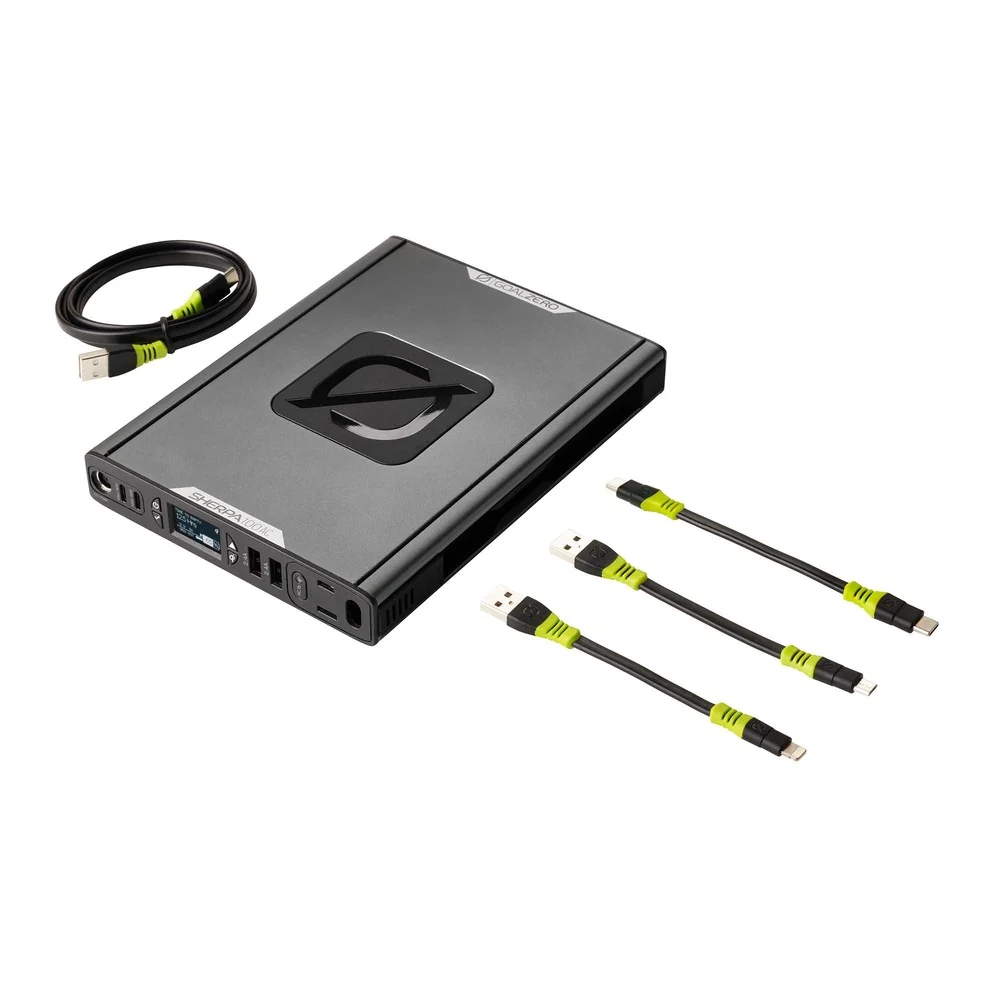
The Sherpa refills from a standard wall outlet in a few hours, and it accepts solar and 12-volt car input through Goal Zero's accessories if you want to top it up off-grid. Pass-through works, so you can charge the unit and a phone at the same time from one wall socket, which is handy on a nightstand or a hotel desk. The display makes it easy to see whether your wall charger is delivering fast input or merely trickling in a few watts. From a standard wall outlet, a full refill takes a few hours; from a compatible solar panel it depends entirely on sun and panel size, so treat solar as a slow top-up rather than a primary source.
Goal Zero (Manufacturer product image)
In daily use, the appeal is that it disappears into a bag and then quietly does its job. The Qi pad is convenient for a nightly phone charge without hunting for a cable. The 2.0-pound weight is noticeable in a jacket but trivial in a backpack. This is a companion object, not a piece of gear you plan a trip around. It rides in the same bag as your laptop and does not change how you pack. Noise is a non-issue, since a 100-watt inverter runs cool enough to skip a fan under most loads. And because the whole pack weighs just 2.0 pounds, you are never deciding whether it is worth bringing.
How It Stacks Up
At $299, the Sherpa 100AC competes with things that are either cheaper, larger, or both. EcoFlow's River 2 offers far more capacity and a much stronger inverter for roughly the same money, but it is heavier and will not clear the 100Wh airline limit. Jackery's smallest Explorer models undercut the Sherpa on price while matching or beating its capacity, again at the cost of flight legality. Anker's own USB power banks handle the phone-and-laptop job for a fraction of the price, with the obvious catch that none of them include an AC outlet.
Goal Zero (Manufacturer product image)
That is the real competitive frame. The Sherpa is not winning on watt-hours per dollar, where it loses badly to every name above. It wins, if at all, on a narrow overlap: pure sine wave AC, wireless charging, premium build, and under-100Wh capacity in one small object. If you specifically need mains AC on a plane, the list of true rivals is short. If you don't, the Sherpa becomes one of the most expensive ways to charge a phone on the market.
Who Should Buy It — and Who Should Skip
Buy the Sherpa 100AC if you are a frequent flyer, a traveling photographer, or someone who lives out of a carry-on and occasionally needs a real wall outlet for a device that refuses to charge over USB. The flight-legal 94.7Wh capacity, the clean AC waveform, and the pocketable 2.0-pound weight form a coherent package for that specific person.
Skip it if you want backup power for your home, if you camp with anything more demanding than phones and a laptop, or if you simply want the most charging capacity for your $299. In each of those cases a larger station or a plain USB power bank serves you far better. Anyone picturing this unit keeping a fridge cold or running gear through a blackout is shopping in the wrong aisle.
Verdict
The Sherpa 100AC is a well-made, honestly small charger wearing a price tag that only makes sense for one kind of buyer. Its 100-watt AC outlet and pure sine wave inverter are genuinely useful for laptops and camera gear, and its sub-100Wh capacity is the rare spec that helps rather than hurts, because it keeps the pack in your carry-on. But 94.7Wh for $299 is a steep price per watt-hour, and the instant your needs grow past personal electronics, this becomes the wrong tool. Buy it for the airplane and the camera bag. Buy something larger for everything else.
Frequently Asked Questions
Can I take the Sherpa 100AC on a plane?
Yes. At 94.7Wh it sits under the 100Wh limit airlines apply to lithium batteries carried into the cabin, so you can bring it aboard without special approval. It must travel in your carry-on, never in checked luggage. Rules vary slightly by carrier, so confirm with your airline, but 94.7Wh is comfortably inside the standard allowance.
Will it run a refrigerator or keep essentials going during an outage?
No. The 100-watt inverter is far too small to start a fridge compressor, which surges to several hundred watts, and 94.7Wh would be gone in under an hour even if it could. Treat this strictly as a device charger, not as home backup.
How many times will it charge my phone?
Roughly five to six full charges from empty, depending on your phone's battery size and charging losses. Larger phones land at the lower end of that range, compact ones at the higher end.
Can it charge a laptop while I work?
Yes, through the USB-C Power Delivery port or the AC outlet, as long as the laptop draws 100 watts or less. Expect a bit over an hour for a laptop pulling a full 60 watts, and considerably more for an efficient ultrabook that averages below its peak.
Is the AC outlet a pure sine wave?
Yes. That matters for sensitive chargers and adapters that stumble on cheaper modified-sine inverters, and it is one of the few features that helps justify the price.
What is the battery chemistry, and how long will it last?
It uses standard lithium-ion cells rather than the longer-cycle lithium iron phosphate found in newer stations. Expect a few hundred full charge cycles before capacity noticeably fades — fine for occasional travel, less ideal if you intend to cycle it every day for years.
Are there hidden costs after buying it?
Very few. It recharges from a normal wall outlet, and optional solar or 12-volt car charging uses accessories you can add later. There are no subscriptions and no consumables. The real "cost" is the price itself measured against 94.7Wh.
Should I buy this or a plain USB power bank?
If you never need a wall outlet, a USB power bank handles the phone-and-laptop job for far less money. Choose the Sherpa only when you specifically need a genuine AC socket in a flight-legal shell.
Is $299 a fair price?
For the raw capacity, no — the premium per watt-hour is high. For the specific bundle of pure sine wave AC, wireless charging, premium build, and under-100Wh flight legality, it is defensible for frequent travelers. Everyone else should spend less elsewhere.