
First Look
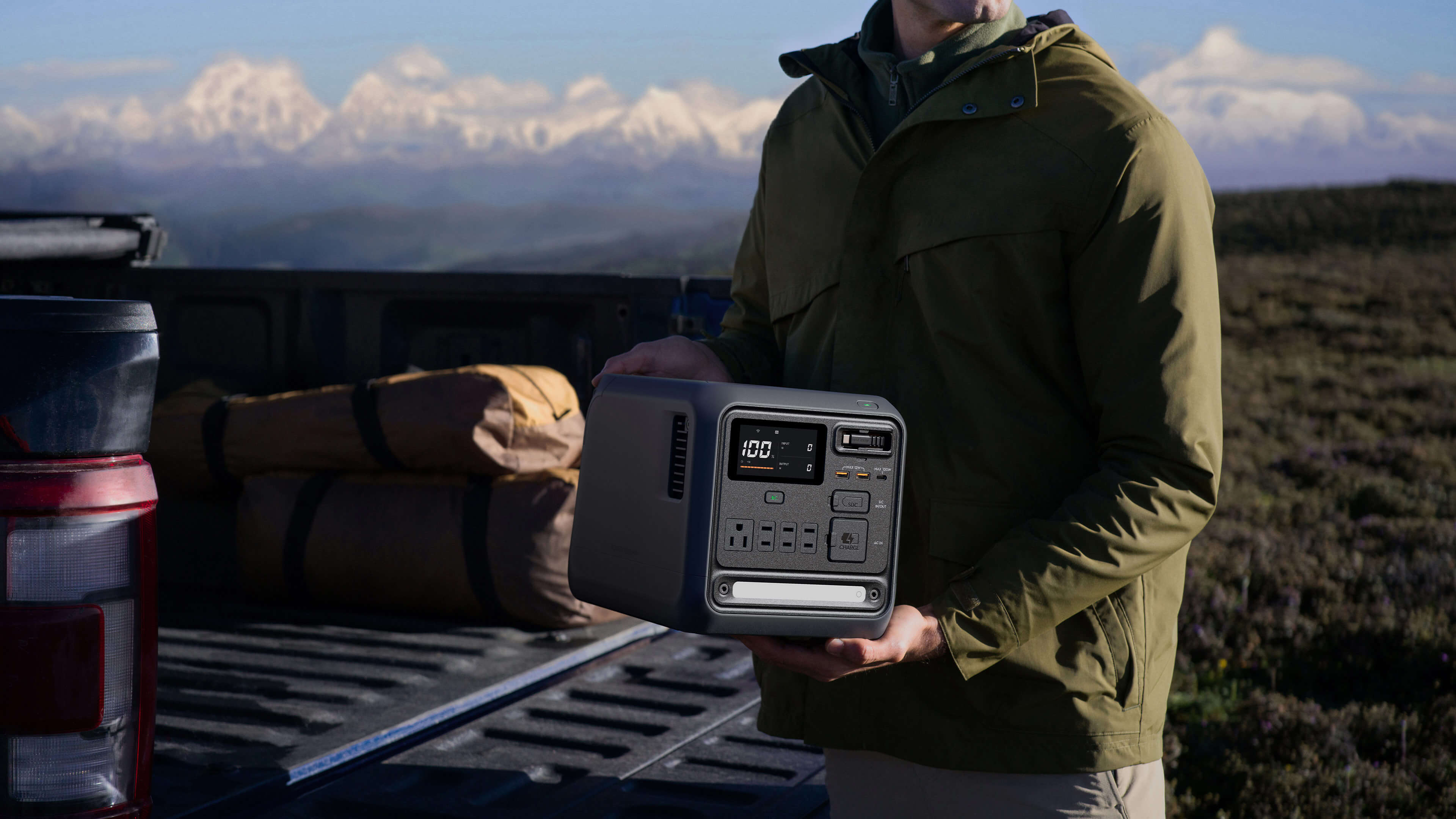
The Power 1000 Mini is the unit DJI should probably have led with. Where the Power
2000 is a 48-pound expandable slab and the original Power 1000 leaned on quiet
operation, the Mini is unapologetically a travel battery: 1,008 watt-hours of
lithium iron phosphate in a box that weighs 25.4 pounds and measures 314 by 212
by 216 millimetres. Pick it up and the pitch is obvious. This is the DJI Power you
throw in a car, a camper or a hard case and forget about until the drone batteries
run low.
DJI (Manufacturer product image)
And that, once again, is the whole story. The Mini keeps the one feature that makes
a DJI power station a DJI power station — an SDC port that fast-charges the
company's own drone batteries — and shrinks everything else around it. For a pilot
who owns a Mavic or an Air and travels light, that single port reframes the
purchase. For anyone else, the Mini has to compete as a plain 1kWh station, and on
that battlefield DJI has made one decision that undercuts the rest of the design.
That decision is the inverter. DJI rates AC output at 800 watts continuous, with a
1,000-watt ceiling and 1,440 watts available only in bypass when the unit is
plugged into the wall. Every mainstream 1kWh rival runs an 1,800-watt inverter or
larger. So the Mini stores a full kilowatt-hour of energy but can only pour it out
through a comparatively narrow spout — a mismatch that shapes who should and should
not buy it.
Design and Hardware
Physically the Mini is the most likeable object DJI has made in this line. The
proportions are close to a cube, the mass is genuinely one-hand carryable, and the
grey-on-grey styling reads as a piece of gear rather than an appliance. At 25.4
pounds it sits within a pound of the lightest 1kWh units on the market, and the
compact footprint means it takes up less bench or trunk space than its capacity
suggests.
DJI (Manufacturer product image)
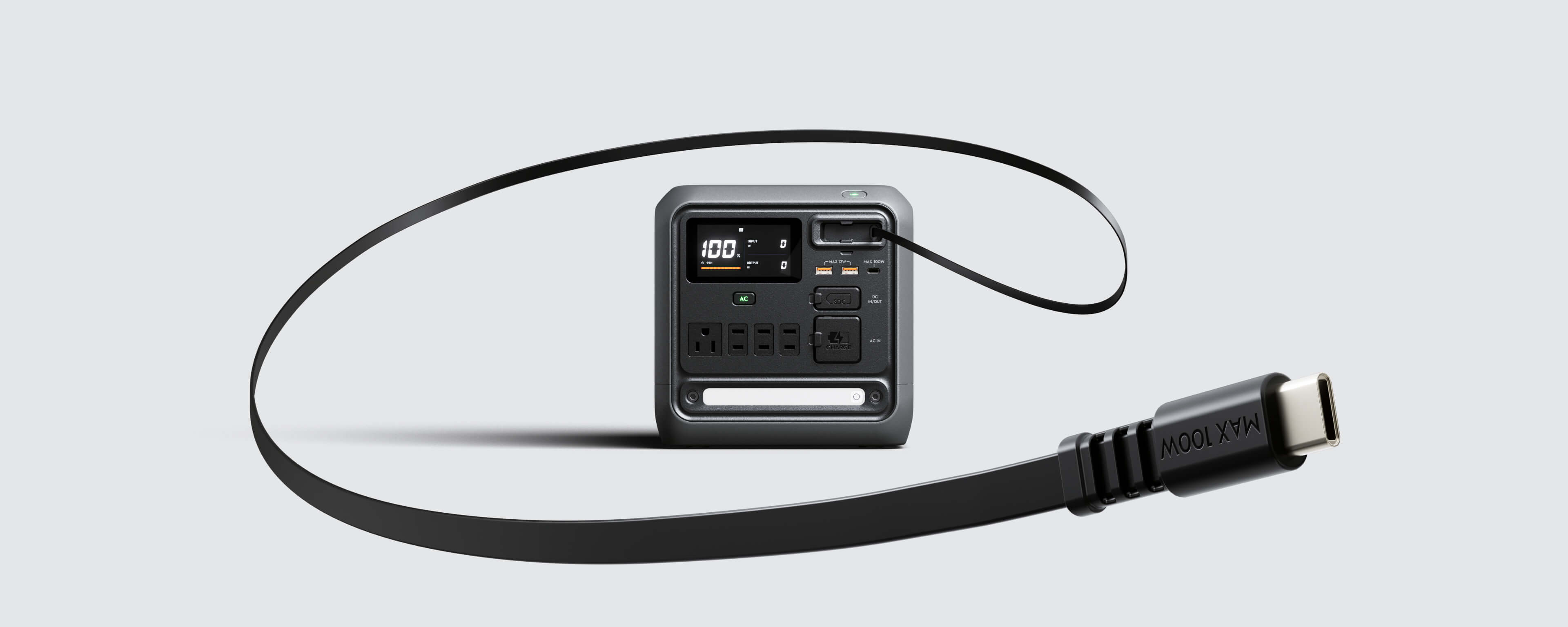
Two design touches stand out because rivals rarely bother with them. The first is a
retractable USB-C cable built into the chassis, rated to deliver up to 100 watts on
its own. It is the sort of detail that sounds trivial until you are in a field with
one fewer cable to lose, and DJI even makes the cable module user-replaceable by
prying open a cover and releasing the side clips. The second is a bar-shaped LED
light along the front: a single press toggles it, a double press triggers an SOS
pattern, and a long press cycles brightness. The original Power 1000 shipped
without any light at all, so this is a pointed correction.
Port provision is sensible for the size. US and Japanese units get four AC
outputs; other regions get two, because the physically larger local plug standards
leave less panel room. Alongside those sit one 100-watt USB-C port, the retractable
cable, two USB-A ports and a single SDC connector. Use the fixed USB-C port and the
retractable cable together and the pair share a 150-watt budget — 100 watts to the
cable, 50 watts to the port — rather than delivering 100 watts each at once. It is a
reasonable compromise, but worth knowing before you plan a two-laptop charge.
The USB-A story is where the small size shows its teeth. Each of the two USB-A
ports maxes out at 12 watts. That is fine for a phone on a slow overnight top-up and
frankly poor for a modern tablet, which will charge at a crawl. If your device fleet
leans on USB-A, the Mini expects you to move to its USB-C provision instead.
The SDC Port and Drone Charging
The SDC connector is the reason this product exists, and it is the reason a pilot
would pick it over a cheaper rival. SDC is DJI's proprietary fast-charge standard,
and on the Mini the single port is rated for 9 to 28 volts at up to 300 watts on
output. Paired with the matching drone cable, it charges intelligent flight
batteries far quicker than routing them through the aircraft's normal USB-C brick.
DJI lists an unusually broad set of supported aircraft: the Matrice 4 Series, the
Mavic 3 Series, the Mavic 4 Pro, the Air 3 Series, the Matrice 30 Series and the
Inspire 3. That range spans hobbyist folding drones up to enterprise machines, which
is a wider net than the smaller Power 500 casts. Two honest caveats apply, though.
There is only one SDC port, so you charge one battery at a time rather than
cycling a whole set in parallel. And the fast-charge cables are accessories sold
separately — the Mini ships ready to charge DJI drones, but not with the lead that
actually does it. DJI also notes that the final five percent of a drone battery is
delivered by slow trickle charging, so a pilot in a hurry can pull the pack at 95
percent and lose almost no flight time.
That same SDC port doubles as the Mini's charging inlet, which keeps the design
tidy. It accepts up to 400 watts of solar through DJI's MC4 cable and the built-in
MPPT controller, up to 400 watts of fast car-battery charging, or 120 to 240 watts
from a 12-volt or 24-volt vehicle outlet depending on the socket. One connector,
many jobs.
Performance and Charging
Start with the inverter, because it defines the ceiling on everything else. At 800
watts continuous the Mini runs a laptop, a monitor, a camera-charging rig, a small
fridge or a string of lights without complaint. What it will not run is the
higher-draw kit that a 1kWh battery might tempt you toward: a 1,000-watt microwave,
a 1,500-watt kettle or space heater, a hair dryer, most toasters. The 1,000-watt
maximum and the 1,440-watt bypass figure soften that slightly when the unit is
plugged in, but on battery alone this is an 800-watt device, and DJI publishes no
separate surge number to reassure you about motor start-up spikes. For a company
selling a full kilowatt-hour of storage, choosing such a modest inverter is a real
limitation, not a rounding error.
DJI (Manufacturer product image)
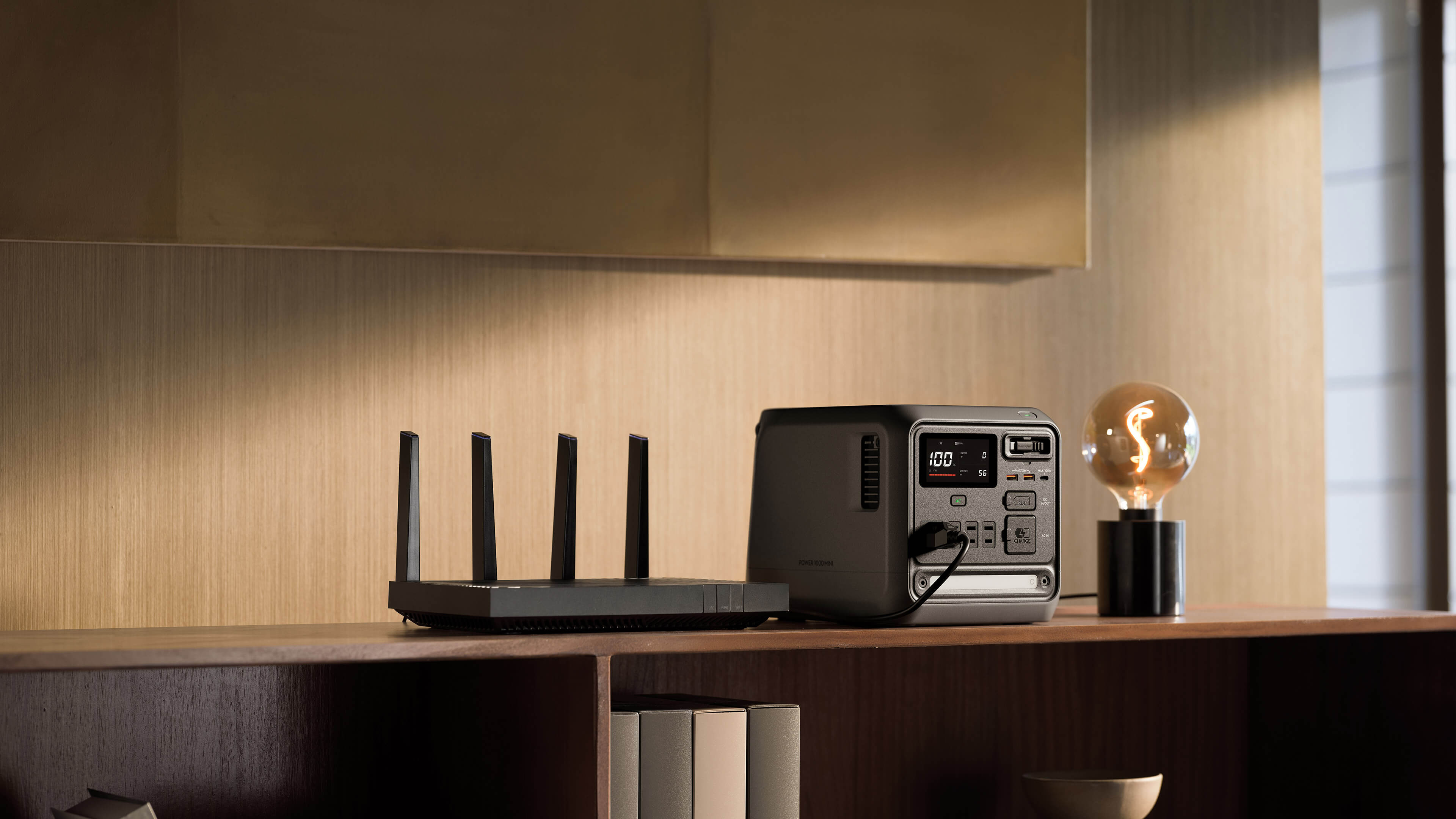
Where the Mini is genuinely strong is uninterruptible power. DJI's documentation
puts the UPS switchover at 0.01 seconds — 10 milliseconds — which is quick enough
that a desktop, a home router, a NAS or a CPAP machine rides straight through a grid
cut without rebooting. For a work-from-home desk or a medical device on the
nightstand, that 10-millisecond figure is worth more than a couple of hundred extra
watt-hours would be, and it matches the switchover DJI quotes on the much pricier
Power 2000.
Charging inputs are flexible. The AC inlet mirrors the output, drawing up to 1,000
watts from the wall, and both the AC and SDC car-charging rates can be throttled in
the DJI Home app if you would rather trade speed for a gentler charge. DJI does not
print a headline 0-to-100 percent recharge time in its spec table, so rather than
invent one, note the arithmetic: a roughly 1,008Wh pack fed at close to 1,000 watts
implies something near an hour of wall charging, before the usual slow-down over the
final stretch of a lithium charge. Treat that as a ceiling, not a promise.
Solar is a quiet win, and a pointed contrast with DJI's own larger unit. The Mini
publishes a clear 400-watt maximum solar input through its SDC inlet, so you can
size a panel array against a real number. The Power 2000, oddly, never states a
solar ceiling at all — so on this one metric the cheaper Mini is the
better-documented product. Four hundred watts is not fast for a kilowatt-hour pack,
implying most of a good day to refill from empty, but it is honest and it is
buildable.
Longevity is reassuring. DJI rates the LFP pack to keep more than 80 percent of its
capacity after 4,000 charge cycles under its stated 25°C, 400-watt test conditions,
and backs the unit with a default five-year warranty. The one asterisk: the
retractable cable module is explicitly excluded from that five-year coverage, so the
part most likely to see mechanical wear is also the part with the shortest
guarantee.
Expandability and Software
Here the Mini draws a hard line. It cannot take an expansion battery — DJI states
plainly that it does not work with the Power Expansion Battery 2000 — and it is not
compatible with DJI's 1kW super-fast car charger or the 1.8kW solar-and-car
super-fast charger either. What you buy is the entire system. That is a coherent
choice for a travel unit, but it means the Mini can never grow into a larger backup,
and buyers who suspect their needs will expand should look at a modular platform
instead.
DJI (Manufacturer product image)
On the software side the Mini carries Wi-Fi on 802.11 b/g/n and Bluetooth 5.0, and
connects to the DJI Home app for remote monitoring, firmware updates and charge-rate
control. It needs no separate dongle, since the wireless radio is built in. The app
is competent rather than clever, but it does the jobs that matter: watching state of
charge from across a campsite and dialling the input rate up or down.
Competitive Comparison
vs. Bluetti Elite 100 V2 ($499, 1,024Wh). The Bluetti is the Mini's harshest
critic. For a firm price it offers essentially the same capacity, an 1,800-watt
inverter with a 3,600-watt surge, up to 1,000 watts of solar, a claimed 45-minute
charge to 80 percent, a 10-millisecond switchover and the same five-year warranty —
at 25.3 pounds. On raw power-station merit it out-specs the Mini in every column
that does not involve a drone. The DJI's only reply is the SDC port.
vs. EcoFlow DELTA 3 ($629, 1,024Wh). EcoFlow pairs 1,024Wh with an 1,800-watt
inverter, a 3,600-watt X-Boost mode, a 4,000-cycle pack and app-driven home
integration, at 24.7 pounds. It is more powerful, similarly portable and still
cheaper than most DJI pricing. Unless you fly DJI aircraft, the DELTA 3 is the more
capable everyday unit.
vs. Anker SOLIX C1000 ($1,099, 1,056Wh). The Anker brings an 1,800-watt
inverter with a 2,400-watt surge and a HyperFlash charge that hits 80 percent in
about 43 minutes, though at 28.6 pounds it is heavier than the DJI. It is the fast-
charging, higher-output alternative for a buyer who wants a workhorse rather than a
drone accessory.
vs. Jackery Explorer 1000 v2 ($1,099, 1,070Wh). The Jackery undercuts the Mini
on weight at 23.8 pounds and offers a 1,500-watt inverter with a 3,000-watt surge,
but its 200-watt solar input is meagre. It is a lighter, simpler self-contained unit
with no ecosystem hook. Against it, the Mini wins on solar headroom and, of course,
on drone charging, and loses on inverter muscle.
Who Should Buy It
Buy the Power 1000 Mini if you fly DJI drones and value a small kit. The SDC port
turns it into a portable field charger for your Mavic, Air, Inspire or Matrice
batteries, and at 25.4 pounds with a retractable cable and a built-in light, it is
the DJI Power unit most at home in a car boot or a camera case. For that buyer the
modest inverter barely matters, because the loads are laptops, monitors and
batteries, not kettles.
It also suits a light-duty backup role. A 10-millisecond UPS switchover, a
4,000-cycle pack and a five-year warranty make it a tidy sentinel for a home-office
desk, a router cabinet or a CPAP machine, and the 400-watt solar input means you can
keep it topped up off-grid on a sunny day.
Look elsewhere if you want a 1kWh unit that behaves like one. The 800-watt
continuous inverter cannot drive the microwaves, heaters and kettles that rivals
handle easily, the fixed capacity rules out ever growing the system, and — outside
the drone ecosystem — the Bluetti Elite 100 V2 and EcoFlow DELTA 3 deliver more
power for less money. If you do not own a DJI aircraft, you are paying for a port you
will never plug in.
Final Verdict
The DJI Power 1000 Mini is the most charming unit in DJI's power range and, on
paper, the most compromised. As a drone pilot's travel battery it is close to ideal:
light, tidily designed, with a single SDC port that fast-charges a genuinely wide
list of DJI aircraft, a clear 400-watt solar ceiling, and a 10-millisecond UPS mode
that the rest of the household can lean on. The retractable cable and the LED bar
show DJI actually listening to how these units get used in the field.
But the 800-watt continuous inverter is a self-inflicted wound. It turns a full
kilowatt-hour of storage into a device that politely refuses most high-draw
appliances, and there is no surge rating and no expansion path to soften the news.
Against the Bluetti Elite 100 V2 and the EcoFlow DELTA 3 — both cheaper, both with
more than double the continuous output — the Mini's general-purpose case is thin.
So the recommendation is narrow but sincere. If you fly DJI and want the smallest,
lightest way to keep your batteries fed in the field, buy it and enjoy a feature
nobody else sells. If you just want a 1kWh station that can run a microwave, keep
walking — the field is full of stronger, cheaper answers.
Frequently Asked Questions
What can the 800W inverter actually run?
CPAP machine, a small fridge. Not: a 1,000W microwave, a 1,500W kettle or space
heater, a hair dryer, most toasters. The unit reaches 1,000W as a brief maximum and
1,440W only in bypass while plugged into the wall, and DJI publishes no separate
surge rating, so plan around 800W continuous on battery.
What is the SDC port for, and does it need extra cables?
3 Series, Mavic 4 Pro, Air 3 Series, Matrice 30 Series and Inspire 3. It is rated 9
to 28 volts at up to 300 watts. The matching fast-charge cable for each drone is sold
separately, so the Mini is ready to charge those aircraft but does not include the
lead that does it.
Can I charge more than one drone battery at once?
to cycle a large battery set quickly in the field, that single port is a genuine
constraint, and a larger DJI unit with two SDC ports would suit you better.
How do I recharge the Mini itself?
400 watts using DJI's MC4 cable and built-in MPPT, from a car battery at up to 400
watts, or from a 12-volt or 24-volt vehicle outlet at 120 or 240 watts. Both the AC
and SDC car-charging rates are adjustable in the DJI Home app.
How long does a full wall recharge take?
roughly 1,008Wh pack at close to its 1,000-watt AC maximum works out near an hour in
theory, before the normal slow-down over the last stretch of the charge. Treat that
as an estimate rather than a DJI figure.
Will it keep my computer or CPAP running during a power cut?
fast enough that a desktop, router, NAS or CPAP machine keeps running through a grid
interruption without rebooting.
Can I add a second battery later to increase capacity?
Power Expansion Battery 2000. Its 1,008Wh is fixed for the life of the product, so
buy the capacity you need up front.
How much solar can it take, and how fast is that?
clearly published ceiling — better documented than DJI's larger Power 2000, which
states none — but 400 watts is modest for a kilowatt-hour pack and implies most of a
sunny day to refill from empty.
How long will the battery last, and what does the warranty cover?
cycles under its stated test conditions, and the unit carries a default five-year
warranty. Note that the retractable USB-C cable module is excluded from that
five-year coverage.
Is it worth it if I do not own a DJI drone?
with an 800-watt inverter. The Bluetti Elite 100 V2 and EcoFlow DELTA 3 both offer
far more continuous output for less money, so the DJI mainly makes sense inside its
own drone ecosystem.