Introduction
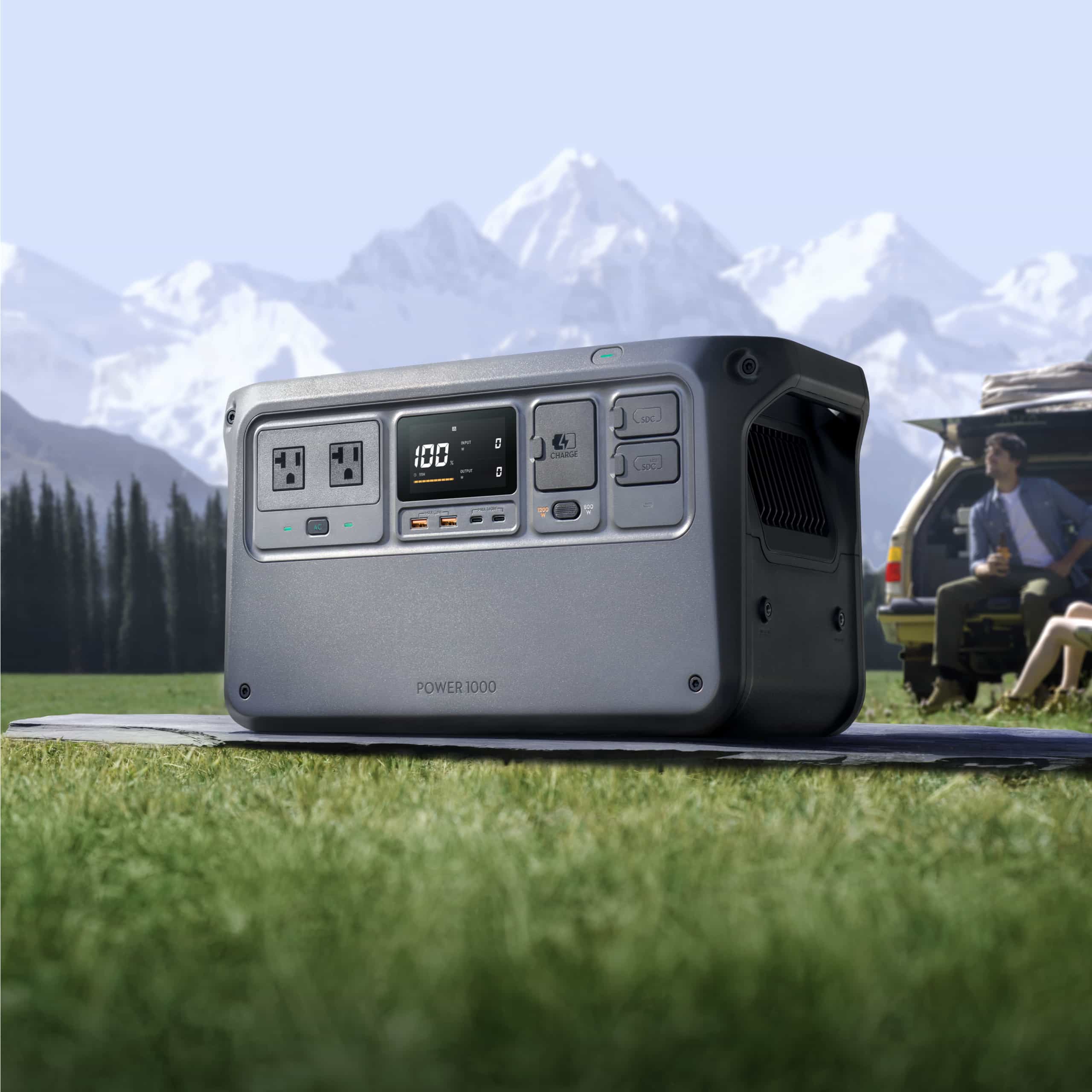
DJI — best known for dominating the drone and camera stabilizer markets — surprised the industry in 2024 by launching its first portable power station.
The DJI Power 1000 brings the company's hallmarks of premium industrial design, intuitive operation, and creator-focused features to a market segment long dominated by EcoFlow, Anker, and Bluetti.
DJI's target buyer is clear: photographers and videographers who work on location, need to power cameras, laptops, lights, and audio equipment simultaneously, and cannot tolerate a noisy power station ruining ambient sound recordings.
The result is a genuinely impressive 1,024Wh unit that excels in the areas DJI knows best: quiet operation, beautiful hardware, and seamless integration with a creative professional workflow.
It isn't perfect — efficiency and solar input lag behind rivals, and the outlet count is genuinely limiting.
But at sale pricing ($699–$799), it's a compelling buy for content creators, campers who value silence, and anyone who appreciates DJI's commitment to industrial design.
At full MSRP of $999, the value case weakens when the Anker SOLIX C2000 Gen 2 offers double the capacity at $799.
Unboxing & First Impressions
Cracking open the box, it's immediately obvious this is a DJI product.
DJI (Manufacturer product image)
DJI (Manufacturer product image)
The build quality is exceptional — every surface feels precise, the display is crisp, and the included carrying case signals a premium ownership experience most power station brands don't match.
Most competitors at this capacity ship with no case; DJI includes a fitted case that protects the unit during transport.
At 28 lbs, it's lighter than most 1kWh competitors.
The Anker SOLIX C1000 (1,056Wh) weighs 25 lbs; the EcoFlow Delta 3 Plus (1,024Wh) weighs 30.8 lbs.
The DJI is competitive on weight without sacrificing build quality.
The handle placement makes it genuinely easy to carry single-handed for short distances.
The DJI Power app connects within 30 seconds and provides more detailed monitoring including historical usage graphs and per-port output tracking — useful for a creator managing battery life across a shoot day.
Key Features
Whisper-Quiet Operation: The Defining Feature
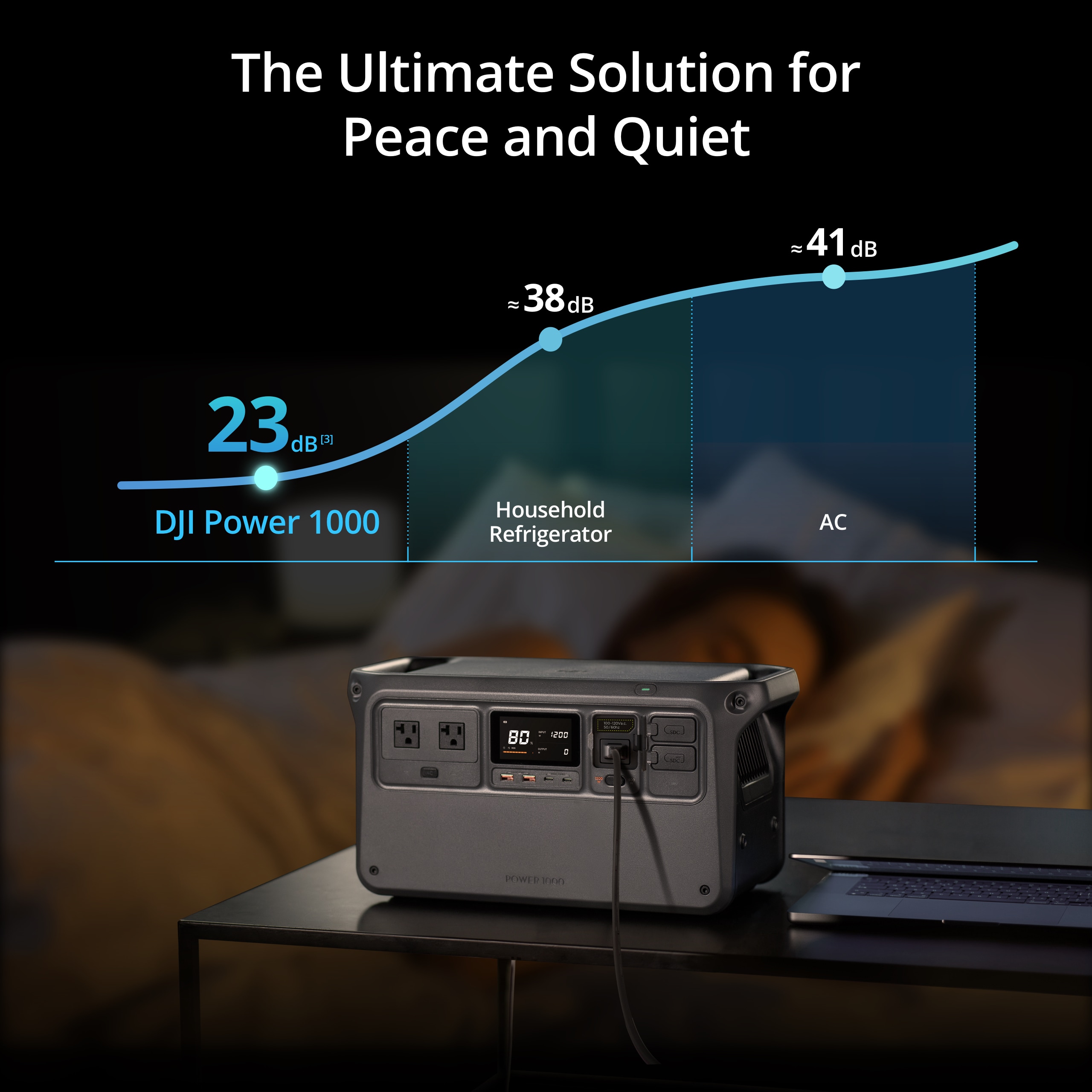
The DJI Power 1000's most important feature for its target audience is how quietly it operates.

DJI (Manufacturer product image)
The cooling fan spins slowly enough under typical loads to be effectively inaudible in most environments.
Rivals at this capacity class produce 35–45dB of fan noise under moderate load.
DJI's thermal management keeps the fan below ambient room noise levels under typical use.
For video shoots where ambient noise ruins recordings, this is not a luxury — it's a functional requirement.
No other power station in this capacity range matches the DJI's noise profile.
The silent operation extends to van life and camping use: sleeping next to a running power station in a tent is vastly more comfortable when it operates without fan noise.
2,200W Inverter: Appropriately Sized for Creators
The 2,200W continuous output (4,400W surge) is generous for a 1kWh unit.
Most cameras, monitors, audio equipment, and professional lighting draws well under 500W each.
Running a cinema camera (50W), a monitor (80W), an audio recorder (15W), two lights (400W combined), and a laptop (100W) totals around 645W — well within the inverter envelope with significant headroom.
The 4,400W surge handles startup spikes from power tool startup draws, strobe lights, and similar transient loads.
Dual 140W USB-C PD: Creator-Essential Feature
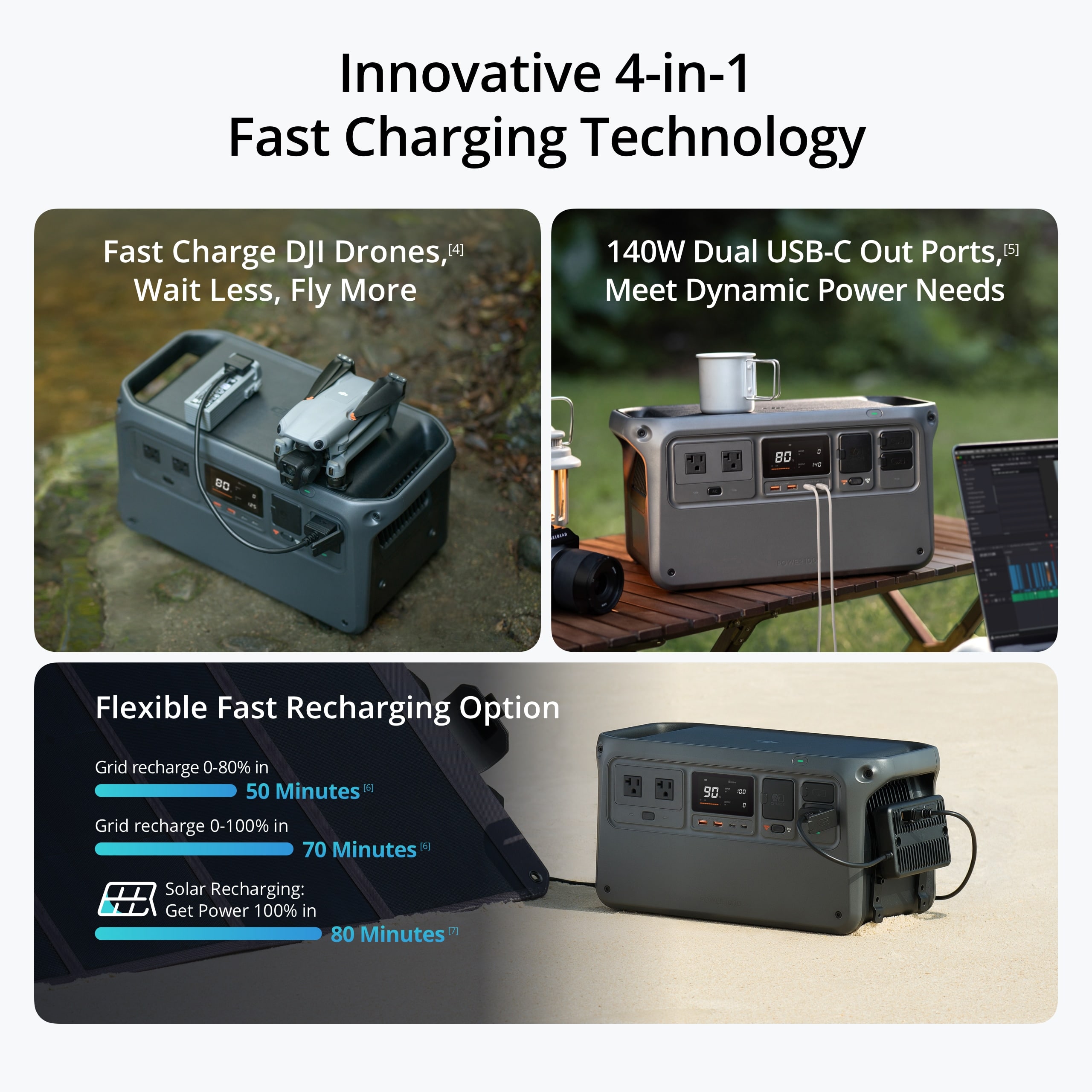
Two 140W USB-C ports are a highlight.
Charging a MacBook Pro (140W) and a mirrorless camera battery bank simultaneously at full speed is genuinely useful for creators in the field.
No battery shuffling, no serial charging, no waiting.
Both devices get maximum charge rates simultaneously.
This USB-C spec exceeds what many competitors offer: the Bluetti Elite 200 V2 caps at 100W per port.
1-Hour AC Recharge
At 1,200W AC input, the DJI Power 1000 reaches full charge in about an hour — on par with the fastest competitors in this capacity range.
For field professionals who arrive at a location with grid access and need to charge quickly before going off-grid, the 1-hour charge is practically useful.
Premium Build and Included Case
DJI's industrial design team treated the Power 1000 as a professional tool rather than a consumer appliance.
The build materials, precision of fit and finish, and included carrying case collectively communicate a product designed to be taken seriously in professional environments.
The carrying case specifically is a meaningful inclusion: it protects the unit during transport to and from shoots and makes it look professional when visible on set.
Performance Testing
Efficiency: The Honest Trade-Off
Real-world efficiency tested at approximately 76% under full load.
DJI (Manufacturer product image)
In practical terms, you'll lose roughly 260Wh to heat on every full cycle — more than EcoFlow's Delta 3 (85–88%) or Anker's SOLIX line (89%).
At 76% efficiency, you get approximately 779Wh of usable energy from the 1,024Wh battery.
Compared to the Jackery Explorer 1500 Ultra at 98% efficiency (which delivers 1,505Wh from a 1,536Wh battery), the DJI delivers significantly less usable energy per charge despite similar stated capacity.
The efficiency drop at full load (76%) is steeper than most competitors, suggesting DJI's inverter was optimized for quiet noise profile rather than maximum conversion efficiency.
For occasional use this barely matters; for daily heavy cycling, it adds up.
AC Charging Inconsistency
The 1-hour AC charge claim is achievable under optimal conditions (stable household voltage, under 75°F ambient temperature).
In practice, real-world testing showed charging times ranging from 58 minutes to 75 minutes depending on conditions.
Hot environments and slightly variable utility voltage extended charge times measurably.
Solar Charging Reality
The 400W solar ceiling means full recharging takes 2.5+ hours under ideal conditions.
Significantly slower than the 800W input on the EcoFlow Delta 3 Plus or the Jackery Explorer 1500 Ultra.
Fine for occasional solar supplementation; frustrating for off-grid power independence on a multi-day location shoot.
AC Outlet Count: A Real Constraint
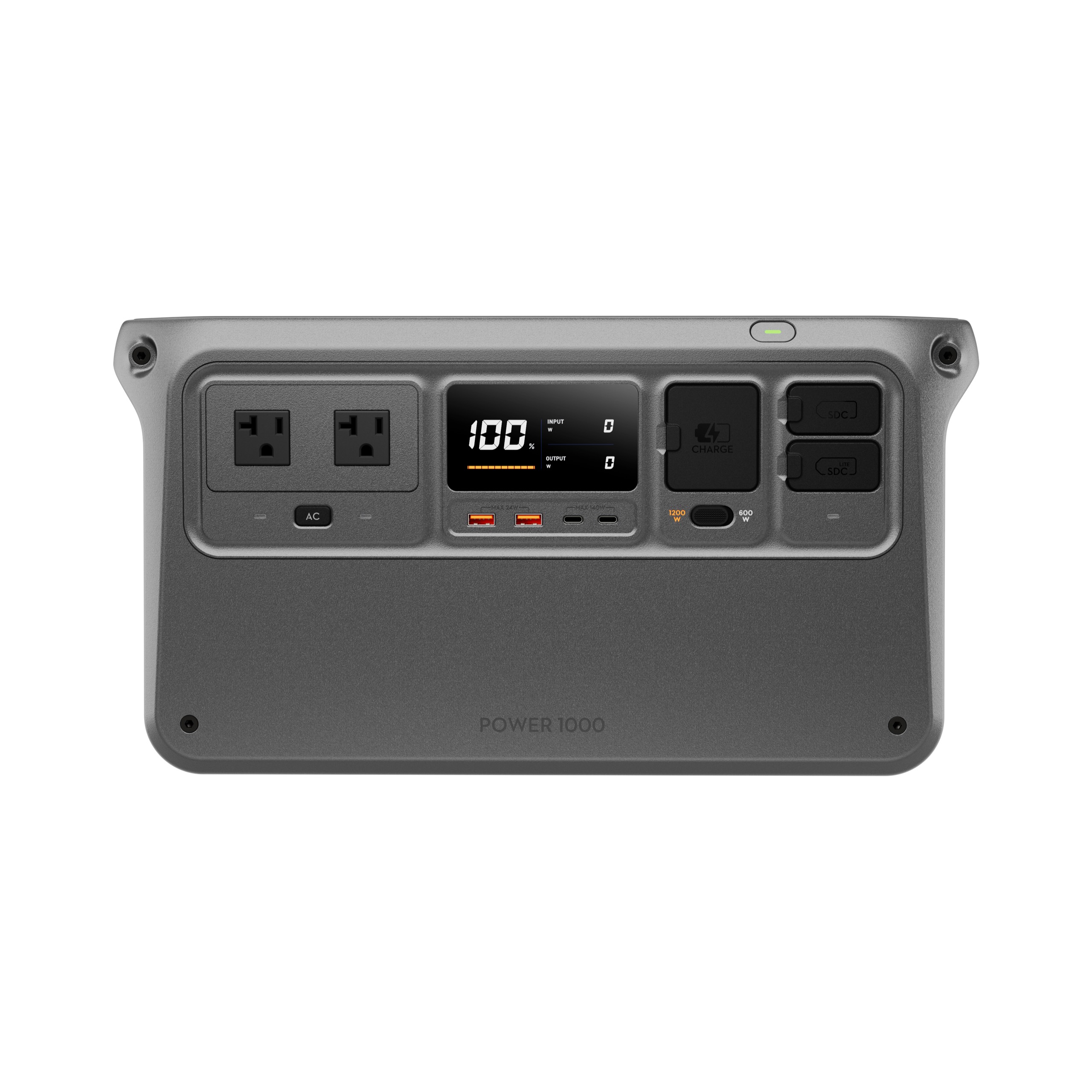
Two AC outlets is the most frequent complaint from reviewers, and it's valid.
If you need to power a monitor (outlet 1), a laptop charger (outlet 2), and a desk lamp simultaneously, you'll reach for a power strip.
Bluetti and EcoFlow typically offer 4–5 outlets at this capacity tier.
On a working set, two AC outlets forces either a power strip or serial device use.
Competitive Analysis
vs. Anker SOLIX C2000 Gen 2 ($799 for 2,048Wh)
At $799 (the DJI's common sale price), Anker offers double the capacity, better efficiency (89% vs 76%), more solar input (800W vs 400W), 5 AC outlets, a 30A RV plug, and the best display in the category.
The DJI wins decisively on noise (silent vs audible) and design quality.
For creators where silence is essential: DJI. For everyone else: Anker.
vs. EcoFlow Delta 3 Plus ($1,099 for 1,024Wh)
EcoFlow has the same capacity with more solar input, 5 AC outlets, UPS functionality, and X-Boost.
DJI wins on quiet operation, included case, and build design.
EcoFlow is the better overall power station; DJI is the better professional-environment tool for audio-sensitive shoots.
vs. Jackery Explorer 1500 Ultra ($899 for 1,536Wh, 98% efficiency)
Jackery has 50% more capacity, dramatically better efficiency (98% vs 76%), IP65 weather resistance, and 800W solar.
DJI wins on quiet operation and creator-specific design.
The Jackery delivers far more usable energy per charge and handles weather.
For field work outside controlled environments: Jackery. For studio and controlled-environment shoots: DJI.
Who It's For
Ideal For:
✅ Content creators needing silent power on video sets, photo studios, and interview locations
✅ Campers and van lifers who value compact, quiet units for overnight use near sleeping areas
✅ Anyone already in the DJI ecosystem who values integrated app management
✅ USB-C heavy workflows — MacBook Pro + camera charging simultaneously at 140W each
Consider Alternatives If:
❌ You need 4+ AC outlets — two is genuinely limiting for multi-device setups
❌ Off-grid solar charging is a priority — 400W is too slow for serious solar dependence
❌ Efficiency and long-term cycling economics matter — 76% is the category's low end
❌ You're comparing at full $999 MSRP — Anker C2000 Gen 2 at $799 offers double the capacity
Final Verdict
The DJI Power 1000 is a well-engineered, beautifully designed power station that earns its place in the market by excelling at silence and creator-friendly features.
The quiet operation is genuinely differentiated — no other 1kWh power station comes close to the DJI's noise profile.
The dual 140W USB-C ports, premium build, and included case target content creators with precision.
The efficiency and outlet count limitations are real.
At sale pricing of $699–$799, the DJI Power 1000 is an easy recommendation for content creators who need silent power.
At full MSRP of $999, compare carefully against the Anker SOLIX C2000 Gen 2 and EcoFlow Delta 3 Plus before committing — both offer significantly more capability for the same or less money, at the cost of more fan noise.
Frequently Asked Questions
Q: How quiet is "whisper-quiet" exactly?
A: Under typical loads (under 500W combined), the DJI Power 1000's fan operates at or below ambient room noise levels — roughly 25–30dB.
A refrigerator compressor runs at approximately 40dB; a quiet conversation is 60dB.
The DJI at typical creator loads is quieter than a running refrigerator and inaudible in many recording situations.
Q: Can the 76% efficiency be improved with usage habits?
A: Partially.
Efficiency improves at lower loads — keeping loads below 500W moves real efficiency toward 79–81%.
The rated 76% reflects the worst-case full-load scenario.
For typical creator loads (400–600W combined), real efficiency is closer to 79–81% — still below class leaders but less extreme.
Q: Does the DJI Power app integrate with DJI drone batteries?
A: No — the DJI Power app monitors the Power 1000 independently and does not currently integrate with DJI drone battery monitoring.
Cross-device battery management from a single dashboard is not currently available.
Q: Is the carrying case protective enough for airline travel?
A: The included case is a padded carry case for transport protection — not a hard case suitable for checked baggage.
Note that LiFePO4 battery stations over 100Wh (the DJI Power 1000 is 1,024Wh) generally require airline approval and are typically not permitted on commercial flights as carry-on.
Check with your specific airline before traveling with this unit.
Q: Why does DJI use LiFePO4 rather than a lighter lithium-ion chemistry?
A: LiFePO4 offers greater thermal stability and longer cycle life (3,500+ cycles vs 500–1,000 for traditional lithium-ion), at the cost of lower energy density.
For a product used repeatedly in professional settings and expected to last years, the cycle life advantage outweighs the weight penalty.
DJI prioritized longevity over absolute minimum weight.