Introduction
DJI makes drones, so when DJI makes a power station, the interesting question is not
whether it can run a lamp — it is what the company builds in for the people already
carrying its aircraft. The DJI Power 500 answers that plainly. It is a compact 512Wh LFP
unit weighing 16.1 lb, with a 1,000W inverter and a set of ordinary AC, USB-C and USB-A
outlets. Then there is the part that explains the whole product: an SDC Lite port,
outputting 9-27V at up to 240W, engineered to fast-charge DJI drone batteries in the
field.
That single port reframes the unit. Judged as a general-purpose 512Wh box, the Power 500
is competent but unremarkable and, at this capacity, arguably out-specced by rivals for
similar money. Judged as the fast-charging hub a Mavic or Air pilot drops in the trunk
alongside the aircraft case, it is doing something none of those rivals do. Which
review you should read depends entirely on why you are shopping.
Two honesty notes shape everything that follows. DJI publishes no separate surge rating
for the 1,000W inverter, and the company did not expose a current purchasable USD price
on the fetched store listing. Both are unusual omissions, both matter to a buyer, and
neither is something we will paper over with an invented number.
Design and Build
At 16.1 lb (7.3kg) and 12.01 x 8.15 x 6.97 in (305 x 207 x 177mm), the Power 500 is
squarely in grab-and-go territory. This is a unit sized to sit in the boot next to a
drone bag or a camera pelican, not to anchor a garage. The high portability score
reflects that: a single person moves this without a second thought, which is the entire
point for a product aimed at location shooters.
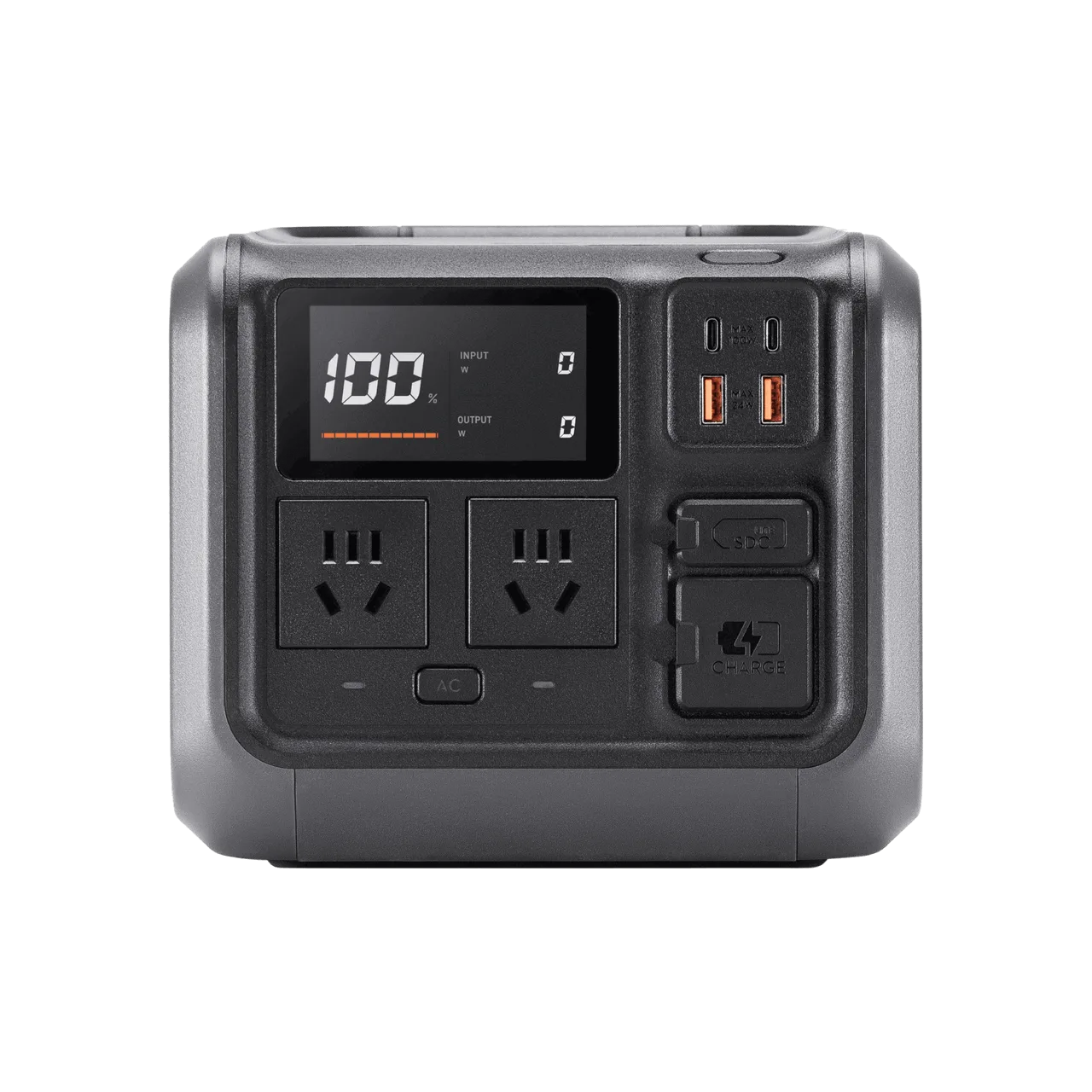
DJI product page (Manufacturer product image)
The chemistry is LFP — lithium iron phosphate — which is the right call for durability.
DJI rates the pack to hold over 70% of its capacity after 4,000 cycles under its stated
test conditions, a longevity figure consistent with the chemistry and reassuring for a
unit that will get charged and drained repeatedly across shoots. LFP also tolerates the
knocks and temperature swings of field use better than higher-density alternatives.
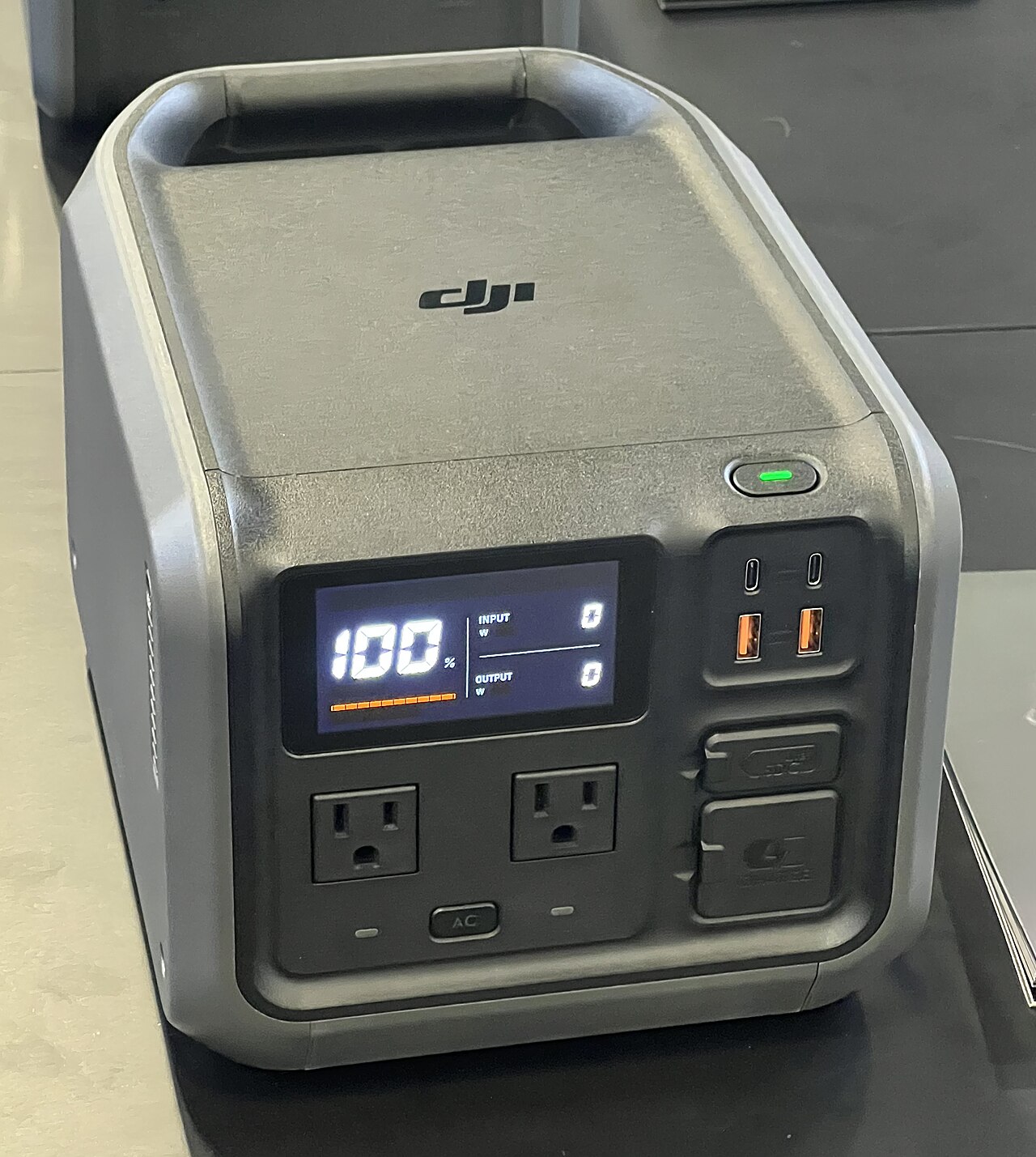
Port provision is sensible for the size. There are two AC outlets and a dedicated AC
input, two USB-C ports rated 100W each, two USB-A ports at 24W each, and the SDC Lite
output. Two 100W USB-C ports is a genuinely useful allocation — enough to fast-charge a
laptop and a phone at once — and the pairing of USB-C and the drone-specific SDC Lite is
where the design shows its intended owner.
The SDC Lite port deserves its own paragraph because it is the reason to buy this over
anything else at 512Wh. It outputs 9-27V at up to 240W, and DJI lists fast charging for
Mavic 3, Air 3 and 3S, Inspire 3 and Matrice 30-series batteries. The important caveat,
which DJI states, is that this requires separately sold accessories — the right cable or
hub for your aircraft is not necessarily in the box. And DJI does not publish the exact
per-drone charging wattage, so we cannot tell you precisely how fast a given battery
refills; we will describe the capability rather than invent the numbers.
Charging and Performance
Output first. The Power 500 delivers 1,000W of continuous AC, with one qualifier DJI is
careful to state: that rating applies above 20% battery. In other words, as the pack
nears empty, sustained output tapers. That is a reasonable and honest disclosure, but it
is worth knowing if you plan to lean on the full 1,000W late in a discharge.
The larger gap in the performance picture is what DJI does not say. There is no published
surge rating for this inverter. Most power stations quote a peak figure well above their
continuous rating to cover the inrush of motor-driven loads — a fridge compressor, a
power tool, a pump. DJI simply does not provide one for the Power 500. That is not proof
the unit cannot handle surges; it is an absence of information, and it means anyone
intending to start a motor load should test conservatively rather than trust an unstated
margin. We would rather flag the silence than fill it with a guess.
Charging, by contrast, is a clear strength. DJI claims a full recharge in just 70 minutes
over AC, drawing up to 540W under its stated temperature and state-of-charge conditions.
A 512Wh pack refilling in a little over an hour is quick, and it suits the field workflow
this unit is built for — top it up over a lunch break and get back to flying. Solar is
supported too, at up to 300W through the SDC Lite input with a DJI MPPT setup, which is a
respectable ceiling relative to the 512Wh capacity.
What DJI does not document on the performance side is a UPS or EPS switchover time, or
any battery-expansion capability. We cannot confirm the Power 500 works as an
uninterruptible supply, and we cannot confirm it accepts add-on batteries, because the
manufacturer does not state either. Treat it, for now, as a fixed-capacity field
station rather than an expandable backup system, and verify with DJI if either capability
is central to your plan.
Competitive Comparison
vs. DJI Power 2000 ($1,299, 2,048Wh). DJI's own larger station is the natural
step-up. It stores 2,048Wh, outputs 3,000W, carries four AC outlets and USB-C at 140W and
65W, weighs 48.5 lb, recharges 0-80% in 55 min, offers a documented 10ms UPS transition
and expands to 22,528Wh across ten batteries. It answers almost every question the Power
500 leaves open — surge headroom aside — but it is four times the capacity, triple the
weight and a different budget. If you need a home-capable unit, it is the DJI to look at;
if you need something that rides in a drone bag, it is overkill.
vs. Bluetti Elite 100 V2 ($499, 1,024Wh). For general use at similar money, the
Bluetti is the value argument against the Power 500. It doubles the capacity to 1,024Wh,
runs an 1,800W inverter with a published 3,600W surge, weighs 25.3 lb, takes 1,000W of
solar, quotes a 10ms transition and is rated for 4,000+ cycles. On paper it is the better
general-purpose box. What it cannot do is fast-charge a DJI drone battery through an SDC
Lite port, which is the Power 500's entire reason to exist.
vs. EcoFlow DELTA 3 ($629, 1,024Wh). EcoFlow's entry unit tells the same story from
another angle: 1,024Wh, 1,800W (3,600W surge), two 100W USB-C ports and a 4,000-cycle
LFP pack rated to 80+% capacity, for not much more than a fully accessorised Power 500
would cost. Buy it if you want capacity and a surge figure you can read; skip it if the
drone-charging port is what you are actually after.
vs. Jackery Explorer 2000 v2 ($999, 2,042Wh). A different tier entirely — 2,042Wh at
39.5 lb with 2,200W output and a sub-20ms transition — but a useful benchmark for how much
more energy the same money buys elsewhere. The comparison underlines the Power 500's
positioning: this is not bought for watt-hours per dollar, it is bought for the SDC Lite
port and the 16.1 lb carry weight.
Who Should Buy It
Buy the DJI Power 500 if you fly DJI aircraft and want to charge batteries fast, far from
a wall outlet. That is the buyer this product was designed for, top to bottom. The SDC
Lite port, the 16.1 lb weight, the 70-minute recharge and the LFP durability all serve
the same workflow: keep the drone in the air across a long day in the field. For a Mavic,
Air, Inspire or Matrice pilot, nothing else at this size does the same job.
It also suits the general user who wants a light, well-built 512Wh station and happens to
value DJI's fit and finish. The two 100W USB-C ports and 1,000W output cover a laptop, a
phone, a camera kit and small appliances comfortably, and the up-to-5-year warranty
through the DJI Official Online Store is reassuring.
Look elsewhere if you are shopping on capacity per dollar and do not own DJI gear. At 512Wh,
the Power 500 is outpaced by 1,024Wh rivals like the Bluetti Elite 100 V2 and EcoFlow DELTA
3 near the same money, both of which also publish the surge rating DJI omits. And look
elsewhere if you need a documented UPS or an expandable system — DJI states neither for this
unit, and honest shopping means not assuming a capability the maker never claimed.
Verdict
The DJI Power 500 is a purpose-built tool wearing the shape of a general-purpose power
station, and it should be judged as the former. For the drone pilot it targets, the
combination of a 512Wh LFP pack, a 16.1 lb carry weight, a 240W SDC Lite fast-charging
port and a claimed 70-minute recharge is close to ideal for a day of field work. The
build is solid, the USB-C provision is strong, and the warranty is generous through DJI's
own store.
The reservations are real and worth repeating. DJI publishes no surge rating, so
motor-start headroom is genuinely unknown. There is no stated UPS switchover time and no
documented expansion path. Drone fast-charging depends on accessories sold separately. And
DJI did not expose a current purchasable USD price on the fetched store listing, which
makes value hard to judge with precision — a buyer should confirm the delivered price and
what accessories it includes before ordering.
Weighed as a general 512Wh box, the Power 500 is merely fine and arguably out-specced by
cheaper 1kWh rivals. Weighed as the field charger for a DJI drone kit, it is a smart,
focused piece of gear that does something no competitor at this size does. Buy it for the
SDC Lite port, and it makes complete sense; buy it for raw watt-hours, and you can do
better.
Frequently Asked Questions
What makes the DJI Power 500 different from a normal power station?
batteries in the field — DJI lists support for Mavic 3, Air 3 and 3S, Inspire 3 and
Matrice 30-series packs. That drone-charging capability is the reason to choose it over a
conventional 512Wh station.
Does it have a surge rating for starting motors?
no separate surge figure appears on DJI's specs. If you plan to start a motor load, test
conservatively, because the headroom above 1,000W is not documented.
How long does it take to recharge?
temperature and state-of-charge conditions. Over solar, it accepts up to 300W through the
SDC Lite input with a DJI MPPT setup, which refills the 512Wh pack reasonably quickly in
good sun.
Can I charge my drone batteries directly, out of the box?
separately sold accessories, so you may need the correct cable or hub for your specific
aircraft. Confirm which accessory your drone needs before relying on the feature.
How heavy is it and will it fit in my kit?
light and compact enough to carry to a shoot alongside a drone case or camera bag, which is
exactly the use DJI designed it around.
What can the 1,000W output actually run?
small fridge and most modest appliances. Because DJI does not publish a surge figure,
high-inrush motor loads are the uncertain case; everything resistive or electronic within
1,000W is well within scope.
How many devices can it charge at once?
SDC Lite output. The two 100W USB-C ports are the standout — enough to fast-charge a laptop
and a phone simultaneously alongside AC loads.
How long will the battery last?
stated test conditions. For a field unit that gets cycled hard, that is a durable rating and
one of LFP chemistry's core advantages.
Can it work as a UPS or take extra batteries?
Power 500, so neither can be confirmed here. Treat it as a fixed-capacity field station, and
check with DJI directly if uninterruptible operation or expansion is essential for you.
Why is there no clear price listed?
why the price reads "See DJI Store." Check the DJI Official Online Store for the delivered
price and note which accessories are and are not included, since drone-charging cables are
sold separately.