Introduction
The DJI Power 1000 V2 is a better power station than its awkward accessory strategy suggests. It stores 1,024Wh, delivers 2,600W continuously, recharges quickly, and switches to battery power quickly enough to protect a desktop setup from a short outage. It is also quiet enough to sit in a studio or bedroom without becoming the loudest device in the room.
That combination makes the V2 especially attractive to creators, DJI drone owners, home-office users, and campers who value fast wall charging. DJI introduced it on July 9, 2025, as an updated version of the original Power 1000. The upgrades are practical rather than cosmetic: four AC outlets instead of two, a 2,600W inverter instead of 2,200W, faster charging, a shorter UPS transition, and a new DJI Home app.
The catch is the SDC ecosystem. Solar charging, car charging, 12V accessories, drone fast charging, and expansion batteries all rely on proprietary ports and separately sold hardware. If you want a simple solar input built into the station, the DJI is the wrong kind of convenient. If you mainly charge from the wall and want a quiet, powerful, expandable box, it is much easier to recommend.
Design and build
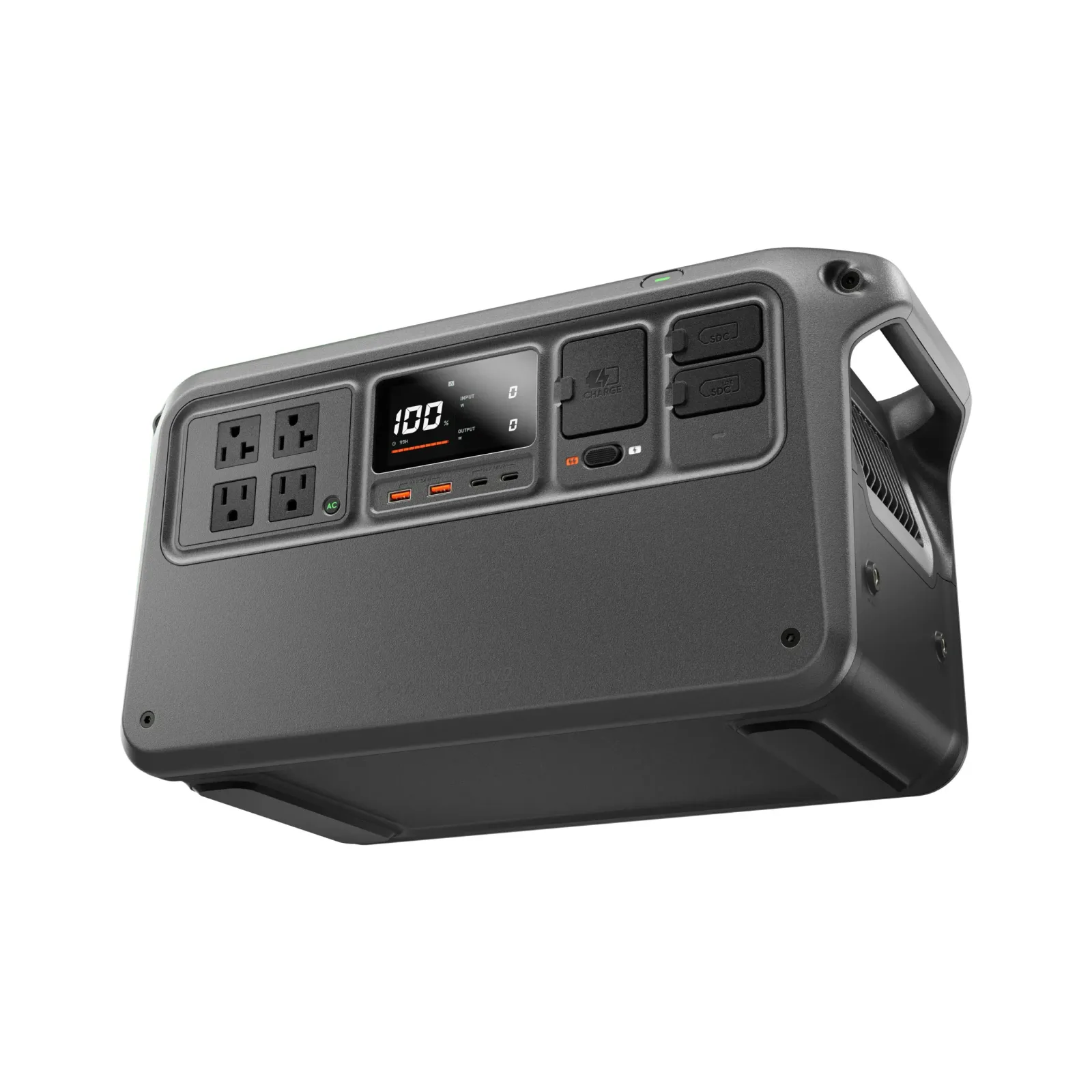
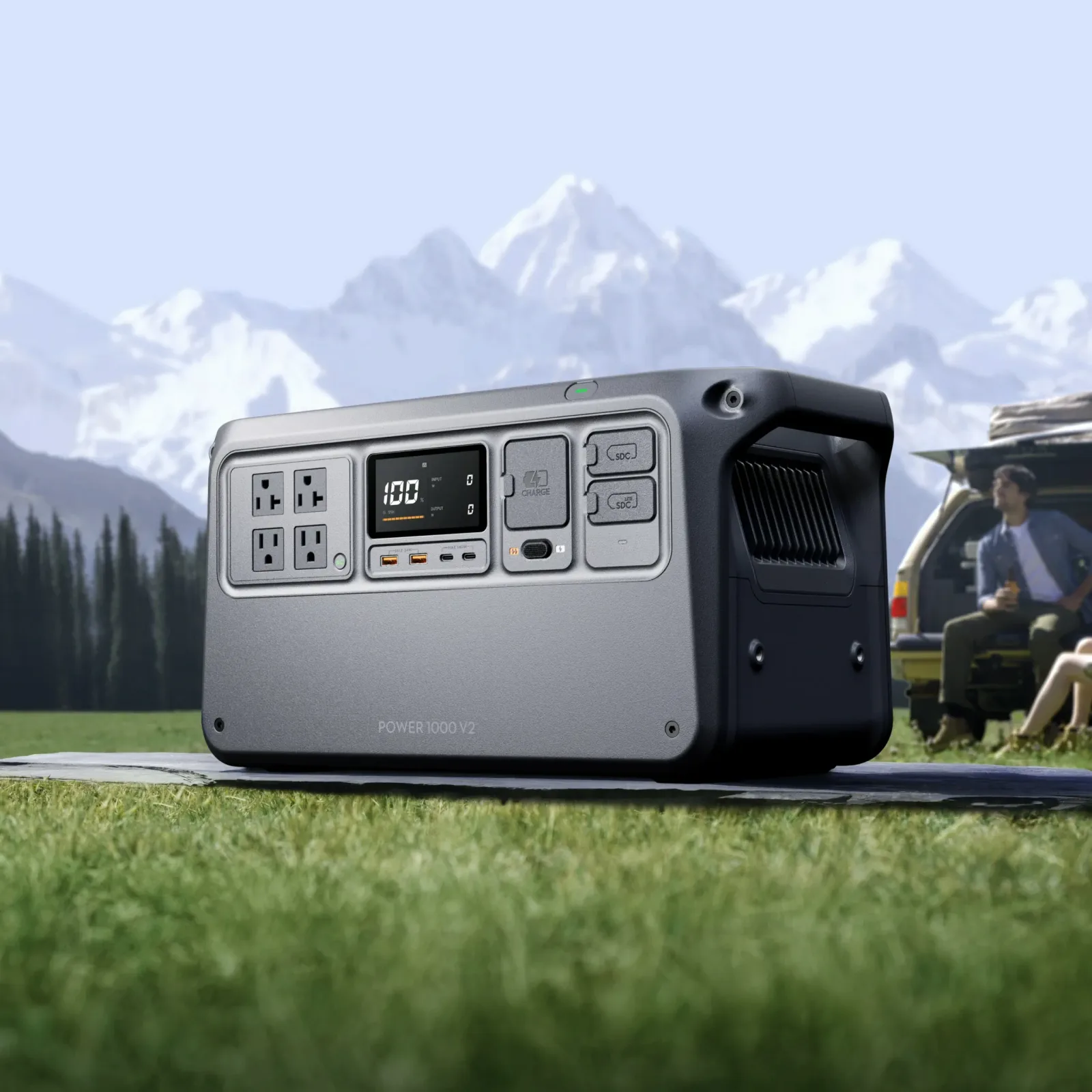
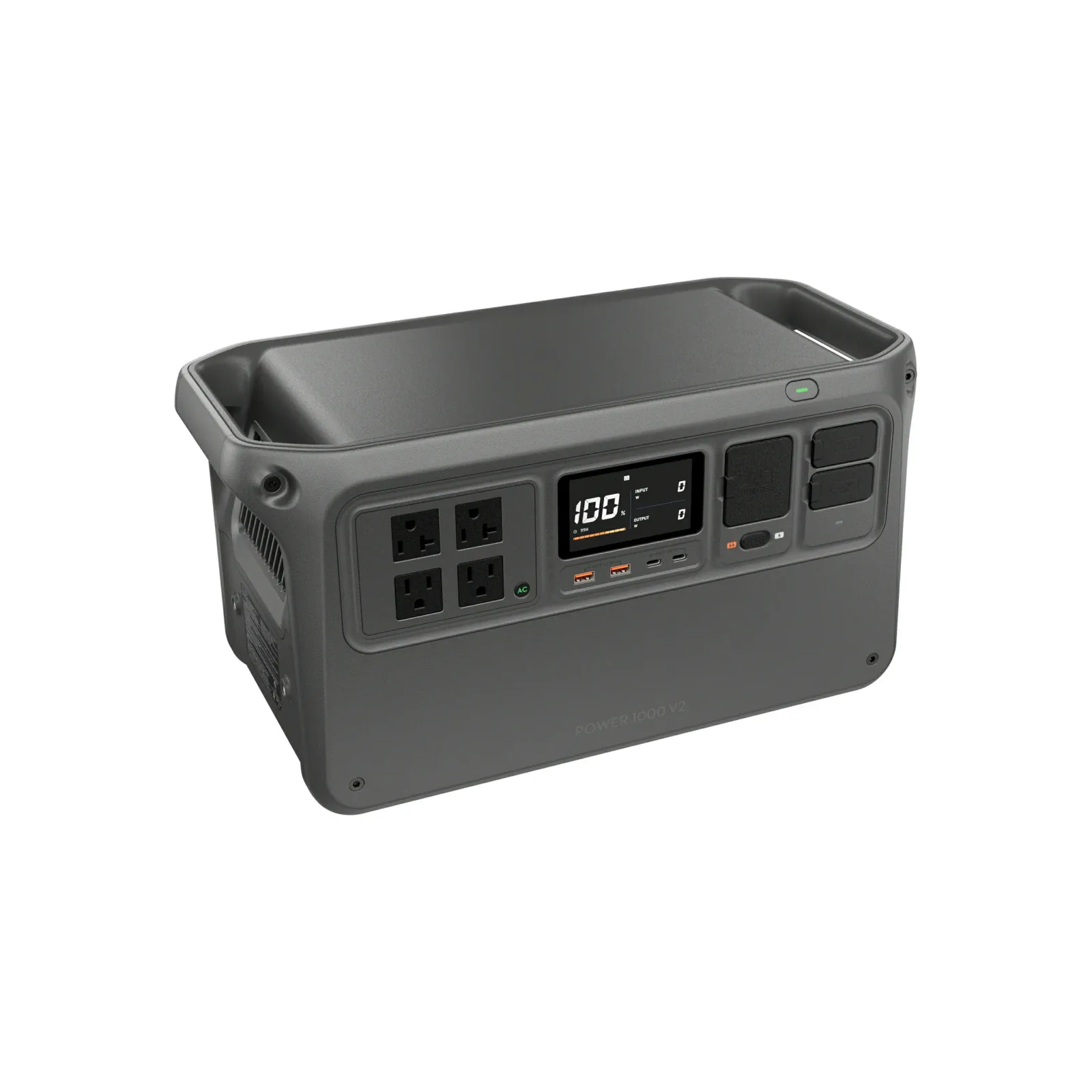
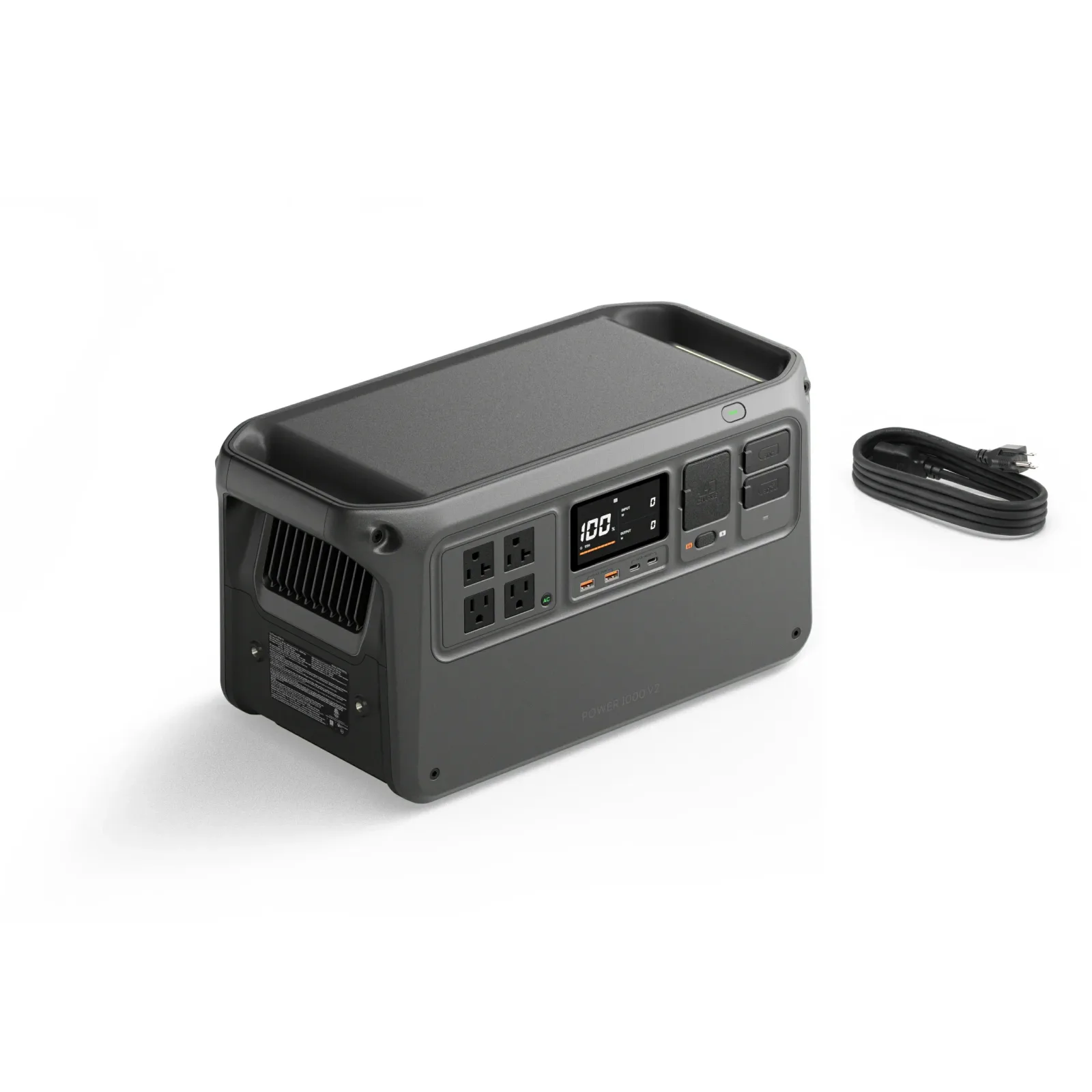
At 31.3 lb (14.2kg), the Power 1000 V2 is transportable but not truly light. It is reasonable to lift into a car or move around a house, yet it is a poor choice if your definition of portable means carrying it several hundred yards every day. The low, rectangular chassis and front-facing controls make it easier to place than many taller stations, and the screen exposes input, output, battery level, and runtime without requiring an app.
DJI product page (Manufacturer product image)
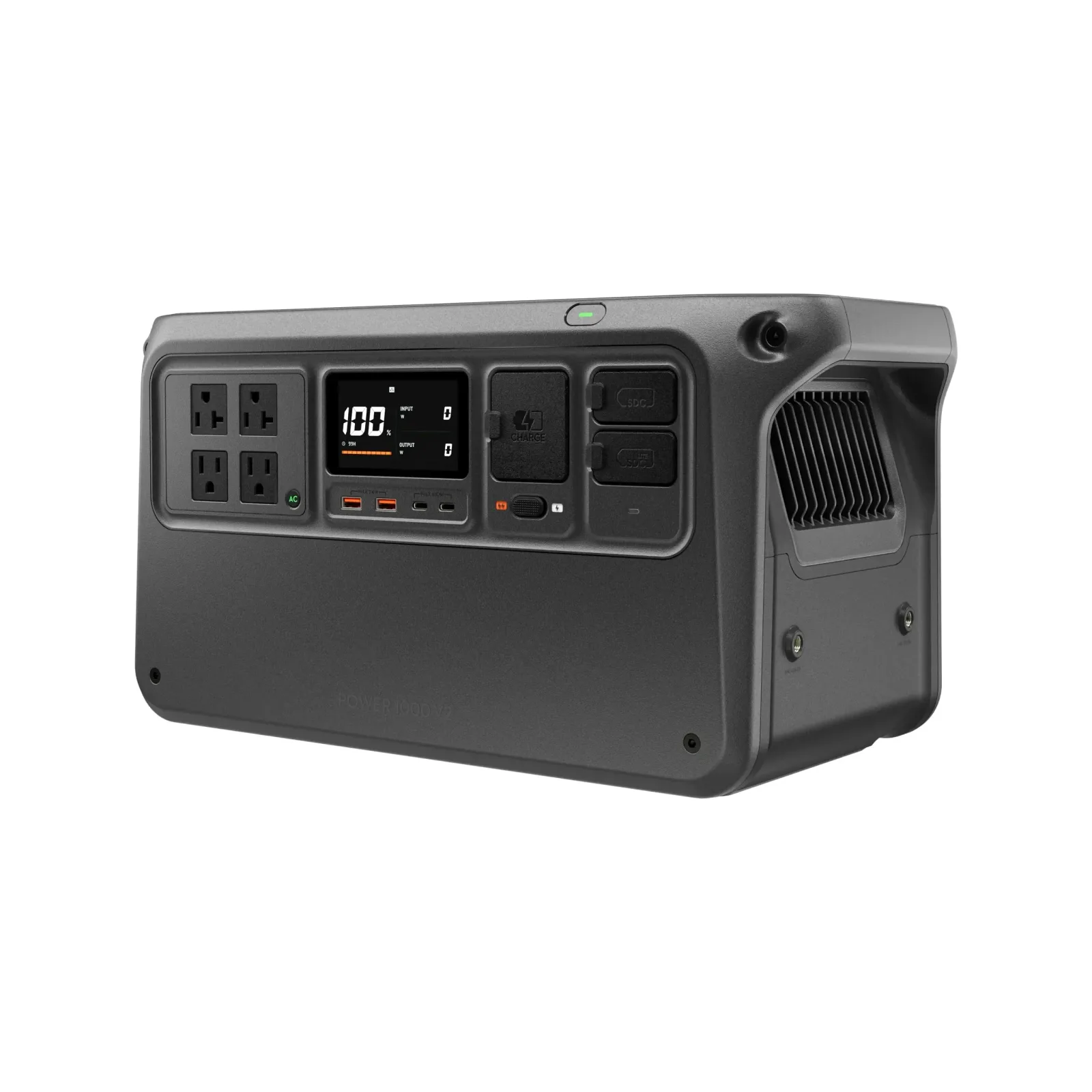
The front panel is a meaningful improvement over the original. Four AC outlets give the V2 enough room for a laptop charger, lights, camera chargers, and a small appliance at the same time. There are also two USB-A ports and two USB-C ports rated at 140W each, or 280W combined. The USB-C output is useful for high-performance laptops, but the connected device and cable must support USB PD 3.1 and EPR to reach the maximum.
There are two SDC ports, and they are the center of the product's design compromise. DJI uses them for expansion batteries, drone charging, solar and car adapters, and other DC accessories. That keeps the exterior clean, but it also means the station does not have a conventional built-in solar input or a standard 12V car socket. Use one SDC port for an expansion battery and another for solar, and there is no spare port for a separate DC accessory.
The physical fast-charge switch is a good touch. It lets you choose a faster or more conservative recharge mode on the unit instead of hiding the decision in software. The DJI Home app adds remote monitoring, port control, and settings for the station and compatible accessories, but the hardware remains usable without living inside the app.
Charging and real-world performance
DJI rates the V2 at 2,600W continuous output under its stated laboratory conditions. That is a substantial increase over the original model and enough headroom for demanding combinations of appliances, lights, tools, and creator equipment. It does not turn a 1,024Wh battery into a whole-house system: high-wattage loads still drain the pack quickly. The useful distinction is that the inverter is less likely to be the first limitation when several moderate loads run together.
DJI product page (Manufacturer product image)
Wall charging is the clearest performance upgrade. DJI claims 0-80% in 37 minutes and a full charge in 56 minutes. Those are controlled-condition figures, not a promise that every outlet, temperature, and battery state will reproduce the same result, but they are excellent targets for a station this size. The official product page says maximum grid input depends on battery level and temperature, so the headline rate should be treated as a peak rather than a constant.
The UPS mode is more than a checkbox. DJI specifies a 0.01-second transition when the station is powered and connected to the wall, and independent testing from DroneXL describes the V2 as fast enough for computers and networking equipment to keep running. That does not replace a properly sized office UPS for every workload, but it makes the Power 1000 V2 a plausible desk-side backup rather than merely an emergency battery.
Noise is another strength. DJI lists a 26dB measurement in standard recharge mode, while independent reviewers consistently describe the station as unusually quiet during ordinary use. The fans can become audible under sustained heavy load, as they must to move heat, but quiet baseline operation matters when the station is beside a microphone, a bed, or a campsite.
Efficiency is less exceptional. DroneXL measured roughly 80% efficiency at about 195W output, which is respectable for this class but not a reason to buy the DJI over every rival. Low-load operation also has an idle draw, so leaving AC output enabled for days wastes energy even when the connected devices barely consume anything.
Solar, drones, and expansion
The V2 can accept up to 1,800W of solar input, but not directly from a normal panel connection on the main unit. DJI's 1.8kW Solar/Car Super Fast Charger can accept up to 1,200W from solar and 600W from a vehicle at the same time; other configurations use DJI's MPPT adapter module. That is powerful, but it is not simple. The adapter cost, extra wiring, and SDC-port competition are part of the purchase decision, not footnotes.
DJI product page (Manufacturer product image)
The same proprietary approach is valuable for DJI drone owners. With separately sold charging cables, DJI says selected drone batteries can charge from 10% to 95% in roughly 30 minutes, with the Inspire 3 battery listed at 28 minutes by Mashable. Those are specific ecosystem benefits that ordinary power stations cannot duplicate. They also disappear if you do not own compatible DJI aircraft.
Expansion is unusually ambitious for a station this size. Up to five 2,048Wh DJI Power Expansion Battery 2000 units can raise the system's stated capacity to 11,264Wh. That makes the V2 a credible starting point for a staged backup system, although the batteries, connecting hardware, and transport solution add substantial cost and weight. It is expansion potential, not portable capacity.
DJI Power 1000 V2 vs. the alternatives
Anker SOLIX C1000 Gen 2: The Anker is the more straightforward general-purpose choice if you want a 1kWh station with ordinary charging connections and a lower carry weight. It has five AC outlets and weighs about 25 lb, according to Mashable's comparison. The DJI counters with higher continuous output, quieter operation, faster headline charging, and native DJI drone integration. Choose Anker when solar simplicity and portability matter more than creator-focused features.
DJI product page (Manufacturer product image)
EcoFlow DELTA 3: EcoFlow's 1,024Wh DELTA 3 is a strong alternative for buyers who want a mainstream ecosystem and conventional solar workflow. Its appeal is broad usability rather than DJI-specific charging. The Power 1000 V2 is the better fit for someone who values its quiet operation, 2,600W inverter, and expansion path; EcoFlow is easier to justify when you do not need SDC accessories.
Jackery Explorer 2000 v2: Jackery's 2,042Wh station makes the DJI look expensive if your priority is stored energy. It is a heavier, larger product, but it roughly doubles capacity in one box. The DJI wins on weight, charge speed, and creator workflow. Jackery wins for extended off-grid use where carrying extra adapters is less attractive than having more battery.
DJI Power 2000: DJI's own Power 2000 is the logical step up for users who want 2,048Wh before adding batteries. It is heavier and costs more, but it avoids the immediate capacity ceiling of the 1,024Wh V2. Buy the Power 1000 V2 for portability; buy the Power 2000 if the station will spend most of its life as home backup.
Who should buy it
Buy the DJI Power 1000 V2 if you are a creator, DJI drone owner, home-office user, or camper who mostly recharges from the wall and wants quiet operation. The fast AC refill, dual 140W USB-C ports, four AC outlets, and UPS behavior all support that use. It is also a good platform for a buyer who wants to start at 1,024Wh and add capacity later.
Skip it if solar is your primary charging method and you want panels to connect directly to the station. Skip it if you need a built-in 12V outlet, a flashlight, or the lowest cost per watt-hour. The V2's core hardware is strong, but the accessories turn a good price into a larger system cost surprisingly quickly.
Verdict
The DJI Power 1000 V2 is a high-performing 1kWh station with a narrow definition of convenience. It is fast, quiet, powerful, and unusually capable as a UPS. The four-outlet redesign fixes the original's most obvious usability problem, and expansion gives it a credible long-term path.
But DJI has made the best charging options the least universal ones. Solar and 12V use require adapters, expansion consumes an SDC port, and drone fast charging only matters to people already invested in DJI. At the $699.99 MSRP, those trade-offs make the V2 a poor value for a generic emergency battery. For creators and DJI pilots who will use the ecosystem, it is one of the most polished options in its class. Buy it for the quiet, fast, expandable workflow—not simply because the label says 1,024Wh.