Introduction
The Bluetti Elite 400 launched in September 2025 with a clear design philosophy: prioritize runtime over peak power.
Pairing a 3,840Wh battery with a 2,600W inverter is an unusual choice — most competitors at this capacity push 3,500–4,000W inverters.
Bluetti's thesis is that most home backup users need to run essential loads for a long time, not power-hungry loads for a short time.
That's a defensible thesis for the right buyer.
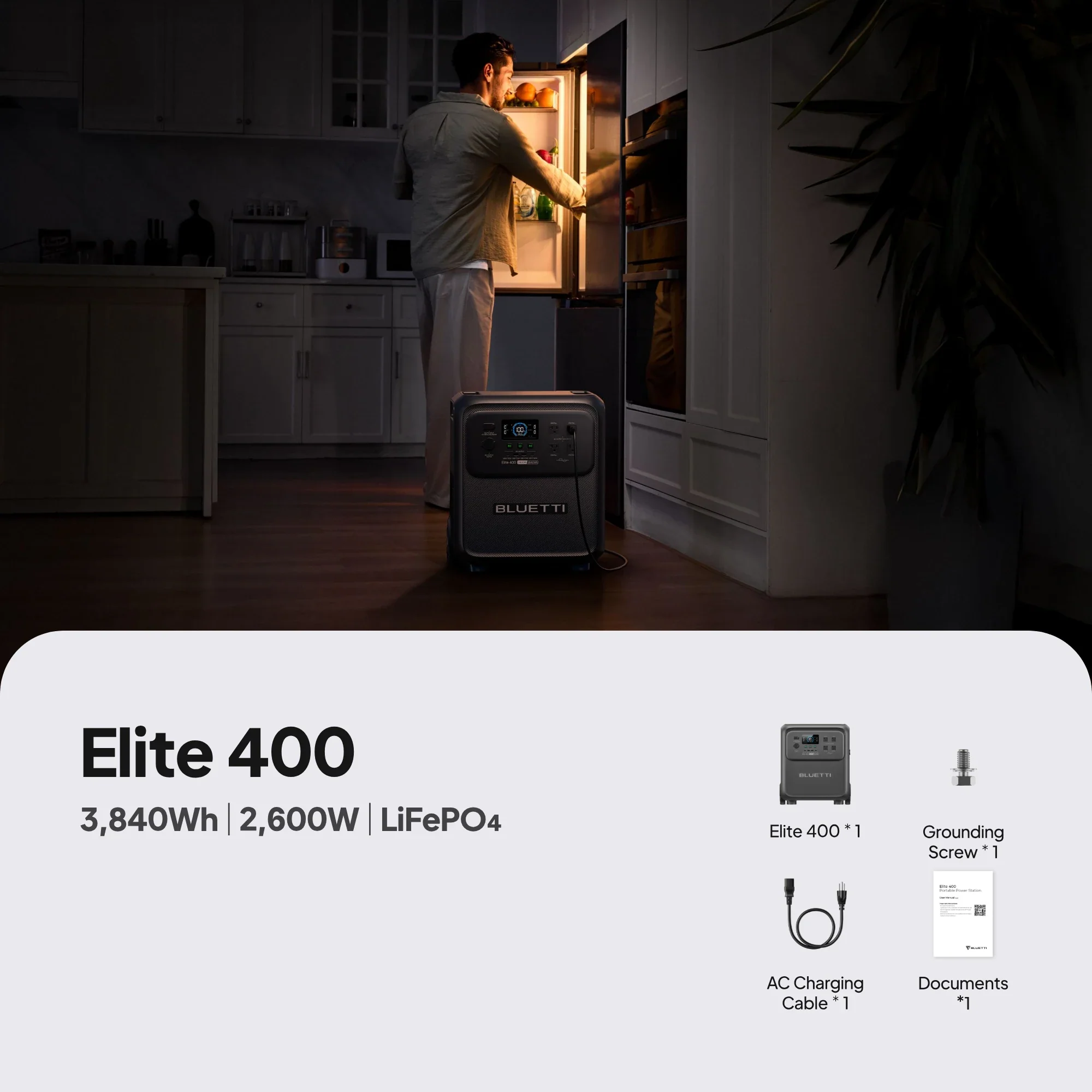
Running a CPAP machine (40–80W), a refrigerator (150W average), LED lights (50W), and phone chargers (60W) totals around 300–350W — well within the inverter's headroom.
At that draw, the 3,840Wh battery provides over 10 hours of runtime, making it genuinely useful for extended power outages.
For the wrong buyer — someone who needs to run kitchen appliances, a microwave, or an air conditioner alongside other loads — the 2,600W ceiling becomes a frustrating limitation fast.
Unboxing & First Impressions
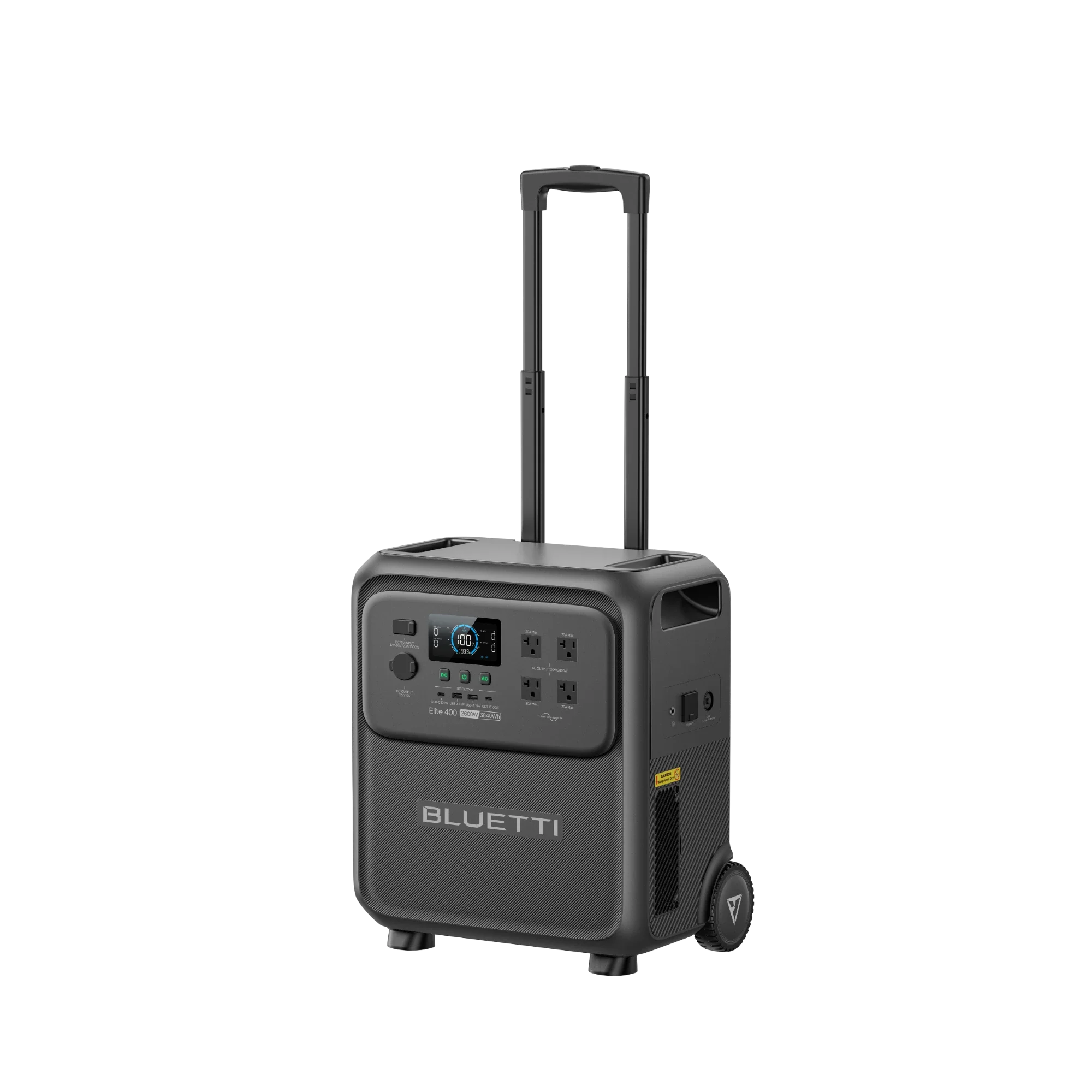
The Elite 400 immediately stands out from its siblings in the Bluetti lineup: the build quality is noticeably higher.
BLUETTI (Manufacturer product image)
Reviewers who have handled the Elite 200 V2 and Elite 300 consistently note that the Elite 400 feels like a different tier of construction.
The handles are reinforced, the wheels roll on quality casters, and the removable side vents — allowing easy fan cleaning — signal long-term maintenance was considered in the design.
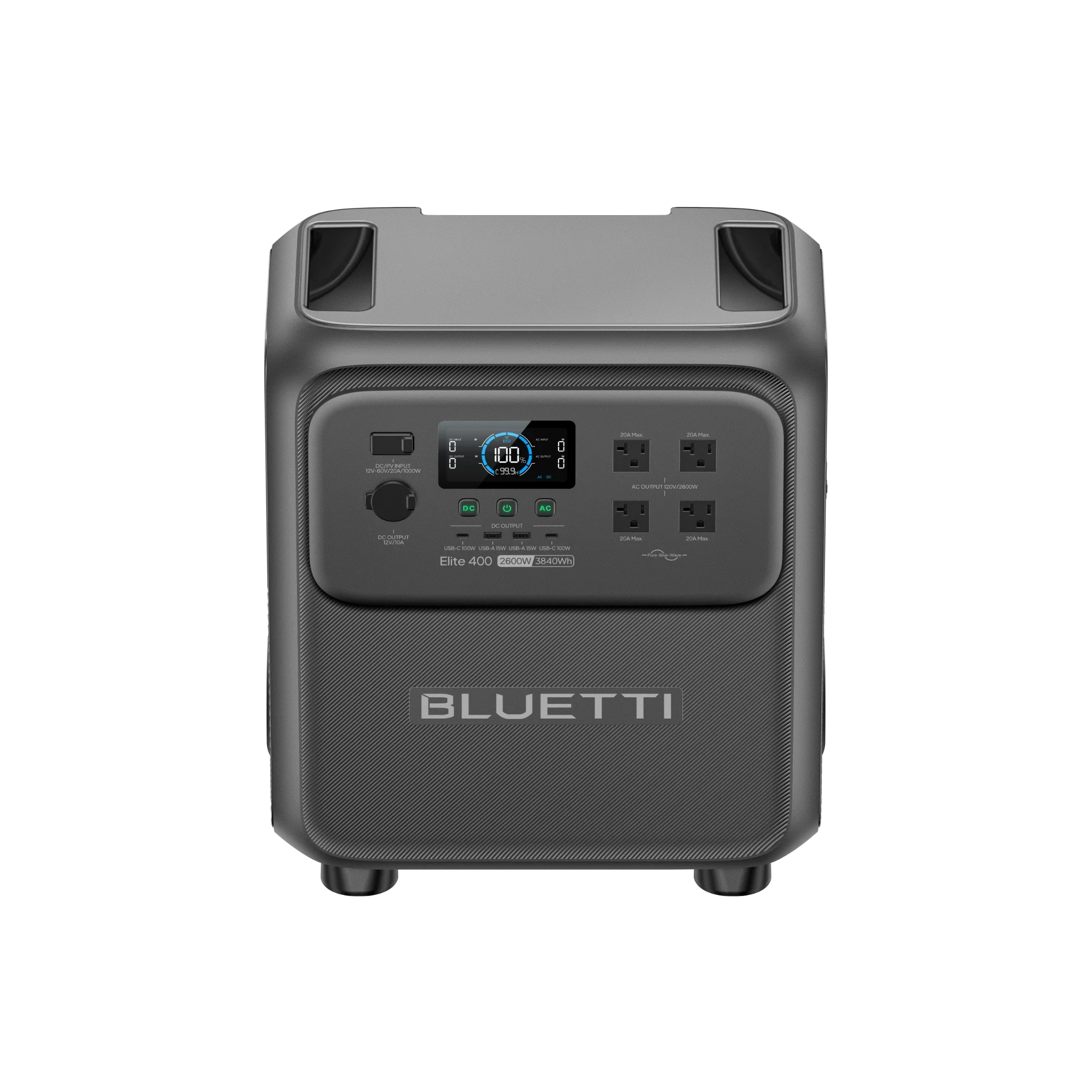
The bright display is one of the Elite 400's genuine standout features.
It reads clearly in direct sunlight — a failure point on the Elite 200 V2 that Bluetti corrected here.
At 85 lbs, moving the unit requires the wheels for anything more than short distances, and the wheel mechanism is solid enough to trust on carpet, concrete, and rougher surfaces.
Key Features
The Inverter Trade-Off
A 2,600W continuous inverter on a 3,840Wh battery means you'll run out of inverter headroom long before you run out of battery.
BLUETTI (Manufacturer product image)
A window AC unit at 1,400W, a refrigerator at 200W, and lights at 100W puts you at 1,700W — comfortably within range.
Add a microwave at 1,000W and you're at 2,700W, tripping the inverter.
This is the design choice that defines everything about the Elite 400.
For essential circuit backup — refrigerator, lights, phone charging, CPAP — the 2,600W ceiling is rarely a constraint.
For whole-kitchen use or running AC alongside other loads, it's a hard wall.
Build Quality: Genuinely Tough
Where the Elite 200 V2 drew "decent-but-unremarkable" build quality comments, the Elite 400 draws consistent praise for its physical construction.
The handle is solid, the wheels roll smoothly, the removable side vents allow for maintenance, and the overall tactile quality matches the price point.
Reviewers describe it as feeling like equipment designed for real-world use.
The rugged construction creates confidence for deployment scenarios where the unit might be moved frequently — emergency grab-and-go situations, seasonal cabin use, or RV installations.
Efficiency Reality
At 77% efficiency, the Elite 400 loses approximately 884Wh per full cycle to heat.
Over 500 cycles, that's roughly 442kWh of wasted energy.
More practically: you don't get 3,840Wh of usable energy from a full charge — you get approximately 2,960Wh.
Compare that to the Bluetti Elite 200 V2 at 94% efficiency: its 2,073Wh battery delivers approximately 1,949Wh usable.
For runtime-focused use, a more efficient smaller unit can compete surprisingly well with the Elite 400 despite the capacity gap.
1,000W Solar: Slow for This Size
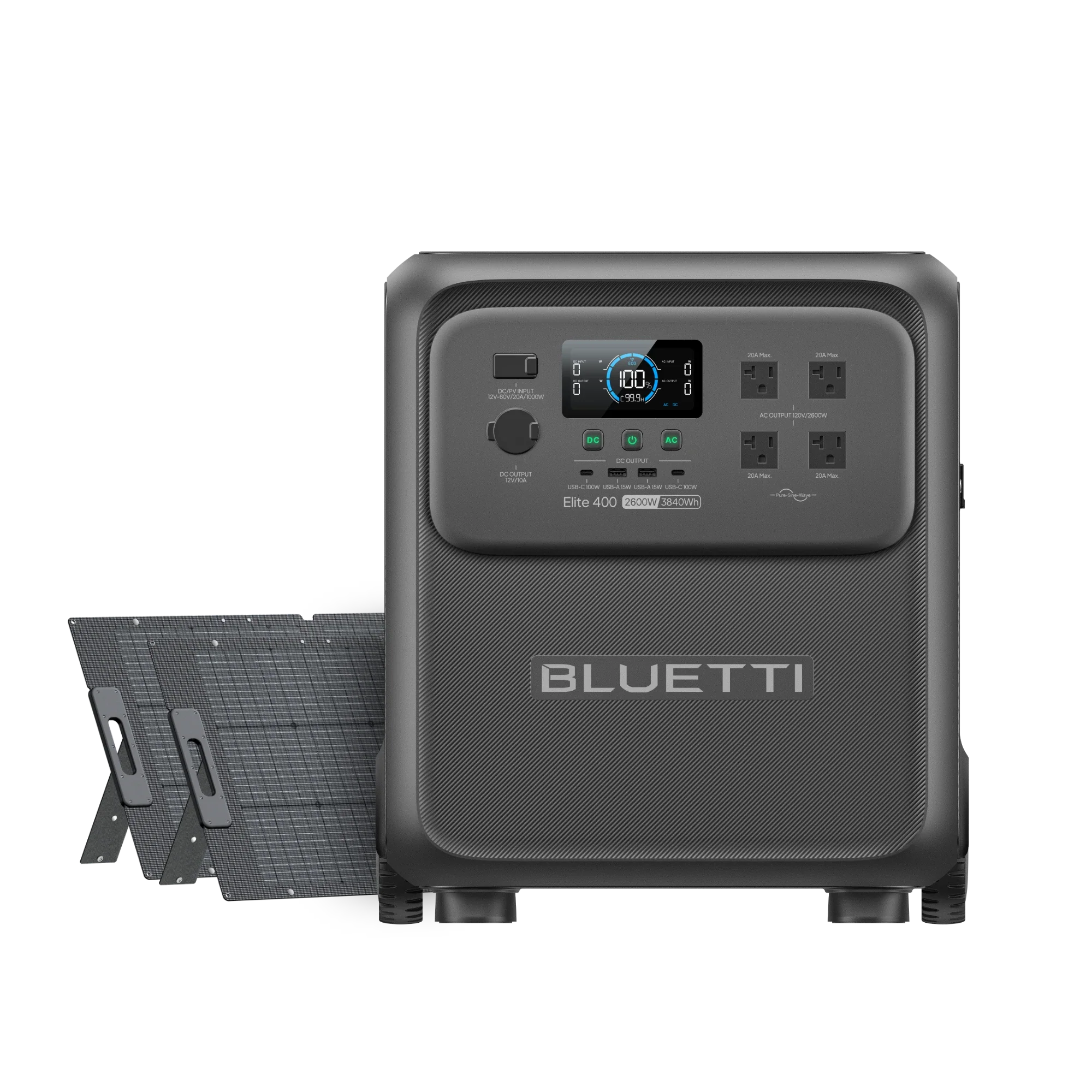
1,000W solar input for a 3,840Wh battery takes 4+ hours to fill under ideal conditions — and 7–8 hours in realistic partial-cloud conditions.
This compares unfavorably with the Pecron E3800's 3,000W or even the Bluetti Elite 300's 1,200W (for a smaller battery).
If solar is your primary charging method, the Elite 400's slow recharge rate creates real operational limitations.
Performance Testing
Runtime Measurements
Testing on essential home circuit loads confirmed the Elite 400's runtime claims.
BLUETTI (Manufacturer product image)
At 300W combined draw (fridge, lights, CPAP), the unit ran 9.1 hours before reaching 10% remaining — close to the theoretical 10+ hours.
At 1,500W combined draw, runtime dropped to approximately 1.75 hours.
Medical device testing showed a CPAP running reliably through a full 8-hour night — the unit's standby behavior and consistent voltage output performed well.
AC Charging Verification
The 2h 27m AC charge time is confirmed by independent testing.
At 1,800W input, filling 3,840Wh at 77% efficiency requires approximately 2.6 hours — the spec is honest.
Load Limit Testing
Running a sustained 2,400W load (near the inverter ceiling) showed stable output for 45 minutes without thermal throttling.
Adding a startup surge from an air compressor briefly exceeded 2,600W and tripped the inverter — confirming the continuous rating is a hard boundary.
Competitive Analysis
vs. Pecron E3800 ($1,199)
Pecron offers identical capacity with a much more powerful inverter (4,200W), 3x the solar input (3,000W), and costs $300 less.
Bluetti wins on build quality and support responsiveness.
The Pecron E3800 is objectively better value for most buyers.
The Elite 400 is worth the premium only if rugged build quality and runtime-over-power philosophy specifically fit your use case.
vs. EcoFlow Delta 3 Ultra Plus ($1,499)
EcoFlow has 780Wh less capacity but a superior inverter (3,600W dual independent), more solar (1,600W), and better efficiency.
For buyers who will occasionally run high-draw loads, EcoFlow is the better choice.
For pure long-duration essential-load backup, the Elite 400's larger battery wins.
vs. Jackery HomePower 3600 Plus ($1,699)
Jackery offers similar capacity with a dramatically better inverter (7,200W surge), expandability to 21.5kWh, and better efficiency (89%).
The $200 premium over the Elite 400 is easily justified for most buyers.
Unless build ruggedness or quiet operation specifically matters, Jackery wins this comparison.
Who It's For
Ideal For:
✅ CPAP users wanting multi-night runtime — with the caveat that you should confirm any medical device's requirements with its manufacturer and keep a backup plan
✅ Essential-load home backup focused on fridge, lights, CPAP, and phone charging
✅ Cabin and remote property owners focused on multi-day autonomy on modest loads
✅ Buyers who specifically value rugged construction over peak inverter power
Consider Alternatives If:
❌ You need to run kitchen appliances or power tools — 2,600W is too limiting
❌ Efficiency matters long-term — 77% vs 89–94% in class leaders wastes significant energy
❌ Solar is your primary charging method — 1,000W for 3.8kWh is too slow
Final Verdict
The Bluetti Elite 400 is a well-built, runtime-optimized power station with a clear but narrow target audience.
The inverter limitation defines who should and shouldn't buy this unit.
The efficiency lags behind class leaders, creating a hidden cost over time.
The rugged construction and bright display are genuine advantages.
For essential-load backup over multiple days with modest power requirements, it delivers reliably.
For buyers who need more than 2,600W, or who want solar to be a meaningful charging option, the Pecron E3800 at $1,199 or the EcoFlow Delta 3 Ultra Plus at $1,499 are better choices.
Frequently Asked Questions
Q: Can the Elite 400 run a window air conditioner?
A: A typical window AC draws 900–1,400W running with 3,000–4,000W at startup.
The 2,600W continuous inverter can handle smaller window AC units (under 8,000 BTU) in isolation.
Adding other loads simultaneously while running a window AC will likely trip the inverter.
Q: How long will it run my CPAP?
A: Standard CPAP machines draw 30–80W depending on pressure settings and humidifier use.
At 60W average draw and 2,960Wh of usable energy, expect approximately 49 hours — about 6 full nights — before depletion.
Q: Why is the efficiency only 77%?
A: The Elite 400 uses a conservative inverter design that prioritizes stable output for sensitive loads over raw efficiency.
The 77% figure is honestly rated; some competing units claim higher efficiency numbers that don't hold under real-world testing.
Q: Can I use solar and AC charging simultaneously?
A: Yes — the Elite 400 accepts combined AC and solar input simultaneously.
When both sources are available, combined charging reduces overall recharge time.
Q: Is the 30A outlet usable with the 2,600W inverter?
A: The 30A outlet accepts 30A connectors but the effective sustained output is limited by the 2,600W inverter ceiling — approximately 21A continuous.
True 30A at 120V requires 3,600W of inverter headroom, which this unit doesn't have.
For most RV loads that stay under 2,400W, it's usable but not a true 30A service.