Introduction: What the BLUETTI AC500 Actually Is
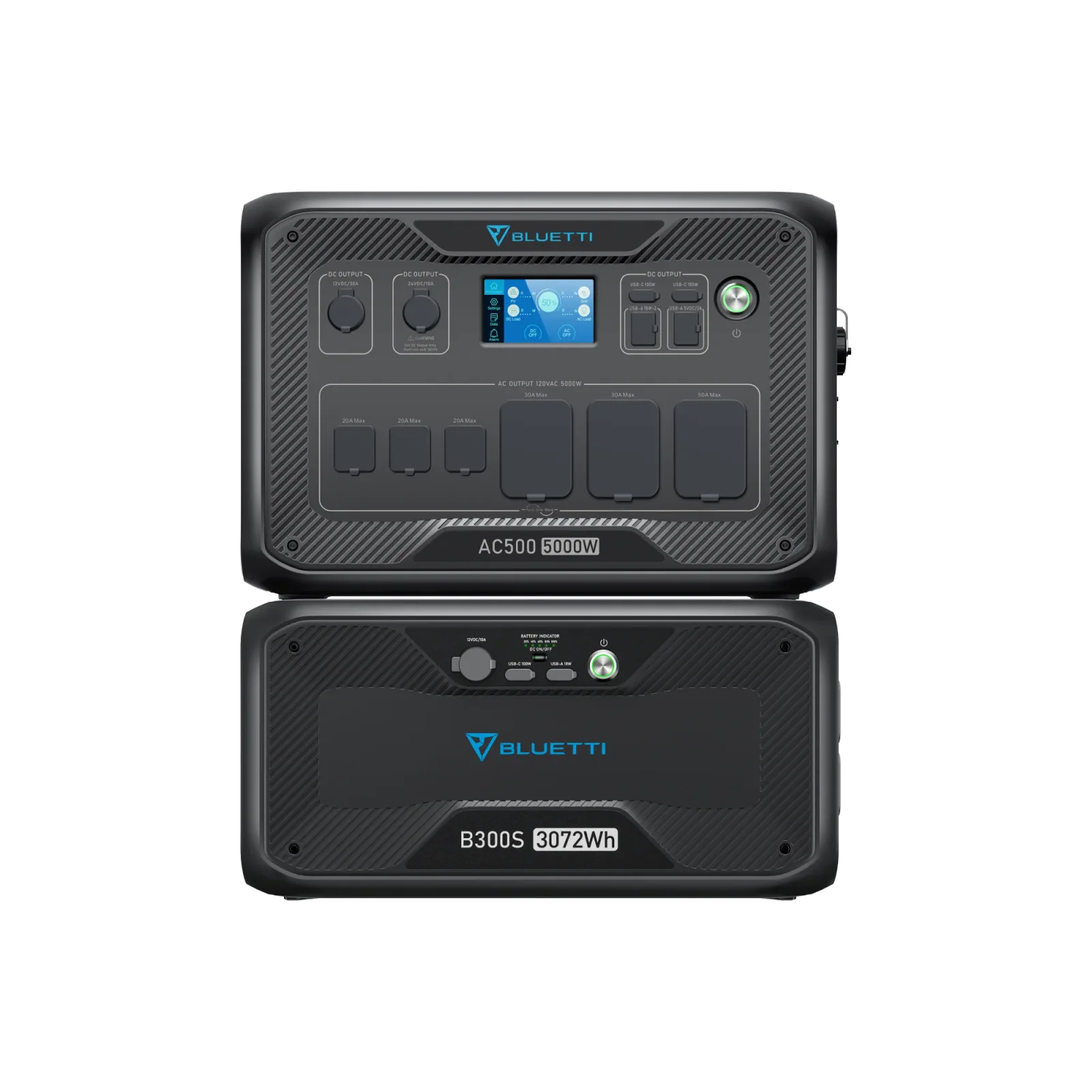
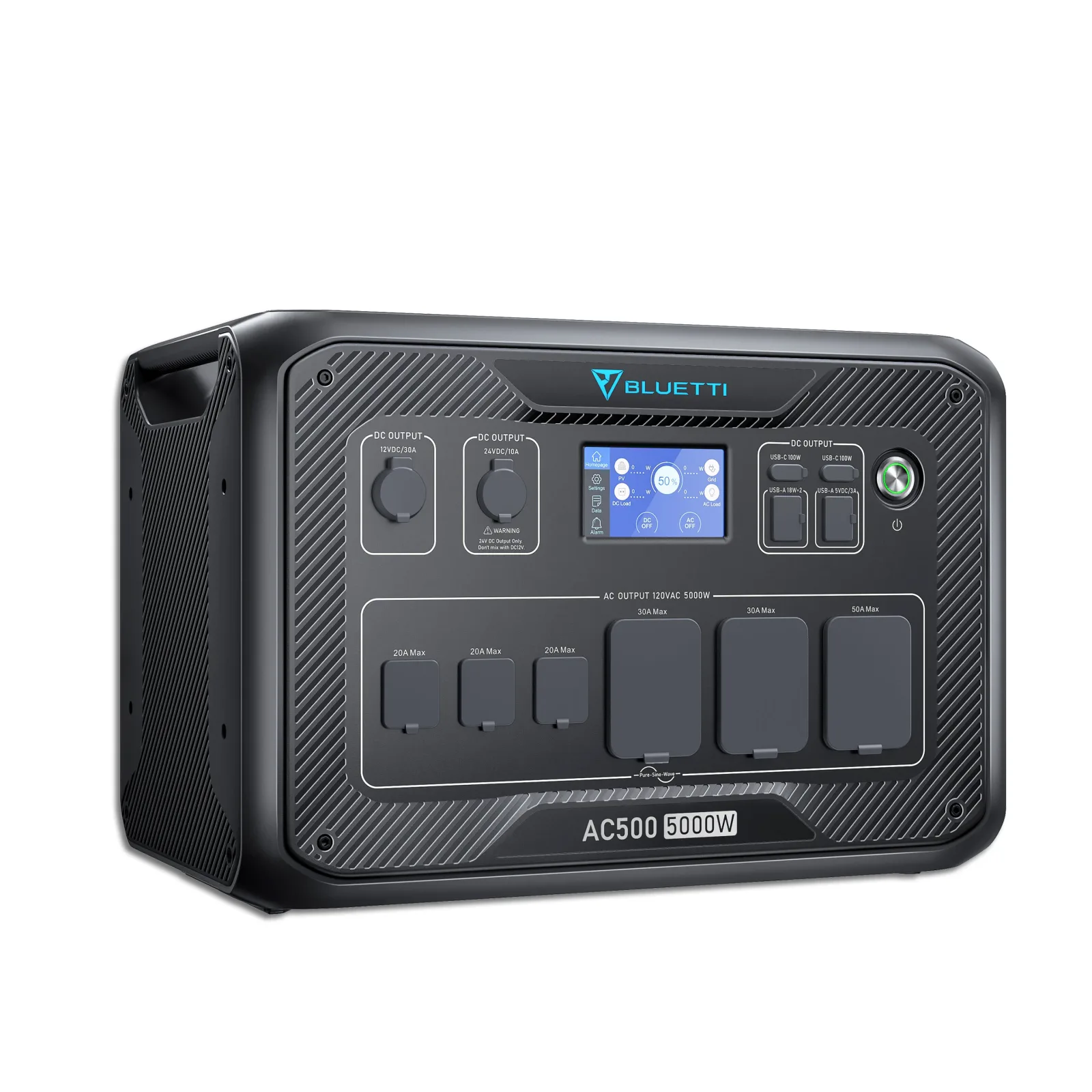
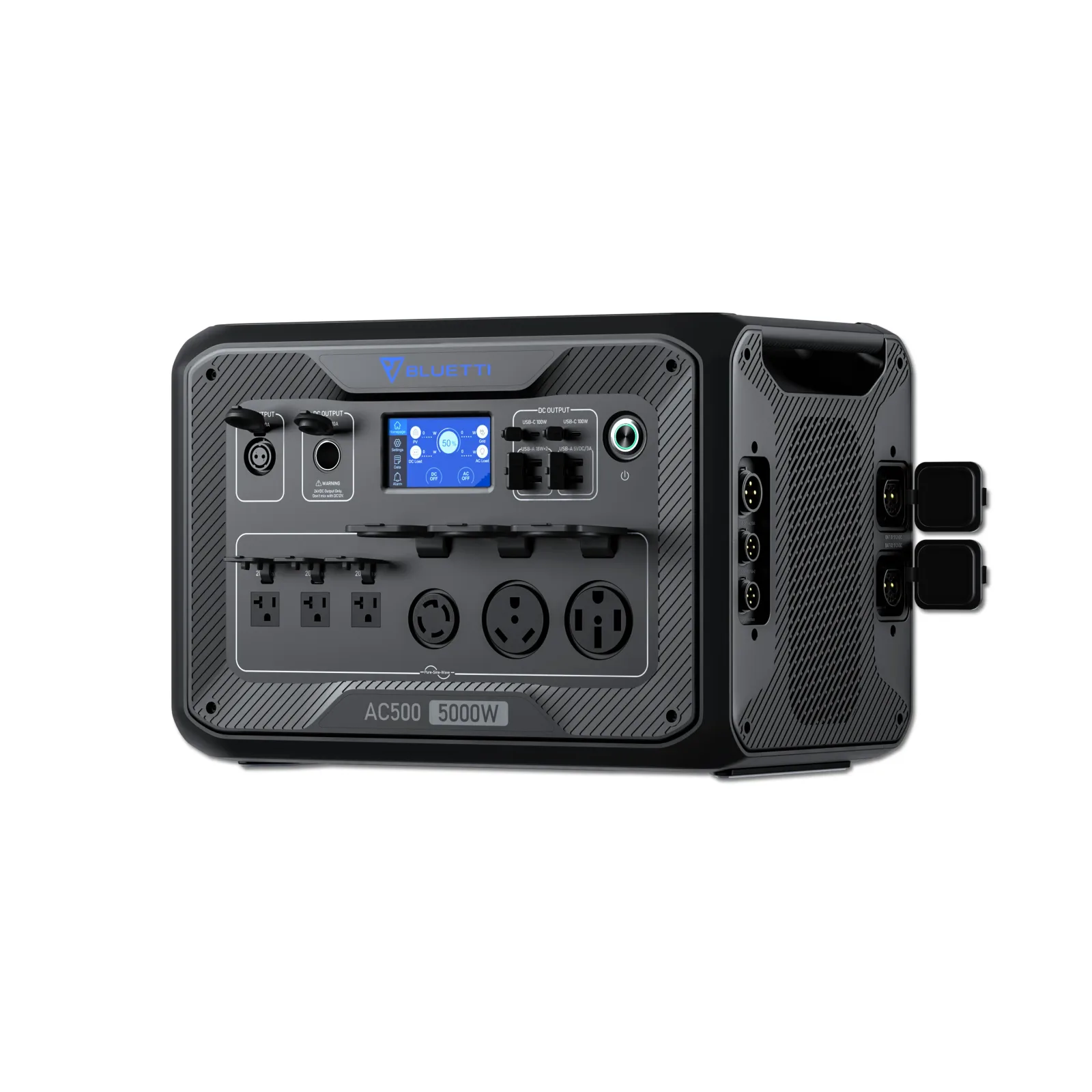
The BLUETTI AC500 makes sense only when you stop calling it a complete portable power station. It is a 5,000W inverter, charger, display, and port hub that borrows its energy from separate B300, B300S, or newer B300K batteries. BLUETTI’s own product page describes the AC500 as a 5,000W-output, 5,000W-solar-input system, while its current catalog sells it in battery bundles rather than as a self-contained box (BLUETTI AC500 product page; BLUETTI AC500+B300S catalog record).
BLUETTI product page (Manufacturer product image)
That distinction is the review’s central point. The AC500 is a compelling foundation for a fixed home-backup setup, an RV with serious electrical demands, or an off-grid system that will grow over time. It is a poor choice for a buyer who wants to grab one box, charge it, and take it camping. There is no internal battery, so the inverter is not usable by itself. A first-time buyer needs to budget for at least one expansion battery, the large interconnect cable, and potentially a transfer switch or home-integration hardware.
BLUETTI introduced the AC500 platform in 2022 through its official crowdfunding campaign. That is the product’s launch year, not the date of the current US catalog record: BLUETTI’s present Shopify record for the AC500+B300S kit was created in late 2024 and published in January 2025. The distinction matters in 2026 because this is a mature design, not a new-generation station. Its strengths are still substantial, but newer platforms have made 240V integration and easier portability more common.
Design and Build: A Two-Box System With Home-Backup Priorities
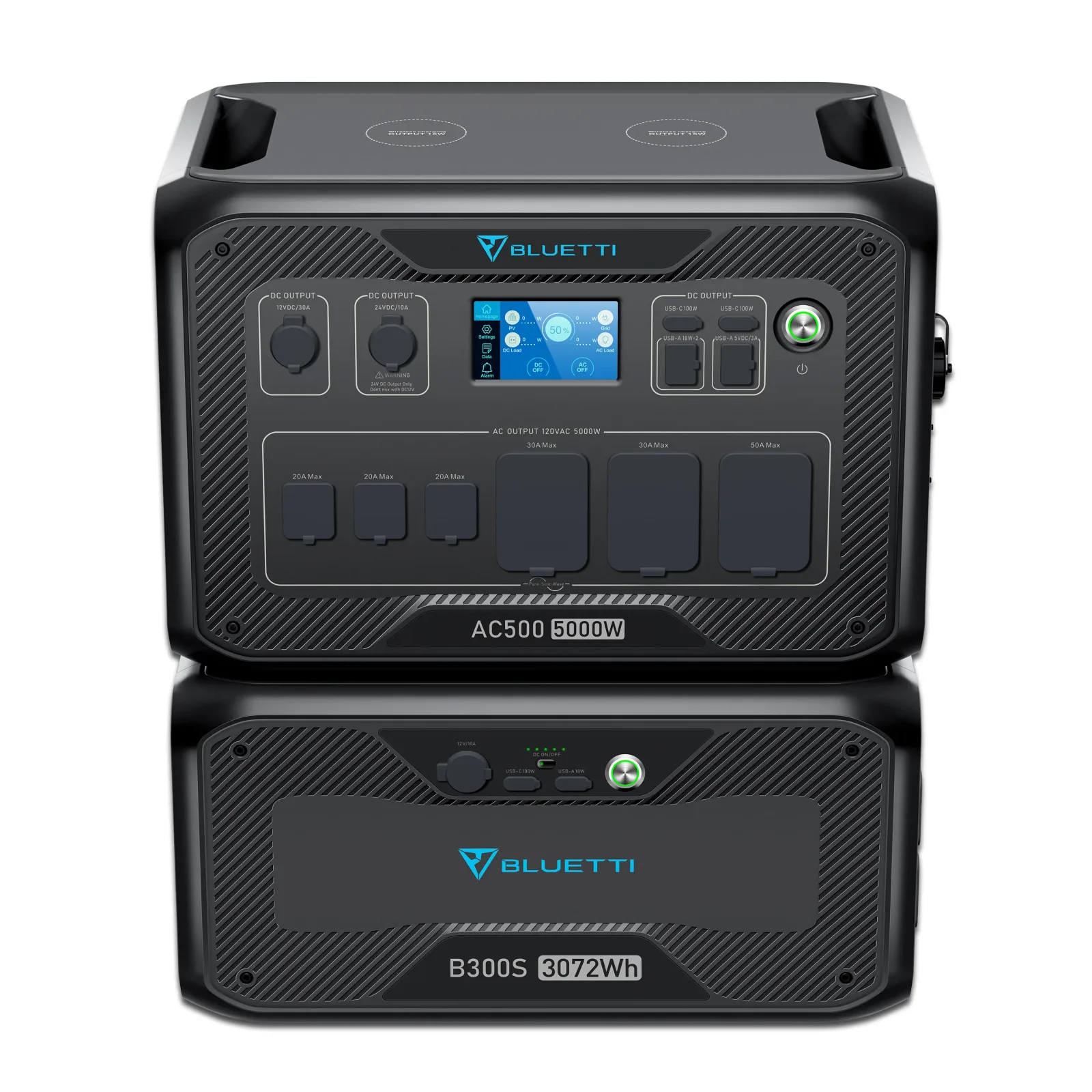
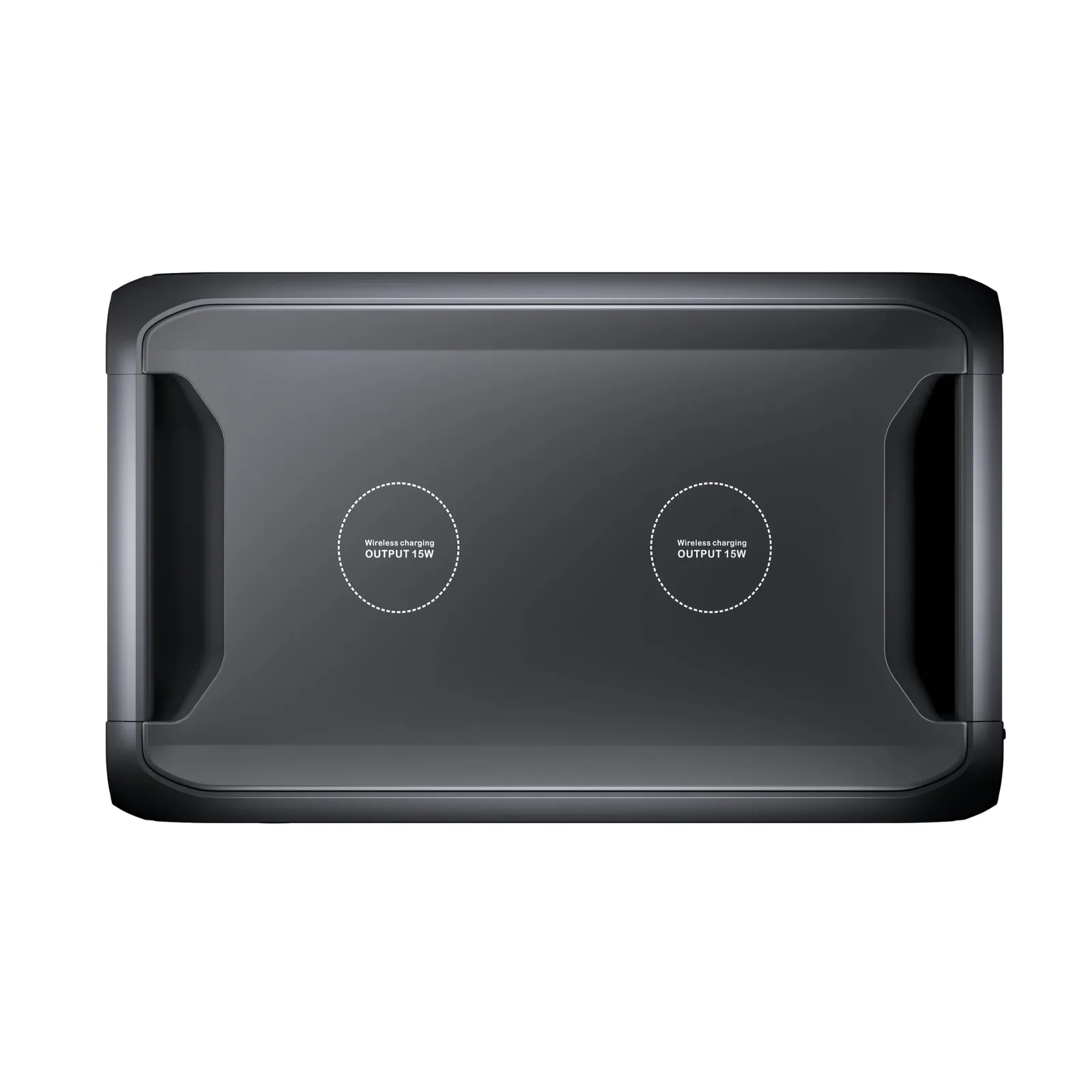
The AC500’s physical design is dominated by its role as stationary equipment. You get a large control head with a display, high-current AC connections, charging electronics, and a battery port. The B300S supplies the energy storage and adds its own DC and USB outputs. That separation lets you move the battery and inverter independently, but it does not make the system light. One head plus one battery is already a substantial installation; adding a second or third battery turns a “portable” station into equipment better moved with a cart.
BLUETTI product page (Manufacturer product image)
The port selection is more useful than the usual collection of USB sockets. BLUETTI lists 120V receptacles alongside 30A, L14-30, and 50A connections, which gives the AC500 a plausible path into an RV or a properly installed selected-circuit backup panel. Those connectors are also a warning: this is not just a weekend cooler-and-laptop product. A transfer switch must isolate a home from the grid, and permanent wiring belongs with a qualified electrician. Never backfeed a household panel through an improvised cable.
The front display and BLUETTI app are valuable because the system can be spread across a garage, utility room, or RV compartment. Monitoring input, output, state of charge, and charging behavior remotely is more useful here than on a small station that sits beside your chair. The interface cannot remove the physical friction, though. Batteries must be connected, cables must be routed cleanly, and the units need ventilation and a dry storage location.
Battery Architecture and Expansion
The AC500’s battery flexibility is its best reason to exist. The B300S is a 3,072Wh LiFePO4 battery, and BLUETTI’s catalog offers configurations with one, two, or three B300S packs: 3,072Wh, 6,144Wh, or 9,216Wh. The batteries are not a hidden accessory; they are the system. A single AC500 without one is effectively an expensive control box.
BLUETTI product page (Manufacturer product image)
This modularity works well for staged buying. A homeowner can begin with one B300S for refrigeration, networking, lighting, and device charging, then add another pack when a longer outage or heavier daily load justifies it. The same inverter remains in service as storage grows. That is more sensible than replacing an all-in-one station every time your backup plan gets bigger.
There is a ceiling to the value proposition. Each expansion battery adds cost, floor space, cables, and weight. The system’s advertised capacity is also not the same as energy delivered at AC outlets: inverter losses, conversion overhead, reserve settings, and the load itself all reduce usable runtime. A 3,072Wh battery should therefore be treated as a starting energy budget, not a promise of 3,072Wh reaching your appliances.
BLUETTI also supports a two-AC500 arrangement. Its current product materials describe 240V output and up to 33,177.6Wh when two AC500 units are combined with as many as 12 B300K batteries. That is an impressive ceiling, but it belongs to a larger system category with more hardware, more cost, and more installation planning. It should not be confused with what one AC500 and one B300S can do.
Performance and Real-World Use
The headline number is 5,000W of continuous AC output, with a 10,000W peak figure shown in BLUETTI’s current product materials. That is enough inverter capacity for demanding tools, kitchen appliances, pumps, and many well-chosen backup circuits. It also gives motor loads more starting headroom than the 1,000W-to-2,000W stations that dominate ordinary camping shelves.
BLUETTI product page (Manufacturer product image)
Output capability is not the same as unlimited runtime. At a steady 500W load, a 3,072Wh battery contains roughly 6.1 hours of idealized energy before conversion losses and reserve limits. At 1,000W, the same arithmetic drops to about 3.1 hours. Those are planning estimates, not lab results, and actual runtime varies with temperature, battery age, inverter efficiency, and the load’s duty cycle. A refrigerator that cycles on and off can last far longer than a continuously running 500W heater, even though both may be described loosely as “500W appliances.”
The AC500 is most convincing when the load is intermittent but consequential: a refrigerator compressor, sump pump, furnace blower, microwave, or jobsite tool. The large inverter means a buyer is less likely to hit an overload just as a motor starts. It does not make every appliance safe to run. A resistive heater can consume 1,500W or more continuously, while a clothes dryer, range, or central air-conditioner may exceed the system’s practical energy budget even if the startup surge is manageable.
Solar input is unusually ambitious. BLUETTI rates the AC500 for up to 5,000W of solar input, though reaching that figure requires a correctly configured array, favorable sun, and equipment that meets the input voltage and current limits. Solar production is weather-dependent and peaks only during part of the day. The value is not that the unit will always charge at 5,000W; it is that a properly designed array can refill a large battery bank much faster than the 400W-to-800W solar inputs common on smaller stations.
For outage use, treat the AC500 as an EPS/UPS-style backup product rather than assume that every electronic device will tolerate every transfer event. Computers, routers, and networking equipment are sensible candidates, but unusually sensitive equipment should be tested on the exact setup. The AC500 can keep a circuit energized; it cannot guarantee that every device sees a perfect zero-interruption waveform.
Charging, Controls, and Ownership Friction
The fast solar and AC inputs are useful only if the rest of the installation can support them. A homeowner needs suitable breakers, wiring, panels, and a safe place to manage cables. The 5,000W input rating is an upper bound, not a reason to connect random panels in series. Follow the AC500 and battery manuals for voltage, current, grounding, and operating-temperature limits.
The app’s value is practical rather than glamorous. A large battery system may be out of sight when it is doing its job, and remote status checks can reveal whether the bank is charging, discharging, or sitting at a reserve level. The app is not a substitute for inspecting connections or maintaining a safe installation. It also does not solve the basic ownership question: the more B300S packs you add, the more you are committing to BLUETTI’s battery ecosystem and future accessory availability.
The current catalog price illustrates the platform’s volatility. BLUETTI’s AC500+B300S record showed $2,299 when accessed for this review, but the item was marked unavailable. A listing price is not a permanent street price, and a discontinued or intermittently stocked bundle should not be compared with a continuously available competitor on price alone. Verify the exact battery, cable, warranty, and home-integration components before buying.
AC500 vs. the Alternatives
The EcoFlow DELTA Pro is the more straightforward rival for a buyer who wants a single battery-integrated unit with an expansion path. It is easier to understand at checkout and offers a 240V route through paired equipment, while the AC500 starts with a separate inverter and battery architecture. Choose the AC500 when its 5,000W inverter, high solar-input ceiling, or BLUETTI battery ecosystem is the priority; choose the DELTA Pro when a simpler all-in-one starting point matters more (EcoFlow DELTA Pro).
Anker’s SOLIX F3800 is a better fit for buyers who want a modern whole-home platform with 240V capability in the core product. It is larger and more expensive, but its design is closer to a home battery than to a battery-less inverter head. The AC500 remains attractive when you want to build capacity in smaller steps or already own compatible BLUETTI batteries (Anker SOLIX F3800).
The BLUETTI AC300 is the closest internal comparison. It uses the same broad modular idea but has a 3,000W inverter, so the AC500 is the choice for heavier loads and more solar input. The AC300 makes more sense when its lower output is sufficient and the system can be bought at a meaningfully lower price (BLUETTI AC300).
For ordinary camping, a smaller integrated station such as the EcoFlow DELTA 2 Max or BLUETTI AC200-series is easier to carry, easier to replace, and less likely to leave unused capacity in a closet. The AC500 wins only when its electrical headroom and expansion plan will actually be used.
Who Should Buy the AC500, and Who Should Skip It?
Buy the AC500 if you are planning selected-circuit home backup, an RV installation with high-demand appliances, or an off-grid system that may grow from one battery to several. It is also a good fit for a workshop where a 5,000W inverter and high surge capacity matter more than one-person portability. The modular architecture rewards a buyer who understands wiring, load planning, and the difference between power and energy.
Skip it if you want a grab-and-go camping station, if you cannot safely accommodate large battery modules, or if you need 240V from one inverter today. Skip it too if your backup plan is just a modem, laptop, lights, and a refrigerator: a smaller integrated station will be simpler and may deliver better value. The AC500’s most important feature is headroom, and headroom is waste when your actual loads are modest.
Verdict
The BLUETTI AC500 remains a capable home-backup foundation in 2026, but it is not a universal portable power station. Its 5,000W inverter, 5,000W solar-input ceiling, LiFePO4 expansion batteries, and optional 240V system architecture give it real electrical credibility. The same architecture also makes it bulky, expensive, and demanding to configure.
My recommendation is narrow: buy the AC500 when you are intentionally building a modular backup system and can use its large inverter. Do not buy it because “5,000W” sounds impressive or because you want one convenient box for occasional trips. The AC500 is good infrastructure, not casual luggage. Its age is visible in the 120V limitation of a single unit and the amount of hardware needed to reach whole-home ambitions, but the core proposition still works for the buyer who values expandability over simplicity.
FAQ
Does the AC500 include a battery?
No. The AC500 is the inverter and control unit. It needs a compatible expansion battery such as the B300S before it can store energy or power loads. A bundle described as “AC500+B300S” includes the battery; an AC500-only listing does not.
How much energy does one B300S provide?
BLUETTI lists the B300S at 3,072Wh. That is the battery’s nominal storage figure. AC runtime will be lower after inverter conversion, reserve settings, and the specific load are taken into account.
Can I add more batteries later?
Yes. BLUETTI’s AC500+B300S catalog configurations show one, two, and three B300S batteries, corresponding to 3,072Wh, 6,144Wh, and 9,216Wh. Confirm compatibility before mixing battery generations or buying used accessories.
Can one AC500 provide 240V?
No. One AC500 is a 120V system. BLUETTI’s 240V configuration uses two AC500 units and additional integration hardware. That is a materially larger installation than a single AC500 with one battery.
Can it run a refrigerator?
Usually, yes, provided the refrigerator’s startup demand and running load fit the inverter and the battery is adequately charged. The 5,000W inverter gives substantial headroom, but runtime depends on the refrigerator’s duty cycle and the rest of the connected load.
Can it run a space heater?
It can power many electric heaters, but that does not make the setup efficient. A 1,500W heater can consume about half of a 3,072Wh battery’s idealized energy in roughly one hour before losses. Heating an entire home from batteries is generally a poor use of stored energy.
Is the AC500 portable enough for camping?
It is portable in the broad technical sense, but it is not a comfortable one-person camping station. The head and battery are separate, heavy pieces, and a multi-battery setup is better treated as semi-stationary. Smaller integrated stations are more practical for most campsites.
How much solar can the AC500 accept?
BLUETTI rates the AC500 for up to 5,000W of solar input. That is a maximum under the input limits and conditions in the product documentation, not a guaranteed daily charging rate. Panel voltage, current, sunlight, shading, and wiring all matter.
Does it work as a UPS?
It supports EPS/UPS-style home backup use. Computers, routers, and other ordinary electronics are sensible candidates, but equipment that is unusually sensitive to transfer behavior should be tested on the exact AC500 configuration before an outage.
Can I connect it to my breaker panel?
Only through a properly installed transfer switch or compatible home-integration equipment that prevents backfeed. The AC500’s 30A, L14-30, and 50A connections make selected-circuit integration possible, but panel work should be handled by a qualified electrician.
Is the current catalog price a good deal?
BLUETTI’s catalog showed $2,299 for an AC500+B300S kit when accessed for this review, but the listing was unavailable. Treat that figure as a dated reference, not a promise. Check what battery, cable, warranty, and integration parts are included in the offer you can actually buy.
Is the AC500 still worth buying in 2026?
It is worth considering for a modular home-backup or workshop installation where 5,000W output and expansion matter. It is a weaker choice for casual camping, small emergency loads, or anyone who wants built-in 240V and a simpler setup. Newer platforms are easier to live with; the AC500 still wins on its specific combination of inverter headroom and modularity.