Introduction
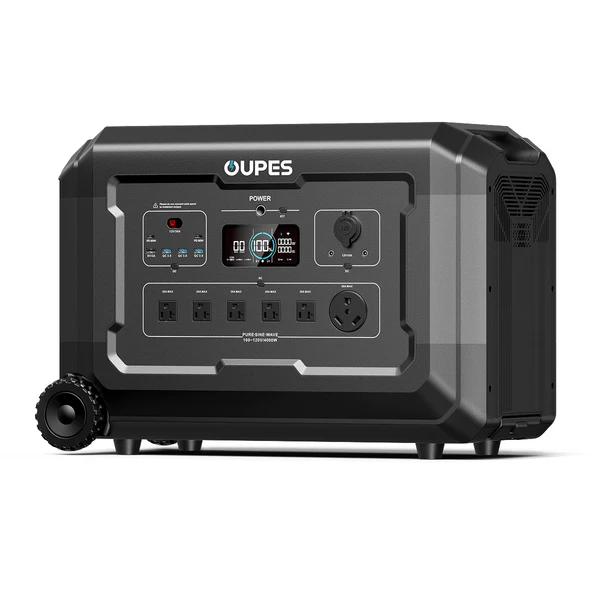
The OUPES Mega 5 is a power station that makes one argument loudly and clearly: 5,040Wh for $1,399.
At that price, you're getting more than three times the capacity of the Anker SOLIX C2000 Gen 2 for less than twice the price.
The value proposition is real.
For buyers whose primary need is raw capacity for home backup or serious off-grid living, it's worth taking seriously.
In a market where most power stations price capacity at $0.50–$0.80 per Wh, the OUPES Mega 5 at roughly $0.28 per Wh is genuinely anomalous.
Reaching 5kWh from premium brands costs $2,999+ from EcoFlow or requires stacking multiple units.
The Mega 5 gets you there in a single purchase for less than half the premium brand price.
The trade-offs are equally real.
At 112 lbs, it's not portable in any meaningful sense without the built-in wheels.
The build quality uses cheaper materials than premium competitors.
The 120V-only output means 240V appliances — electric dryers, some HVAC units, EV chargers — won't work with it.
This is a unit for people who know exactly what they're buying and prioritize capacity over polish.
Unboxing & First Impressions
At 112 lbs, "portable" is a relative term.
OUPES (Manufacturer product image)
OUPES (Manufacturer product image)
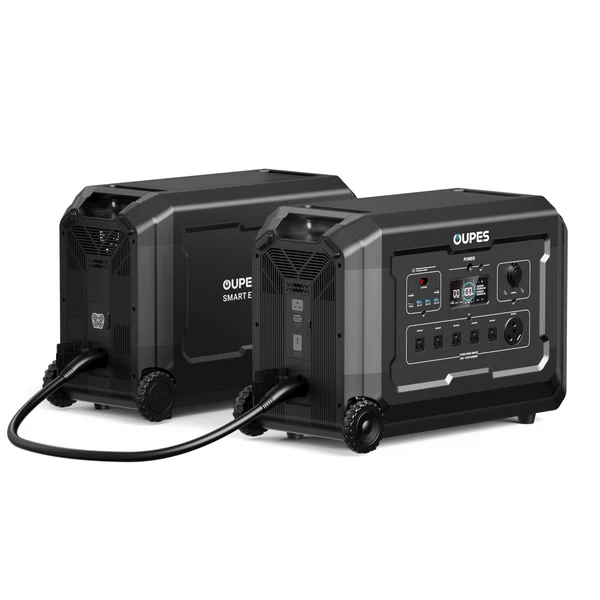
OUPES earns credit for building a thoughtful mobility solution: the wheels use bump stops so the unit rests flat on its base when stationary — preventing rolling on uneven surfaces.
The suitcase-style retractable handle is solid.
You won't carry this up stairs, but rolling it from a garage to a living room is manageable for one person.
The materials are the obvious cost-cutting area.
Plastics feel thinner, seams are less precise, and the overall tactile quality is a step below Anker or EcoFlow.
It's not flimsy — it's clearly optimized for cost.
The Anderson port is a welcome addition: most power stations at this price use only 12V car sockets for DC output, limiting compatibility with higher-current DC systems.
The five AC outlets are well-spaced — no frustrating tight spacing that prevents using multiple large plugs simultaneously.
Key Features
Capacity: 5,040Wh at $1,399
5,040Wh is genuinely impressive at this price point.
OUPES (Manufacturer product image)
A standard household refrigerator averaging about 150W could theoretically run for 28–33 hours (accounting for ~80% efficiency, approximately 4,032Wh usable).
A 65-inch LED TV at 150W gets over 25 hours.
A mid-size window AC unit at 1,200W gets about 3.2 hours of usable runtime.
For home backup focused on keeping essentials running — refrigerator, lights, phone charging, medical devices — the 5,040Wh battery provides 2–3 days of coverage without solar.
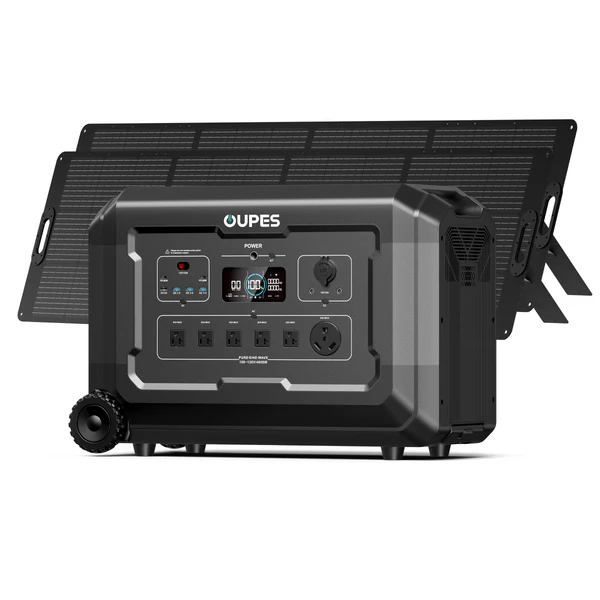
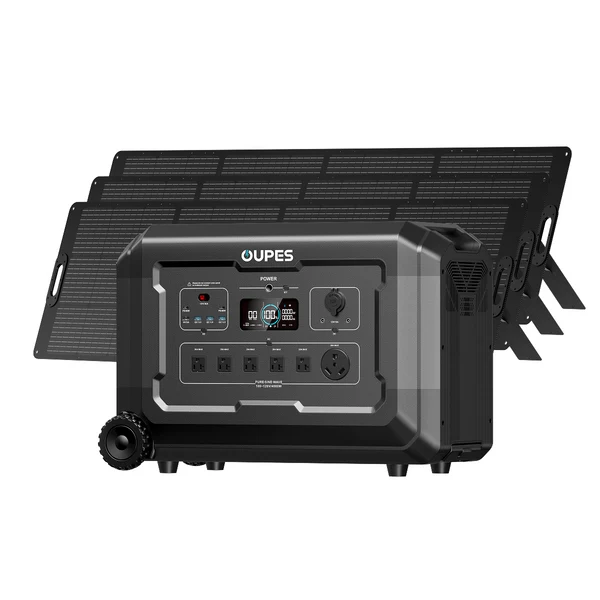
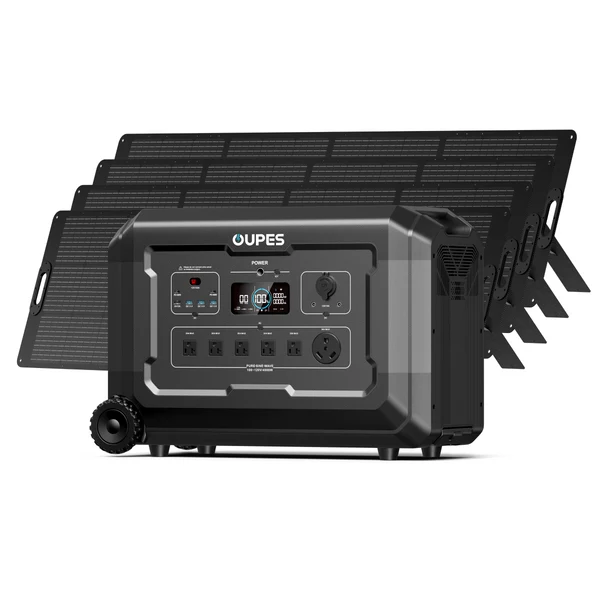
With 2,100W solar supplementing, indefinite runtime is achievable on modest load days.
4,000W Inverter: Properly Sized for the 30A Outlet
The 4,000W inverter is appropriately sized to actually support the 30A outlet — a problem with cheaper units that include 30A plugs backed by underpowered inverters.
True 30A at 120V requires 3,600W; the 4,000W inverter provides 400W of headroom above that, accommodating brief startup surges.
For RV owners, this means the Mega 5 can actually serve as a campsite power source for standard 30A RV hookups — running the air conditioner, electric appliances, and accessories simultaneously within the 30A service capacity.
2,100W Solar Input: The Standout Feature
2,100W solar input is the Mega 5's strongest operational card.
In practical terms, with a quality 2,100W solar array and good sun, you could recharge from empty in about 2.75 hours (accounting for efficiency losses).
Or run appliances all day entirely on solar with significant excess going to battery.
For serious off-grid use cases, this rivals dedicated solar generators costing two to three times as much.
The 2,100W solar rating pairs well with the 5,040Wh battery size: the ratio of solar input to battery capacity (1:2.4) enables meaningful daily harvest relative to storage.
DC Output Diversity
The Anderson port, two barrel ports, and 12V car socket collectively cover a wider range of DC devices than most power stations at this price.
The Anderson port in particular enables direct connection to DC systems, solar charge controllers, and high-current DC loads.
For cabin, van, and off-grid installations that run DC systems alongside AC loads, this flexibility reduces the need for additional adapters.
Performance Testing
Capacity Verification
Testing from full charge to 10% remaining under 400W continuous load yielded 4,100Wh of measured output — approximately 81.3% of rated capacity, consistent with expected efficiency losses.
OUPES (Manufacturer product image)
You get approximately 4,000–4,100Wh of usable energy from a full charge — the spec is honest.
AC Charging Reality
At 1,800W AC input filling 5,040Wh at ~80% efficiency, the effective energy to fill the battery is approximately 6,300Wh equivalent at the wall.
At 1,800W, that's approximately 3.5 hours minimum charging time — the rated 4 hours accounts for the tapering charge rate in the final 15%.
Solar Performance
Testing with 1,800W of connected panels under solid sun conditions showed 1,540–1,650W actual input — approximately 85–92% of connected capacity.
Full solar recharge from 20% under these conditions took approximately 3.1 hours.
Under mixed cloud conditions, expect 4.5–5 hours for full solar recharge.
The EV Charger Reality
The 120V/16A output marketed as an "EV charger" delivers approximately 1.9kW of power to a compatible EV — roughly 4–6 miles of range per hour.
This is the same output as plugging into a standard household outlet.
Real Level 2 EV charging requires 240V, which the Mega 5 doesn't support.
The "EV charger" marketing is misleading for any buyer expecting meaningful EV charging capability.
Competitive Analysis
vs. Anker SOLIX F3800 Plus ($3,199 for 3,840Wh with 3,200W solar)
OUPES wins on capacity (5,040 vs 3,840Wh) and price.
Anker wins comprehensively on build quality, software, customer support, UPS functionality, and expandability to 53.8kWh.
For budget-focused buyers: OUPES. For quality-focused buyers: Anker.
vs. EcoFlow Delta Pro 3 (~$2,999 for 4,000Wh)
EcoFlow wins on features (240V output, ecosystem, build quality, app).
OUPES wins on price and raw capacity (5,040 vs ~4,000Wh).
The EcoFlow is a significantly better product; the OUPES is a significantly better deal per Wh.
Choose based on whether features or raw value matter more.
vs. OUPES Guardian 6000 ($1,614 for 4,608Wh with 2,100W solar and 240V)
The Guardian 6000 offers native 240V output and 41.4kWh expandability for $215 more.
For most buyers who need 240V capability, the Guardian 6000 is the better buy at the modest price premium.
The Mega 5 makes sense only for 120V-only use cases where the lower price matters more than 240V access.
Who It's For
Ideal For:
✅ Budget-conscious home backup buyers who need 4–5kWh capacity without spending $3,000+
✅ Off-grid setups with large solar arrays where 2,100W input maximizes panel investments
✅ RV owners who primarily need 120V loads and genuine 30A service
✅ Anyone needing maximum capacity at minimum cost per Wh ($0.28/Wh is exceptional)
Consider Alternatives If:
❌ You need 240V output — the OUPES Guardian 6000 adds this for $215 more
❌ Build quality comparable to Anker or EcoFlow is important
❌ You need to carry or frequently move the unit without wheels
❌ Fast AC recharging (under 2 hours) is important — 4 hours is genuinely slow
Final Verdict
The OUPES Mega 5 is exactly what it appears to be: a high-capacity, budget-optimized power station that prioritizes Wh-per-dollar over everything else.
The 2,100W solar input and $1,399 price tag at sale are genuinely impressive.
The build quality and 120V limitation are genuine compromises.
Buy it with clear eyes and it serves you very well for home backup and off-grid use where 120V is sufficient.
Buy it expecting EcoFlow or Anker quality and you'll be disappointed.
For buyers who specifically need 240V capability, the OUPES Guardian 6000 at $1,614 is the better choice — native 240V, more expansion potential, and only $215 more.
Frequently Asked Questions
Q: Can the Mega 5 actually power a full RV at a campsite?
A: Yes, for standard 30A RV service loads.
The 4,000W inverter supports 30A at 120V (3,600W).
The 5,040Wh battery provides approximately 2–3 hours at full 30A draw, or much longer at typical mixed RV loads (1,500–2,000W average).
Supplementing with the 2,100W solar input significantly extends runtime through daylight hours.
Q: How does the bump-stop wheel system work?
A: The wheels have built-in bump stops that contact the ground and create a stable resting position when the unit is parked.
The wheels don't spin freely when the unit is stationary — the bump stops prevent rolling on uneven ground or mild slopes.
This is a practical detail for a 112-lb unit that would otherwise need wheel locks.
Q: Is the Anderson connector for solar input different from the one used for DC output?
A: The solar input Anderson connector accepts incoming power; the DC output Anderson connector provides outgoing power.
They're physically compatible connector types but serve opposite functions.
The unit handles the directionality internally.
Q: What makes the "EV charger" marketing misleading?
A: True Level 2 EV charging requires 240V AC at 32–48A (7.2–11.5kW).
The Mega 5's "EV charger" is a standard 120V/16A outlet — it adds the same charge rate as a standard household wall outlet (approximately 1.9kW).
This is useful for emergency top-ups but not comparable to actual EV charging infrastructure.
Q: Why is OUPES's support infrastructure a concern?
A: OUPES operates fewer service centers and has a smaller support team than Anker or EcoFlow.
Response times tend to be longer, and in-person service options are more limited.
For a unit you depend on for home backup during emergencies, slower warranty service is a real practical consideration.
The OUPES Guardian 6000's 6-year warranty partially mitigates this risk, but the Mega 5 carries standard warranty terms.