First look: who this camera is actually built for
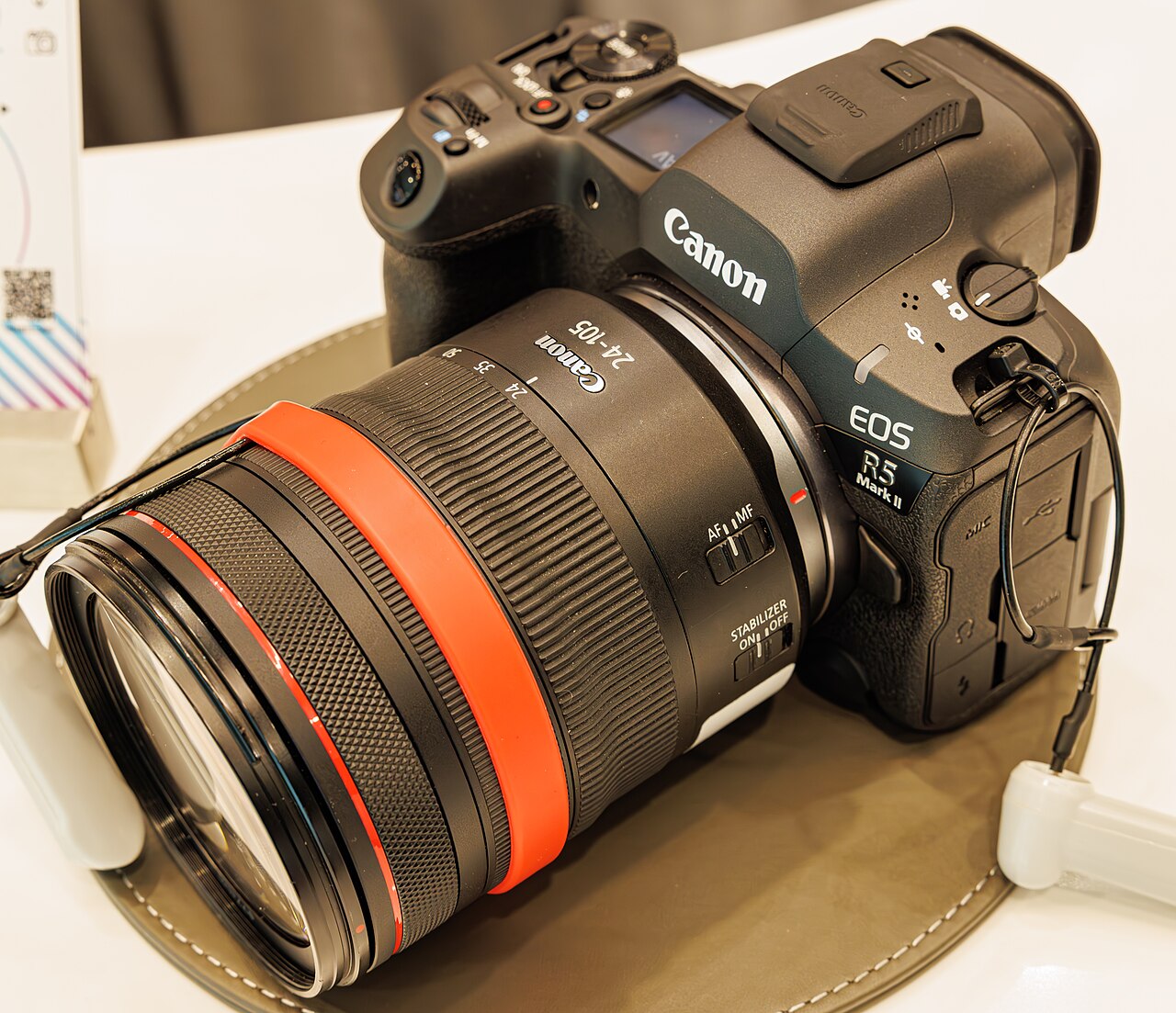
Canon took the 45-megapixel body that photographers loved in 2020 and rebuilt it around a stacked, back-illuminated sensor so it could finally keep up with fast action. That is the whole story of the R5 Mark II. The original R5 was a gorgeous stills camera saddled with a slower readout and a video mode that would tap out on heat before a ceremony ended. This second version keeps the resolution, adds the quick sensor, and borrows the Eye Control autofocus from the pro-grade R3. The buyer it courts is the person who refuses to own two bodies: someone who shoots a wedding on Saturday, a youth soccer match on Sunday, and a catalog product spread on Monday, and wants one camera that says yes to all three.
GodeNehler / Wikimedia Commons (CC BY-SA 4.0)
It mostly earns that ambition. But the sticker reads $4,299 body-only, which is $300 above where the first R5 arrived, and that puts it in a bracket where a Nikon Z8 undercuts it by several hundred dollars while doing much of the same work. This is not a casual upgrade. If you already own an R5 and mostly shoot portraits or landscapes, the Mark II will not transform your photos. Its case is built almost entirely on speed and on fixing old frustrations, so the question is whether those frustrations were yours.
Build, controls, and the thermal design question
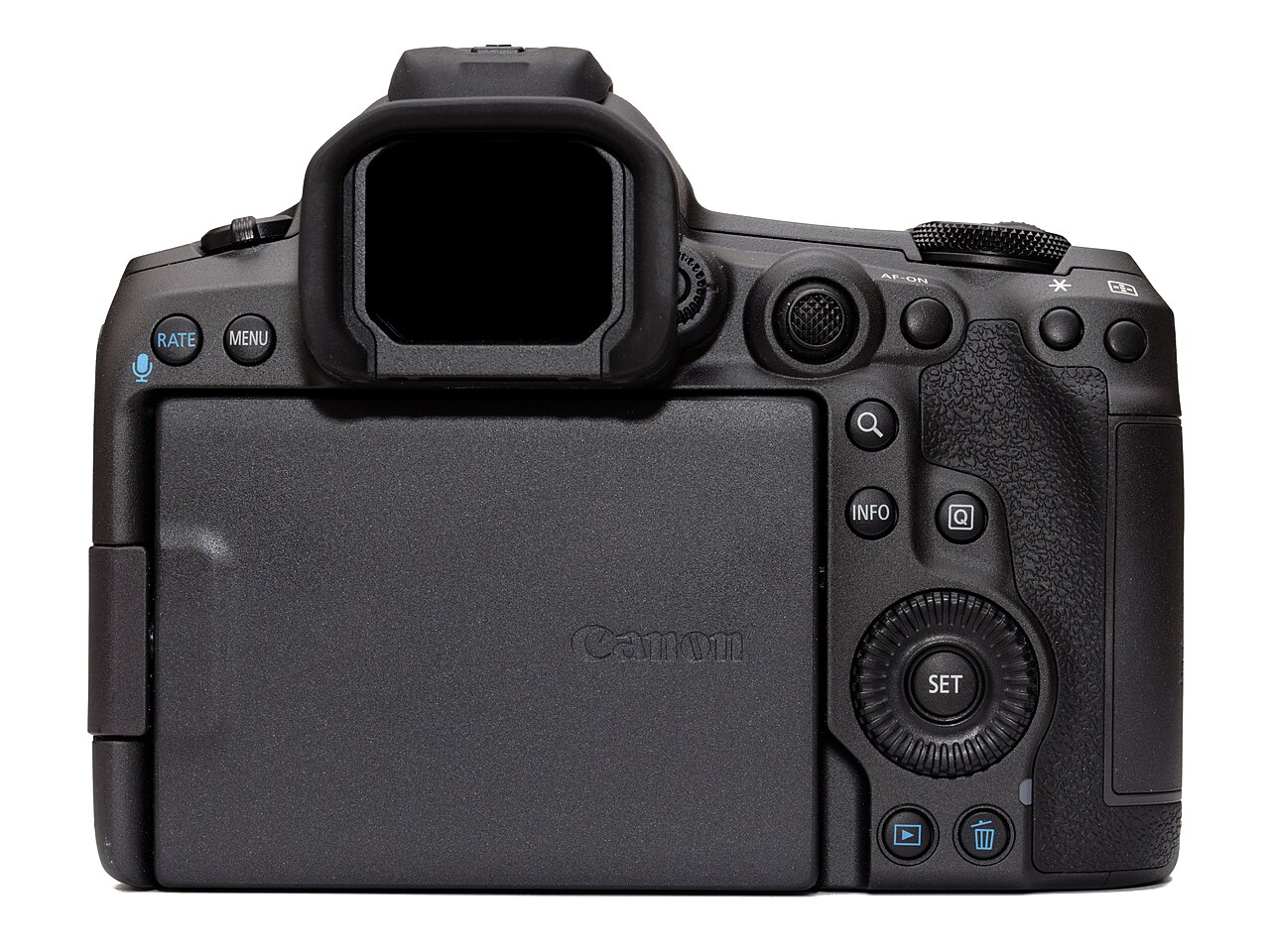
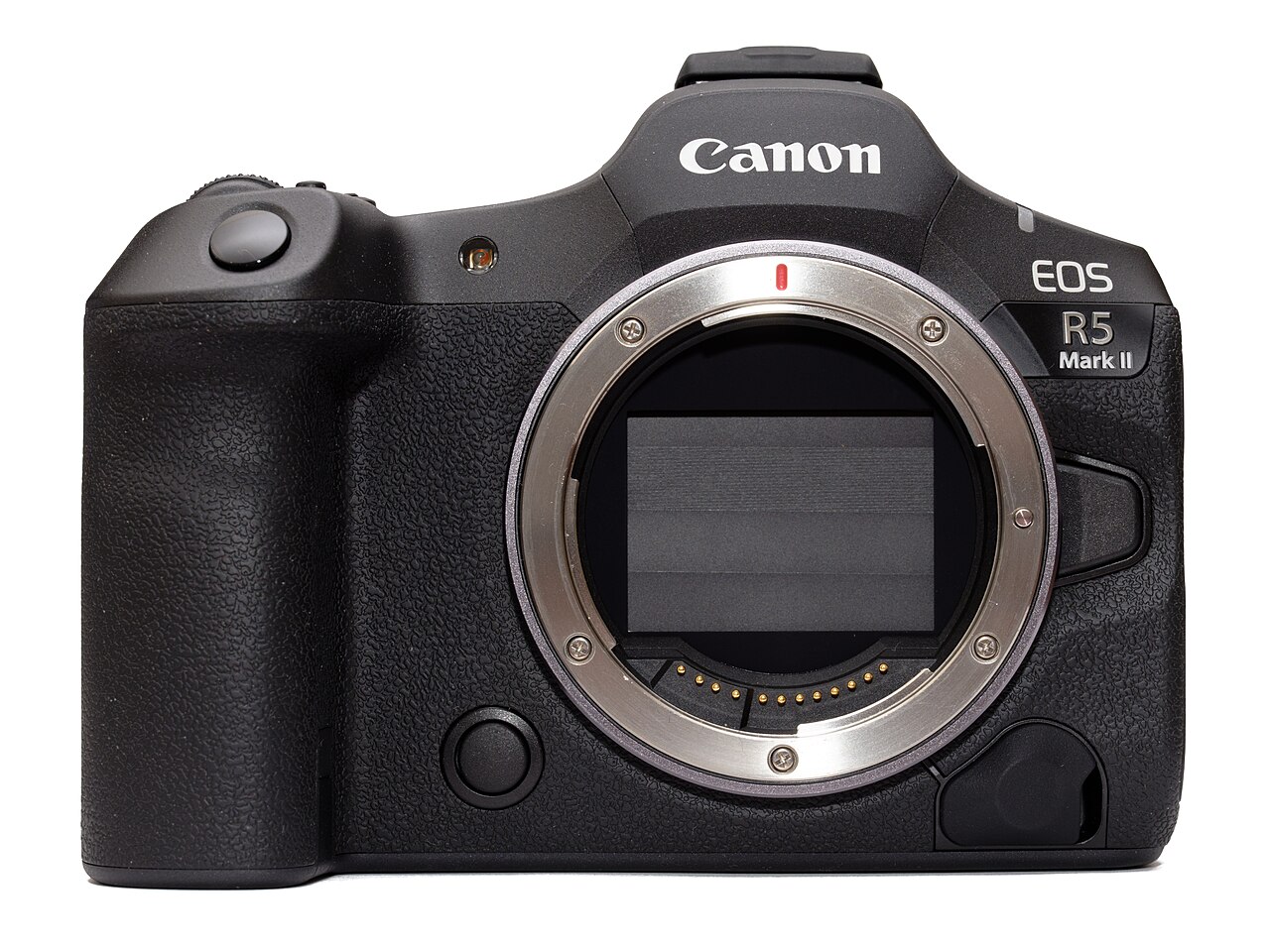
Pick it up and the R5 Mark II feels like a Canon pro body, because it essentially is one. It weighs roughly 746 grams with a card and battery, the magnesium-alloy chassis carries the same weather sealing Canon has trusted for years, and the grip suits larger hands better than any mirrorless rival short of the R3. The control layout will be muscle memory for anyone coming from an R5 or R6: the top mode dial, the smart controller nub on the rear, the customizable multi-function bar's absence in favor of proper buttons. Canon did not reinvent the ergonomics, and that restraint is the right call.
D. Benjamin Miller / Wikimedia Commons (CC0)
Two changes matter. The first is a new battery. The R5 Mark II runs on the LP-E6P, a higher-output cell that the older LP-E6NH cannot fully replace for the demanding drive modes — your old batteries will work, but not at the camera's peak. Canon rates it for roughly 340 frames through the viewfinder and about 630 using the rear screen under CIPA testing, and in real bursts you will empty a pack faster than those numbers suggest because the stacked sensor and heavy processing are power-hungry. Carry two spares. The second change is thermal: Canon redesigned the internal heat path and offers a clip-on cooling fan grip, the CF-R20EP, for video shooters who intend to roll long takes.
Card slots are split, one CFexpress Type B and one SD UHS-II. That mismatch is deliberate and slightly annoying: the high-frame-rate RAW bursts and 8K RAW essentially demand the CFexpress card, so the SD slot becomes an overflow or backup rather than an equal partner. Budget for a fast CFexpress Type B card, because a slow one throttles the camera you paid a premium to get.
Autofocus, Eye Control, and burst speed
The stacked sensor unlocks up to 30 frames per second in electronic shutter with full 45-megapixel RAW, and paired with a CFexpress card the buffer runs deep enough that you rarely think about it during a match. Rolling-shutter skew, the curse of the original R5's electronic shutter, is dramatically reduced here, so panning shots of cars or birds no longer lean like a funhouse mirror. Mechanical shutter tops out lower, around 12 frames per second, and most action shooters will simply live on the silent electronic mode.
GodeNehler / Wikimedia Commons (CC BY-SA 4.0)
Dual Pixel CMOS AF II with subject recognition is the reason to buy this over a cheaper Canon. It locks onto people, animals, and vehicles with the kind of tenacity that makes you trust it, and a new "Action Priority" mode for team sports tries to guess which player will receive the ball. Eye Control AF, which moves the focus point to wherever you are looking in the viewfinder, is the headline trick — and the honest caveat. When it calibrates to your eye it feels like magic; when it doesn't, it feels like a gimmick. Glasses wearers, people with strong astigmatism, and left-eye shooters report inconsistent results, and there is no guarantee it will read your eye well until you try it. Treat it as a bonus, not a reason to buy.
Image quality and the 8K heat story
At base ISO the 45-megapixel files are everything Canon's color science reputation promises: skin tones that need almost no correction, generous latitude for recovering highlights at a wedding, and enough resolution to crop hard and still print large. Dynamic range at base is very good, though a stacked sensor trades a sliver of it against a conventional design, so pixel-peepers pulling extreme shadow lifts will find marginally more noise than a non-stacked 45-megapixel chip would show. In normal use you will not notice.
Dinkun Chen / Wikimedia Commons (CC BY-SA 4.0)
Video is where the Mark II settles an old score. It records 8K up to 30p and 4K up to 120p, with Canon Log 3 for grading and RAW options for people who want them. The original R5 became notorious for overheating and shutting down mid-8K; this one runs meaningfully longer thanks to the reworked heat path, and with the CF-R20EP fan grip attached it can hold long 8K takes in a way its predecessor never could. It is not thermally infinite. In a hot room, with no fan, recording 8K continuously, you can still hit a limit — just far later than before. For a wedding ceremony shot in 4K, overheating is essentially a non-issue now.
How it stacks up: Nikon Z8, Sony A1 II, and A7R V
The Nikon Z8 is the R5 Mark II's most dangerous rival. It uses the same stacked 45-megapixel class of sensor, shoots internal RAW video, has arguably a stiffer build with dual CFexpress slots, and typically sells for less. If you have no lens loyalty and want the most camera per dollar, the Z8 is the harder-nosed value. Canon's answers are Eye Control, superior in-hand ergonomics for many, and the RF lens ecosystem's excellent teleconverter-friendly telephotos.
Sony's A1 II sits above, faster and pricier, and only makes sense if your work truly needs its blend of resolution and speed and you are already invested in E-mount glass. The Sony A7R V goes the opposite direction: 61 megapixels, no stacked readout, built for landscape and studio shooters who want maximum detail and do not care about 30-frame bursts. Choose the A7R V if resolution is your religion and action is a footnote; choose the R5 Mark II if you need one body that shifts from stills to fast action to serious video without flinching.
Who should buy it, and who should skip it
Buy the R5 Mark II if you are a working hybrid shooter who genuinely uses both stills and video for money, if you shoot sports or wildlife and want the resolution to crop, or if you are deep in RF glass and want Canon's best all-rounder. It rewards people who will actually push its speed.
Skip it if you own the original R5 and shoot mainly portraits, products, or landscapes — you would be paying $4,299 for a faster sensor you rarely stress. Skip it if you are a stills-only landscape shooter, where the A7R V or a used high-resolution body gives you more pixels for less. And skip it if the Eye Control feature is your main reason for interest, because there is a real chance it will not calibrate well to your eye. This is a specialist's tool priced like one.
Verdict
The R5 Mark II is the camera the first R5 always wanted to be: the resolution stayed, the speed arrived, and the overheating that dogged its 8K largely got solved. It is genuinely one of the most capable do-everything bodies on the market. It is also expensive, power-hungry in its best modes, and sold on features — Eye Control chief among them — that not every buyer will be able to use. Get it if you will lean on its speed and video hard enough to justify the outlay. If you won't, Canon makes cheaper cameras that will make your photos look nearly identical.
FAQ
Will the R5 Mark II overheat recording 8K through a full wedding ceremony?
For 8K specifically, in a warm room without the accessory fan, you can still reach a thermal limit on a very long continuous take, though far later than the original R5 managed. Most wedding shooters record ceremonies in 4K, where overheating is effectively a non-issue. If you insist on continuous 8K for long events, buy the CF-R20EP cooling grip and the problem largely disappears.
Can I keep using my old LP-E6NH batteries?
Yes, they physically fit and power the camera for general shooting, but they cannot deliver the full output the new LP-E6P provides, so the most demanding high-speed drive modes are restricted. For full performance you need the LP-E6P cells, and you should carry at least two given how quickly fast bursts drain a charge.
Do I need CFexpress cards, or will SD do?
You need at least one CFexpress Type B card. The 30-frame-per-second RAW bursts and 8K RAW essentially require it; the single SD UHS-II slot is best treated as backup or overflow. A slow card will bottleneck the exact performance you paid for.
Is the image quality actually better than the original R5?
For static subjects, no meaningfully so — both are 45-megapixel Canon sensors with lovely color. The Mark II's advantage is speed: faster readout, far less rolling-shutter distortion, and deeper high-speed buffering. If you never shoot action, the upgrade barely touches your image quality.
Does Eye Control AF work for everyone?
No, and this is the honest catch. It calibrates to your individual eye and works beautifully for some shooters, but glasses, astigmatism, and left-eye shooting can all degrade it. Try it before you rely on it, and never buy the camera solely for this feature.
How does it compare to the Nikon Z8 for the money?
The Z8 usually costs less, uses a similar stacked 45-megapixel sensor, and offers dual CFexpress slots and strong internal RAW video. If you have no system loyalty, it is the tougher value. The R5 Mark II counters with Eye Control, Canon's color and ergonomics, and RF telephotos.
Is the stacked sensor worse for dynamic range than a normal one?
Slightly, at the extremes. Stacked designs give up a small amount of base-ISO latitude compared with conventional sensors, so aggressive shadow lifts show marginally more noise. In ordinary shooting and normal grading, you will not see it.
What lenses should a new buyer plan for?
Canon's RF mount is the commitment here. The RF 24-70mm f/2.8 and 70-200mm f/2.8 cover most professional work, and the RF 100-500mm suits wildlife and sports. Note that Canon has restricted third-party full-frame autofocus RF lenses, so budget for Canon's own glass, which is excellent but not cheap.