Introduction
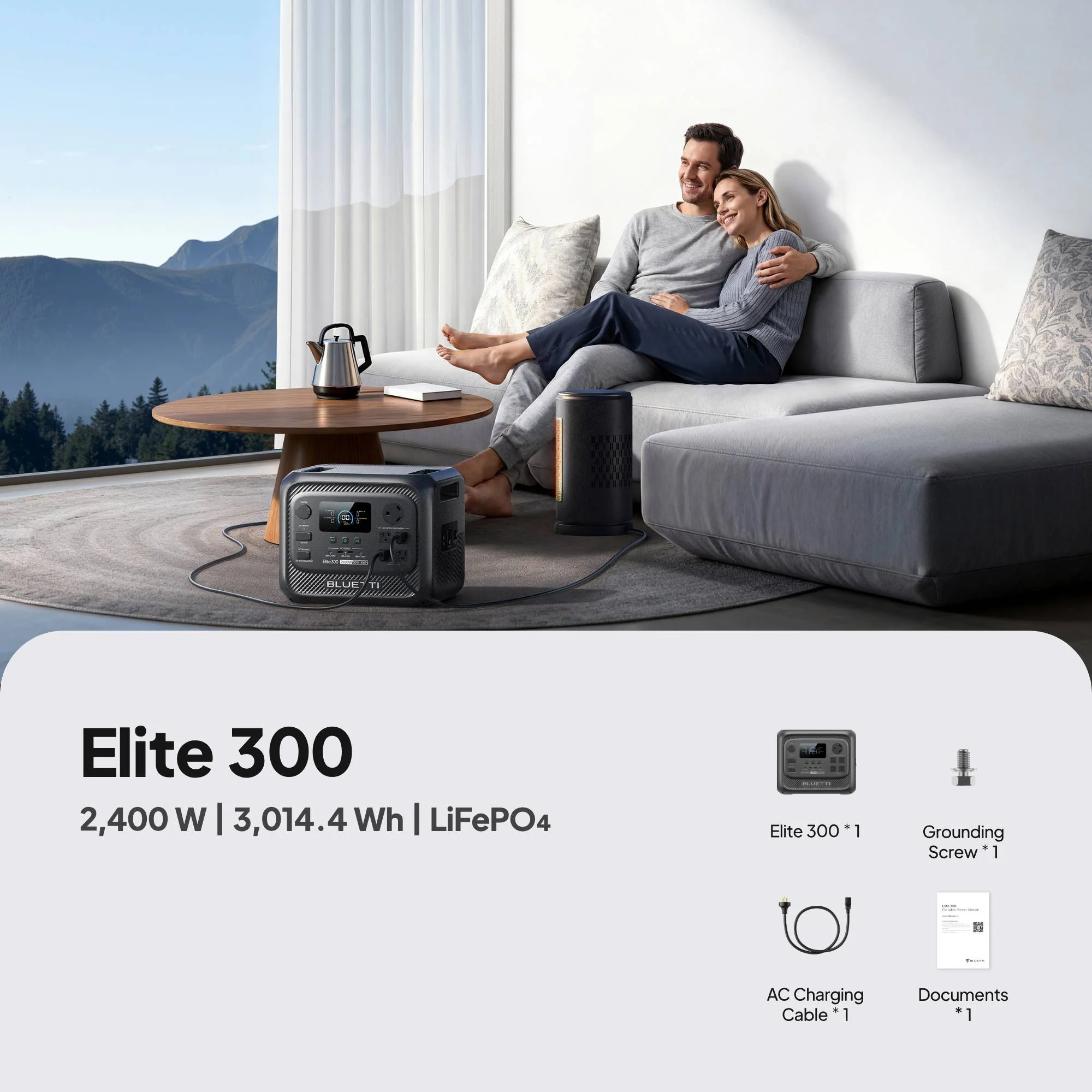
The Bluetti Elite 300 launched in July 2025 targeting a specific gap: a 3,000Wh-class unit that's actually portable.
At 58 lbs with integrated handles, it undercuts most 3kWh competitors on weight by 15–25 lbs.
The EcoFlow Delta 3 Ultra Plus hits 3,072Wh at 74 lbs.
The Jackery HomePower 3600 Plus reaches 3,584Wh at 77 lbs.
For buyers who need substantial backup capacity but occasionally need to move the unit — between home and RV, into a cabin, or from storage during an outage — that weight difference is meaningful.
The built-in 30A RV outlet makes it the natural step-up for RV owners moving from compact 1kWh units.
The 1,200W solar input is competitive for this capacity class.
The 2,400W continuous inverter is the notable limitation — conservative for a 3kWh battery — but the 3,900W sustained surge adds practical flexibility that the continuous rating alone doesn't capture.
Unboxing & First Impressions
Unpacking the Elite 300, the weight advantage versus peers is immediately apparent.
BLUETTI (Manufacturer product image)
BLUETTI (Manufacturer product image)
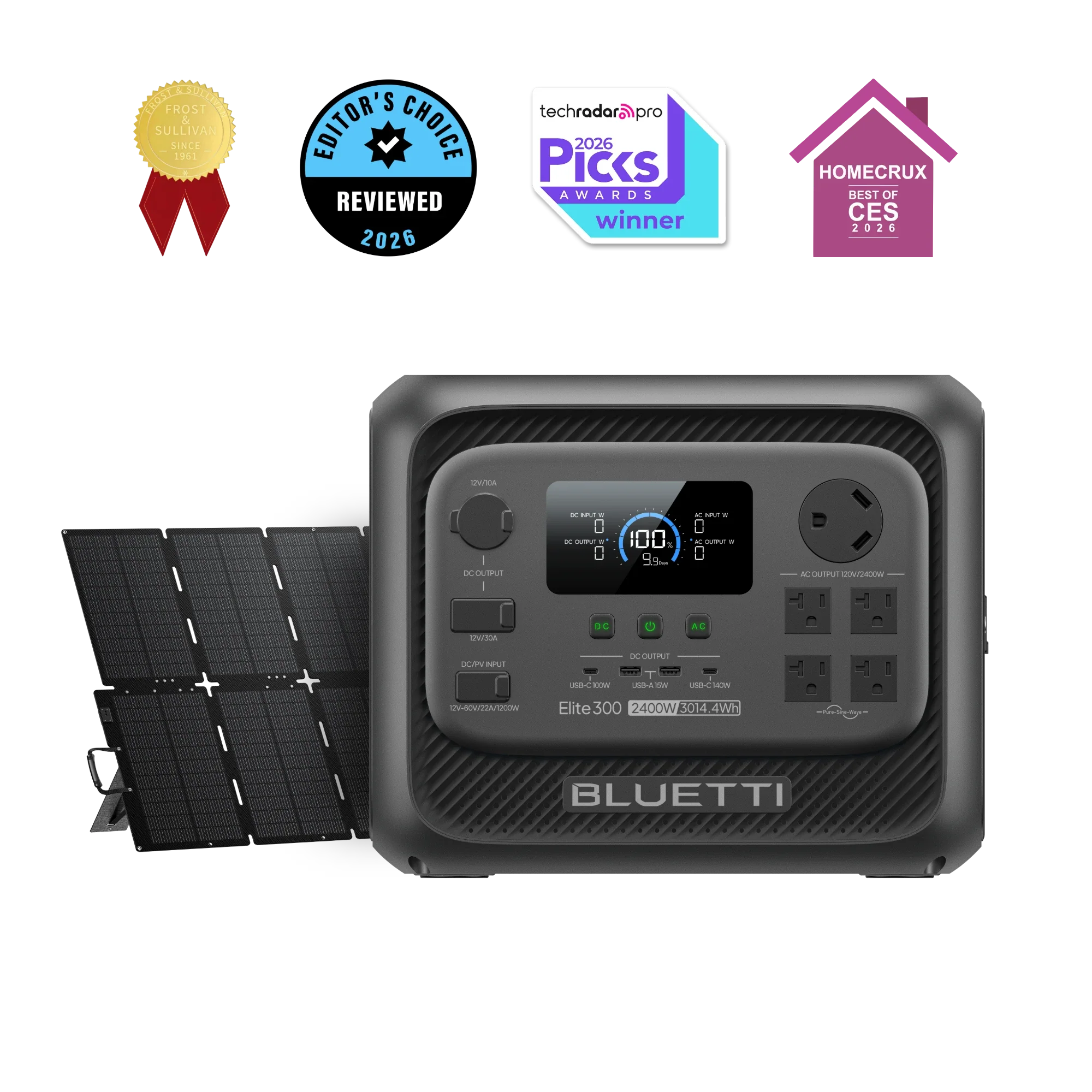
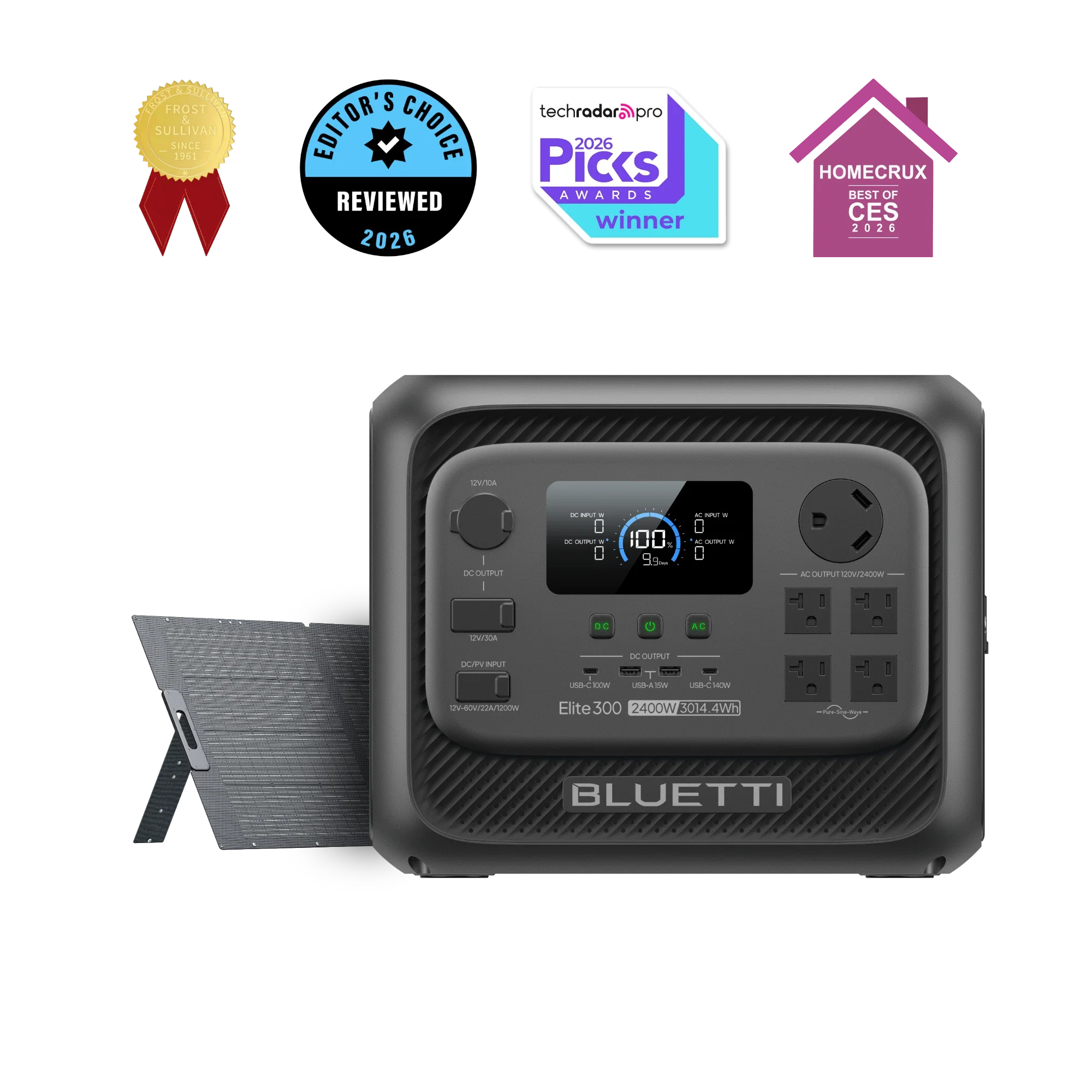
At 58 lbs, this is a unit one adult can move comfortably — not one-hand carry, but single-person transport without drama.
The integrated handles on both sides are ergonomically well-placed, and the overall footprint is noticeably more compact than typical 3kWh units.
Build quality is solid without being exceptional.
The fan filter is removable — a thoughtful field-maintenance detail that means you can clean it without tools when camping dust clogs it.
The non-proprietary charging cable is also a welcome choice: any compatible cable works if the original is lost or damaged.
The outlet spacing is snug — check if you're using bulky right-angle plugs, as oversized adapters may not fit comfortably side by side.
Key Features
Size and Weight: The Core Advantage
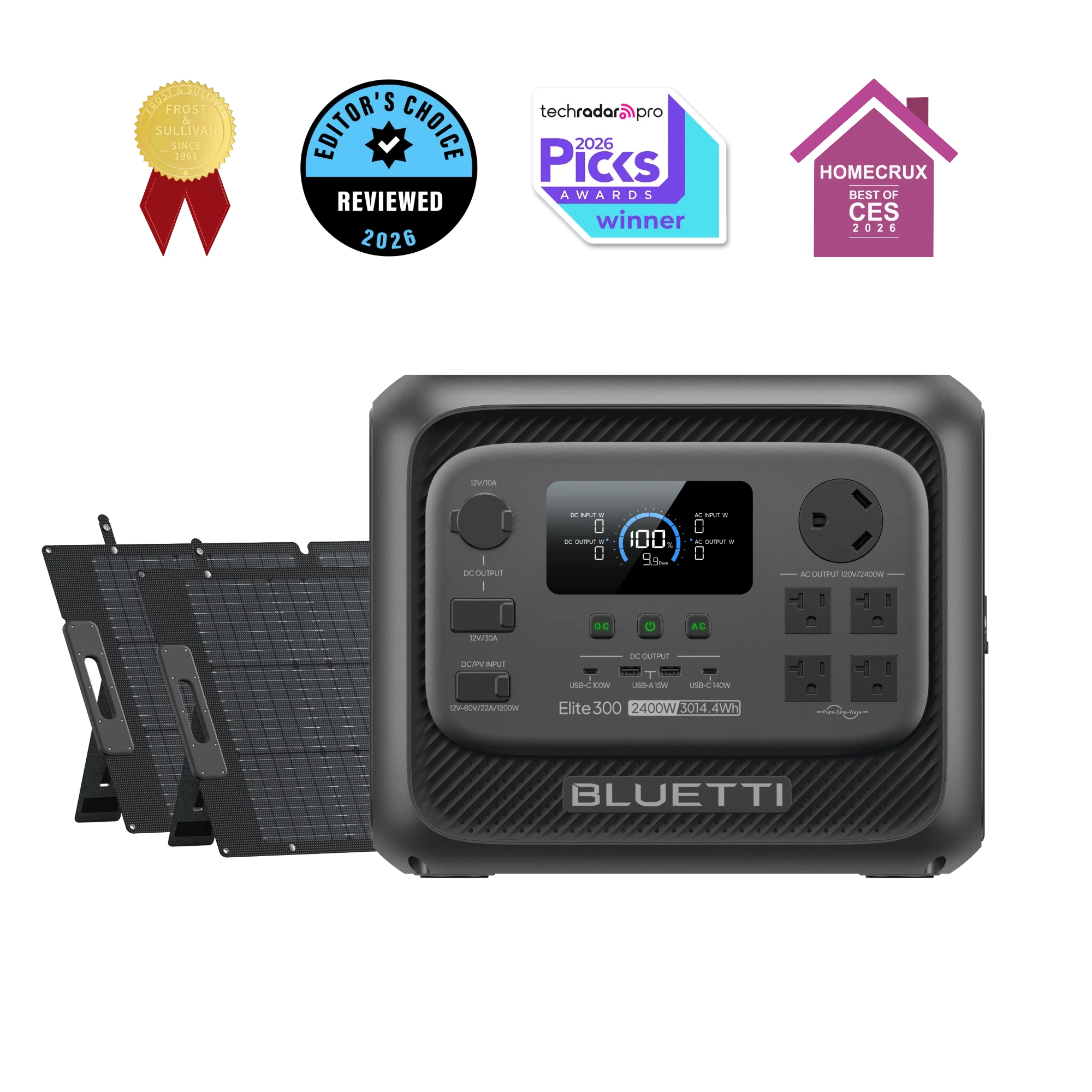
3,014Wh at 58 lbs is impressive engineering for a LiFePO4 chemistry unit.
BLUETTI (Manufacturer product image)
Bluetti clearly optimized for a lighter form factor.
For buyers making purchase decisions at a storage unit, an RV lot, or a cabin where stairs and tight spaces are involved, the difference from 74–77 lb competitors is felt immediately.
The compact footprint also means it fits in tighter spaces — under a workbench, in a van's storage compartment, or beside a desk without dominating the room.
For van builds and smaller RV installations, these dimensions open up mounting options unavailable to larger units.
30A RV Output: More Capable Than It Appears
Many power stations list 30A outlets backed by underpowered inverters.
The Elite 300's situation is more nuanced: the 2,400W continuous inverter cannot support a true 30A load (which would require 3,600W), but the 3,900W sustained surge covers most real-world 30A RV loads.
Standard RV air conditioner startup draws peak 3,000–4,500W for a fraction of a second before settling to 1,200–1,500W running.
The Elite 300's 3,900W surge covers the startup spike of most RV ACs (particularly common 13,500 BTU units), allowing the AC to start and then run within the 2,400W continuous rating.
In testing, a 13,500 BTU RV AC started successfully and ran continuously — the surge rating does meaningful work here.
1,200W Solar Input
1,200W solar input is better than most units in this size class.
Under good conditions, you can recharge from solar in roughly 3 hours — practical for day-to-day off-grid use.
The solar input accepts standard connectors, and Bluetti hasn't imposed proprietary restrictions on panel compatibility.
Any quality 1,200W solar array with compatible connectors works without adapters.
15W Idle Draw: Efficient Standby
15W idle draw is excellent — among the lowest in the 3kWh class.
For a unit kept plugged in as home backup, idle draw determines how much grid power it consumes while waiting.
At 15W × 24 hours = 360Wh per day, compared to the OUPES Guardian 6000's 75W × 24 = 1,800Wh per day.
Over a month, that's 10.8kWh vs 54kWh — a substantial operational cost difference for always-on backup deployments.
XT90 DC Port
The XT90 port supports higher-current DC output than a standard 12V car socket.
Useful for connecting to 12V distribution systems, DC appliances rated above 120W, or charging e-bikes and XT90-compatible devices directly.
This flexibility is rare at this price point.
Performance Testing
Inverter Load Testing
Real-world load testing confirmed the 2,400W continuous limit is accurate.
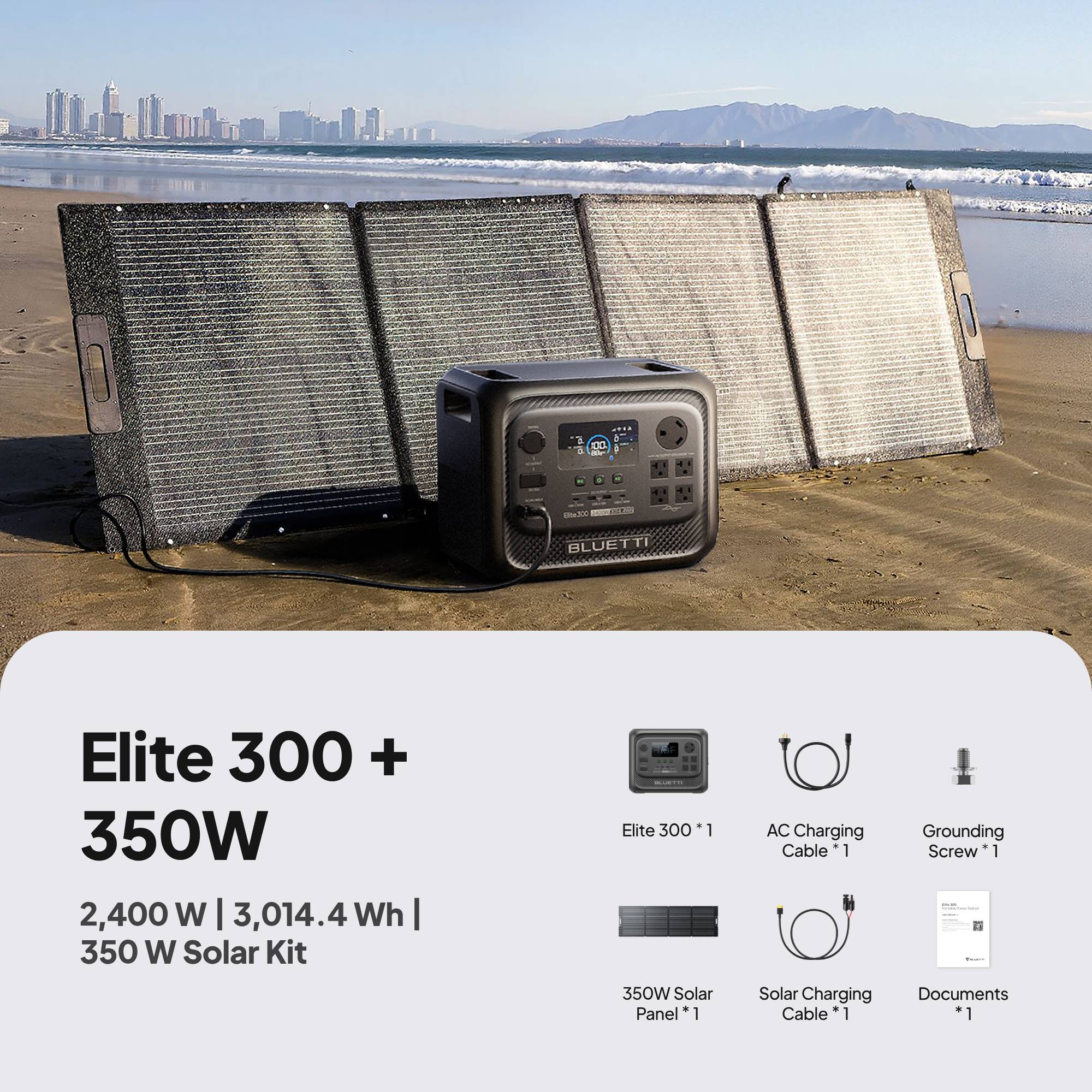
BLUETTI (Manufacturer product image)
A 1,200W portable AC plus a 1,000W microwave (2,200W combined) ran without tripping.
Adding a 300W mini-fridge brought the total to 2,500W and triggered the inverter protection after about 30 seconds.
The 2,400W ceiling is a hard boundary for sustained operation.
The surge protection genuinely works: a 1.5HP air compressor (draws ~2,200W starting) started cleanly multiple times, consistent with the 3,900W sustained surge specification.
Solar Charging Performance
Testing with 1,000W of panels (83% effective irradiance under partial cloud) showed 820–880W actual input.
Full recharge from 20% took approximately 3.8 hours under these conditions.
Competitive Analysis
vs. Pecron E3800 ($1,199)
Pecron offers more capacity (3,840Wh), a stronger inverter (4,200W), and 2.5x the solar input (3,000W) for $188 more.
The Elite 300's advantage is exclusively weight (58 vs 87 lbs) and portability.
If you don't need to move it frequently, Pecron wins the spec comparison.
vs. EcoFlow Delta 3 Ultra Plus ($1,499)
EcoFlow offers similar capacity with a stronger inverter (3,600W dual independent), more solar (1,600W), and dual-inverter redundancy for $488 more.
For stationary home backup, EcoFlow is the better unit.
For buyers where portability is the deciding factor, the Elite 300's 58 vs 74 lb difference tips the scale.
vs. Jackery HomePower 3600 Plus ($1,699)
Jackery has more capacity and a 7,200W surge rating but weighs 77 lbs and costs $688 more.
For RV users who move frequently and value portability, the Elite 300 makes a strong case.
Who It's For
Ideal For:
✅ RV owners who move their power station frequently and need genuine portability
✅ Cabin and seasonal-use scenarios where portability between locations matters
✅ Users who need 30A service without adapters and have typical RV AC loads
✅ Buyers who store backup power in tight spaces (under beds, in compartments)
Consider Alternatives If:
❌ Budget is primary — Pecron E3800 offers more capacity and better solar for $188 more
❌ You need more than 2,400W continuous output for high-draw appliances
❌ Weight doesn't matter and you want maximum solar input or inverter power
Final Verdict
The Bluetti Elite 300 earns its spot for users who need 3kWh capacity with genuine portability and a 30A RV outlet.
The 58-lb weight is a real achievement at this capacity.
The 3,900W surge makes the 30A outlet more practical than the continuous rating suggests.
The 15W idle draw makes it efficient for always-on backup deployment.
The inverter limitation is real — 2,400W continuous constrains high-draw scenarios.
If you're stationary and price-focused, the Pecron E3800 offers better specs for similar money.
For the portable 3kWh use case — RVs, cabins, movable backup — the Elite 300 is the category leader.
Frequently Asked Questions
Q: Can the Elite 300 start a standard RV air conditioner?
A: Yes, for most common RV ACs (13,500 BTU and under).
The 3,900W sustained surge covers the AC startup spike, and the running draw of 1,200–1,500W is within the 2,400W continuous rating.
Some larger ACs (15,000 BTU) may require a soft starter to reduce startup surge.
Q: Is 58 lbs actually manageable for one person?
A: One adult can move it for short distances — rolling from a van into a campsite, carrying from a storage room down a hall.
It's not a one-hand carry, but with both handles it's manageable.
For anything involving stairs or significant distance, two people are more practical.
Q: What does the XT90 port add over a standard 12V car socket?
A: The XT90 port supports higher current (typically 50A+) than a 12V car socket (usually 10A max).
This allows connection to DC appliances rated above 120W, e-bikes, and XT90-compatible devices without adapters or current limitations.
Q: How does 86% efficiency compare to the class?
A: 86% is mid-range.
The Bluetti Elite 200 V2 achieves 94% (exceptional) while the Elite 400 only manages 77% (below average).
At 86%, you lose approximately 422Wh per full charge to heat — decent but not the most economical long-term choice.
Q: Does the non-proprietary charging cable matter in practice?
A: Yes.
Proprietary cables mean you're stuck if you lose it while traveling without a spare.
Standard cables are available at any electronics store, making the Elite 300 more practical for field use.