Introduction
Most portable power stations ask you to accept a hard ceiling: the capacity on the box is
the capacity you own for the life of the unit. The Anker SOLIX F3000 is built on the
opposite premise. Its 3,072Wh base pack is the entry point to a modular platform that
stacks to 12,288Wh on a single chassis, pairs with a second unit for 240V, and carries a
UL9540 certification that signals it was engineered as an energy-storage system rather
than a scaled-up battery box. At $1,399.99, it is priced and positioned as infrastructure.
The trade for that ambition is mass and cost. The F3000 weighs 91.5 pounds — a figure that
removes any pretence of casual portability — and the $1,399.99 sticker buys only the base
unit. A meaningful expansion battery, a set of solar panels, or the second unit needed for
240V each add hundreds of dollars more. This is a platform you commit to, not a
plug-and-forget appliance.
The analysis here draws on Anker's published specifications and the competitive field
rather than any hands-on bench testing; figures are Anker's claims unless attributed to a
named outlet. The question worth answering is whether the F3000's scalability and its
strong 3,600W/7,200W inverter justify the weight, the price and the ecosystem lock-in
against rivals like the EcoFlow DELTA 3 Ultra and Anker's own larger F3800.
Design and Build
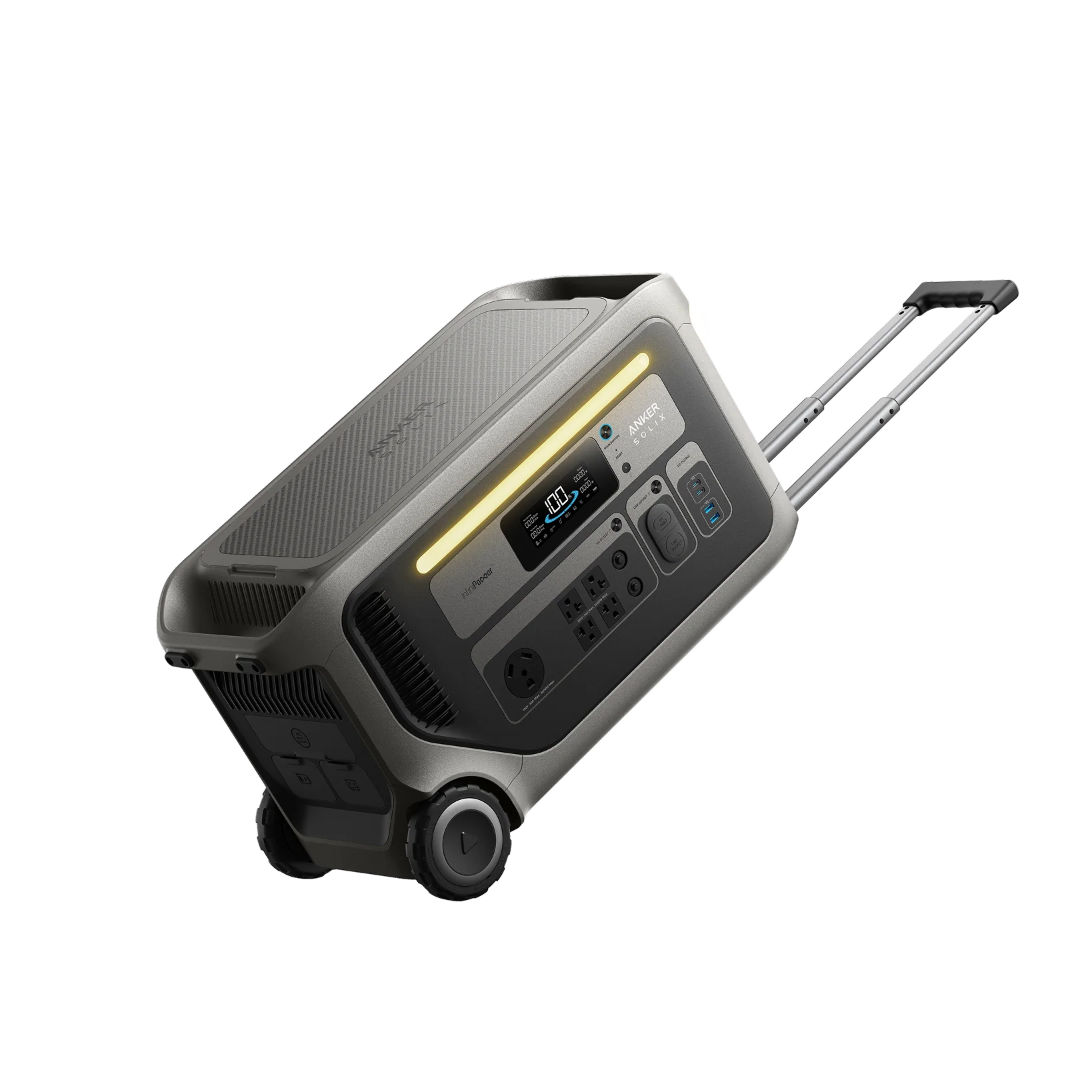
The F3000 is a substantial box: 25.6 by 11.8 by 14.8 inches, with a pair of wheels and a
telescoping handle that betray how Anker expects it to move. You roll this unit; you do not
carry it upstairs one-handed. At 91.5 pounds it is heavier than the F2600 by roughly 22
pounds and heavier than most rivals in its capacity tier, though the wheels make flat
transitions between a garage, a driveway and a vehicle tailgate manageable for one person.
Anker (Manufacturer product image)
Anker (Manufacturer product image)
The construction signal that matters most is not the chassis but the certification. Anker
lists the F3000 as UL9540 certified — the standard for energy-storage systems, covering the
battery, inverter and control electronics as an integrated whole, rather than the narrower
UL enclosure listings that some competitors cite. For anyone considering wiring the unit
into a home, UL9540 is the certification insurers and inspectors tend to ask about, and its
presence is a meaningful point of differentiation.
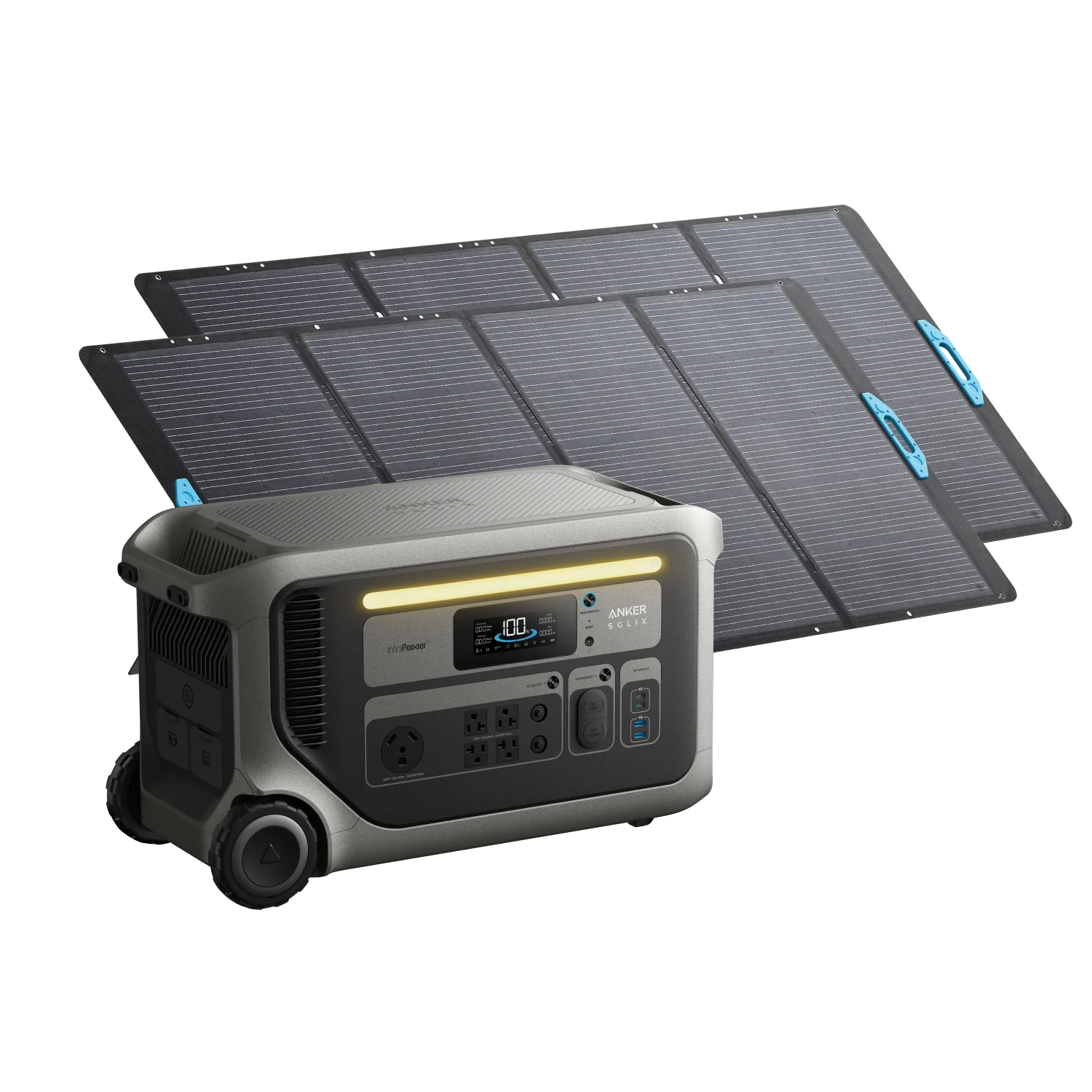
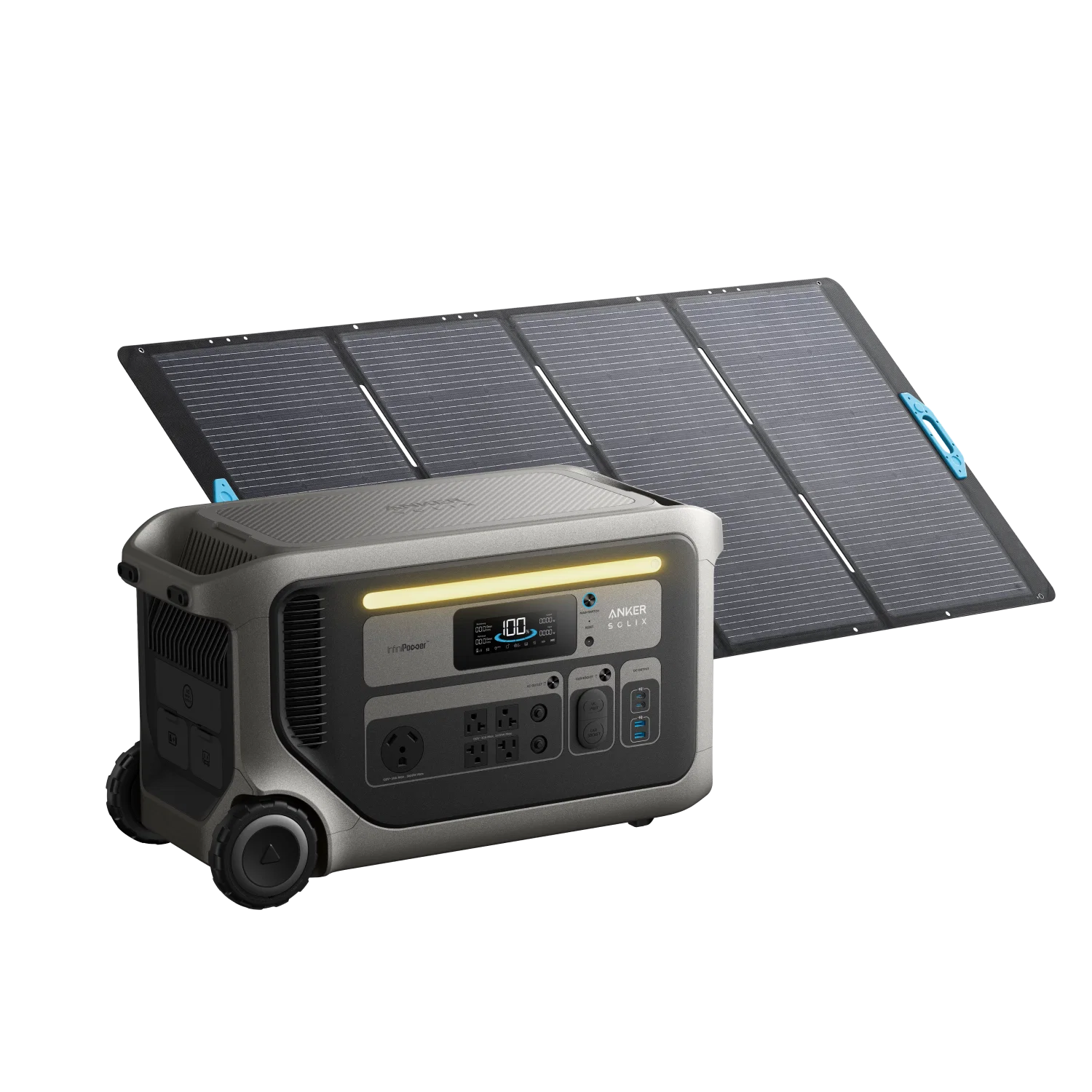
The front panel is dominated by AC: four standard 120V outlets each rated to 1,800W and a
3,600W 30A TT-30R receptacle for RV shore-power cords. The DC side is comparatively
sparse. Two 100W USB-C ports, two 12W USB-A ports and a single 120W car socket is a lean
allocation for a unit this large — a household charging several laptops and tablets
alongside phones will run out of high-wattage USB-C ports quickly. It is the clearest
place where the F3000's home-backup priorities show through at the expense of the
device-charging use case.
The battery is lithium iron phosphate, rated by Anker for more than 3,000 cycles to 80%
capacity, and the unit carries a 5-year warranty. Expansion is the structural story: a
single F3000 accepts up to three BP3000 batteries, taking total capacity from 3,072Wh to
12,288Wh. That is the mechanism that turns a power station into a home-scale reserve, and
it is engineered into the chassis rather than bolted on.
Charging and Runtime Performance
The 3,600W continuous inverter is the F3000's strongest asset, and unlike the F2600 it
comes with real surge headroom: Anker rates the surge at 7,200W, a 2x ratio that starts
essentially any household motor — a well pump, a large compressor, a table saw — without the
hesitation that a thin surge margin introduces. For a unit meant to back a home rather than
a campsite, that headroom is exactly the right specification to prioritise.
Anker (Manufacturer product image)
Anker (Manufacturer product image)
Capacity behaves the way LiFePO4 capacity always does. The 3,072Wh nameplate becomes
roughly 2,600 to 2,750Wh at the outlet after inverter conversion losses, and it scales
linearly as you add BP3000 batteries. A single-unit, fully-expanded F3000 at 12,288Wh
approaches four days of running lights and a fridge, which is Anker's stated design target
for the platform.
Charging is genuinely fast in both directions. Anker rates AC input at up to 3,600W with
pass-through support, meaning the unit can charge and power loads simultaneously at full
speed without shutting down — a practical detail during a rolling outage when you need to
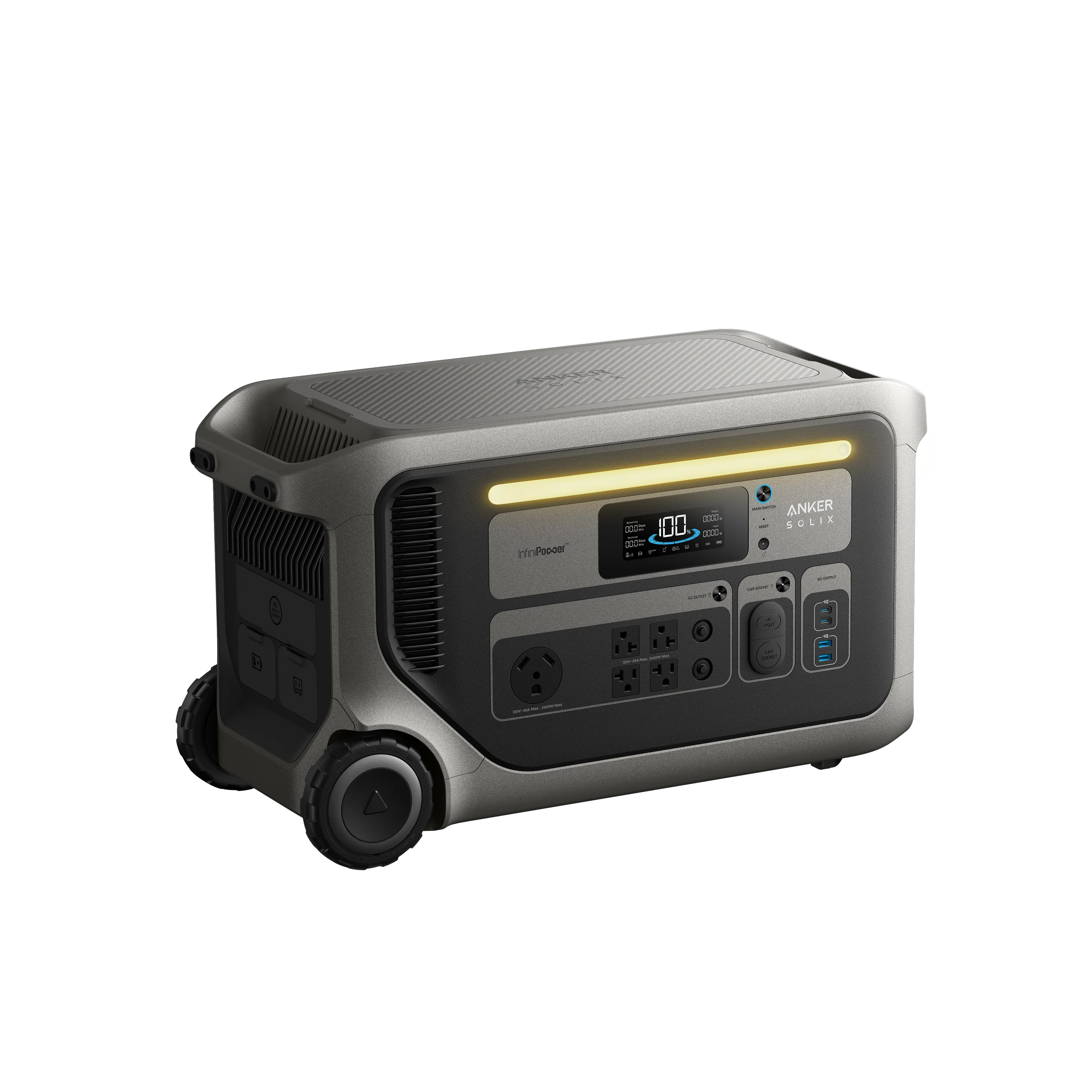
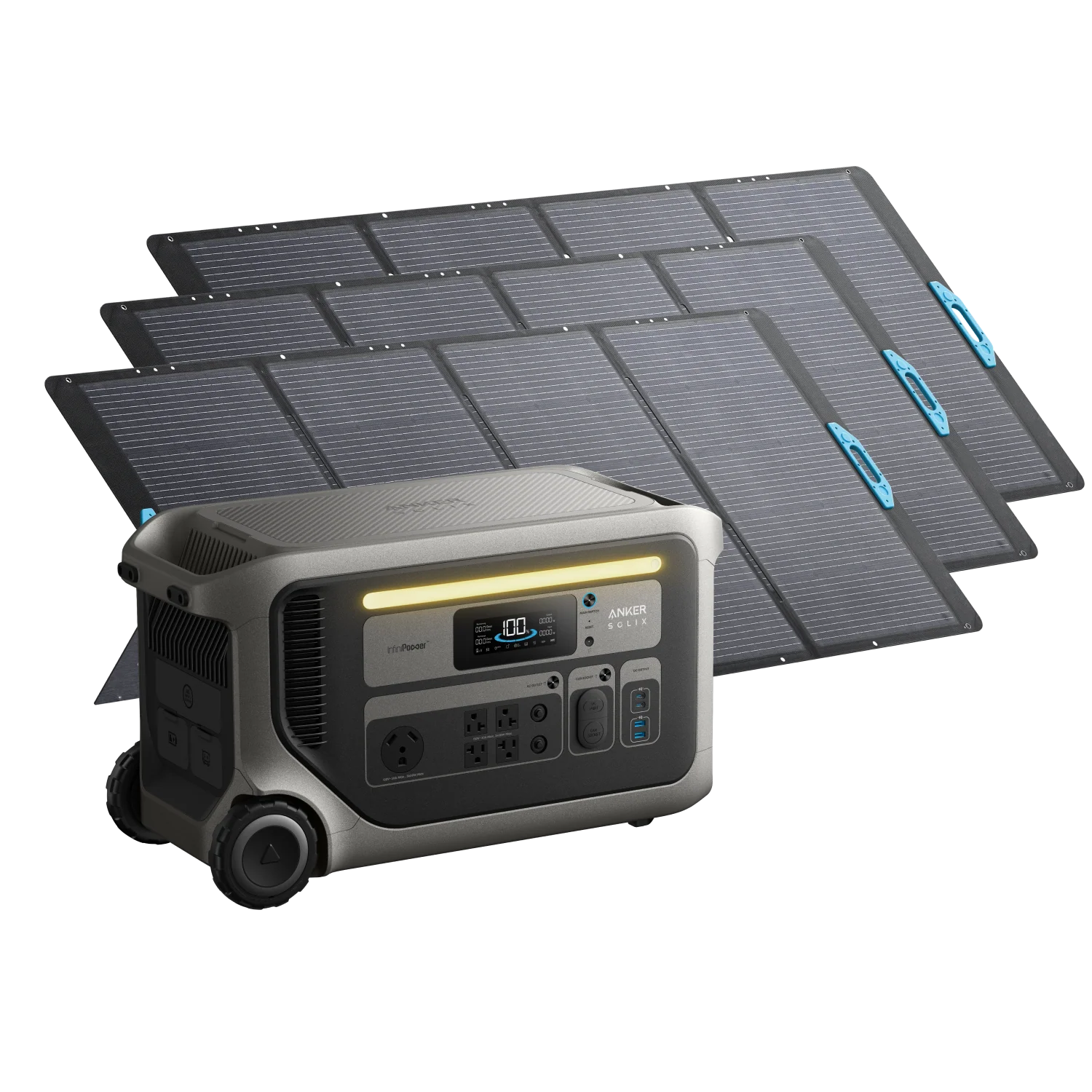
top up between cuts. Solar input is rated at 2,400W across an 11-165V, 17A MPPT window,
and Anker claims a full recharge in under two hours in optimal sun. That claim deserves
the usual scepticism reserved for best-case solar figures — real-world angle, temperature
and cloud cover will extend it — but even discounted, a 2,400W ceiling on a 3,072Wh pack is
a strong ratio that makes the F3000 practical for genuinely off-grid use.
Two caveats belong in the runtime picture. First, Anker does not publish a UPS switchover
time for the F3000, unlike the 20ms figure it quotes for the F2600. Until a spec or an
independent measurement confirms otherwise, treat the F3000 as a backup source you switch
to, not a seamless UPS for a desktop or a NAS. Second, the 240V capability is real but
conditional: it requires pairing two F3000 units, which Anker describes as plug-and-play
with no electrician needed. That unlocks 240V appliances and higher combined output, but
it doubles the purchase.
Competitive Comparison
vs. EcoFlow DELTA 3 Ultra ($1,399, 3,072Wh). This is the most direct rival — identical
3,072Wh capacity, $100 cheaper, and matching the F3000's 3,600W/7,200W inverter almost
exactly. EcoFlow further publishes a 0-80% recharge in 89 minutes and a 10ms UPS
switchover, the latter a specification the F3000 does not quote. The F3000's counterweights
are its UL9540 certification, its 2,400W solar input, and its three-battery expansion to
12,288Wh. Buyers who want a documented UPS time and a lower price will lean EcoFlow; those
who prioritise expansion ceiling and the energy-storage certification will lean Anker.
vs. Anker SOLIX F3800 (3,840Wh). Anker's own larger unit holds 3,840Wh and runs a
6,000W inverter, outclassing the F3000 on raw output and base capacity. The F3000's case
against its sibling is price and modularity for buyers whose needs sit at 3kWh rather than
4kWh, and who would rather expand incrementally than pay for the bigger base unit upfront.
Anyone genuinely targeting whole-home backup should price both.
vs. Goal Zero Yeti PRO 4000 ($3,999, 3,994Wh). The Goal Zero is a different budget
class entirely — nearly $4,000 for 3,994Wh, expandable to 20kWh, with a 5-year warranty. It
outscales the F3000 but at more than 2.5 times the entry price. The F3000 is the value
route into a scalable system; the Yeti PRO 4000 is the choice when budget is secondary to
raw ceiling.
vs. Anker SOLIX F2600 ($1,099). Anker's own step down holds 2,560Wh and runs a 2,400W
inverter with only a 2,800W surge, expanding to 5,120Wh. For $400 less it saves 22 pounds
and adds a documented 20ms UPS time, but it gives up the surge headroom, the 240V pairing,
the UL9540 certification and two-thirds of the expansion ceiling. The F3000 is the buy for
motor loads and whole-home ambitions; the F2600 for a lighter, cheaper closet reserve.
Who It's For
Buy the F3000 if you are building a home-backup system rather than shopping for a portable
battery. The combination of a 7,200W surge, three-battery expansion to 12,288Wh, 240V
pairing and UL9540 certification is aimed squarely at the buyer who wants to back a house's
essential circuits — including motor-driven appliances — and to grow that capacity over time
without replacing the core unit.
It also suits the serious off-grid user. The 2,400W solar input and 3,600W pass-through
charging mean the F3000 can be genuinely lived off, recharging fast enough from panels to
sustain daily use in good weather, and the LiFePO4 pack with its 5-year warranty supports
years of daily cycling.
Look elsewhere if you need portability, a true seamless UPS, or a lower entry cost. At 91.5
pounds this is a wheeled, place-heavily appliance; the absence of a published switchover
time makes it a poor fit for protecting a desktop against blackouts; and at $1,399.99 before
accessories it is a commitment. Buyers who want most of this capability for less should
compare the EcoFlow DELTA 3 Ultra, and those who only need 2kWh should not overbuy.
Final Verdict
The SOLIX F3000 is one of the most complete expandable platforms in its price class. The
3,600W/7,200W inverter has the surge headroom that the smaller F2600 lacks, the expansion
path to 12,288Wh is engineered rather than improvised, the 240V pairing genuinely unlocks
larger appliances, and the UL9540 certification matters the moment you consider wiring it
into a home. As the backbone of a growing energy system, it is a strong, coherent buy.
The reservations are the price of that ambition. At 91.5 pounds it is a two-person or
wheels-only proposition. At $1,399.99 it is the entry fee to a platform whose full value —
12kWh, 240V, solar — requires buying more. The lean two-port USB-C array is stingy for the
size, and the absence of a published UPS switchover time means it should not be the answer
for anyone whose priority is protecting a computer.
Judged as scalable home-backup infrastructure, the F3000 delivers, and it does so at a
price that undercuts the whole-home tier while nearly matching the EcoFlow DELTA 3 Ultra
spec-for-spec. Judged as a portable power station in the everyday sense, it was never
trying to be one. Know which purchase you are making before the weight and the ecosystem
commit you.
Frequently Asked Questions
How much can the F3000 expand?
the 3,072Wh base to 12,288Wh. That expansion is built into the chassis, which is the
central reason to buy the platform over a sealed unit — you can start at 3kWh and grow to
12kWh without replacing the core.
Can it really output 240V?
as plug-and-play with no electrician required. A single F3000 outputs 120V only. The 240V
capability unlocks larger appliances and higher combined output, but it means buying a
second unit.
What does UL9540 certification actually mean?
and control electronics together as an integrated system. It is a broader and more relevant
certification for home installation than a narrow UL enclosure listing, and it is the one
inspectors and insurers are most likely to ask about.
How fast does the F3000 charge?
loads simultaneously at full speed. Solar input is rated at 2,400W, and Anker claims a full
recharge in under two hours in optimal sun. Treat the solar time as a best case — real angle,
temperature and cloud cover will extend it.
Will it start a well pump or a large power tool?
ratio — which handles the start-up spike of most household motors, including well pumps,
large compressors and power tools. This surge margin is the F3000's clearest advantage over
the smaller F2600 and its 2,800W ceiling.
Can I use it as a UPS for my computer?
quotes for the F2600. Without a confirmed figure, treat the F3000 as a backup source you
switch over to rather than a seamless UPS, and use a dedicated UPS for a desktop or NAS
that cannot tolerate any interruption.
How does it compare to the EcoFlow DELTA 3 Ultra?
DELTA 3 Ultra is $100 cheaper and publishes an 89-minute 0-80% recharge and a 10ms UPS
time. The F3000 answers with UL9540 certification, 2,400W solar input and three-battery
expansion to 12,288Wh. Your priority — documented UPS versus expansion ceiling — decides it.
How heavy is it, and can one person move it?
across flat ground, but lifting it into a vehicle or up stairs is a two-person job. This is
not a unit you carry to a campsite.
How long will the battery last?
the F3000 with a 5-year warranty. At regular home-backup use that implies well over a decade
of service before meaningful capacity loss.
Is it worth $1,399.99 over the cheaper F2600?
time. The F3000 buys a much stronger 7,200W surge, 240V pairing, UL9540 certification,
2,400W solar input and expansion to 12,288Wh instead of 5,120Wh. If you have motor loads or
whole-home ambitions, the F3000 is worth the premium; if you need a lighter 2kWh-class
reserve, the F2600 is the better fit.