Introduction
The Anker SOLIX C300X answers a question most power stations dodge: what if you actually had to carry the thing? At 9 pounds and roughly the size of a lunch cooler, it is small enough to sling into a backpack and light enough that lifting it never enters your mind. That portability is the whole point, and it is what separates the C300X from the heavier 500-to-1,000Wh boxes that anchor most buyers' shortlists.
Set your expectations to match the hardware. The C300X pairs a 288Wh lithium iron phosphate battery with a 300-watt AC inverter. That is enough to charge laptops, phones, cameras, and drone batteries, run a CPAP or a small fan overnight, and keep a router alive through a short outage — and it is not enough to run a refrigerator, a microwave, or anything else that pulls serious wattage. If you understand that ceiling going in, the C300X is one of the most useful little stations you can buy, especially at a price that usually lands around $200. If you were hoping for backup power that carries a household, this is the wrong size class and no amount of clever marketing changes that.
What makes the C300X interesting rather than just cheap is that Anker did not gut the feature set to hit the price. You get three grounded AC outlets, a 140-watt bidirectional USB-C port, app control, a built-in light, and a one-hour wall recharge — a spec sheet that would have looked premium two years ago, now sitting under a name-brand budget label.
Design and Build
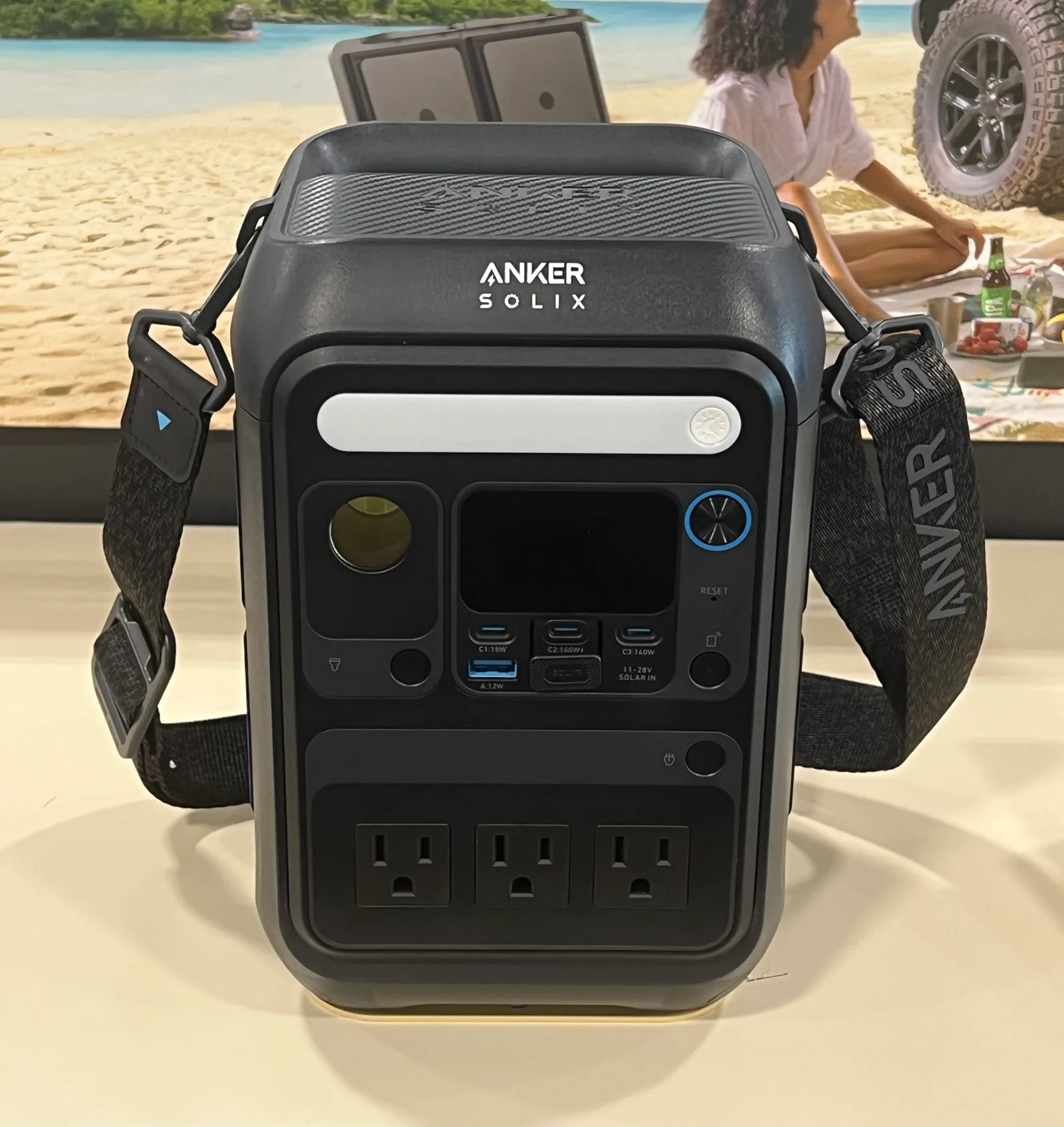
Anker built the C300X to be grabbed and gone. The chassis is a compact upright block with a molded top handle that clears the surrounding shell, so your fingers actually fit. It is the rare station in this class that feels designed for a hand rather than a shelf. Anker also added strap rings and includes a shoulder strap, though that strap is the one design element I would skip — carried on one shoulder, a 9-pound cube swings awkwardly against your hip, and the top handle is the better way to move it nearly every time.
Fit and finish punch above the price. The two-tone gray shell is dense and rattle-free, the seams are tight, and the whole unit reads as a scaled-down version of Anker's larger SOLIX stations rather than a bargain-bin knockoff. Independent testing by The Solar Lab framed it as a purpose-built replacement for the older Anker 525 Power Station, and that is the right comparison: this is slimmer, lighter, and more obviously meant to travel than the boxy units it succeeds.
The front panel is where the C300X earns its keep. A signature "unibrow" LED light bar stretches across the top of the face, bright enough to light a tent or a work area during a blackout while sipping only about 3 watts. Below it sits a clear status display that reports charge percentage, input and output wattage, and a running time-to-empty estimate. The three AC outlets are spaced properly across the lower panel, so you can seat three wall plugs at once without them fighting for room — a small thing that the competition frequently gets wrong.
Connectivity and the Anker App
The port layout is unusually generous for the size. Alongside the three AC outlets, you get three USB-C ports and a USB-A port, plus a 12-volt car socket and a dedicated solar input. The USB-C ports are not all equal, and it is worth knowing which is which: two are high-output ports rated up to 140 watts — one of them bidirectional, so it doubles as a fast charging input — while the third is a 15-watt port for phones and accessories. The USB-A port tops out around 12 watts. That 140-watt bidirectional port is the headline. It lets you fast-charge a modern USB-C laptop directly, skipping the inverter entirely, and it means you can top the station itself back up from a laptop charger or a USB-C wall brick when you do not have the main adapter handy.
App support is the other feature you rarely see at this price. The C300X connects to the Anker app over Bluetooth and Wi-Fi, and the app is genuinely useful rather than a checkbox: you can watch charge and draw in real time, adjust settings, and flip the light on from your phone without leaving your sleeping bag. Cheaper no-name stations almost never offer this, and it is a real quality-of-life edge if you leave the unit charging in another room or another tent.
Performance and Real-World Runtime
Do the arithmetic before you buy, because 288 watt-hours is a modest tank. Run it through the inverter and you keep roughly 250 watt-hours at the AC outlets, which lines up with the 87 percent efficiency The Solar Lab measured when it ran a continuous 300-watt load — the station held on for about 50 minutes against a theoretical 57. For a unit this small, 87 percent is a strong result; even large stations are often praised for clearing 80 percent. Draw power over USB-C instead of AC and you keep even more, because you skip the inverter's conversion loss.
Translate that into devices and the picture gets practical. A 60-watt laptop runs roughly four hours from the AC outlet, and longer if you charge it over USB-C. A phone holding about 15 watt-hours can be topped up somewhere in the neighborhood of a dozen to sixteen times. A 40-watt CPAP running without heated humidification should get you through a full night with margin to spare — verify your own machine's draw first, and leave the humidifier off, because heating the air can double the load and gut that runtime. Camera batteries, drone packs, LED lights, a router, and a small fan are all comfortably within its wheelhouse.
The honest limit is the 300-watt inverter, not the battery chemistry. The C300X handled brief pushes slightly above its rating in testing but made it clear it was not happy about it, and sustained loads near 300 watts ran cleanly with no drama. What it will not do is start or run appliances that spike well beyond 300 watts — kettles, hair dryers, space heaters, full-size refrigerators. Plan your loads around that number and you will rarely be caught out; ignore it and you will trip the inverter. This is a station for electronics and small draws measured in tens of watts, not hundreds.
Everyday Use: Noise, Light, and Pass-Through
Three smaller behaviors matter more in daily use than any spec line. First, noise: the C300X is remarkably quiet. Even with the internal fan spun up under a heavy load, it stays close to silent, which makes it a legitimate bedside option for a CPAP or a comfortable companion inside a tent where a whining fan would ruin the night. Second, the light: the front bar is bright enough to be the only lantern you pack for a weekend, and at about 3 watts it barely dents the battery. (If you lean toward the cheaper DC-only sibling, note that Anker moved its light to a pop-up lantern on the top instead of the front bar.)
Third, and easy to overlook, is pass-through charging. The C300X can charge your devices while it is itself being refilled from the wall or a solar panel, so you can leave it plugged in as an always-topped-up hub during an outage or a long campsite stay without cycling it off to recharge. It is the kind of feature you stop noticing precisely because it just works.
How It Compares
The most direct rival is the EcoFlow River 3, which Anker clearly built this to beat. The River 3 carries a smaller 245Wh battery against the C300X's 288Wh — about a 17 percent difference — and gives you only two AC outlets, one of them a cramped, ungrounded "half" outlet that is awkward to use for a laptop charger. The River 3 also trails badly on USB versatility, with nothing like the C300X's 140-watt bidirectional port. It does recharge a touch faster — roughly ten minutes quicker to full in testing — but at nearly identical prices, the Anker is the more useful box in almost every real scenario.
If you are cross-shopping the DC-only version, the EcoFlow Trail 300 is the obvious foil: it matches the 288Wh capacity and 300-watt rating and is even lighter at about 5.7 pounds, but it drops app connectivity entirely and costs a little more. For most buyers the Anker's app and extra USB-C ports justify staying in the family.
Two other names belong on the list for context. If 300 watts and 288Wh feel tight, Anker's own SOLIX C800 steps up to 768Wh and a 1,200-watt inverter for meaningfully bigger jobs — at nearly twice the weight and price. And if you find yourself tempted to expand a tiny station past the $300 mark, don't: a unit like the Pecron E1000LFP offers about 1,024Wh and an 1,800-watt inverter for around $379, which is simply a different and more capable tier. The C300X's job is to be the small, light, cheap one, and it should be judged on how well it owns that lane rather than how it scales up.
Who Should Buy It — and Who Should Skip
Buy the C300X if you want the lightest capable station you can get: backpackers and campers who count every pound, road-trippers and van-lifers who mainly charge devices, photographers and drone pilots refilling batteries in the field, CPAP users who have checked their machine's wattage, and anyone who wants a quiet, simple cushion for short power outages. It is also a genuinely good gift — cheap enough to be an impulse, useful enough to be kept.
Skip it if your goal is backup that carries a household through a multi-day outage, if you need to run anything above 300 watts, or if you plan to live off solar — the 100-watt solar cap means a full recharge from a single 100-watt panel takes around three hours in good sun, and there is no headroom to speed that up with a bigger array. Those buyers want a larger, expandable system, and paying for one is money well spent.
The Bottom Line
The Anker SOLIX C300X is the small power station done right. It is light enough to actually carry, quiet enough to sleep beside, quick to recharge, and stocked with real AC outlets and a standout 140-watt USB-C port that shame rivals costing the same. The 288Wh battery and 300-watt inverter draw a hard line under what it can do, and pretending otherwise would set you up to be disappointed — this is a device-charging and short-outage companion, not home backup. Judged as what it is, though, it is hard to beat, and at a street price that routinely dips toward $200 it is the easy recommendation in its class. For campers, travelers, and anyone who wants a grab-and-go battery that punches above its size, the C300X is the one to buy.
Frequently Asked Questions
Can the Anker C300X back up my house during an outage?
No. With 288Wh of storage and a 300-watt inverter, it is built to keep phones, a laptop, a router, lights, and other small electronics running for a stretch of hours, not to power a home. It is a useful bridge through a short outage, but whole-home or multi-day backup needs a much larger, expandable system.
Will it run my CPAP through the night?
Usually yes, with one caveat. A CPAP drawing around 40 watts without heated humidification should run a full night on the C300X, since about 250 usable watt-hours at the outlet stretches to roughly six hours or more at that draw, and its near-silent operation makes it a good bedside unit. Turn on heated humidification and the draw can roughly double, cutting runtime sharply. Check your machine's rated wattage and prefer running without the humidifier.
What can the 300-watt inverter actually power?
Laptops, phones, tablets, cameras, drone batteries, LED lights, fans, routers, and other electronics that stay under 300 watts. It cannot start or run high-draw appliances like kettles, hair dryers, space heaters, or full-size refrigerators — those spike well past its inverter rating. The limit you hit is output wattage first and runtime second, so it suits small, steady loads.
How long does it take to recharge?
About an hour from a standard wall outlet — independent testing clocked a full 0-to-100 percent charge in roughly one hour and eight minutes, close to Anker's claim. A single 100-watt solar panel takes around three hours in good sun. You can also recharge it over the 140-watt USB-C port from a laptop-style charger, though you need a cable rated for that wattage to hit full speed.
What is the difference between the C300X and the C300 DC?
The C300X reviewed here includes three 120-volt AC outlets and its front-mounted light bar. The cheaper C300 DC drops the AC inverter entirely — leaving USB, the 12-volt socket, and solar — and moves its light to a pop-up lantern on top. If you only ever charge USB and 12-volt devices, the DC version saves money; if you need to plug in anything with a wall plug, you want the C300X.
How long will the battery last before it wears out?
The C300X uses lithium iron phosphate (LiFePO4) cells rated for roughly 3,000 charge cycles before meaningful capacity loss. In practice that means you can cycle it frequently for years and still expect it to hold most of its capacity — a longevity advantage over the older NMC chemistry some competing stations still use.
Can I take it on a plane?
No. At 288Wh it is far above the 100Wh lithium-battery limit airlines set for carry-on bags, and stations this size are not allowed in the cabin or checked luggage. Only small personal power banks under 100Wh clear that bar, so the C300X stays home when you fly.
Do I need to buy Anker's solar panels to charge it with solar?
No. The C300X accepts solar input from 11 to 28 volts up to 100 watts, so many third-party folding panels within that range work fine, and independent reviewers noted Anker's own panels run pricey enough that a compatible panel from another brand is often the smarter buy. Just match the panel's voltage and wattage to the input spec, and expect roughly three hours for a full charge from a 100-watt panel in strong sun.
Is it quiet enough to use in a tent or bedroom?
Yes. Even under a heavy load with its fan running, the C300X stays close to silent, which is one of its real strengths. That makes it comfortable to run beside a bed for a CPAP or inside a tent overnight, where a louder station's fan would be a constant annoyance.
How does it compare to the EcoFlow River 3?
The C300X generally wins. It carries a larger 288Wh battery versus the River 3's 245Wh, offers three properly spaced grounded AC outlets against the River 3's two (one of them a cramped, ungrounded outlet), and includes a 140-watt bidirectional USB-C port the EcoFlow can't match. The River 3 recharges about ten minutes faster, but at similar prices the Anker is the more versatile, more practical choice for most people.