Introduction
The Sensi Touch 2 is the thermostat for people who do not want their thermostat to become the main character of the house. That sounds like faint praise until the furnace quits obeying a clever algorithm, a guest cannot find the menu, or a mesh router refuses to cooperate with a wall device that was designed like a tiny phone. The ST76 is more conservative than the Nest Learning Thermostat and less ecosystem-rich than ecobee, but there is a reason the Sensi line has a contractor-friendly reputation: it generally tries to behave like a thermostat first and a gadget second.
At $167.99, this listing also changes the conversation. CNET reviewed the Sensi Touch 2 as a $210 product and scored it 3.7 out of 5, which put it uncomfortably close to stronger rivals. Under $170, the compromises feel less insulting. It still asks for a C-wire. It still omits the wall plate and the power adapter. It still does not publish enough hard specifications for a buyer who wants a complete HVAC compatibility table. Yet the core pitch is coherent: a clean color touchscreen, flexible scheduling, geofencing, and optional room sensors without pretending to be a self-learning climate brain.
That last point matters. The Sensi Touch 2 is not a Nest-style learning thermostat. CNET's comparison table lists no presence sensing or learning functions, and the geofence described in the review is blunt rather than magical: when the phone is more than 3 miles away, the target moves by 3 degrees. If the cooling setpoint was 77 degrees, the away setpoint becomes 80 degrees. For some households, that is too rigid. For others, it is exactly the right amount of automation because it is predictable and easy to explain.
This is the quiet professional's choice in the Sensi family: not cheap enough to be an impulse buy, not advanced enough to impress a smart-home hobbyist, but plausible for a homeowner who wants a modern wall control that will not turn every seasonal HVAC tweak into a research project.
Design and Build
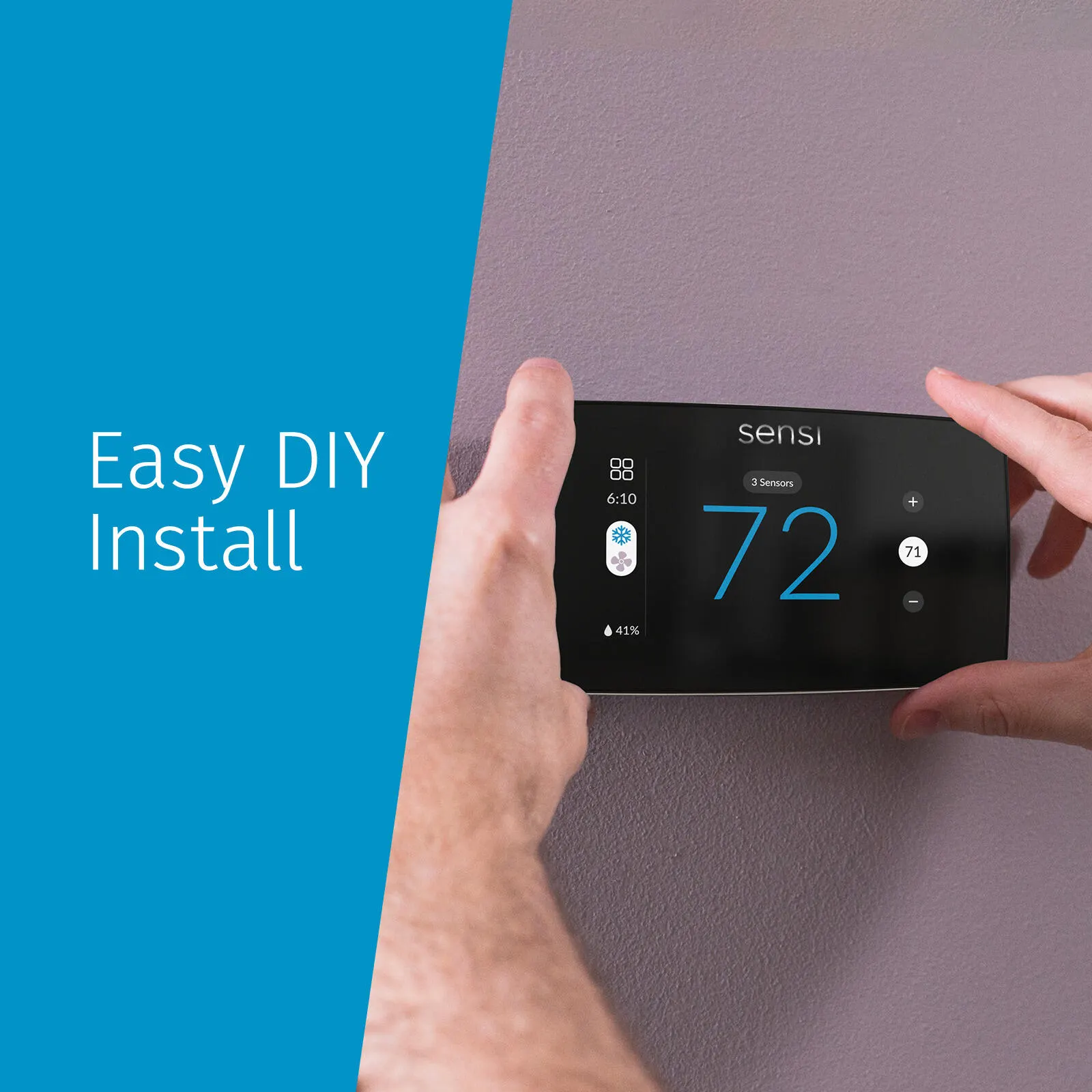
The visible upgrade over old programmable thermostats is obvious: the Touch 2 uses a color touchscreen. CNET called the display big, bold, and simple, and the important part is not the color so much as the input model. There is no rotating outer ring, no side swipe strip, and no row of mystery buttons. You tap the thing you want. For a shared household, that can be more valuable than an elegant industrial design that only one person understands.
Emerson does not publish the exact display size, body dimensions, weight, or finish list in the accessible material used here, so those details should not be dressed up as facts. That absence is annoying because wall fit matters. A thermostat can be electrically compatible and still leave a beige rectangle from the 1990s staring at you from the drywall. The omission becomes more pointed because CNET says the Sensi Touch 2 does not include a wall plate. If the old thermostat covered a larger footprint, plan on paint, a separate plate, or a visible scar.
Power is the other design decision that moves from small print to buying criterion. The Touch 2 requires a C-wire, and the adapter is not in the box. That is not unusual in 2026, but it is less graceful than ecobee's approach, where the Smart Thermostat Enhanced includes a Power Extender Kit. It is also less forgiving than the older Nest Learning Thermostat, which usually avoids a C-wire by drawing small amounts of power from existing heating and cooling wires. The Sensi approach is electrically cleaner once installed, but the burden lands on the buyer before purchase.
The optional room sensor support is the most meaningful hardware feature. CNET says the Touch 2 does not include a sensor, but compatible sensors can be purchased for about $40 each, and the reviewer found setup almost unbelievably easy. That gives the ST76 an answer to the classic hallway problem: the thermostat is mounted where the builder found convenient, not where people sleep, cook, or work. The maximum number of supported sensors was not published in the accessible sources, so the safe assumption is not "whole-home zoning." It is better to think of the add-on sensor as a way to bias comfort toward a problem room.
The result is a device that looks modern without relying on speculative hardware claims. No published Matter radio, no confirmed Thread path, no Apple Home listing in CNET's table, and no hard screen measurement to brag about. The build story is instead practical: a readable touchscreen, optional sensor ecosystem, mandatory common wire, and a box that could have been more generous.
Performance in Everyday Use
The Touch 2 should appeal most to people who still believe a schedule is the right foundation for comfort. CNET confirmed flexible day grouping, which means the owner can decide which days share a program instead of accepting a rigid weekday/weekend split. That sounds minor until shift work, alternating custody, or hybrid office schedules enter the house. A thermostat that lets Tuesday and Thursday behave differently from Monday and Wednesday is solving a real domestic problem.
Early Start is the second useful behavior. Instead of beginning the furnace or air conditioner at the scheduled time, the thermostat can start early so the room reaches the target when the schedule says it should. That is the difference between "heat starts at 6 a.m." and "the kitchen is warm at 6 a.m." The feature is not unique, but it belongs in the practical column because it makes schedules feel less mechanical.
The auto heat/cool range also gives the Touch 2 a grown-up mode for shoulder seasons. CNET notes that the app allows an auto schedule where the user picks a temperature range for a given time of day. In spring and fall, that can prevent the ritual of flipping between heat and cool every other afternoon. It is not adaptive intelligence; it is a sensible control surface for a mixed-weather week.
Geofencing is where Sensi's restraint becomes debatable. The fixed behavior described by CNET is simple: more than 3 miles away means a 3 degree adjustment. There is comfort in that predictability, but not much finesse. A 3 degree cooling setback from 77 degrees to 80 degrees may save energy without upsetting pets or plants. A household that wants deeper away savings, custom distance rings, or motion-based recovery will find the implementation too narrow.
Because the Touch 2 does not have confirmed presence sensing or learning functions, it cannot replace a thoughtful schedule the way a Nest Learning Thermostat tries to. That is not a defect if the owner actually wants control. It is a defect if the buyer expects the thermostat to discover routines by watching occupancy and temperature changes. The ST76 is a very capable programmable thermostat with smart conveniences around the edges, not an autonomous HVAC manager.
The largest performance unknown is HVAC breadth. The accessible sources do not publish stage compatibility, heat pump details, dual-fuel support, millivolt exclusions, accessory terminals, or a warranty length. A buyer with a straightforward single-zone forced-air system may never care. A buyer with a heat pump, auxiliary heat, boiler, or multi-stage furnace should not treat the marketing name as a compatibility guarantee. Check the wiring and the return policy before opening the box.
Competitive Comparison
Against the ecobee Smart Thermostat Enhanced, the Sensi Touch 2 looks simpler and less complete. The ecobee costs about $184.83, has a 4-inch full-color LCD touchscreen, measures 103.89 mm square and 23.88 mm deep, includes a Power Extender Kit, and supports SmartSensors sold separately over a 915 MHz radio. Its official spec table also lists 2.4GHz and 5GHz Wi-Fi, Bluetooth 5.0, 3 years of limited warranty coverage, and up to 26% claimed heating and cooling savings compared with a 72°F hold. The Sensi Touch 2 counters with a lower $167.99 price and a less busy personality, but ecobee wins the documentation battle decisively.
The Amazon Smart Thermostat is the value ambush. At $79.99, it is far cheaper, but it is also more dependent on Alexa. CNET and Tom's Guide describe it as Alexa-only, with no Google Home or Apple Home support. It requires a C-wire and does not include the adapter, and Tom's Guide described the body as a rounded square measuring 3.5 inches by 3.5 inches. If the home already runs on Alexa and only needs a basic smart thermostat, Amazon makes the ST76 look expensive. If Google Home or SmartThings matters, Sensi has the broader confirmed platform list.
The Google Nest Thermostat at $129.99 is the more stylish mainstream alternative. It has a 2.4-inch mirrored display, a 3.3-inch diameter body, a 60GHz Soli radar presence sensor, and official guidance that it is designed to work without a C-wire in most homes. It also uses the Google Home app and lacks compatibility with the original Nest Temperature Sensor. Compared with the Touch 2, the Nest is more automated and cheaper, but less direct on-device scheduling is a real trade-off.
The older Nest Learning Thermostat 3rd Gen remains the automation benchmark if you can live with discontinued hardware. It has a 2.08-inch circular display at 480 by 480, a 3.3-inch diameter body, support for up to 6 Nest Temperature Sensors, and up to 3 stages of heating plus 2 stages of cooling on 24V systems. It also costs around $239 in third-party stock and has no Matter or Apple Home support. For a buyer who wants self-programming, Sensi is not the substitute. For a buyer who wants fewer surprises, the ST76 may be the calmer wall device.
Honeywell Home's X8S plays a different game: premium screen, Matter, and bundled sensor. At $219.99 from HoneywellHome.com, it brings a 5-inch 480 by 800 touchscreen, dimensions of 5.24 in by 3.54 in by 0.96 in, 2.4GHz and 5GHz Wi-Fi, Apple Home through Matter, and 1 room sensor in the box. That is a stronger smart-home résumé. It is also a more complex and expensive product than many households need.
Who Should Buy It
Buy the Sensi Touch 2 if the phrase "smart thermostat" makes you cautious rather than excited. It is best for a homeowner who wants a modern touchscreen, app-enabled scheduling, geofencing, and the option to add a room sensor without handing control to a learning algorithm. It is also a sensible pick for a household where guests, relatives, or renters need to change the temperature without being trained on a dial or capacitive strip.
It is a weaker choice for anyone trying to minimize installation risk. The C-wire requirement is firm in the CNET review, and the adapter is not included. If the existing thermostat wiring lacks a common wire, the ecobee Enhanced is friendlier because its PEK is in the box, and the Nest Thermostat may avoid the issue on many systems. The Touch 2 can still be the right device, but it is not the easiest device to recommend sight unseen.
It is also not the Sensi to buy purely on price. The ST55 and Sensi Lite listings are far cheaper, and the Amazon Smart Thermostat undercuts it by roughly $88. The reason to pay more for the Touch 2 is the touchscreen-plus-sensor package. If those two features do not matter, the premium is hard to defend.
Smart-home platform buyers should slow down. Alexa, Google Home, and Samsung SmartThings support are confirmed by CNET; Apple Home, Matter, and Thread are not. In a Google or Alexa home, that may be enough. In an Apple Home build, it is not enough to assume compatibility from the Sensi name.
Final Verdict
The Emerson Sensi Touch 2 is easy to respect and a little hard to love. Its strengths are sober: a clear color touchscreen, flexible scheduling, Early Start, auto heat/cool ranges, geofencing, confirmed Alexa/Google/SmartThings support, and optional room sensors at about $40 each. None of that is revolutionary. All of it is useful.
The weaknesses are equally concrete. A required C-wire with no adapter in the box makes installation less forgiving. No included wall plate makes cosmetic cleanup the buyer's problem. The public documentation available here does not provide the display size, dimensions, weight, warranty, Wi-Fi bands, HVAC stage table, or current manufacturer price. That is too much missing information for a product that sometimes competes near premium pricing.
At $167.99, the Sensi Touch 2 earns a qualified recommendation. It is a good thermostat for people who want a dependable smart programmable control with a touchscreen and do not care about learning algorithms. It is not the best value, not the best smart-home hub, and not the safest bet for unusual HVAC wiring. The quiet professional's choice is still professional; just read the wiring checklist before buying.