Introduction
The Sensi ST55 is the thermostat in this group that makes the least dramatic promise, and that is why it is worth taking seriously. Most smart thermostats try to persuade buyers that the old way of controlling heat and air conditioning was primitive. They talk about learning, radar, home-energy intelligence, remote sensors, and platform support. The ST55, at $65.68, invites a more basic question: what if the right answer is merely a programmable thermostat with Wi-Fi in the name and a price low enough that the upgrade does not need to become a household technology project?
That question is more compelling than the product's public documentation. The accessible research trail for this model was thin. Manufacturer pages were not reachable, retailer pages were blocked or failed, and no current review outlet supplied a full ST55 specification set. Display type, C-wire requirement, HVAC stage support, room-sensor compatibility, smart-home platforms, warranty, and energy certification were not verified. A normal review would treat those as supporting details. Here they become the center of the buying advice.
So the ST55 should not be sold in your mind as a cheap ecobee or a cheaper Sensi Touch 2. That framing creates disappointment. It is better understood as a low-cost replacement candidate for a household that still wants deliberate programming and does not care whether the thermostat becomes part of a larger smart-home graph. At this price, the winning scenario is narrow but real: the wires match, the return window is clear, and the owner wants fewer features, not more.
There is a contrarian argument here. A good programmable thermostat can already save energy if the schedule matches the home. The U.S. Department of Energy's ENERGY STAR program is cited by Tom's Guide for a general smart-thermostat estimate of about 8%, or around $50 per year, but that is an average for smart thermostats broadly, not a verified ST55 claim. The real savings for a budget thermostat often come from not spending $180 more than necessary.
Design and Build
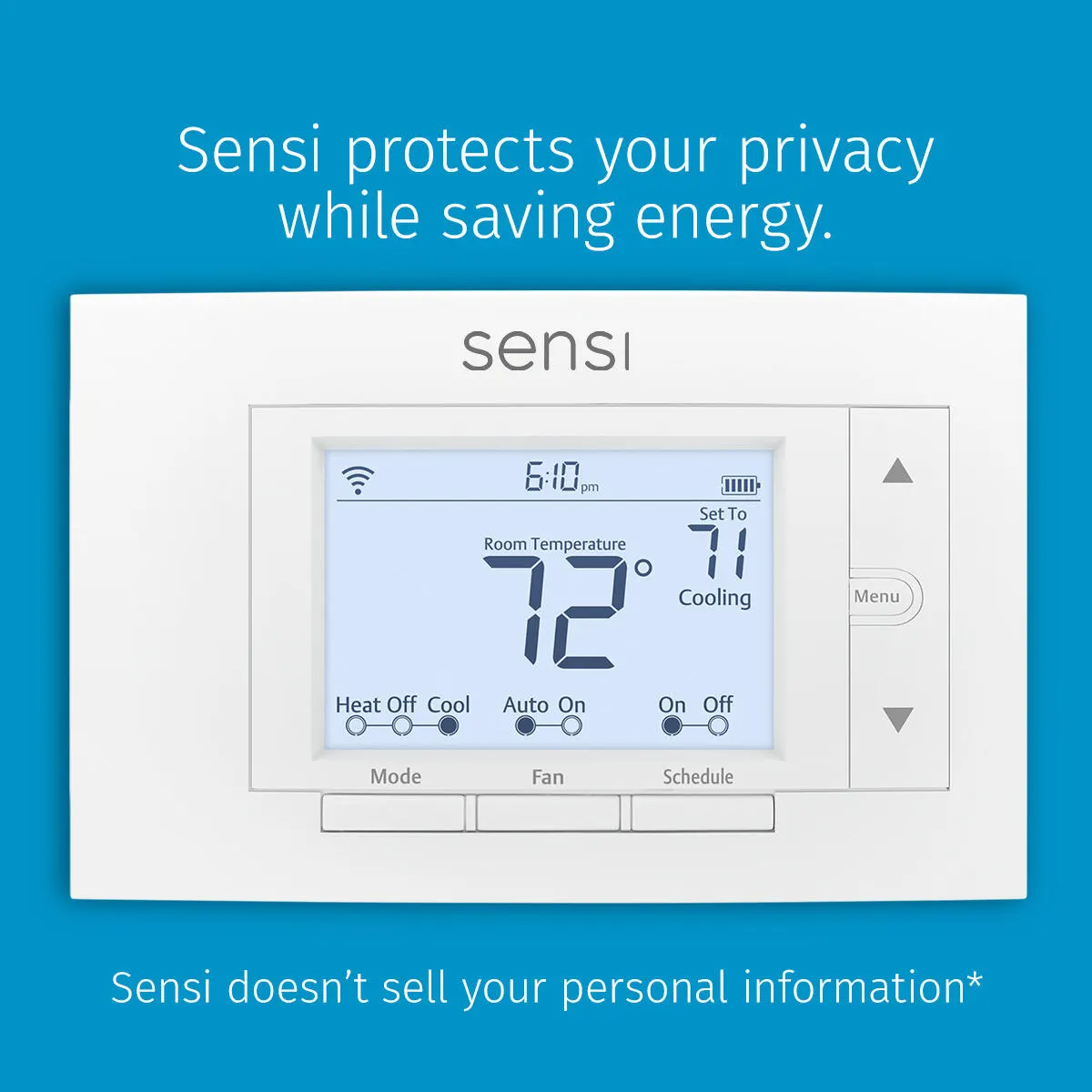
The ST55 does not get to coast on a glossy spec list. In the accessible sources, its display type and control layout were not confirmed, even though the broader market treats it as the more traditional, non-touch member of the Sensi family. That distinction should be handled carefully: it may match what shoppers recognize from retailer photos, but the verified source set did not provide a clean manufacturer statement. The safest buying posture is to inspect the live listing photos and installation guide before purchase rather than relying on memory of earlier Sensi generations.
That uncertainty is not automatically fatal. Many people do not need a 4-inch color panel on a hallway wall. A thermostat's display has one daily job: show the set temperature clearly enough that someone can change it without opening an app. If the ST55 gives up the Sensi Touch 2's touchscreen, that may actually make sense for the price class. Buttons age better than tiny touch targets in garages, rentals, vacation cabins, and homes where visitors are expected to adjust the temperature.
The problem is that basic does not mean unimportant. Dimensions, included wall plate, terminal labels, power method, and warranty are the details that decide whether a cheap thermostat remains cheap. A $65.68 device can become a bad purchase if it leaves wall damage exposed, needs an adapter, or cannot support the existing heat pump. The available evidence did not verify those items for the ST55, so the recommendation has to be conditional rather than enthusiastic.
Compared with the Sensi Touch 2, the ST55 is less about visual polish and more about restraint. The Touch 2's color touchscreen and optional $40 room sensors give it a clearer feature story. The ST55's appeal is that it may avoid paying for a display and sensor ecosystem you never intended to use. That is a valid reason to buy down, provided the buyer does not confuse less visible hardware with guaranteed simplicity.
The practical design checklist is therefore short and unforgiving. Confirm the wiring before removing the old thermostat. Confirm whether a C-wire is required. Confirm whether the package includes a trim plate if old paint or screw holes matter. Confirm compatibility with heat pumps, auxiliary heat, boilers, or multi-stage systems if the home has anything beyond a straightforward conventional setup. A cheap thermostat should simplify the project; if the listing cannot answer those questions, pause.
Performance in Everyday Use
A programmable thermostat lives or dies by habits, not by silicon. If the household wakes, leaves, returns, and sleeps at predictable times, a manual schedule can be more transparent than a learning system. Nobody has to wonder why the target changed. Nobody has to train the thermostat for a week. Nobody has to decide whether a radar sensor misread a quiet afternoon as an empty house. The owner writes the program, the thermostat follows it, and the HVAC system stops being a guessing game.
That is the ST55's best possible day. It is the device for people who look at the Nest Learning Thermostat's automation and see another thing to supervise. The older Nest can build a schedule after about a week of adjustments; the ST55's pitch is the opposite. You already know when the house should be warm or cool. Enter that schedule, adjust it for seasons, and resist paying for intelligence you do not want.
The performance caveat is that almost every advanced behavior remains unverified for this model in the accessible sources. There is no sourced room-sensor story, no verified geofencing behavior, no confirmed learning mode, no published HVAC stage table, and no checked smart-home platform list. That does not mean the thermostat lacks every feature. It means a responsible buyer should not purchase it because of any of those features unless the live retailer or manual confirms them.
That makes the ST55 a different kind of recommendation from the Touch 2. The Touch 2 has confirmed flexible day grouping, Early Start, auto heat/cool scheduling, and a documented geofence that changes the target by 3 degrees beyond roughly 3 miles. The ST55, by contrast, should be evaluated on the minimum viable promise: can it replace the existing thermostat, accept the desired program, and stay out of the way? If the answer is yes, its simplicity becomes a strength.
For energy use, keep expectations plain. A thermostat cannot save meaningful money if the programmed temperatures are the same as the old thermostat's temperatures. It saves when the schedule allows setbacks during sleep, work, travel, or empty-house periods. The number that belongs in a purchase conversation is not a claimed ST55 percentage; there was no verified ST55 savings claim. The useful reference is the general smart-thermostat estimate of 8% and around $50 per year from ENERGY STAR as cited by Tom's Guide, then adjusted downward or upward based on actual behavior.
Reliability is also an open question because the source set did not verify warranty coverage. Budget thermostats often win because they are boring. But boring is only good when the manufacturer publishes enough information for a clean install and a confident support path. The ST55's price is excellent; the paper trail around it is not.
Competitive Comparison
The Amazon Smart Thermostat is the obvious price neighbor. At $79.99, it costs only $14.31 more than the ST55. It requires a C-wire, does not include a C-wire adapter, and is best understood as an Alexa product. CNET says it does not play nicely with Google Home or Apple HomeKit, while Tom's Guide says it only works with Alexa. It has no dedicated room-sensor support, though some Echo devices with built-in temperature sensors can be used in Alexa automations. For an Alexa household, Amazon is better documented and easier to justify. For anyone outside Alexa, the ST55 may still be attractive if its own compatibility checks out.
The Google Nest Thermostat is the aspirational cheap upgrade at $129.99. It brings a 2.4-inch mirrored display, a 3.3-inch round body, a 60GHz Soli radar chip for presence, and official Google wording that it is designed to work without a C-wire in many homes. It supports 1 or 2 stages rather than 3-stage heating, does not work with the original Nest Temperature Sensor, and scheduling is handled in the Google Home app rather than on the device. Compared with the ST55, Nest buys polish and presence detection; the ST55 buys thrift and, likely, fewer ecosystem assumptions.
The ecobee Smart Thermostat Enhanced is what the ST55 is not trying to be. Around $184.83, it has a 4-inch LCD touchscreen, 540 by 540 display resolution, a 103.89 mm square face, 23.88 mm depth, 2.4GHz and 5GHz Wi-Fi, Bluetooth 5.0, a 915 MHz radio for SmartSensors, and a Power Extender Kit in the box. It also publishes a 3 years limited warranty and a 5 years warranty condition when installed by a Pro. That extra $119.15 over the ST55 is buying documentation, sensor architecture, and installation help as much as design.
The Sensi Touch 2 is the in-family step-up. At $167.99 here, it gives confirmed touchscreen control, optional room sensors at about $40 each, Alexa, Google Home, Samsung SmartThings, Early Start, flexible scheduling, and a fixed geofence behavior. It also requires a C-wire and does not include the adapter. If you want a Sensi with a clearer feature set, buy the Touch 2. If you only want to spend as little as possible on a programmable Sensi, the ST55 remains the interesting gamble.
The Honeywell Home X8S makes the ST55 look tiny by comparison. Honeywell's model costs $219.99, has a 5-inch 480 by 800 touchscreen, measures 5.24 in by 3.54 in by 0.96 in, supports 2.4GHz and 5GHz Wi-Fi, is Matter certified, and includes 1 room sensor. It is the wrong comparison if the budget is strict, but the right comparison if the buyer expects a full smart-home specification sheet. Honeywell tells you what you are buying. The ST55 asks you to verify it yourself.
Who Should Buy It
Buy the ST55 if the house needs a low-cost thermostat and the buying decision is governed by compatibility, not novelty. It makes the most sense for conventional systems, secondary spaces, rental turnovers, and owners who would rather set a schedule manually than let a thermostat infer routines. The $65.68 price is the entire point: the product should be inexpensive enough that the owner does not need to pretend it is a platform investment.
It is also a reasonable candidate for people who dislike thermostat fashion. A color touchscreen can be pleasant, but it is not required to run a sensible heating schedule. Room sensors can solve real comfort problems, but they are wasteful if the thermostat location already represents the home well. Voice assistants can be convenient, but they are irrelevant to someone who changes the target twice a week.
Do not buy it blindly for complex HVAC. Heat pumps, auxiliary heat, boilers, dual-fuel systems, and multi-stage equipment all deserve explicit compatibility confirmation. The available source set did not verify the ST55 stage table or C-wire requirement, and that is too important to wave away. The cheapest thermostat is not cheap if an installer has to undo it.
Smart-home buyers should probably start elsewhere. The Amazon Smart Thermostat is the clearer low-cost choice for Alexa. The Nest Thermostat is a better-looking Google Home choice. The ecobee Enhanced is stronger if sensor expansion, published specifications, and an included PEK matter. The ST55 is for people who want a thermostat, not a smart-home node.
Final Verdict
The Emerson Sensi Wi-Fi Programmable Thermostat ST55 is not a product to romanticize. Its public documentation trail is too thin, and too many important items were unverified: display, C-wire, HVAC stages, sensors, platforms, warranty, and energy certification. That would be unacceptable at $180. At $65.68, it becomes a buyer-risk calculation.
The best version of the ST55 purchase is refreshingly ordinary. The owner checks the wiring, confirms compatibility from the current listing or manual, installs it on a simple system, writes a schedule, and never thinks about learning algorithms again. In that scenario, spending more on Nest, ecobee, Honeywell, or even the Sensi Touch 2 may be unnecessary.
The worst version is just as clear. The buyer assumes the Sensi name means the same features as a more expensive model, discovers a missing wire or unsupported system, and ends up returning a cheap thermostat after wasting an afternoon. The ST55 is worth considering, but only as a disciplined budget buy. Treat it as proof that many homes do not need a smart thermostat at all; they need a compatible programmable one at the right price.