Introduction
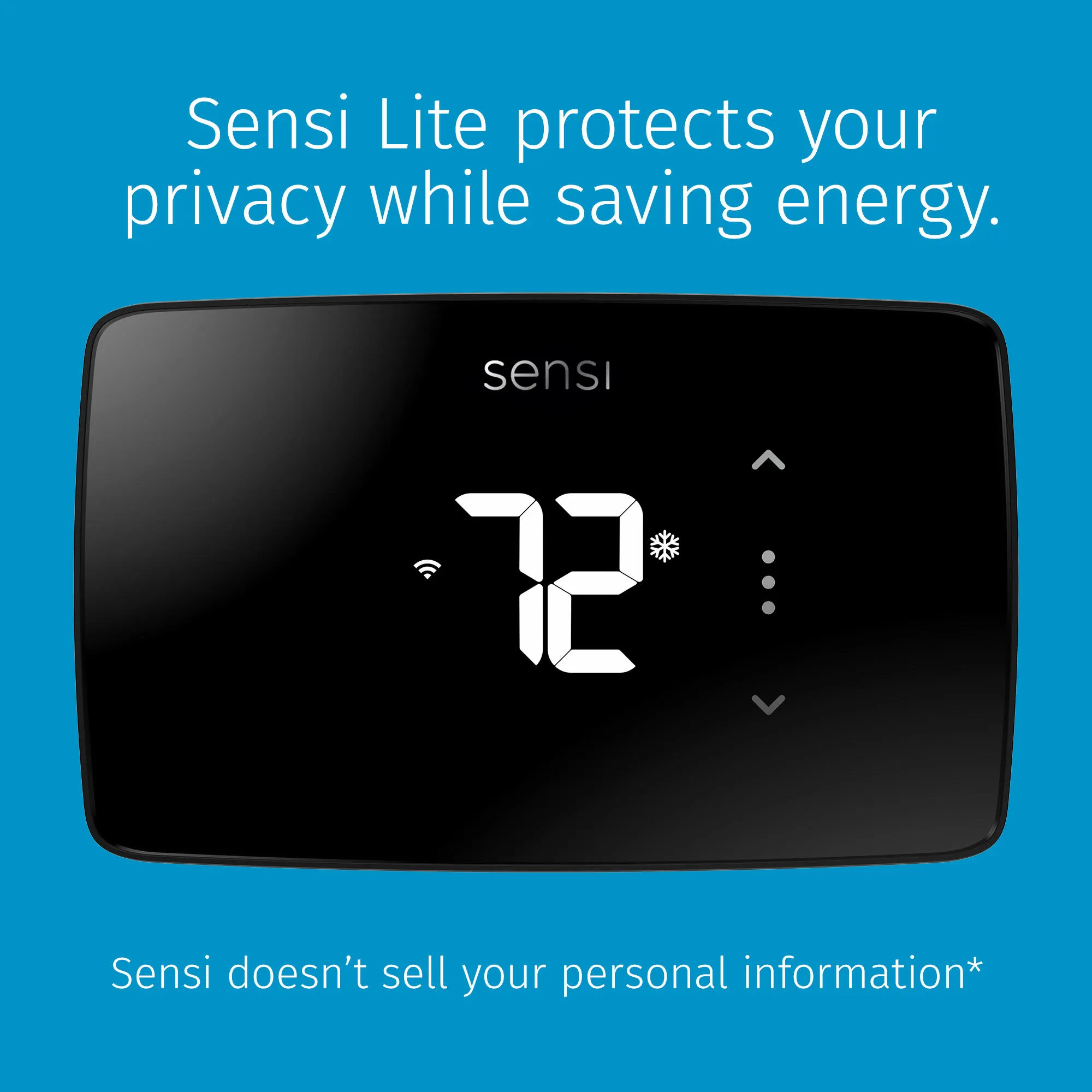
The Sensi Lite is the rare smart-home product whose most persuasive feature is restraint. At $39.99, the ST25 is not asking to be the brain of the house. It is asking whether a thermostat can be cheap enough that a buyer stops chasing flagship features and starts asking the boring questions: Will it fit the wires? Will it run the system? Will the schedule be easy enough? Will the return policy protect the purchase if the answer is no?
That is not a glamorous product story, but it is an honest one. The Sensi Lite sits below the Sensi Touch 2 and below the ST55 in price, and it should be judged accordingly. Expecting ecobee-style sensor architecture or Nest-style automation from a $39.99 thermostat is how buyers end up disappointed. The better framing is humbler: this is a possible low-cost wall control for people who want a smart thermostat label without paying smart thermostat money.
There is a catch, and it is not small. The accessible sources did not verify the ST25's display type, C-wire rule, HVAC stages, heat pump support, room-sensor support, platform integrations, warranty, dimensions, or energy certification. The Sensi brand pages were unavailable during research, and major retailer pages were blocked or unreachable. That does not prove the thermostat lacks those details. It does mean any confident recommendation must be conditional.
So this review is deliberately tougher than the price tag might suggest. A cheap thermostat still touches expensive equipment. The wrong wall device can short-circuit comfort, waste an afternoon, or require a professional visit that costs several times the purchase price. The ST25 may be a smart little bargain. It may also be a product whose low price hides too much homework. Both can be true.
Design and Build
A budget thermostat does not need luxury materials, but it does need clarity. The Sensi Lite should be physically judged by readability, button or touch behavior, wall coverage, and terminal labeling rather than by how modern it looks in a product photo. Unfortunately, those specifics were not verified in the accessible sources. The safe move is to treat every listing image as provisional until the current installation guide confirms the details.
That sounds severe for a $39.99 device, yet thermostats are not phone cases. A missing trim plate can expose old paint. A confusing terminal block can turn a 20 minutes swap into a support call. A power requirement can decide whether the project is simple or impossible without an adapter. None of those issues become less real because the checkout total is low.
The Lite name should therefore be read literally. The ST25 is not the model to buy for a showcase display, a rich sensor network, or a smart-home roadmap. It is the model to consider when the old thermostat is ugly, the schedule is simple, and the budget is strict. If the wall is in a hallway and nobody wants to admire the thermostat, saving money can be rational.
There is also a durability argument for plain hardware. Touchscreens are convenient on products like the Sensi Touch 2, but many thermostats spend their lives in dusty entries, rental units, basement zones, or vacation homes. A simpler interface can be easier to live with if the temperature changes are occasional. That point remains conceptual here because the ST25's exact controls were not verified; still, it explains why a low-end thermostat can be desirable rather than merely compromised.
A final design point belongs before any feature discussion: the box contents matter. If a thermostat at $39.99 excludes an adapter or trim plate, that may be perfectly reasonable. The buyer just needs to know before opening the package. With the Sensi Lite, verify what is included, verify the wiring, and verify whether support materials mention the exact system in the house. The inexpensive path only stays inexpensive if those answers are settled early.
Performance in Everyday Use
The most important performance expectation for the Sensi Lite is that it should not be asked to perform like a flagship. A thermostat in this price class should keep a schedule, permit reasonable adjustment, and avoid making the HVAC system feel mysterious. Anything beyond that is a bonus, not the purchase thesis.
This is where the ST25 becomes philosophically appealing. Plenty of homes do not need occupancy radar, a 5-inch display, remote room prioritization, or AI-flavored scheduling. They need heat lower overnight, cooling higher when the house is empty, and a quick override when plans change. If the Lite delivers those basics on a compatible system, it has done enough to justify $39.99.
But the phrase "if it delivers" carries weight. No ST25-specific savings claim was verified, and no feature list in the accessible sources confirmed geofencing, learning, room sensors, or voice assistant behavior. A buyer should not assume the Sensi Lite mirrors the Sensi Touch 2 just because both share a brand. The Touch 2 has confirmed geofencing behavior, optional room sensors at about $40 each, Early Start, auto heat/cool scheduling, and Alexa/Google/SmartThings support in CNET's table. The Lite's public evidence did not establish the same list.
That distinction makes the ST25 more like a low-risk experiment than a full recommendation. If the goal is to reduce energy use, the behavior of the humans in the house matters more than the sticker on the thermostat. Tom's Guide cites the U.S. Department of Energy's ENERGY STAR program for a general smart-thermostat savings estimate of around 8%, or roughly $50 per year, but that is not an ST25 guarantee. A $39.99 thermostat can theoretically pay for itself quickly if it enables better setbacks; it can also save nothing if the schedule never changes.
Performance also depends on comfort geography. A single thermostat reads one location. If the hallway is warm while the nursery is cold, a room-sensor system can help. No room-sensor support was verified for the Sensi Lite, so buyers with uneven rooms should budget for a higher model or choose ecobee. The cheapest thermostat is often best in compact homes where the thermostat location already reflects the spaces people use.
Finally, consider support. A thermostat that costs less than dinner for two should still have a clear manual and an easy compatibility checker. When public information is thin, the return policy becomes part of the product. Buy only from a retailer that makes the first week painless.
Competitive Comparison
The Sensi Lite's first competitor is not ecobee or Nest. It is the existing thermostat. If the current device already holds a reliable schedule, the ST25 must earn even $39.99 by adding something useful: easier programming, remote access, cleaner design, or better seasonal control. Without a verified feature list, that case has to be made against the exact listing in front of the buyer.
The Amazon Smart Thermostat is the closest named alternative with a clearer identity. At $79.99, it costs almost exactly twice as much as the Sensi Lite, but it brings stronger third-party documentation. Amazon's model requires a C-wire, does not include the adapter, works with Alexa and Ring, and does not support Google Home or Apple HomeKit according to CNET and Tom's Guide. Tom's Guide described it as a rounded square measuring 3.5 inches by 3.5 inches, and CNET describes the interface as closer to an old-school thermostat than a phone. If the household is Alexa-first, Amazon's extra $40 may buy confidence.
The ST55 is the internal comparison that may matter more. At $65.68, the Sensi Wi-Fi Programmable Thermostat is still inexpensive, but it is $25.69 above the Lite. The accessible sources were also thin for the ST55, so moving up within Sensi does not automatically solve the documentation problem. The reason to consider it is positioning: a programmable thermostat may be the more natural fit if smart features are not the goal.
The Sensi Touch 2 is the point where the Sensi ladder becomes much clearer. At $167.99 here, it is $128 more than the Lite, but CNET verifies a color touchscreen, room sensors sold separately for about $40, a required C-wire, no adapter in the box, no wall plate, flexible scheduling, Early Start, auto heat/cool ranges, and a fixed geofence that changes temperature by 3 degrees beyond about 3 miles. That is a real feature story. The Lite's advantage is price, not certainty.
Google's Nest Thermostat sits in the middle of the wider market at $129.99. It has a 2.4-inch mirrored display, a 3.3-inch diameter body, a 60GHz Soli sensor for presence, and live Google guidance saying it is designed to work without a C-wire in many homes. It does not support the original Nest Temperature Sensor, and schedules are managed in the Google Home app rather than edited directly on the thermostat. It is much more expensive than the ST25, but also easier to evaluate.
The ecobee Smart Thermostat Enhanced is the adult in the room. Around $184.83, it offers a 4-inch touchscreen, 540 by 540 resolution, 103.89 mm by 103.89 mm dimensions, 23.88 mm depth, a Power Extender Kit, 2.4GHz and 5GHz Wi-Fi, Bluetooth 5.0, a 915 MHz radio for SmartSensors, and a 3 years limited warranty. It is overkill if the Lite fits the job. It is the safer buy if the household needs sensors, accessory support, or published detail.
Honeywell Home's X8S goes further upscale at $219.99. It has a 5-inch 480 by 800 touchscreen, a body measuring 5.24 in by 3.54 in by 0.96 in, Matter certification, 2.4GHz and 5GHz Wi-Fi, Apple Home support through Matter, and 1 room sensor included. A buyer comparing the ST25 with the X8S is really choosing between a minimal gamble and a premium system.
Who Should Buy It
The Sensi Lite is best for someone who knows the HVAC system is simple, wants the lowest possible price, and is comfortable verifying details before installation. Think small homes, secondary zones, budget-conscious replacements, and owners who do not want the thermostat to become a smart-home project.
It is also a fit for people who believe less software can be better. A learning thermostat is impressive when it guesses correctly and irritating when it does not. A radar sensor is useful when occupancy maps to comfort and irrelevant when the thermostat is in the wrong hallway. A room sensor is valuable in a tricky upstairs bedroom and wasteful in a compact apartment. The Lite's lack of a grand promise can be a relief.
Do not buy it for a complicated system unless a current compatibility tool explicitly approves it. Heat pumps, auxiliary heat, multi-stage furnaces, boilers, dual-fuel arrangements, and unusual wiring should push buyers toward better documented options. The Sensi Lite may support more than the available sources confirmed, but a purchase should not rely on may.
Avoid it if smart-home ecosystem support is the main reason for shopping. Apple Home, Matter, Alexa, Google Home, and SmartThings were not verified for the ST25 in the accessible evidence. The Amazon Smart Thermostat is the clearer Alexa choice, Nest is the clearer Google Home choice, ecobee is the clearer multi-platform choice, and Honeywell X8S is the clearer Matter choice.
Final Verdict
The Sensi Lite ST25 is a $39.99 thermostat that should be purchased with a checklist, not with excitement. Its low price is excellent. Its verified public detail, at least in the accessible sources used here, is not. That combination does not make it bad; it makes it situational.
For the right buyer, the Lite's austerity is the appeal. There is no need to pay $184.83 for ecobee hardware or $219.99 for a Honeywell X8S if the job is a simple schedule on a simple system. There is no need to buy the Sensi Touch 2 if a touchscreen and remote sensors are irrelevant. Cheap, plain, and adequate can be the correct answer.
The recommendation is therefore narrow: consider the Sensi Lite only after verifying wiring, HVAC compatibility, box contents, app requirements, and the return policy. If those checks pass, $39.99 is hard to argue with. If any check is unclear, spend more on a thermostat with better documentation. The Lite buys less than shoppers may think, and that is fine only when less is exactly what the house needs.