Introduction
The ecobee Smart Thermostat Enhanced has an unusually plain problem: it is probably the right ecobee for more households than the more glamorous Premium, yet it is also the ecobee that makes you notice what is missing. At $184.83, it sits well below the high-end Nest and Honeywell models, brings a modern square touchscreen, and solves the common-wire anxiety better than most rivals by putting a Power Extender Kit in the box.
The honest catch is the sensor story. Ecobee's whole identity is room-aware comfort, but this model does not include a SmartSensor. It supports SmartSensors over a 915 MHz radio, and that matters, but the first remote room reading costs extra. It also skips the built-in air-quality sensor found on the Premium. Those omissions do not ruin the thermostat. They define it.
What remains is a carefully targeted middle product. The Enhanced gives you radar occupancy and proximity at the thermostat itself, a 4-inch display, dual-band Wi-Fi at 2.4 GHz and 5 GHz, and broad 24VAC HVAC coverage. It does not pretend to be a speaker, security hub or indoor-air monitor. That restraint is refreshing if you want the thermostat to be excellent at running heating and cooling. It is less satisfying if you expected the word Enhanced to mean ecobee's full feature set.
Design and Build
Ecobee chose a square face rather than Nest's jewellery-like circle, and the choice pays off in readability. The front is black, the backing is white, and the whole thermostat measures 103.89 mm tall by 103.89 mm wide by 23.88 mm deep. In wall terms, that is compact but not dainty: the screen reads like a small control panel rather than a hidden sensor.
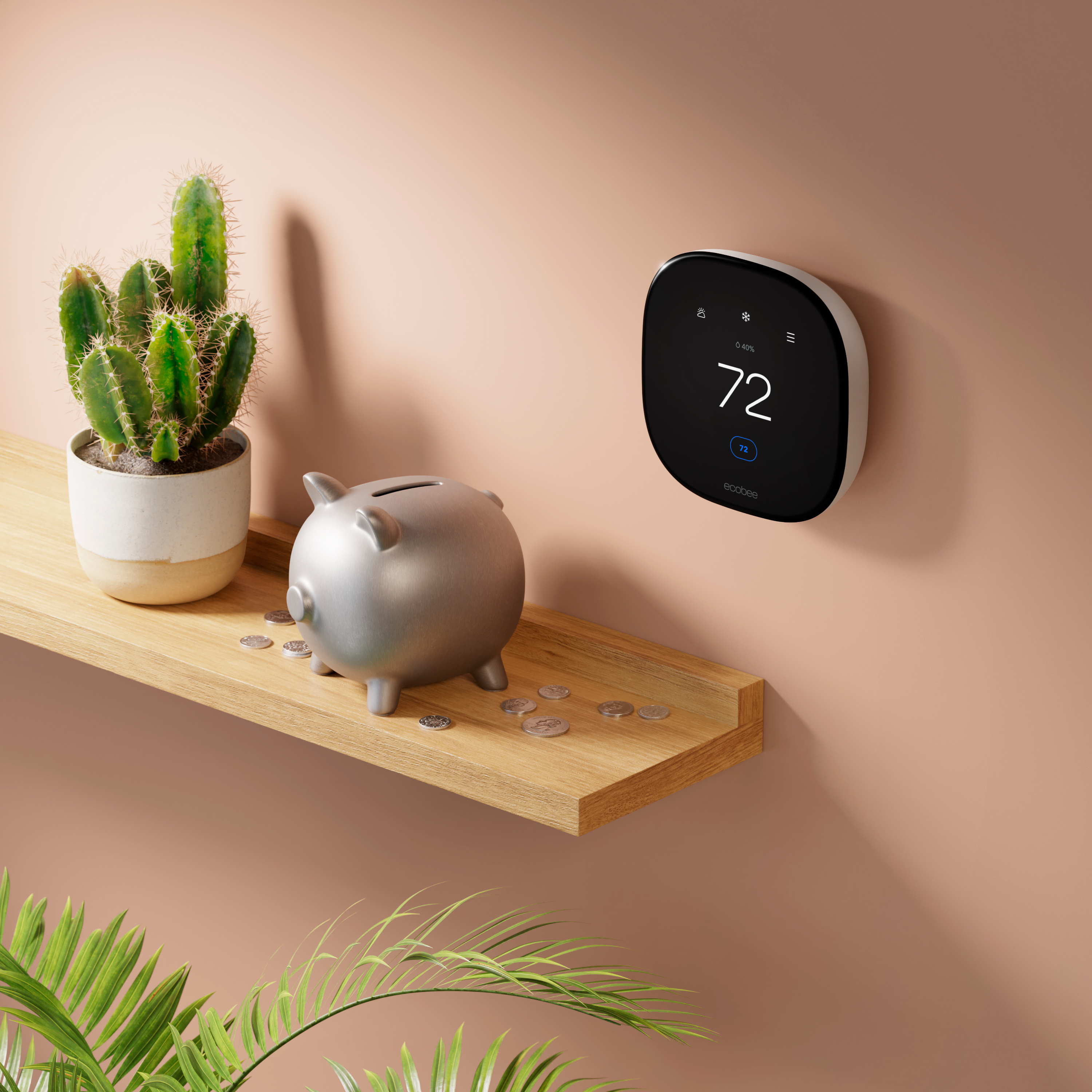
ecobee.com (Manufacturer product image)
The display is the strongest visual argument for this model. It is a 4-inch full-colour LCD touchscreen at 540 by 540 pixels, which gives it more working room than the older Google Nest Learning Thermostat's 2.08 inches circular display. A thermostat screen does not need phone-level sharpness, but it does need enough space for mode, setpoint, humidity and menu controls without turning every tap into a guessing game. Ecobee gets that balance right.
The included trim plate is practical rather than pretty. It spans 143.5 mm high by 159.9 mm wide by 7.71 mm deep, so it can cover the paint shadow or screw scars left by an old rectangular thermostat. The included Power Extender Kit is smaller at 62 mm by 62 mm by 23 mm, and it is the more important box item. Ecobee requires a C-wire, but the PEK can supply reliable thermostat power without pulling a new fifth wire on compatible systems.
The built-in sensor package is sensible. Temperature and humidity are expected. Radar-based occupancy and proximity are the useful additions because they let the thermostat know when people are near the device, not merely when an app location says someone should be home. There is no air-quality sensor. There is no built-in Alexa speaker or microphone. Those are Premium features, and ecobee is not subtle about the product ladder.
Ecobee also publishes more environmental and operating detail than many competitors. The setpoint range is 45 to 92 degrees F, the display range is 40 to 100 degrees F, humidity display spans 20% to 90%, and humidity sensitivity is listed at ±5%. The base limited warranty is 3 year, with a 5 year warranty when installed by a Pro. Ecobee does not publish the thermostat's weight, and that absence is worth saying plainly because several rivals are equally vague.
Performance in Everyday Use
A smart thermostat earns trust by disappearing into the background, and the Enhanced is built for that quieter version of smart home life. Its eco+ features include Schedule Assistant, Smart Home & Away, humidity adjustment, Time of Use, Community Energy Savings and Pause when Open. The most relevant one here is Smart Home & Away because ecobee says occupancy works on the Enhanced out of the box, using the thermostat's own radar rather than requiring an add-on room puck.
That does not make it a Nest-style self-programmer. The Enhanced can help build and refine a schedule, but its appeal is not that it learns a week of habits and writes the whole routine for you. Its appeal is that it combines occupancy, humidity and utility-rate awareness into a schedule you can still understand. For households that prefer explicit control, that is better than a black box.
HVAC coverage is a real strength. Ecobee says the thermostat works with most 24VAC equipment, including conventional furnaces and air conditioners at 2H/2C, heat pumps at 2H/2C plus 1 stage auxiliary heat, boilers, PTACs and fan coil units with up to 3 fan speeds. It also supports a 1-wire accessory such as a humidifier, dehumidifier or ventilator. That last point is unusually important in dry or damp climates, where comfort is not just a target temperature.
There is a limit, and ecobee states it: Enhanced supports accessories connected by one wire. Self-powered accessories may need an additional 24V isolation relay. In other words, the thermostat can run more than basic heat and cool, but it is not a blank cheque for every complicated mechanical room.
Connectivity is better than the category average. Dual-band Wi-Fi covers 802.11 b/g/n at 2.4 GHz and 802.11 a/n/ac at 5 GHz, while Bluetooth 5.0 and the 915 MHz SmartSensor radio handle setup and room-device communication. Ecobee lists WPA, WPA2, WPA3 and 168 bit SSL encryption, plus an estimated 15 MB to 20 MB of monthly bandwidth depending on Alexa Voice Service usage. None of those numbers makes the thermostat exciting, but they do make it feel current.
The energy-savings claim needs careful framing. Ecobee says customers can save up to 26% on heating and cooling costs compared with a hold of 72 degrees F, based on an internal April 2021 analysis. That is a manufacturer claim, not a guaranteed household result. It is still directionally credible: a thermostat with occupancy detection, schedules and humidity-aware control should cut waste. The exact savings depend on climate, utility rates, insulation and how disciplined the old thermostat schedule was.
Competitive Comparison
Against the Google Nest Learning Thermostat 3rd Gen, the ecobee Enhanced looks less iconic and more practical. The Nest has the famous rotating ring, Auto-Schedule and support for up to 6 remote Nest Temperature Sensors, but it is discontinued and still sells around $239 from third-party retailers. Its display is 2.08 inches, its body is 3.3 inches across and 1.2 inches deep, and its Wi-Fi is 2.4 GHz only. Ecobee gives you the bigger 4-inch touchscreen, 5 GHz Wi-Fi, an included PEK and stronger accessory control for less money.
Against the cheaper Google Nest Thermostat from 2020, the choice is less obvious. Google's current budget Nest costs about $129.99 and has a 2.4-inch mirrored display plus a 60 GHz Soli radar presence sensor. It also has Matter support, which ecobee does not publish for the Enhanced. But it does not support Nest's older remote temperature sensors, cannot edit schedules directly on the device, and caps out below the older Learning model's full HVAC flexibility. The ecobee is the more capable thermostat; the Google is the simpler ecosystem purchase.
The Amazon Smart Thermostat is the value threat at $79.99. It covers the basics, works cleanly with Alexa and costs less than half the ecobee. It also has no dedicated remote sensor support, no Google Assistant, no Apple Home and no published official dimensions, Wi-Fi band or HVAC stage count. If you want the lowest price and live entirely in Alexa, Amazon wins. If you want room-sensor expansion or a richer wall interface, ecobee is easily worth the step up.
The Honeywell Home X8S pushes the opposite direction. Honeywell's newer premium model has a 5-inch colour touchscreen, 480 by 800 resolution, Wi-Fi 6, Matter, Apple Home support and a room sensor in the box, with a manufacturer price around $219.99. It is more ambitious than the ecobee Enhanced, but Tom's Guide also described a much more involved installation experience. Honeywell is the feature showcase. Ecobee is the lower-risk HVAC controller.
The Sensi Touch 2 is a closer philosophical rival: a clean touchscreen thermostat with optional room sensors and conventional scheduling. CNET listed it at $210 and noted its room sensors cost about $40 each. It requires a C-wire and does not include an adapter. That is exactly where ecobee's PEK changes the value math. A thermostat that anticipates the C-wire problem is simply easier to recommend.
Who Should Buy It
Buy the ecobee Smart Thermostat Enhanced if you want a serious thermostat rather than a cheap connected switch. The best fit is a homeowner with a 24VAC system, a missing C-wire or an old wall opening to cover, and some interest in room sensors later. The included PEK and trim plate remove two common annoyances before the installation begins.
It is also a strong fit for homes with humidity equipment. If your HVAC setup includes a humidifier, dehumidifier or ventilator that can work through 1-wire accessory control, the Enhanced has a practical advantage over simpler budget thermostats. The same is true for two-stage heating and cooling. A basic Alexa thermostat may be fine for a single-stage furnace; a more complex system deserves a controller that publishes the compatibility clearly.
Do not buy it expecting the full ecobee experience in the box. If you want a remote room sensor included on day one, look at ecobee Premium or Honeywell Home X8S. If you want an air-quality sensor, the Enhanced is the wrong ecobee. If you want a thermostat that talks from the wall, it also misses the Premium's speaker and microphone.
Apple Home users should keep it on the list because Apple HomeKit is named by ecobee. Alexa and SmartThings users are also covered. Google Assistant users should be more cautious: ecobee shows a Google Assistant badge on the product page, but the official compatibility text retrieved for this model names Apple HomeKit, Amazon Alexa, Samsung SmartThings and IFTTT, then says “and more.” That is not clean enough to treat as a headline feature.
Final Verdict
The ecobee Smart Thermostat Enhanced is the thermostat I would point to when someone wants a modern, capable, non-fussy upgrade and does not want to pay flagship money. At $184.83, it gives up the Premium's air-quality sensor, built-in voice hardware and bundled SmartSensor, but keeps the parts that matter most to comfort: a bright 4-inch touchscreen, radar occupancy, humidity awareness, broad HVAC compatibility and expansion for room sensors.
The missing SmartSensor is the main frustration. Ecobee knows remote room sensing is one of its best ideas, so leaving even a single sensor out of the box makes the Enhanced feel a little less complete than it should. The lack of an air-quality sensor is easier to accept because that feature sits outside the thermostat's core job.
The recommendation is clear. Choose the Enhanced over the Amazon Smart Thermostat if you want platform flexibility, accessory control or remote-sensor growth. Choose it over the discontinued Nest Learning Thermostat if you care more about current hardware and HVAC pragmatism than Auto-Schedule. Skip it only if you need the Premium's bundled sensor and air-quality features, or if $79.99 is the budget ceiling. Ecobee trimmed the luxuries, not the essentials.