Introduction
The Google Nest Thermostat from 2020 is easy to misread. It wears the Nest name, uses the same broad circular silhouette as the famous Learning Thermostat, and shows up beside much more expensive Google hardware in search results. That makes it tempting to call it the cut-rate Nest Learning Thermostat. That is not quite fair, and it also gives buyers the wrong checklist.
This G4CVZ model is a simpler product with a sharper price argument. At a $92.50 street price, it lands closer to the Amazon Smart Thermostat than to the current Nest Learning Thermostat. Google's own list price has been cited at $129.99, but the retail number makes the 2020 Nest one of the least expensive ways into a Google-made, Matter-capable wall control. The point is not luxury. The point is whether the house gets smarter enough for little money.
The answer is yes for the right home. The thermostat has a 2.4-inch mirrored display, a 60GHz Soli radar chip for presence sensing, four finishes, Savings Finder suggestions, HVAC monitoring alerts, and a Google Home app experience that fits naturally into a Google household. It also works with Alexa, and Google announced a Matter update for the G4CVZ beginning April 18, 2023. PCMag's current smart thermostat coverage describes Matter support for this model, while one older Wikipedia text note conflicts with that timeline. The responsible reading is that Matter is part of the 2020 Nest story now, but that buyers who depend on Apple Home or SmartThings should verify their exact setup before purchase.
The tradeoffs are not small. There is no Auto-Schedule, no on-device schedule editing, no Nest Temperature Sensor compatibility, and no support for 3-stage heating. Those omissions are the heart of the review, not footnotes. This Nest is for people who want a clean wall control, remote management, occupancy-based away behavior, and a very low buy-in. It is not for people who want a thermostat that writes its own program.
Design and Build
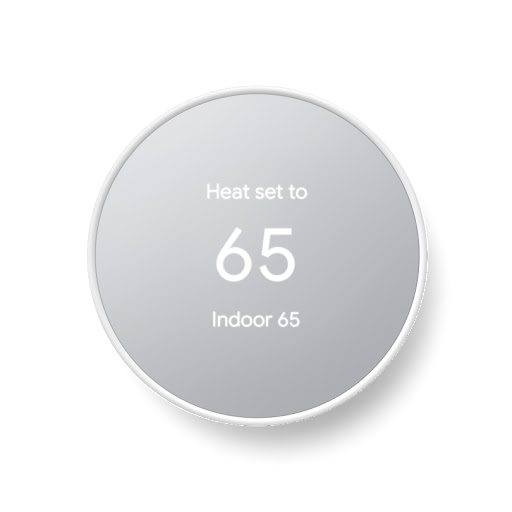
Google made the 2020 Nest look almost blank, and that is the best design choice on the product. The face is mirrored, the sensor does not sit behind a visible porthole, and the temperature readout appears only when the thermostat needs to talk. In Snow it reads like a modern light switch. In Charcoal it becomes more like a small black mirror. Sand and Fog are the quieter choices for warmer or cooler wall colors.
The display measures 2.4 inches, which is larger than the older third-generation Nest Learning Thermostat's 2.08 inches panel but used very differently. The Learning model is a colorful circular instrument. The 2020 Nest is closer to a status object: temperature, mode, and basic prompts float behind the face. Google does not publish the resolution, so any review that presents a pixel count for this model is leaning past the available evidence. That absence matters less in daily reading than it would on a phone, because a thermostat usually needs to show 2 digits and a mode icon, not fine text.
The body diameter is 3.3 inches. Google does not publish the thickness or weight in the accessible material used for this review, and those omissions are worth saying plainly. The product is meant to look thin because the mirrored face visually blends into the wall; an exact depth would be useful for buyers replacing a chunky rectangular thermostat, but it is not available from the current public sources.
Controls are the most divisive part of the hardware. There is no touchscreen. There is also no rotating ring. Instead, a capacitive touch bar runs down the right edge: swipe up to raise the setpoint, swipe down to lower it, and tap to select. It looks tidier than a bank of buttons, but it is less obvious to a guest than a dial or a touchscreen. A person who touches the front glass may think the thermostat is unresponsive. The side strip becomes familiar, but it never becomes charming.
Soli is the cleverer hardware story. Google uses a 60GHz radar chip to detect nearby presence and wake the display through the mirrored face. That keeps the front clean because the sensor does not need a cutout. It is not Farsight from the Learning Thermostat, and Google explicitly treats it as a closer-range behavior. Still, for a device at this price, presence detection that does not depend only on a phone location ping is a meaningful advantage.
Installation is framed as approachable. Google's product page says installation usually takes 30 minutes or less, and the thermostat is designed to work without a common wire in many homes. The important qualifier is in Google's own compatibility language: heating-only, cooling-only, and zone-controlled systems may need a C-wire or another power accessory such as the Nest Power Connector. The safe move is to run the compatibility checker before buying, especially if the old thermostat has only 2 wires or sits on a zoned system.
Performance in Everyday Use
The 2020 Nest's performance is mostly about what it chooses not to automate. It supports schedules, Eco temperatures, holds, a fan timer, Home/Away behavior, energy dashboards, Savings Finder, and HVAC monitoring. That covers the core smart thermostat jobs. What it does not do is watch a week of manual changes and build a schedule by itself. Auto-Schedule is reserved for the Nest Learning Thermostat line.
That difference changes the whole ownership experience. With the Learning model, the first week is training. With this model, the first week is programming. The schedule lives in the Google Home app, and it cannot be created or edited on the thermostat face. That is acceptable for households where one person manages everything from a phone. It is a poor fit for a rental, a shared family home, or anyone who wants a wall control to be the main interface.
Presence Sensing is the feature that keeps the 2020 Nest from feeling basic. It can use phone location and the Soli radar to decide whether the house is occupied, then lean toward Eco temperatures when nobody is home. That is more sophisticated than a simple time clock. It also avoids some of the awkwardness of geofencing alone, because the thermostat has a local signal from the room rather than depending entirely on whether a phone crossed a boundary.
Savings Finder is more advisory than magical, but it is useful in the right tone. Instead of claiming a specific model-level savings percentage, Google presents suggestions in the Home app. It might recommend a slight schedule adjustment or a more efficient temperature target. That is more defensible than promising exact bill cuts, because the accessible sources do not publish a specific 10% or 15% savings study for this 2020 model. For a general benchmark, the U.S. Department of Energy's ENERGY STAR program estimates smart thermostats can save roughly 8% or about $50 per year, but that is category guidance rather than a Nest-specific guarantee.
HVAC monitoring adds a second practical layer. The thermostat can warn when the system appears to take longer than expected to heat or cool. That is not a replacement for maintenance, and it does not diagnose a failed capacitor or a dirty flame sensor with technician-level certainty. It is still useful because an early alert can turn a subtle comfort problem into a service call before the house is stuck at 84 degrees on a bad day.
Compatibility is good for ordinary 24V systems and less impressive for complex ones. Google's published wording covers furnaces, air conditioners, boilers, heat pumps, forced air, radiant delivery, a second stage of heating or cooling, and fans. It does not cover 120V or 240V line-voltage systems. It also caps out at 2 heating stages. That cap is exactly where the cheaper Nest stops being a universal recommendation. A large home with a 3-stage furnace should look at a Nest Learning Thermostat, an ecobee model, or a professionally selected control instead.
The missing Nest Temperature Sensor support is the other major functional cut. The original Nest Temperature Sensors work with the Nest E and the third-generation Nest Learning Thermostat, not this 2020 model. PCMag also calls out that the standard Nest is not compatible with Nest's remote room sensors. Matter might someday make room-temperature ecosystems more flexible, but the accessible sources do not confirm that this thermostat can use Matter sensors for thermostat control. The honest buying advice is simple: if bedroom priority or nursery balancing is a requirement, do not buy this model on a hunch.
Competitive Comparison
The cleanest comparison is against the Nest Learning Thermostat 3rd Gen, because the names invite confusion. The older Learning model has Auto-Schedule, the rotating ring, and support for up to 6 Nest Temperature Sensors. It also handles broader HVAC staging, including 3-stage heating. But it is discontinued, often sells around $239 through third-party stock, lacks Matter, and uses the older Nest app. The 2020 Nest is less capable as a thermostat brain, but cheaper, simpler, and more current for smart-home standards.
The Google Nest Learning Thermostat 4th Gen moves the premium line forward with a larger 2.7-inch display, 600 by 600 pixel resolution, Matter, dual-band Wi-Fi according to PCMag, and an included newer room sensor. It also costs roughly $280. That product is for people who want Google's best thermostat. The 2020 Nest is for people who see a thermostat as infrastructure and would rather spend the difference elsewhere.
The ecobee Smart Thermostat Enhanced is the most balanced rival. It has a 4-inch LCD touchscreen, 540 by 540 resolution, radar occupancy and proximity sensing, a Power Extender Kit in the box, and accessory support for humidifiers, dehumidifiers, and ventilators. It also works with ecobee SmartSensors sold separately. Its approximate $185 price is much higher than $92.50, but it buys a more capable HVAC and room-sensing platform. If the house has uneven rooms, ecobee is the stronger tool.
The Amazon Smart Thermostat is the budget fight. At about $79.99, it can be even cheaper than the Nest street price and fits naturally into Alexa homes. It requires a C-wire, does not have a touchscreen, does not support dedicated remote room sensors, and CNET explicitly describes it as unfriendly to Google Home and Apple's HomeKit. For an Alexa-only apartment, Amazon makes sense. For a Google Home household, the Nest is worth the small premium.
The Honeywell Home X8S sits at the opposite end. At $259.99 in this roundup, it brings a 5-inch color touchscreen, Matter, Apple Home support, Wi-Fi 6 on 2.4 GHz and 5.0 GHz, one included room sensor, IAQ and humidity monitoring, and video doorbell integration with Ring and First Alert VX1. It is a premium dashboard. The 2020 Nest is a quiet control point. Choosing between them is less about brand loyalty than about whether the thermostat should be a screen.
Who Should Buy It
Buy the Google Nest Thermostat if the home is simple, the budget is tight, and Google Home is already the center of the smart-home setup. A conventional 24V furnace and air conditioner, a predictable weekly routine, and no need for remote room sensors make this thermostat look very attractive. At $92.50, the hardware price leaves room for a Nest Power Connector, a trim kit, or a professional compatibility check if the wiring is questionable.
It is also a good choice for people who dislike thermostat screens. The mirrored face, 4 finish options, and hidden Soli sensor make it visually calmer than most connected thermostats. The side touch bar is not as satisfying as a Nest ring, but many owners will change temperature from the app or by voice most of the time anyway. In that use case, the wall hardware mostly needs to look good and stay out of the way.
Do not buy it for a complicated HVAC system. The 2-stage heating limit is a real boundary, not a spec-sheet quirk. Do not buy it for a household that wants to edit schedules at the wall. Do not buy it if remote room sensors are part of the plan. And do not buy it as a cheap substitute for a Learning Thermostat if the learning behavior is what made Nest appealing in the first place.
The Matter situation deserves a cautious note for platform-driven buyers. Google announced the G4CVZ Matter update starting April 18, 2023, and PCMag's 2026 coverage treats Matter support as present. A conflicting older note in Wikipedia's prose makes it smart to verify the exact ecosystem path before relying on Apple Home or SmartThings. For Google Home and Alexa, the picture is much clearer.
Final Verdict
The Google Nest Thermostat (2020) is not the bargain version of the Nest Learning Thermostat. It is a different answer to a different problem. It strips away the self-learning schedule, the rotating control, and the room-sensor system, then keeps the parts that make sense for a lower-cost connected thermostat: attractive hardware, occupancy awareness, remote control, energy nudges, alerts, voice support, and a path into Matter.
That makes the recommendation narrower but strong. For a straightforward 24V system, the $92.50 street price is excellent. The 2.4 inches mirrored display looks better than the price suggests, the 60GHz Soli sensor is genuinely clever, and Savings Finder gives the app something useful to do beyond basic scheduling.
The score drops because the omissions are so visible. No Auto-Schedule is a philosophical break from what made Nest famous. App-only scheduling is inconvenient. The lack of Nest Temperature Sensor support blocks one of the most common smart thermostat upgrades. Google also leaves too many basic hardware details unpublished, including resolution, thickness, weight, and warranty.
Still, this is the cheap Nest to buy on purpose. If the home does not need room sensors or advanced staging, it delivers a polished Google thermostat experience for less than many dumb replacement controls. If the home does need those things, spend more before the wall plate goes on.
Frequently Asked Questions
Is the Google Nest Thermostat the same as the Nest Learning Thermostat?
No. The 2020 Google Nest Thermostat is the G4CVZ model with a side touch bar, no Auto-Schedule, no rotating ring, and no Nest Temperature Sensor compatibility. The Learning Thermostat line is more expensive and more automated.
Does the 2020 Nest Thermostat learn my schedule automatically?
No. It supports manual scheduling through the Google Home app, but it does not create a schedule from your adjustments during the first week. That self-learning behavior is an Auto-Schedule feature of the Learning models.
Can I edit the schedule on the thermostat itself?
No. Schedule creation and editing must be done in the Google Home app. The thermostat can handle basic temperature changes and mode interactions, but it is not a full schedule editor on the wall.
Does it work with Nest Temperature Sensors?
No. The original Nest Temperature Sensors are compatible with the Nest E and third-generation Nest Learning Thermostat, not the 2020 Google Nest Thermostat. Do not buy this model if room priority is required.
Does the Google Nest Thermostat need a C-wire?
Usually not, according to Google's wording, but there are exceptions. Heating-only, cooling-only, and zone-controlled systems may need a C-wire or a Nest Power Connector. Check compatibility before purchase.
What HVAC systems does it support?
It works with many 24V heating and cooling systems, including furnaces, air conditioners, boilers, heat pumps, forced air, radiant systems, and fans. It does not support 120V or 240V line-voltage systems and does not support 3-stage heating.
Does it support Matter?
Google announced an over-the-air Matter update for G4CVZ thermostats starting April 18, 2023, and PCMag's 2026 smart thermostat coverage describes Matter support for the 2020 model. Because one older reference conflicts with that, verify the exact platform path if Apple Home or SmartThings is essential.
How big is the display?
The mirrored display is 2.4 inches. Google does not publish a display resolution in the accessible sources used here, so the safest answer is size only, not pixel density.
What colors are available?
The four finishes are Snow, Sand, Charcoal, and Fog. That is one of the product's underrated strengths, because many thermostats still come in only white or black.
Is it a good value at $92.50?
Yes, for simple systems. At that price it competes with the Amazon Smart Thermostat while offering a more natural Google Home experience, Soli presence sensing, and a cleaner design. It is not the right value if you need remote sensors or advanced HVAC staging.