Introduction
The Amazon Smart Thermostat is a price argument first and a smart-home product second. At $79.99, it costs less than many replacement parts for premium thermostats and less than half of the ecobee Smart Thermostat Enhanced. That alone makes it impossible to ignore. A basic connected thermostat that works with Alexa, schedules from the app and handles ordinary heating and cooling can be the correct purchase for a lot of homes.
The ceiling arrives just as quickly. Amazon does not publish official dimensions, weight, Wi-Fi bands or HVAC stage counts in the accessible product information. It requires a C-wire, and the standard thermostat does not include the adapter many older systems need. It has no dedicated remote room sensor support, no Google Assistant, no Apple Home and no true Nest-style learning schedule. The value is real, but it is narrow.
That narrowness is not automatically bad. The best way to understand this thermostat is as a low-cost Alexa endpoint designed with Resideo, the Honeywell Home parent company. If your home already uses Echo speakers and you mainly want app schedules, voice changes and away adjustments, Amazon's thermostat is coherent. If you are building a cross-platform smart home or trying to fix uneven room temperatures, it runs out of road fast.
Design and Build
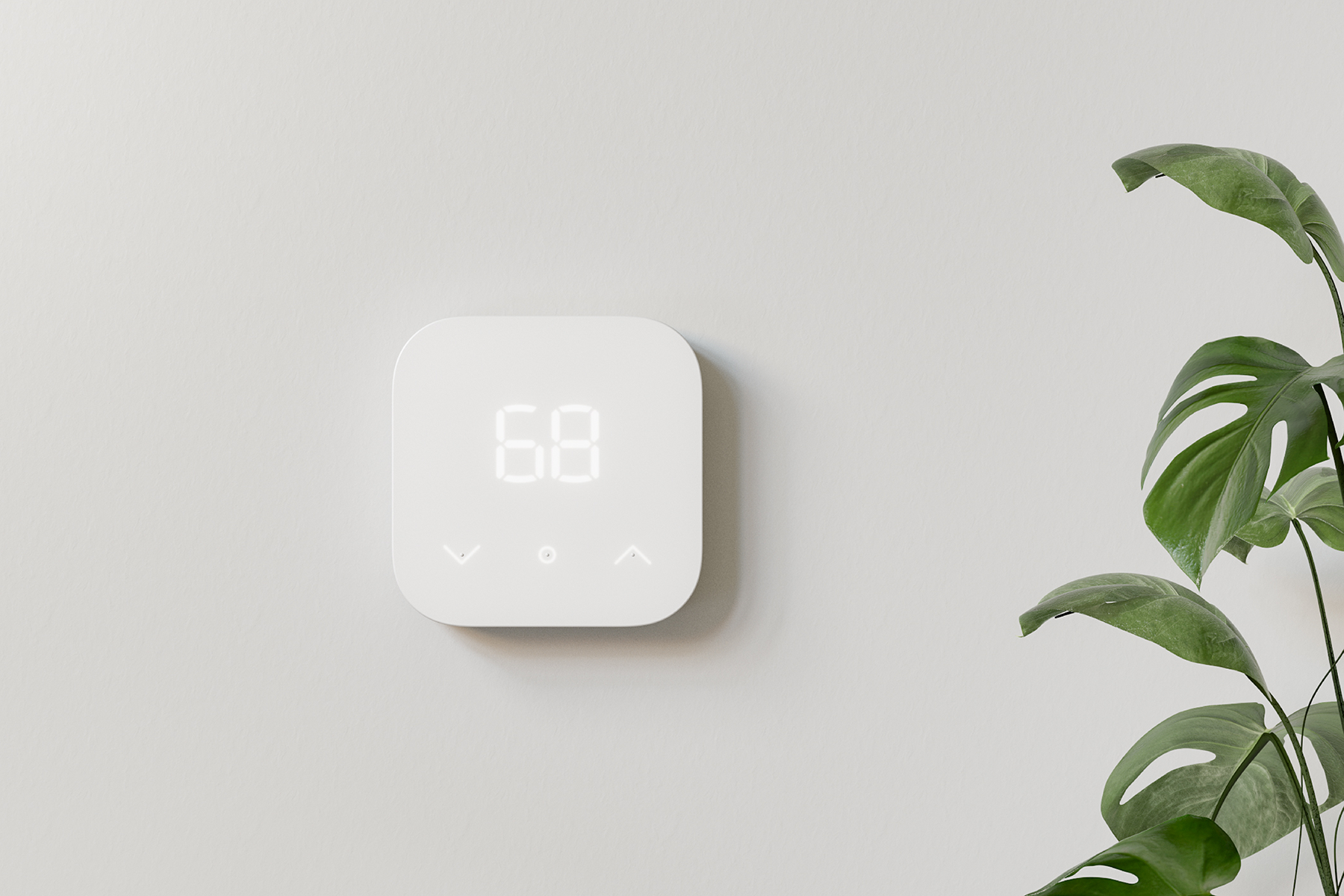
Amazon's wall unit is intentionally simple. Tom's Guide described it as a rounded square measuring 3.5 inches by 3.5 inches, but Amazon itself does not publish official dimensions in the accessible spec sources, so that figure belongs to the outlet, not the manufacturer. The face is clean and minimal, with a large digital temperature readout that looks closer to an appliance display than a phone screen.
It is not a touchscreen. Tom's Guide noted small up and down arrows below the temperature for changing the climate 1 degree at a time, while CNET compared the feel to an old-school thermostat filtered through a Kindle-like interface. Amazon's own FAQ says the display may dim when inactive and can be reactivated by touching the face. That is enough for quick manual changes, but not enough for building schedules or exploring settings from the wall.
The simplicity has benefits. There is less visual clutter than on a 5-inch Honeywell display, and nobody has to learn a rotating ring or a side touch bar. The downside is that nearly all real intelligence lives in the Alexa app. If someone in the house refuses to use the app or voice control, the thermostat becomes a basic up/down device.
The C-wire situation is the biggest hardware caveat. Amazon says the Smart Thermostat requires a C-wire. If the existing wall wiring lacks one, an adapter may need to be purchased separately. Tom's Guide reported a launch-era bundle with a Honeywell Home adapter at $74.99, compared with the original $59.99 thermostat price, but the standard box should not be treated as including that adapter. For buyers moving from an old battery-powered thermostat, this is the detail to check before ordering.
Amazon also leaves several ordinary spec questions unanswered. It does not publish a weight. It does not publish the Wi-Fi band, so there is no official basis for saying whether it is 2.4 GHz only or dual-band. It does not publish a display size in inches. It does not publish official stage counts for heating and cooling. Budget products can be sparse, but this is sparse enough that the gaps become part of the buying advice.
Performance in Everyday Use
The Amazon Smart Thermostat should be judged by the routine tasks it promises, not by the features it never tries to offer. It can set temperatures, hold a manual change, follow schedules created in the Alexa app and participate in Alexa routines. For a single-zone home with a conventional HVAC setup, that may cover the whole job.
Alexa is the centre of the experience. Tom's Guide confirmed that scheduling, preferred temperatures and energy dashboard views live in the Alexa app. CNET described geofencing through Alexa Hunches and found it could act when the user was about half a mile away. That is useful, especially in a home where Echo devices already know whether people are coming and going.
Amazon publishes no energy-savings percentage of its own, and the evidence for one is simply absent rather than disappointing. For a neutral planning figure, the Department of Energy's ENERGY STAR programme estimates a smart thermostat saves roughly 8%, or about $50 a year, across the category. Against a $79.99 purchase price, that is a payback period measured in months rather than years, which is the strongest financial argument this thermostat has.
Still, Hunches are not the same as a learning thermostat. The Nest Learning Thermostat watches manual changes for about a week and creates a schedule from those habits. Amazon's system can infer and automate some actions, but it does not offer the same clear self-programming identity. If your goal is to stop thinking about the schedule altogether, Amazon is not the benchmark.
The lack of remote room sensors is the more practical limitation. Amazon's FAQ identifies Echo Dot 5th gen, Echo Dot with clock 5th gen, Echo 4th gen and the Amazon Smart Air Quality Monitor as devices with temperature sensors that can trigger Alexa automations. That is not dedicated thermostat room-sensor support. It is an automation workaround, and it will not give the thermostat the same structured room-priority behaviour that ecobee, Nest or Honeywell offer.
HVAC compatibility is also hard to score generously because Amazon does not publish enough. The FAQ references heat pump reversing-valve troubleshooting, so heat pump support exists, but official stage counts are not published in the accessible material. There is no confirmed support statement for boilers, radiant systems, accessory humidifiers, dehumidifiers or ventilation. The safest buying advice is to use Amazon's compatibility checker and be conservative with multi-stage or accessory-heavy systems.
PCMag noted that installation uses low-voltage wiring and does not require special tools, which matches the product's budget-friendly pitch. That does not erase the C-wire requirement. A thermostat that costs $79.99 can become less compelling if the missing common wire turns into an adapter purchase or a professional visit.
Competitive Comparison
The ecobee Smart Thermostat Enhanced is the most obvious step-up choice. It costs $184.83, so it is more than twice Amazon's price, but it includes a 4-inch 540 by 540 touchscreen, a Power Extender Kit, 2.4 GHz and 5 GHz Wi-Fi, Bluetooth 5.0 and a 915 MHz radio for SmartSensors. It also publishes broad 24VAC compatibility, including conventional 2H/2C, heat pumps at 2H/2C plus 1 auxiliary heat and 1-wire accessory control. Amazon wins on price; ecobee wins on clarity, expansion and HVAC breadth.
The Google Nest Learning Thermostat 3rd Gen is the opposite kind of competitor. It is discontinued and still sells around $239, yet it remains the category shorthand for automatic scheduling. Its 2.08-inch display sits in a 3.3-inch round body that is 1.2 inches deep, it supports up to 6 Nest Temperature Sensors, and it can run without a C-wire on many systems. Amazon cannot match that automation or room-sensor system. Amazon can only say that it costs about a third as much.
Google's cheaper Nest Thermostat from 2020 is closer in spirit. It has a 2.4-inch mirrored display, a 60 GHz Soli radar presence sensor and a price around $129.99. It does not have the older Learning model's Auto-Schedule, and it does not support Nest Temperature Sensors, but it does offer a broader Google-centred experience than Amazon offers outside Alexa. If your home is split between Google Assistant and Alexa, the Amazon thermostat is the wrong compromise.
The Honeywell Home X8S shows what Amazon leaves behind. Honeywell's premium thermostat is about $219.99 from the manufacturer, uses a 5-inch 480 by 800 touchscreen, supports Wi-Fi 6 on 2.4 GHz and 5.0 GHz, carries Matter certification, and includes 1 room sensor. It is much more expensive and more complex, but it is a complete modern platform. Amazon is deliberately not that.
The Sensi Touch 2 is another instructive middle ground. CNET listed it at $210, described a colour touchscreen, confirmed Alexa, Google Home and Samsung SmartThings support, and noted optional room sensors at about $40 each. It requires a C-wire and does not include an adapter, so Amazon is not alone there. The difference is that Sensi still offers room-sensor expansion and broader platform support.
Who Should Buy It
Buy the Amazon Smart Thermostat if price is the main requirement and Alexa is already the voice assistant in the house. It is especially logical for a small home or apartment with one main living zone, a known C-wire and no need for room-by-room balancing. In that situation, paying $79.99 for app scheduling and voice control is a strong deal.
It is also a reasonable choice for renters or owners who do not want the wall to become a smart-home dashboard. The display is plain, the controls are obvious, and the thermostat does not try to be a speaker, a video screen or an indoor-air station. That restraint is appealing if the rest of the home automation already runs through Echo devices.
Do not buy it for a mixed smart-home household. CNET and Tom's Guide both confirm the Alexa-only reality, and CNET explicitly says it does not play nicely with Google Home or Apple's HomeKit. If Apple Home is important, go to Honeywell X8S, ecobee or a Matter-friendly Nest. If Google Assistant is important, do the same.
Do not buy it as a fix for uneven bedrooms. There is no dedicated remote sensor system, and Echo temperature sensors used in Alexa routines are not equivalent to ecobee SmartSensors, Nest Temperature Sensors or Honeywell room sensors. If one upstairs bedroom always runs 4 degrees warmer than the hallway, Amazon is not the neat solution.
Finally, be careful with complex HVAC. The thermostat may be fine for many ordinary systems, and Amazon references heat pump support, but the lack of published stage counts is a real limitation. Owners of multi-stage furnaces, dual-fuel setups, boilers, radiant heat or accessory humidifiers should verify compatibility before treating the low price as the final answer.
Final Verdict
The Amazon Smart Thermostat is good because it is cheap, not cheap because it is bad. That distinction matters. At $79.99, it delivers credible thermostat fundamentals, Alexa app control and routine automation for far less than ecobee, Nest, Sensi or Honeywell alternatives. The Resideo partnership gives it more legitimacy than a generic white-label gadget would have.
But the boundaries are unusually hard. No dedicated room sensors. No Google Assistant. No Apple Home. No true learning schedule. No published official dimensions, weight, Wi-Fi band or HVAC stage count in the accessible materials. A product this inexpensive can survive missing luxuries; it has a harder time when basic compatibility details are not published clearly.
The recommendation is therefore narrow and positive. Buy it for an Alexa-first, single-zone home with a verified C-wire and ordinary HVAC. Skip it if you want platform freedom, room balancing, advanced HVAC control or a thermostat that grows into a larger smart-home system. Amazon made the budget champion, but it also made a thermostat with walls you can hit quickly.