Introduction
The Fitbit Sense 2 is the most holistic health monitoring smartwatch Fitbit has ever built, designed around a singular insight: stress is one of the most impactful factors in long-term health, and it has been nearly impossible to measure passively on the wrist — until now. The Sense 2's cEDA (continuous electrodermal activity) sensor represents a genuine leap in consumer health sensing, offering the first continuous passive stress detection available in any mainstream wearable.
At $249, the Sense 2 positions itself as Fitbit's premium offering for health-conscious adults who want more than step counting and heart rate. It's not competing with Garmin's training analytics or Apple Watch's app ecosystem. Its pitch is narrower and more specific: if you want the most comprehensive passive health monitoring available — stress, sleep, heart rate variability, skin temperature, SpO2, ECG — the Sense 2 offers a unique sensor stack at a mid-range price.
Design & Display
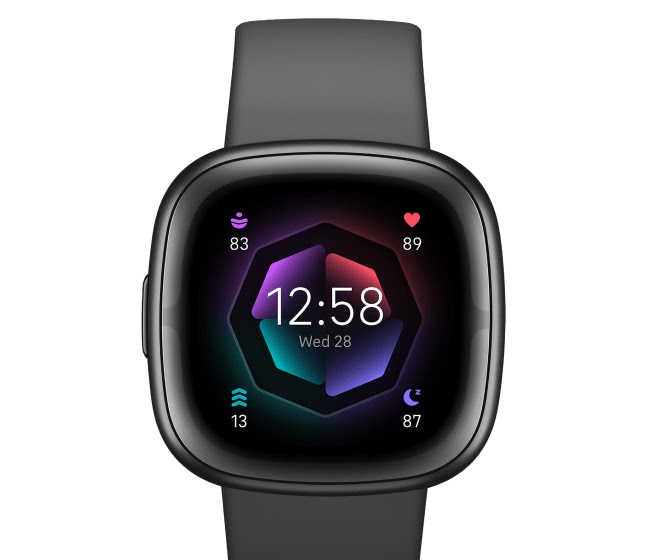
The Sense 2 adopts the same squircle (square with rounded corners) form factor as its predecessor, deviating from the round watch faces dominant in the category. The 40.5mm case is compact and sits comfortably on both smaller and larger wrists. At 45.9g, it's lighter than most competing smartwatches, contributing to all-day and overnight comfort.
The 1.58-inch AMOLED display produces vibrant, accurate colors at 336x336 pixel resolution. Fitbit's watch faces lean toward health-data-forward designs — large metric displays for heart rate, steps, and stress — though the display's quality supports more decorative designs from Fitbit's watch face gallery. Outdoors, the display's brightness is adequate for casual use but not as brilliant as the Apple Watch Series 10's 2000-nit maximum.
The case is aluminum with a frosted back panel housing the sensor array. Google Wallet NFC is integrated, enabling tap-to-pay at modern payment terminals. No physical rotating bezel — navigation is purely touchscreen-based with a single side button. The charging dock is Fitbit's proprietary magnetic design.
Health & Fitness Tracking
The Sense 2's centerpiece sensor is the cEDA (continuous electrodermal activity) sensor, which measures the electrical conductance of the skin — a measure that correlates with emotional arousal and the sympathetic nervous system's fight-or-flight response. Traditional EDA measurements, used in clinical psychology and lie detector research, require gel electrodes and controlled lab conditions. The Sense 2 performs a continuous, passive version throughout the day using sensors embedded in the watch back.
The result is an EDA Score that tracks stress-correlated skin conductance changes over the day, identifying periods of elevated sympathetic arousal. This isn't mind-reading — the sensor detects physiological arousal correlated with emotional stress, excitement, or cognitive load, not specific emotions — but it provides a data stream that most users find broadly correlating with their subjective stress experience once they calibrate to their personal baseline over several weeks.
The Stress Management Score synthesizes cEDA data with heart rate variability, sleep quality, and activity levels to produce a daily 1–100 score reflecting the overall balance between stressors and recovery factors. When the score is low, the app suggests Relax breathing sessions or mindfulness practices. The Relaxation Mode on the watch guides users through real-time heart rate feedback breathing exercises, using the display to visualize breath cadence.
The broader health suite is comprehensive. The ECG app is FDA-cleared for AFib detection, using the side button as the electrical sensor contact point for a 30-second rhythm trace. SpO2 monitoring tracks blood oxygen saturation during sleep. Skin temperature monitoring detects nightly fluctuations associated with illness, menstrual cycle phases, and recovery state. Sleep staging covers all four stages with a comprehensive Sleep Score and, with Fitbit Premium, a Sleep Profile that analyzes monthly sleep trends.
Built-in GPS enables independent run and walk route tracking without a phone, recording pace, distance, and elevation. The GPS accuracy is solid for urban and suburban activity, with the expected signal delay in dense city canyon environments. Heart rate zone tracking during workouts shows Active Zone Minutes accumulation in real-time.
Battery Life
Six days of battery life is the Sense 2's most notable step back from Garmin and budget competitors. With continuous health monitoring, daily GPS workout tracking (approximately 45 minutes), and standard notification use, reviewers commonly report 5.5–6.5 days before the watch reaches the 20% battery warning.
This puts the Sense 2 on a weekly charging cycle — slightly less convenient than the Fitbit Charge 6's 7-day baseline, but still dramatically better than the daily charging required by Apple Watch, Google Pixel Watch, or Samsung Galaxy Watch. For users who prioritize sleep tracking (and Fitbit's sleep algorithms reward consistent nightly tracking data), the Sense 2's ability to run through most of a week without charging is a meaningful advantage.
The always-on display option reduces battery to approximately 2 days and is generally not recommended unless you specifically need constant display visibility.
Software & Google Integration
Fitbit OS on the Sense 2 is focused on health data presentation rather than general smartwatch functionality. There is no third-party app store equivalent to Apple's watchOS App Store or Google Play. Fitbit's own app suite covers the core use cases: workout tracking, sleep analysis, stress monitoring, mindfulness, and menstrual health. Google Maps navigation glances and YouTube Music controls are available for Android users with compatible Google apps installed.
Google Wallet NFC supports contactless payments at modern terminals — a feature that meaningfully raises the Sense 2's daily utility compared to fitness trackers that don't support payments. Notifications from the paired smartphone display on the watch, but responses require the phone; there's no microphone or speaker for voice replies or calls.
Fitbit Premium at $9.99/month unlocks the most valuable analytics features: Daily Readiness Score, Advanced Sleep Analytics, Sleep Profile monthly reports, detailed stress trend analysis, and guided health programs. The base free tier provides all raw tracking data but lacks the synthesized coaching insights that make Fitbit's health platform most actionable.
Fitbit Sense 2 vs Fitbit Charge 6
Fitbit's own product line creates an interesting internal comparison. The Charge 6 at $159 also includes the cEDA sensor, ECG, GPS, and Google Wallet — the four most significant Sense 2 differentiators — at $90 less. The Sense 2's advantages over the Charge 6 are its larger display, the full watch form factor that reads as a smartwatch rather than a fitness band, and slightly richer notification display on the larger screen.
For users who specifically want the watch form factor and larger display, the Sense 2 is the right choice. For users who prioritize the slim, unobtrusive band aesthetic and don't care about the watch-face aesthetic, the Charge 6 delivers the core health capabilities at a lower price.
Fitbit Sense 2 vs Google Pixel Watch 3
The Pixel Watch 3 at $349 offers a better smartwatch experience with Wear OS, Loss of Pulse Detection, and Google ecosystem depth — at $100 more. The Sense 2's advantages are battery life (6 days vs. 24 hours), the cEDA continuous stress sensor not present on the Pixel Watch, and price. For users who care deeply about stress monitoring and are willing to accept limited smartwatch functionality in exchange for comprehensive health sensing, the Sense 2 offers a unique capability that the Pixel Watch 3 doesn't replicate.
Who Should Buy It?
The Fitbit Sense 2 is the ideal choice for adults who prioritize holistic health monitoring — especially stress management — over smartwatch functionality. Users who manage high-stress professional lives, practice mindfulness or meditation, or want data to understand the physiological impact of stress on their health will find the cEDA sensor uniquely valuable. Health-conscious users who want ECG, SpO2, sleep staging, and skin temperature in a comfortable mid-range smartwatch will find the Sense 2's health credentials impressive.
Users who want rich smartwatch notification handling, third-party apps, or voice call capability should look at Samsung Galaxy Watch, Google Pixel Watch, or Apple Watch instead.
Verdict
The Fitbit Sense 2 is the most comprehensive stress and holistic health monitoring smartwatch in the consumer category, offering a sensor suite — cEDA, ECG, SpO2, skin temperature, sleep staging — that no competitor at this price point replicates. Its unique continuous electrodermal activity monitoring provides a window into the body's stress response that most wearables entirely ignore.
The limitations — basic smartwatch functionality, a smaller third-party app ecosystem, and battery life that trails budget competitors — are real but well-defined. For health-first users who want to understand and manage their stress physiology with data, and who are willing to trade smartwatch breadth for health depth, the Fitbit Sense 2 delivers a genuinely differentiated experience.