Introduction
The Apple Watch Ultra 2 is Apple's statement that it can compete with Garmin, Suunto, and Casio's G-Shock PRW in the category of serious outdoor and athletic wearables — and by almost every measurable benchmark, it succeeds. At $799, the Ultra 2 is not a casual purchase. It's a precision instrument built for triathletes, mountaineers, freediver, long-distance trail runners, and anyone whose activities push the limits of what a wrist computer needs to withstand. What separates it from the Apple Watch Series 10 isn't just the price and the titanium case — it's a fundamentally different philosophy about what a smartwatch should prioritize.
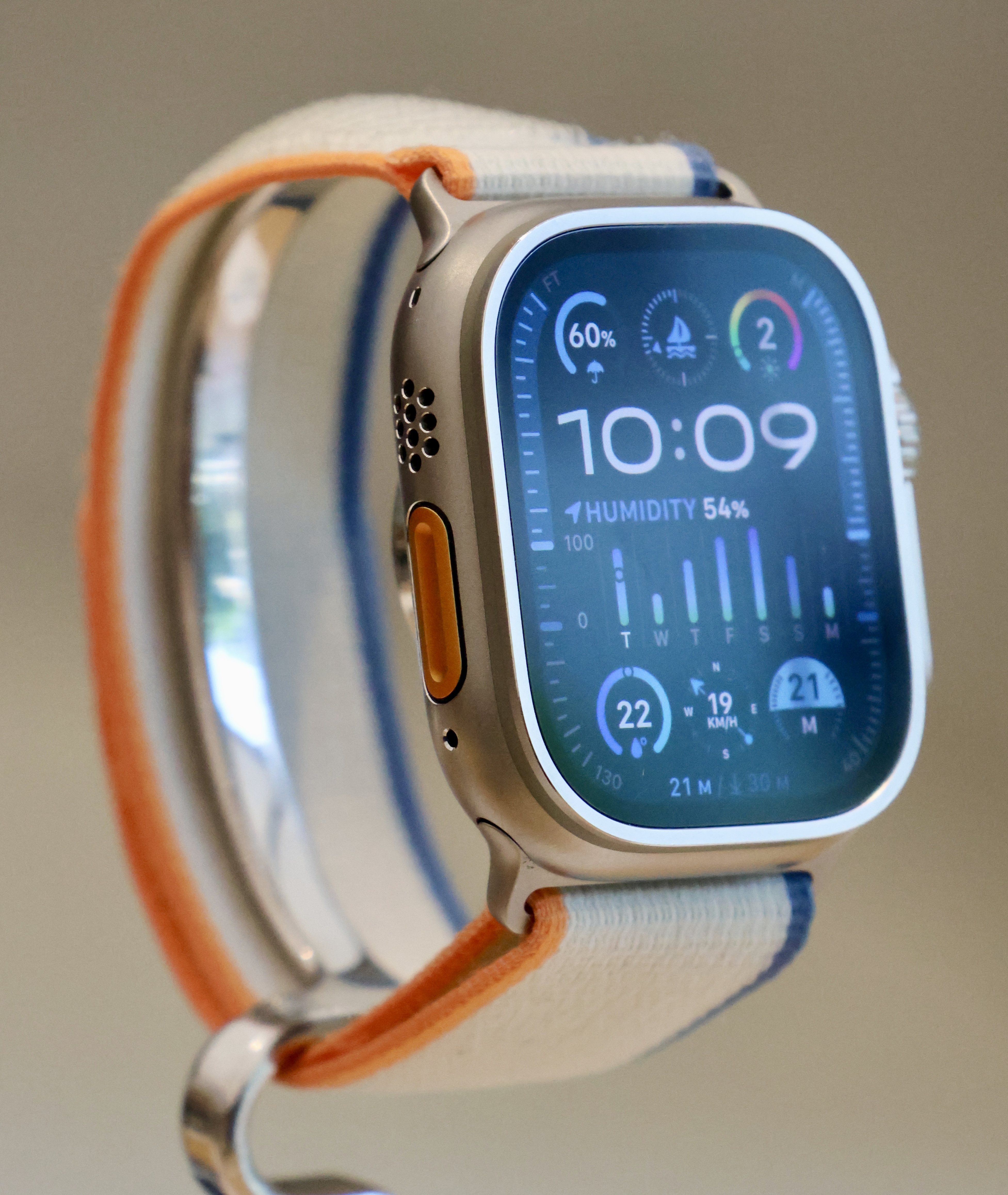
The Ultra 2 was introduced as the second generation of Apple's Ultra line, refining the original's formula with the S9 chip (shared with the Series 9), a brighter display, and the addition of the Double Tap gesture for hands-free interaction. It retains the defining characteristics that made the first Ultra so compelling: a 49mm case machined from aerospace-grade titanium, a flat sapphire crystal front glass, the customizable Action Button on the left side, and a battery life that finally breaks Apple's longstanding 18-hour ceiling by reaching 36 hours standard and an extraordinary 72 hours in Low Power Mode.
For the right buyer — a serious athlete, an adventure traveler, a triathlete who needs a single device from swim start to finish line — the Ultra 2 is arguably the best smartwatch money can buy in the Apple ecosystem. For everyone else, it's a fascinating engineering achievement that may be difficult to justify at twice the price of the Series 10.
Design & Display
The Ultra 2's design language is unmistakably intentional. Where the Series 10 pursues thinness and elegance, the Ultra 2 pursues function and resilience. The 49mm titanium case is larger than any Apple Watch has ever been, with a distinctive flat design, a pronounced titanium frame that forms a raised edge around the sapphire crystal display, and a crown protected by a machined guard. On the left side sits the Action Button — a bright orange programmable button that provides tactile confirmation even with gloves on.
Grade 2 titanium is the same alloy used in aerospace and medical implants. It is lighter than steel while stronger than aluminum, resistant to saltwater corrosion, and capable of surviving drops and impacts that would dent or crack an aluminum Apple Watch. The Ultra 2 carries MIL-STD-810H certification, meaning it has been tested against temperature extremes, humidity, immersion, shock, and vibration. For outdoor athletes, this isn't marketing language — it's a meaningful guarantee.
The display peaks at 2000 nits, making it the brightest Apple Watch screen ever produced. In direct sunlight on a clear day, reviewers consistently rank the Ultra 2 among the most readable smartwatches available — including against the Garmin Fenix 7 Pro's MIP display in sunlight-reflective mode. The Always-On capability is well-implemented with a wide viewing angle, and the flat sapphire crystal provides excellent scratch resistance for long-term daily wear.
Three interchangeable band styles — Alpine Loop, Trail Loop, and Ocean Band — are purpose-designed for the Ultra's outdoor use cases. The Alpine Loop's titanium G-hook closure is particularly secure for high-activity use. All three attach to the 49mm lugs with Apple's standard band mechanism, though third-party band compatibility is limited by the larger case size.
Health & Fitness Tracking
The Ultra 2 carries the same core health sensor suite as the Series 10: ECG via the electrical heart sensor, skin temperature for cycle tracking and fever context, optical heart rate with irregular rhythm detection, and Crash Detection using the dual-core motion co-processor. In the United States, the Blood Oxygen sensor — while present in hardware — remains disabled due to Apple's ongoing patent dispute with Masimo, which is a frustrating omission at any price point but particularly so at $799.
Where the Ultra 2 separates itself is in its dedicated adventure-sports hardware. The depth gauge, rated to 86 meters (282 feet), enables a Scuba-adjacent Oceanic+ app experience for recreational diving. The Apple Watch Ultra 2 is certified to EN 13319, the international standard for dive computers — not a full scuba certification, but sufficient for recreational freediving and snorkeling with genuine depth logging. The water temperature sensor reads ambient temperature in the water column, which matters for open-water swimmers choosing whether to race in a wetsuit and for triathletes assessing conditions.
For running and cycling, the dual-frequency GPS (L1 + L5) is the most accurate GPS Apple has ever put into a watch. The dual-frequency system is designed for exactly these environments — urban canyons, forested trails, and open terrain — and reviewers report route traces that are tighter and more accurate than the Series 10. The combination of barometric altimeter, compass, and cellular LTE connectivity enables the Backtrack feature, which passively logs a breadcrumb trail that can be reversed to navigate back to a start point — a genuine safety feature for trail runners and hikers.
Training Load, VO2 Max estimation via workout data, and the Vitals app from watchOS 11 are all present and benefit from the Ultra 2's larger thermal envelope: the device runs cooler during extended GPS tracking sessions, which has historically been associated with more consistent heart rate readings during endurance efforts.
Battery Life
Battery life is the Ultra 2's most transformative advantage over every other Apple Watch. Apple rates it at 36 hours of standard use — double the Series 10's 18-hour ceiling — and 72 hours in Low Power Mode. In Low Power Mode, the always-on display dims, heart rate checks reduce to every 15 minutes (rather than continuous), and cellular data is suspended, but the watch continues tracking workouts via GPS and provides notifications when the phone is nearby.
Independent testing has found that the Ultra 2 comfortably lasts through a full 24-hour day including an hour of outdoor GPS workout and full notification monitoring with approximately 55% battery remaining. That's enough for a second full day plus a workout, making genuine multi-day use realistic without access to a charger. For an ultramarathon runner crossing a 40-hour finish window, the Ultra 2's Low Power Mode rating leaves enough headroom for GPS tracking on a single charge.
The tradeoff compared to Garmin's Fenix 7 Pro or Forerunner 955 is still significant — Garmin's top athletes watches reach 15–22 days of battery life — but the Ultra 2 narrows the Apple Watch gap with Garmin dramatically compared to previous generations. Fast charging via the updated magnetic USB-C cable takes the Ultra 2 from 0% to 80% in approximately 60 minutes.
watchOS 11 & The Action Button
watchOS 11 on the Ultra 2 gains particular leverage from the Action Button — Apple's most thoughtful hardware addition to the Apple Watch line in years. The Action Button is user-assignable to any of a growing list of functions: start a specific workout, toggle the Compass app, activate the flashlight LED (the Ultra 2 has a true LED flashlight on its display capable of 2000 lumens), mark a waypoint in the Maps app, or trigger a custom shortcut. The button provides instant, tactile access to whatever matters most in a given activity context, without requiring you to navigate through the watch's UI with gloved or wet fingers.
Double Tap — Apple's hands-free gesture that recognizes a rapid double-click of the thumb and index finger — arrives on the Ultra 2 with broader app support than at launch, including third-party apps. Combined with the Action Button, the Ultra 2 offers more physical interaction shortcuts than any Apple Watch previously released.
The Vitals app synthesizes overnight biometric data into a morning health summary. Training Load tracks workout intensity over 28 days, classifying your load across a spectrum and providing gentle recommendations for recovery vs. effort. Smart Stack delivers contextual widgets on the watch face crown scroll. Siri processes an increasing share of requests on-device via the S9's Neural Engine, with noticeably lower latency than prior generations.
Apple Watch Ultra 2 vs Series 10: Who Should Choose What
The choice between the Ultra 2 and the Series 10 comes down almost entirely to use case and wrist size tolerance. The Series 10 at $399 is the better watch for 90% of Apple Watch buyers: it's thinner, lighter, more comfortable for all-day and overnight wear, and delivers 90% of the Ultra 2's health and fitness capabilities. If you track a few workouts per week, want sleep tracking, and prioritize a device that disappears on your wrist, the Series 10 is the clear choice.
The Ultra 2 makes sense if: you regularly compete in events lasting longer than 18 hours; you need a device that can withstand serious physical abuse; you dive or freedive; you run or hike in remote terrain where GPS accuracy and navigation matter; or you simply want the most capable Apple Watch available and the price doesn't deter you. The larger screen real estate is also genuinely useful for reading workout metrics during activity, and the Action Button becomes indispensable once you configure it to your most frequent shortcut.
Who Should Buy It?
The Apple Watch Ultra 2 is built for a specific buyer: the serious outdoor athlete, adventure traveler, triathlete, freediver, or tech enthusiast who demands the absolute best Apple has to offer and is prepared to pay for it. If you have trained for an Ironman, run trail ultras, lead alpine climbs, or simply spend significant time off the grid where battery life and durability matter more than thinness, the Ultra 2 is the Apple Watch for you.
Casual fitness enthusiasts, daily commuters, and anyone primarily interested in health monitoring and smart notifications should look at the Series 10 instead and save $400. Android users cannot use any Apple Watch. Budget-conscious buyers should look at the Apple Watch SE or Samsung Galaxy Watch 7.
Verdict
The Apple Watch Ultra 2 is the most capable smartwatch Apple has ever built, and one of the most capable smartwatches available from any manufacturer for athletes who require Apple ecosystem integration. The 72-hour battery, brightest-ever display, titanium construction, precision GPS, depth gauge, and Action Button collectively make a compelling case for the $799 price among serious outdoor athletes.
The ongoing SpO2 hardware lockout in the US market is a frustrating limitation that Apple has not resolved, and the single 49mm size excludes users with smaller wrists entirely. But on the metrics that matter to the Ultra 2's target audience — endurance, durability, GPS precision, and field usability — no Apple Watch has come close.