
Introduction
The Samsung Galaxy Watch 7 arrives as the clearest statement yet that Wear OS has grown up. Launched in July 2024, it pairs Samsung's most powerful wearable chip — the 3nm Exynos W1000 — with a refined design, Galaxy AI health intelligence, and a BioActive Sensor that packs ECG, blood pressure monitoring, and body composition analysis into a single piece of hardware. At $299 for the 44mm model, it undercuts the Apple Watch Series 10 by $100 while offering a genuinely compelling alternative for Android users.
The Galaxy Watch 7 succeeds the Galaxy Watch 6 with meaningful improvements in processing speed, health sensor breadth, and software intelligence. Where the Watch 6 felt like a capable device held back by sluggish performance, the Watch 7 is fast, responsive, and loaded with features that justify the upgrade. The question, as always with Samsung wearables, is how much of that capability requires a Samsung Galaxy phone — and the honest answer is: more than is ideal.
Display & Design
The Galaxy Watch 7 continues Samsung's commitment to circular Super AMOLED displays, and the result remains one of the best-looking screens on any smartwatch. The 44mm model's 1.47-inch panel renders at 480x480 pixels with approximately 327 ppi — sharp enough that text is crisp and watch faces look genuinely premium. Colors are vivid and punchy, brightness is adequate for outdoor use in direct sunlight, and the Always-On Display mode is smooth and well-implemented.
Samsung Electronics / Samsung (Manufacturer product image)
Physically, the Watch 7 is lighter than it looks. At 33.8g for the 44mm variant, it sits comfortably on the wrist during workouts and sleep without becoming a burden. Samsung has refined the case construction with a smoother bezel transition and a slightly flatter profile than the Watch 6, which improves comfort during extended wear.
The 40mm model is available for smaller wrists, though it sacrifices the speaker and trades down to a 300 mAh battery, which measurably reduces battery life. Most users will be better served by the 44mm unless wrist size is a genuine constraint. Both sizes come in multiple colorways — cream, silver, and green — with a wide ecosystem of compatible bands.
Health & Fitness Tracking
The BioActive Sensor is the Galaxy Watch 7's headline health hardware, and it's legitimately impressive in scope. In a single small sensor array, Samsung has integrated three distinct measurement modalities: optical heart rate monitoring (continuous and on-demand), an electrocardiogram (ECG) accessible via the Samsung Health Monitor app, and bioelectrical impedance analysis (BIA) for body composition measurement including skeletal muscle mass, body fat percentage, and body water percentage.
Samsung Electronics / Samsung (Manufacturer product image)
The ECG implementation is one of the most user-friendly available on any smartwatch. A 30-second reading produces a readable trace, classifies rhythm as normal or potentially indicative of atrial fibrillation, and logs the result in the Samsung Health app. Reviewers report reliable rhythm classification, though it is not a substitute for medical-grade ECG equipment.
Body composition measurement via BIA is a genuinely useful wellness feature, but it comes with caveats. Results can vary based on hydration levels, skin contact quality, and whether you've eaten or exercised recently. Used consistently under similar conditions, BIA trends over time are more informative than any single reading.
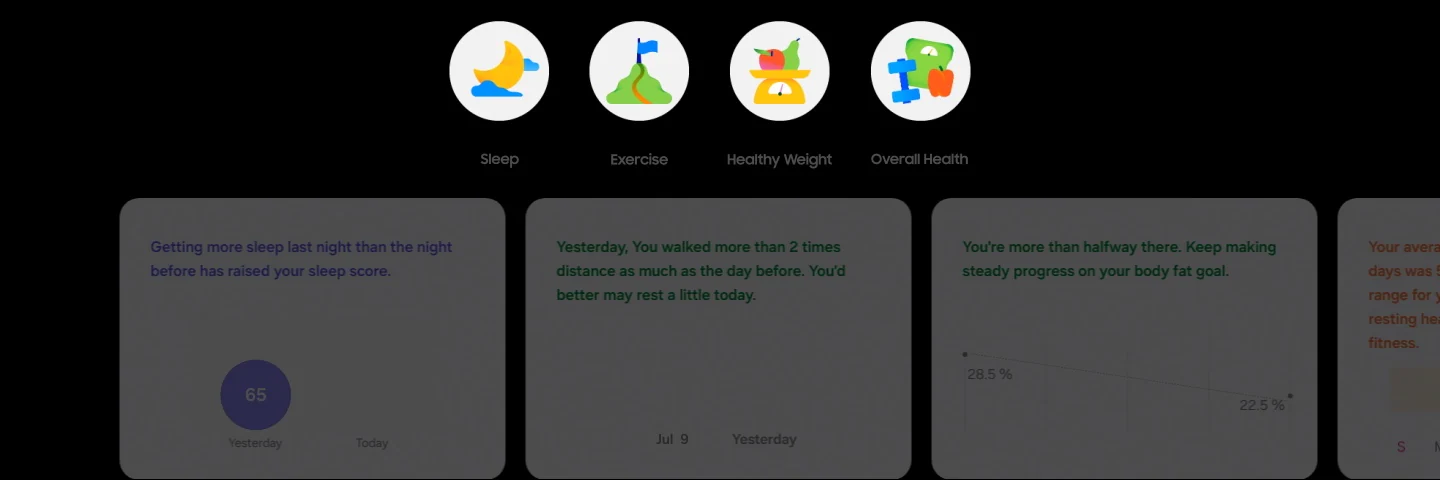
Galaxy AI health coaching is one of the Watch 7's most distinctive additions. The feature aggregates data from sleep, activity, stress, and heart rate variability to produce personalized weekly summaries and actionable recommendations. It identifies patterns — like consistently poor sleep when you exercise late in the evening — and surfaces them in plain language. It's not as granular as Garmin's training intelligence, but for the health-curious mainstream user, it's genuinely useful.
Heart rate accuracy during steady-state cardio is excellent. During high-intensity interval training, the optical sensor occasionally loses tracking accuracy during wrist-flexion-heavy movements, which is a known limitation of optical heart rate sensors across all brands. Pairing a chest strap eliminates this entirely.
Smart Features & OS
Wear OS 5 with One UI Watch 6 is the most polished version of Samsung's wearable software to date. Google's core services — Maps, Wallet, Google Pay, YouTube Music — integrate cleanly, and Samsung layers its own apps including Samsung Health, Bixby, SmartThings control, and the Samsung Health Monitor on top. The result is a comprehensive platform that covers navigation, payments, fitness, and smart home control from the wrist.
Samsung Electronics / Samsung (Manufacturer product image)
Galaxy AI features extend beyond health: the watch can generate meeting summaries transcribed from your phone, provide live translation during conversations, and offer predictive text that's notably more accurate than prior generations. These features are most capable on Samsung Galaxy phones, where the watch acts as a seamless extension of the phone's AI rather than a standalone device.
App selection on Wear OS has improved dramatically. The Google Play Store for Wear OS includes most major fitness apps (Strava, Nike Run Club, Spotify, Komoot), productivity tools, and watch face customization options. While the iOS App Store's Watch app ecosystem remains larger, the Wear OS gap has narrowed to the point where most users will find everything they need.
Battery Life
Battery life is the Galaxy Watch 7's most visible limitation when compared to Garmin or Amazfit alternatives. Samsung rates the 44mm model at 40 hours in power saving mode and 30 hours in normal mode. Reviewers' real-world battery reports with always-on display enabled, continuous heart rate monitoring, two to three workouts tracked per week, and regular notification handling put the 44mm at 26–30 hours before needing a charge.
That means most users will charge the watch every day or every day and a half — manageable, but meaningfully different from the Garmin Forerunner 265's 13-day battery or the Amazfit GTR 4's 14-day claimed endurance. The 15W Qi wireless charging is fast — roughly 30 minutes from 10% to 80% — which softens the blow.
Sleep tracking is a genuinely valuable Galaxy Watch 7 feature via Samsung's Sleep Coaching program, but daily charging forces users to find a charging window outside of sleep hours or accept reduced sleep data some nights.
Samsung Galaxy Watch 7 vs Galaxy Watch 6
The 3nm Exynos W1000 chip is the most meaningful upgrade between generations. Every interaction is faster — apps open in under a second, workouts start instantly, and the UI scrolls without lag. Galaxy AI features require the W1000's processing headroom and wouldn't run adequately on the Watch 6's hardware.
The health sensor suite is broader on the Watch 7, with blood pressure monitoring and improved BIA accuracy. Galaxy AI coaching represents a qualitative leap in software intelligence. Battery life has improved slightly, and the display is marginally brighter.
For Watch 6 owners, the upgrade is worthwhile if you want Galaxy AI features or blood pressure monitoring. For Watch 4 and earlier owners, the Watch 7 is a dramatic generational improvement in performance, health capability, and software quality.
Who Should Buy It?
The Samsung Galaxy Watch 7 is the definitive choice for Android users who want a comprehensive health platform, fast performance, and a premium design at a competitive price. Samsung Galaxy phone owners unlock the full Galaxy AI experience and get the most out of the seamless integration features. Non-Samsung Android users can use the watch via the Galaxy Wearable app but lose some Galaxy AI depth.
iPhone users should not consider the Galaxy Watch 7 — it requires an Android phone with the Galaxy Wearable app to function. Athletes who need multi-week battery life should look at Garmin's lineup. Budget-conscious buyers should consider the Galaxy Watch FE or the Amazfit GTR 4 as capable alternatives at lower price points.
Verdict
The Samsung Galaxy Watch 7 is the best Android smartwatch available in 2024. It's fast, health-capable, well-designed, and runs the most polished version of Wear OS yet. Galaxy AI health coaching is a genuine differentiator that makes the watch feel meaningfully smarter than its predecessors. Battery life remains the key trade-off — daily or near-daily charging is the reality for most users — but the speed, sensor breadth, and software intelligence justify the compromise for anyone invested in the Android ecosystem.