Introduction
Apple's tenth-generation Watch arrives with a headline that sounds almost too simple: it's thinner. At 9.7mm, the Series 10 is the slimmest Apple Watch Apple has ever built — roughly 10 percent thinner than the Series 9 — and that single change has a bigger impact on everyday wearability than any specification on paper can convey. Paired with a larger display squeezed into nearly the same footprint, a brighter Always-On Retina panel, the new S10 silicon, and a pair of genuinely novel aquatic sensors, the Series 10 makes the most compelling argument yet that the Apple Watch remains the gold standard of the consumer smartwatch market.
Starting at $399 for the 42mm aluminum model ($429 for 46mm), the Series 10 isn't cheap, but it competes in a category where rivals like the Samsung Galaxy Watch 7 and Google Pixel Watch 3 are priced similarly. The question isn't whether the Apple Watch is worth buying in 2024 — it clearly is, for iPhone users. The question is whether the improvements justify upgrading from an earlier generation, and who will benefit most.
Design & Display
The thinner chassis is immediately apparent when you first strap the Series 10 to your wrist. Where previous Apple Watches could feel like a puck pressed against the skin during sleep or high-intensity training, the Series 10 disappears. Apple achieved the slimmer profile partly through a redesigned speaker grille that now doubles as a microphone channel, and by optimizing internal component stacking — both changes that required engineering trade-offs the company clearly spent real time solving.
The display is the other immediately striking upgrade. Apple increased the screen area to 46mm on the larger model and 42mm on the smaller (up from 45mm and 41mm on the Series 9), but retained the same external case dimensions. The new LTPO OLED panel peaks at 2000 nits — matching the Series 9's outdoor brightness — but the Always-On mode is dramatically more useful thanks to a wider viewing angle. You can now read the watch face from oblique angles without lifting your wrist, which sounds minor but becomes genuinely useful when your wrists are occupied.
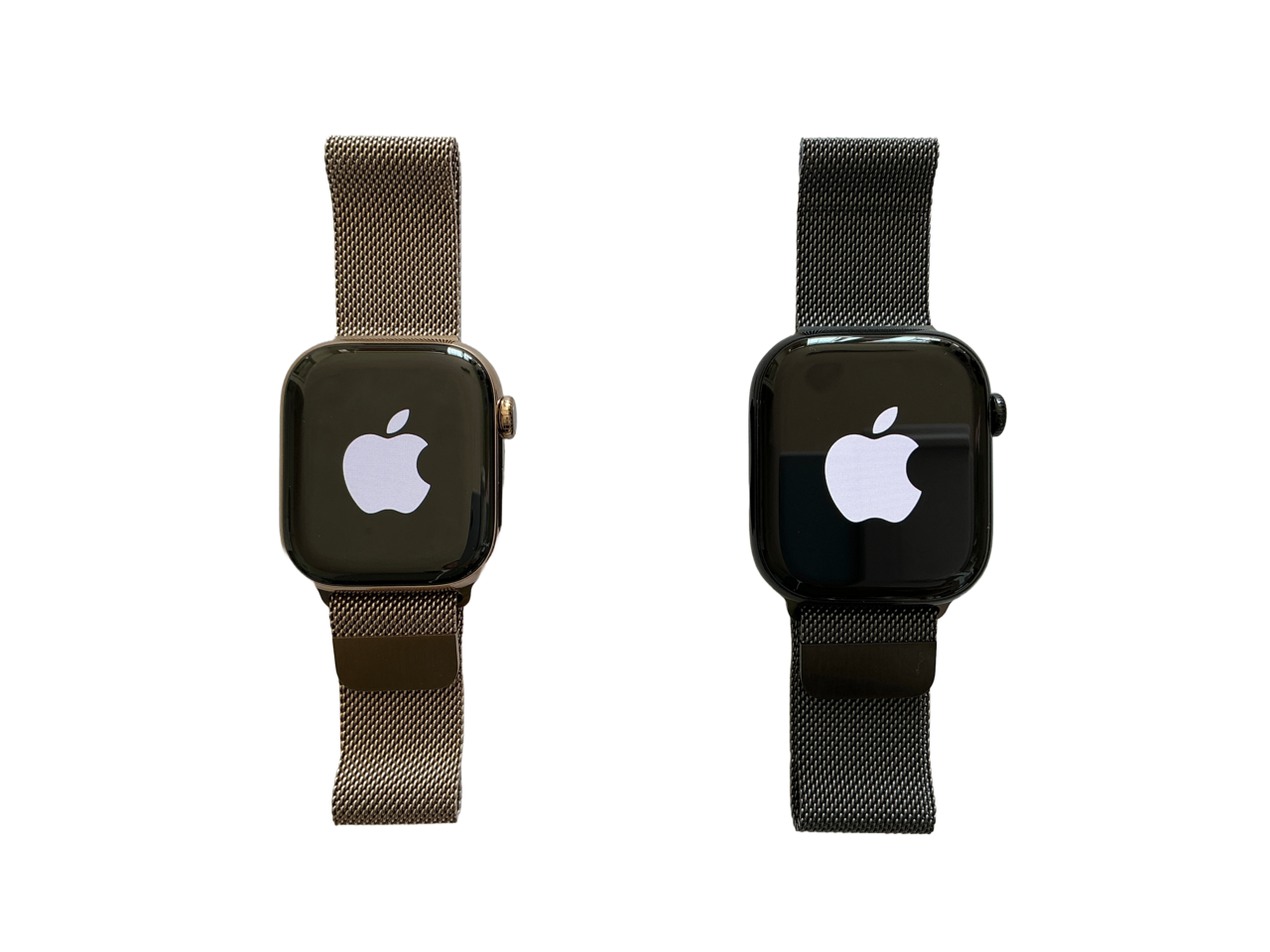
Text rendering is crisp at the display's native resolution, and Apple's updated wide-angle display technology means the watch face remains legible whether you're in direct sunlight or reading it at an awkward angle across a table. Case options include aluminum (jet black, rose gold, silver, gold) and titanium (natural, gold, black titanium), with a new brushed finish on the aluminum that resists fingerprints better than prior generations.
Health & Fitness Tracking
The Series 10's standout new hardware features are its depth gauge and water temperature sensor — both clearly aimed at divers, surfers, open-water swimmers, and ocean enthusiasts. The depth sensor works to 6 meters and enables a new Oceanic+ app that automatically detects when you enter the water, logs depth over time, and issues safety alerts if you descend too quickly for recreational freediving. The water temperature sensor reads ambient water temperature, which is valuable for triathletes and open-water swimmers who need to know whether they're in wetsuit-legal water.
Beyond the new sensors, the core health suite is comprehensive and well-validated. The electrical heart sensor enables ECG readings on demand, and the optical heart sensor now supports irregular rhythm notifications. The skin temperature sensor (introduced with Series 8) continues to provide cycle tracking data and fever detection context. Crash Detection using the dual-core motion accelerometer and gyroscope has received a software refinement — reviewers have reported lower false positive rates than with Series 9.
One important caveat for US buyers: the Blood Oxygen (SpO2) sensor is present in hardware but disabled in software due to an ongoing patent dispute between Apple and Masimo. International units retain full SpO2 functionality. This is a meaningful omission for health-conscious buyers who specifically want SpO2 monitoring.
Fitness tracking remains best-in-class for iPhone users. The Workout app covers over 80 exercise types, auto-detects swimming, cycling, and running, and integrates seamlessly with Apple Health, Fitness+, and third-party apps like Strava and Nike Run Club. Heart rate zone tracking, cadence, pace alerts, and route mapping via the dual-frequency GPS work reliably across urban and trail environments.
Battery Life
Battery life is the Series 10's most persistent weakness, and Apple hasn't meaningfully closed the gap with competitors. Apple rates the Series 10 at 18 hours of normal use — identical to the Series 9 — with a 36-hour Low Power Mode that disables the Always-On display, reduces heart rate checks, and limits GPS connectivity. Independent testing reports the 46mm model typically ending a full day (6 AM to midnight) with 30–40% remaining under normal use, which means daily charging remains mandatory.
Apple claims up to 60 minutes of water resistance at 50 meters and allows the watch to be worn in the shower, but the recommendation remains to charge overnight. For users who want sleep tracking — which watchOS 11 has expanded into a genuinely useful feature via its Vitals app — the charging window needs to be carved out during an evening routine rather than overnight, which requires behavioral adjustment.
Compared to the Garmin Forerunner 265 (13-day battery) or the Garmin Fenix 7 (18 days), the Apple Watch's stamina is a notable limitation. Wireless charging via the magnetic USB-C cable is fast — a 0-to-80% charge in approximately 45 minutes — which somewhat mitigates the situation, but it does mean you're tethered to a charger more often than with fitness-focused rivals.
watchOS 11 Features
watchOS 11 is the software that ties the Series 10's hardware together, and it's the strongest version of Apple's wearable OS to date. The headline additions include the Vitals app, Training Load, and a significantly smarter Smart Stack.
The Vitals app synthesizes overnight health data — resting heart rate, heart rate variability (HRV), respiratory rate, wrist temperature, blood oxygen when available, and sleep duration — into a morning summary that flags unusual readings. It's a useful high-level health dashboard, particularly for users recovering from illness or monitoring trends over time.
Training Load is Apple's answer to Garmin's Training Status and Readiness features. It analyzes workout intensity over the prior 28 days, compares it to your personal baseline, and classifies your load as Low, Moderate, High, or Very High. It won't replace Garmin's Training Readiness score for serious athletes, but for the fitness-curious mainstream user, it's actionable and easy to understand.
The Smart Stack — the widget layer accessible from any watch face with a crown scroll — now dynamically surfaces relevant cards based on context: upcoming calendar events, live activity updates, departure times from your transit app, and medication reminders. It reduces the need to navigate into apps for quick information checks, which is exactly what a wrist-worn device should optimize for.
Siri is faster and more capable on the S10 chip, with more requests processed on-device for improved privacy and latency. Double-tap gesture support has been expanded to additional third-party apps, and the new Translate app brings real-time conversation translation to the wrist.
Apple Watch Series 10 vs Series 9
If you're coming from a Series 9 — released just one year prior — the upgrade math is difficult to justify unless you specifically want the depth gauge, water temperature sensor, thinner chassis, or precision dual-frequency GPS. The display on the Series 9 is already excellent, the S9 chip is fast enough for all watchOS tasks, and the battery situation is identical. The health sensor suite is nearly equivalent outside of the two aquatic additions.
Series 7 and Series 8 owners will find the Series 10 a more compelling jump: the Always-On display improvements, dual-frequency GPS, crash detection, the thinner body, and watchOS 11's new features collectively represent a substantial generational upgrade. Series 4 and Series 5 users are unquestionably overdue for an upgrade and will be impressed by how much the device has evolved.
Who Should Buy It?
The Apple Watch Series 10 is the right choice for iPhone users who want the most capable, most comfortable, best-looking smartwatch Apple has ever made. It's particularly well-suited for users who prioritize daily health monitoring, casual fitness tracking, Apple ecosystem integration (iPhone, AirPods, Apple TV, HomePod), and wearability for extended periods including sleep.
Athletes who want multi-week battery life, advanced running dynamics, or granular VO2 Max and recovery metrics should look at Garmin's Forerunner or Fenix lines instead. Android users should not consider the Apple Watch at all — it requires an iPhone to activate and function. Budget-conscious buyers should also consider the Apple Watch SE (starting at $249), which retains crash detection, fall detection, and the core fitness suite at a significantly lower price.
Verdict
The Apple Watch Series 10 is the best Apple Watch Apple has ever made, and by a meaningful margin in day-to-day wearability. The thinner design, larger brighter display, dual-frequency GPS, new aquatic sensors, and watchOS 11's Vitals and Training Load features make it a genuinely refined device for health-conscious iPhone users. Battery life remains the category's most significant trade-off, and the US SpO2 limitation is a frustrating asterisk on an otherwise strong health story.
If you're in the Apple ecosystem and due for a smartwatch upgrade, the Series 10 earns a confident recommendation. It's the watch that finally makes sleeping with an Apple Watch feel natural — and that's a bigger deal than any single spec on the sheet.