Introduction
The Fitbit Charge 6 occupies the most pragmatic position in the wearable market: a device that delivers the health features most people actually use — heart rate monitoring, GPS, sleep tracking, stress monitoring, and contactless payments — at a price and in a form factor that makes smartwatches feel like unnecessary complexity. At $159, the Charge 6 provides genuinely impressive health capabilities that would have cost hundreds more just two generations ago, wrapped in a slim band that most users forget they're wearing by the end of the first day.
Since Google's acquisition of Fitbit, the Charge series has evolved to incorporate Google's broader platform strengths alongside Fitbit's established health tracking pedigree. The Charge 6 represents that integration at its most complete: Google Maps navigation, YouTube Music controls, and Google Wallet NFC payments sit alongside Fitbit's sleep staging, Active Zone Minutes, and Daily Readiness Score, creating a device that genuinely bridges fitness tracker and light smartwatch functionality.
For the broad population of adults who want to become more aware of and improve their health — without the learning curve, charging anxiety, or price premium of a full smartwatch — the Fitbit Charge 6 is the clearest recommendation in the category. It's not trying to be everything; it's very good at being what most people need.
Design & Display
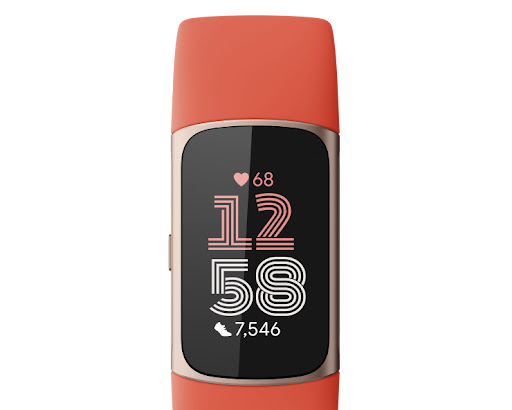
The Charge 6's slim band profile is its most important physical characteristic. Measuring 11.2mm thick, it sits lower on the wrist than any mainstream smartwatch and interferes minimally with keyboard use, wrist motion, and sleep comfort. The silicone band is soft and breathable, and the aluminum housing is light enough that the tracker's presence on the wrist becomes background noise within the first hour of wear.
The AMOLED display measures 0.86 inches — small by smartwatch standards but sufficient for the Charge 6's primary use cases: glancing at heart rate, checking a step count, reviewing a notification sender, or confirming a Google Wallet payment. The display is bright enough for outdoor viewing and the interface has been simplified to optimize for small-screen navigation. Swipes navigate between health tiles, and tapping the physical side button provides haptic confirmation.
The display's limitations become apparent when handling longer notifications, detailed workout summaries, or map navigation glances. For these tasks, the Charge 6's screen size requires squinting or scrolling where a full smartwatch would display the information more readably. This is an inherent trade-off of the slim band form factor, and it's a trade-off most Charge users consciously accept in exchange for comfort and battery life.
Health & Fitness Tracking
Fitbit's health platform is the most validated consumer health tracking ecosystem available, built on over a decade of research data and a user base in the tens of millions. The Charge 6 carries the full Fitbit health suite, starting with 24/7 optical heart rate monitoring that powers Active Zone Minutes — the World Health Organization-endorsed measure of time spent in cardio and peak heart rate zones.
Sleep tracking is among Fitbit's strongest capabilities. The Charge 6 tracks all four sleep stages (REM, deep, light, awake), provides a Sleep Score synthesizing sleep quality across multiple dimensions, and with Fitbit Premium, provides Smart Wake technology that targets the optimal moment in your sleep cycle to deliver a gentler alarm. The Sleep Profile feature analyzes 10 sleep metrics monthly to classify your sleep patterns into one of six animal archetypes (bear, dolphin, etc.) — a memorable way to communicate complex sleep trend information.
The ECG app is FDA-cleared for atrial fibrillation detection. Using the electrical heart sensor embedded in the band, users can take a 30-second on-demand ECG reading that produces a rhythm trace viewable in the Fitbit app. The SpO2 sensor monitors blood oxygen saturation during sleep. The cEDA (continuous electrodermal activity) sensor — a skin conductance sensor in the band — provides continuous stress monitoring that correlates with sympathetic nervous system arousal, producing an EDA Score and alerting users to elevated stress periods throughout the day.
On-device GPS is the Charge 6's most significant fitness upgrade from its predecessor. Previous Charge models required a connected phone for GPS route tracking; the Charge 6 has a built-in GPS chip that records accurate run and walk routes independently. Independent testing generally finds GPS accuracy solid for urban and suburban routes, with some signal delay in dense urban canyon environments. The GPS enables automatic distance, pace, and elevation data during outdoor workouts without phone dependency.
Battery Life
Seven days of battery life is the Charge 6's most decisive advantage over competing smartwatches. With continuous heart rate monitoring, sleep tracking, periodic SpO2 readings, and typical notification use, reviewers commonly report the Charge 6 reaching 6–7 days before requiring a charge. Adding GPS workouts reduces battery toward the 5-day range.
The practical implication is that the Charge 6 can be treated like a traditional watch rather than a daily-charging device: users charge it once or twice per week, typically leaving it on overnight for sleep tracking every night. This charging pattern is radically lower friction than the nightly charging requirement of Apple Watch, Google Pixel Watch, or Samsung Galaxy Watch, and it enables truly comprehensive sleep tracking data without the habit management required for smartwatch users.
For users who have abandoned smartwatch sleep tracking because they don't want to manage charging windows during the evening, the Charge 6's battery profile is a meaningful feature difference.
Google Integration: Maps, YouTube Music, Wallet
The Charge 6 introduces Google ecosystem integrations that are unprecedented for a Fitbit device. Google Maps integration displays turn-by-turn navigation cues on the tracker's display when a route is active on your paired Android phone — a genuinely useful feature for urban walking navigation that removes the need to check your phone at every intersection. The display's small size means these cues are directional arrows and street names rather than full map views, but for point-to-point navigation on foot, they're sufficient.
YouTube Music controls allow track skipping, volume adjustment, and playback control from the tracker when YouTube Music is playing on a paired device. The same control mechanism works with Spotify and other Bluetooth audio sources. For gym sessions where your phone is in a bag or pocket, wrist-based music control is a convenient quality-of-life feature.
Google Wallet NFC is the most practically impactful Google integration. The Charge 6 supports tap-to-pay at virtually all modern payment terminals, storing payment card credentials securely on the device. Leaving your wallet at home during a run and using the Charge 6 to buy a post-run coffee is a level of casual convenience that significantly raises the daily utility of a fitness tracker beyond pure health monitoring.
Fitbit Charge 6 vs Fitbit Sense 2
Fitbit's own lineup presents the most direct comparison: the Sense 2, at $249, adds a 40mm watch form factor with a larger display, a full ECG, and the cEDA stress sensor. The Charge 6 includes the cEDA sensor in the slim band form factor, which is significant. The Sense 2's advantages are the larger display, slightly better notification readability, and the built-in GPS route tracking directly in the larger watch form. The Charge 6's advantages are the smaller, lighter form factor and the Google Maps/YouTube Music integrations that the Sense 2 lacks.
For users specifically prioritizing the slim band aesthetic and longer battery, the Charge 6 is the better choice. For users who want a larger display and a more complete smartwatch-adjacent experience, the Sense 2 is more appropriate.
Who Should Buy It?
The Fitbit Charge 6 is the ideal choice for health-focused adults who want the full spectrum of meaningful health tracking — heart rate, ECG, SpO2, stress, sleep, GPS activity tracking — in a comfortable, unobtrusive form factor that doesn't require daily charging. It's particularly well-suited for users who find full smartwatches too large or too distracting, office workers who type at keyboards all day, and anyone who has tried sleep tracking on a smartwatch and found the nightly charging management too burdensome.
Budget-conscious buyers who want more health features than a basic step counter but don't need full smartwatch functionality will find the Charge 6 delivers exceptional value at $159. Users who need to make and receive calls from their wrist, run complex apps, or navigate rich notification replies should choose a full smartwatch instead.
Verdict
The Fitbit Charge 6 is the best fitness tracker available at any price, combining FDA-cleared ECG, built-in GPS, Google Wallet NFC, 7-day battery, and Fitbit's deepest health analytics into a slim band form that remains the most comfortable wearable design for all-day and overnight use. The Google integrations — Maps, YouTube Music, Wallet — meaningfully expand its utility beyond pure health tracking.
The small display and absence of third-party apps appropriately define its ceiling; this is a focused health instrument with smart features, not a miniature smartphone. For users whose needs align with that definition, the Charge 6 is a confident, enthusiastic recommendation at $159.