Introduction
The Garmin Forerunner 955 occupies a specific and valuable niche in the sports watch market: it's the most capable dedicated triathlon watch available for under $500, and it has held that title through multiple product generations without a credible challenger. Released as the successor to the beloved Forerunner 945, the 955 adds Training Readiness, an improved Race Predictor algorithm, expanded map support, and a Solar variant while retaining the core characteristics that made the 945 a favorite among age-group triathletes and serious runners worldwide.
Priced at $499 (or $599 for the Solar version), the Forerunner 955 sits below Garmin's flagship Fenix 7 Pro in the lineup but above the fitness-tracking-oriented Venu and Vivoactive lines. It's purpose-built for athletes who compete in structured events — 5K through Ironman — and need a single watch that handles every discipline of their sport without compromise.
For triathletes in particular, the 955 is compelling in ways that no other watch in its price category can match. The dedicated triathlon mode allows fully automated transitions — press the action button at the transition area and the watch automatically recognizes and logs T1 and T2 times, switching from swim metrics to bike metrics to run metrics without user intervention during a race. That sounds like a small feature until you're mid-race with adrenaline high and cognitive bandwidth fully allocated to racing.
Design & Display
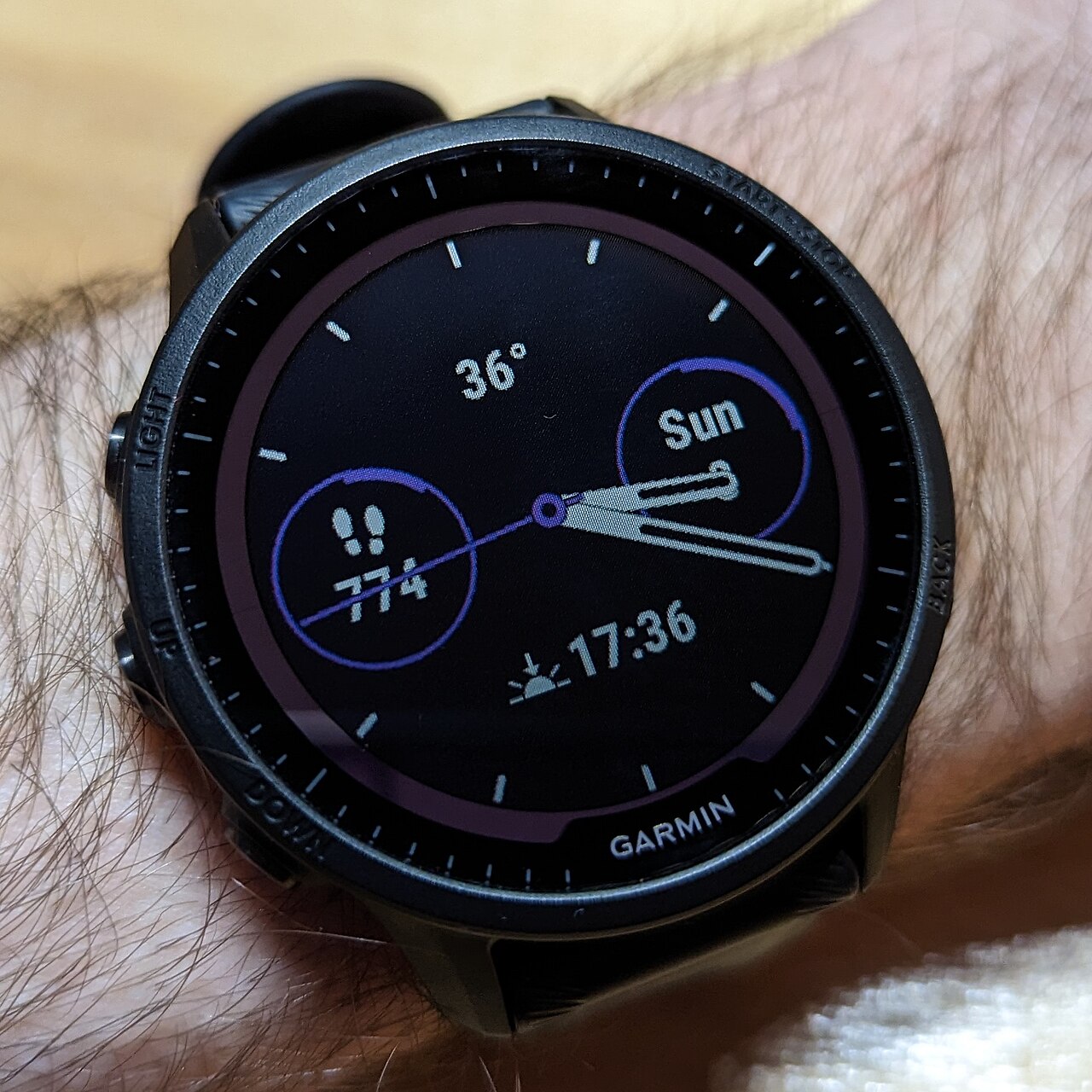
The Forerunner 955 maintains Garmin's Forerunner aesthetic: a circular case in the 46mm size, five physical side buttons, a fiber-reinforced polymer case, and a silicone band. It's lighter than the Fenix 7 Pro at 53g, and the 46mm size translates well to both larger and average wrists. The build quality is solid without being ostentatious — this is a watch that serious athletes wear to training and racing environments, not to boardrooms.
The 1.3-inch MIP display runs at 260x260 resolution and has the same reflective properties as the Fenix 7 Pro's display — increasingly readable as ambient light increases, excellent in direct sunlight, with a backlight for low-light conditions. The Solar variant's power-harvesting lens adds passive charging throughout the day. As with all MIP displays, the tradeoff versus AMOLED is color vibrancy — the 955's display is functional and clear but not visually striking compared to the Forerunner 265's AMOLED panel.
Five ATM water resistance (50 meters) covers open-water swimming and triathlons. The watch's swim metrics include SWOLF score, stroke count, stroke type detection, and distance, with the ability to pre-configure pool length for pool swim workouts. The ANT+ compatibility connects to compatible cycling power meters, cadence sensors, and foot pods for deeper data.
Health & Fitness Tracking
The Forerunner 955's training analytics suite is virtually identical to the Fenix 7 Pro's, which is high praise. The centerpiece feature is Training Readiness, Garmin's synthesis metric that aggregates HRV Status, recovery time from recent training, sleep quality scores, and acute training load history into a single 0–100 daily readiness number. Athletes who follow a structured plan and track consistently over weeks find it remarkably accurate at predicting when their body is prepared for a hard session versus when it needs recovery.
The Race Predictor is one of Garmin's most useful features for competitive athletes. Based on your recent training data, VO2 Max estimate, and current fitness trajectory, it predicts finish times for 5K, 10K, half-marathon, and marathon distances. Reviewers following 12-week marathon training cycles report predicted times within 2–3 minutes of actual race performance — impressive accuracy that rivals the estimates from dedicated running coaches.
Running Dynamics — available with a compatible chest strap or running dynamics pod — measure ground contact time balance, stride length, vertical oscillation, and cadence. These metrics allow athletes and coaches to identify biomechanical inefficiencies that increase injury risk or energy cost. For cyclists, the watch supports Cycling Power via ANT+ connections to pedal-based or crank-based power meters, enabling full Training Stress Score and Intensity Factor calculations used in structured training plans.
HRV Status tracks heart rate variability trends over weeks, establishing a personal normal range and flagging unusual deviations. Combined with the sleep tracking suite — which scores sleep quality based on duration, restfulness, and overnight SpO2 and respiration data — the Forerunner 955 provides a meaningful signal for overtraining detection that many competitive athletes find genuinely useful.
Battery Life
Battery life is among the Forerunner 955's strongest selling points for long-course athletes. The 15-day smartwatch battery is Garmin-typical and reliable. In GPS mode with multi-band positioning active, the watch delivers approximately 20 hours — enough to cover an Ironman 140.6 event (the world record is under 8 hours; even the average age-grouper finishes in 12–15 hours) with meaningful margin remaining.
The Solar variant adds approximately 3–5 hours of additional battery per day in good sunlight conditions, which primarily benefits multi-day adventure racing, backcountry traverse routes, and long training blocks where charging infrastructure is limited. In standard GPS mode (single band), the battery extends to 42 hours — sufficient for any ultra-endurance event.
The Solar model's passive charging means you can extend a week-long tracking deployment significantly with consistent outdoor exposure. For athletes who compete in multi-day adventure races or long trail traverses, the solar version's independence from charging is a practical advantage that compounds over a multi-day event.
Software & Smart Features
Garmin Connect remains the best data platform for endurance athletes, providing post-workout analysis tools, structured training plan integration, peer comparison via segments and Strava integration, and long-term health trend tracking. The Forerunner 955 supports offline maps for trail navigation (though with less detail than the Fenix 7 Pro's TopoActive maps), Garmin Pay for contactless payments, and music storage with Spotify, Amazon Music, and Deezer sync.
Smart notifications are functional but basic — incoming calls, texts, and app alerts display on the watch, but there's no speaker for audio notifications and no microphone for voice replies. For a device this focused on athletic performance, the limitation is understandable, but athletes who want a more complete smartwatch experience alongside their training tools may find it limiting.
Garmin Forerunner 955 vs Forerunner 265
The natural comparison for the 955 is Garmin's own Forerunner 265, which adds an AMOLED display, a slightly more compact design, and a lower $449 price point. The 265 is arguably the better choice for runners who also want a capable daily smartwatch, thanks to its more visually appealing display and somewhat better notification handling. The 955's advantages are the Solar variant availability, slightly longer GPS battery, and — most critically — its dedicated triathlon mode. For pure triathletes, the 955 remains the clear choice. For runners who also ride and swim casually, the 265 may better balance athletic capability with daily usability.
Who Should Buy It?
The Garmin Forerunner 955 is the watch for competitive triathletes, marathon runners with structured training plans, and endurance athletes who need a device capable of covering their entire competitive season without limitations. The dedicated triathlon mode, Race Predictor accuracy, Training Readiness synthesis, and 20-hour multi-band GPS battery collectively make it the most complete triathlon watch available below $600.
Casual runners and fitness enthusiasts should look at the Forerunner 265 or Garmin Venu 3 instead. Pure cyclists are better served by a Garmin Edge head unit with a dedicated cycling computer feature set. Smartwatch-first users who happen to exercise should consider an Apple Watch or Samsung Galaxy Watch.
Verdict
The Garmin Forerunner 955 earns its place as the best triathlon watch under $500 through a combination of mature, proven training analytics, race-specific functionality, and the stamina to match the longest events on the athletic calendar. The Race Predictor, Training Readiness, and seamless multi-sport transitions are features that serious competitors will use every week. The basic smartwatch notification experience and MIP display are conscious trade-offs that Garmin's target audience consistently accepts.
If you compete in triathlons, run marathons with a structured plan, or need a single watch to handle multi-sport training across a full competitive season, the Forerunner 955 belongs on your wrist.