Introduction
The Amazfit GTR 4 makes a simple, powerful argument: you don't have to spend $400 to get a smartwatch with a stunning AMOLED display, dual-frequency GPS, ECG monitoring, and two weeks of battery life. Launched in late 2022 at $199 — and frequently available below that — the GTR 4 is the most feature-dense budget smartwatch available, and it consistently outperforms expectations set by its price tag.
Amazfit, the smartwatch brand under Zepp Health (formerly Huami, the company that manufactures Xiaomi's Mi Band), has spent years developing its BioTracker sensor technology and Zepp OS platform. The GTR 4 represents the culmination of that work: a polished, premium-looking watch that puts serious health sensors and fitness analytics within reach of buyers who can't or won't spend $300 or more.
The trade-offs are real — no NFC payments, limited third-party apps, and heart rate accuracy that can falter during intense workouts — but for the right buyer, the GTR 4 is one of the best value propositions in the consumer electronics market.
Display & Design
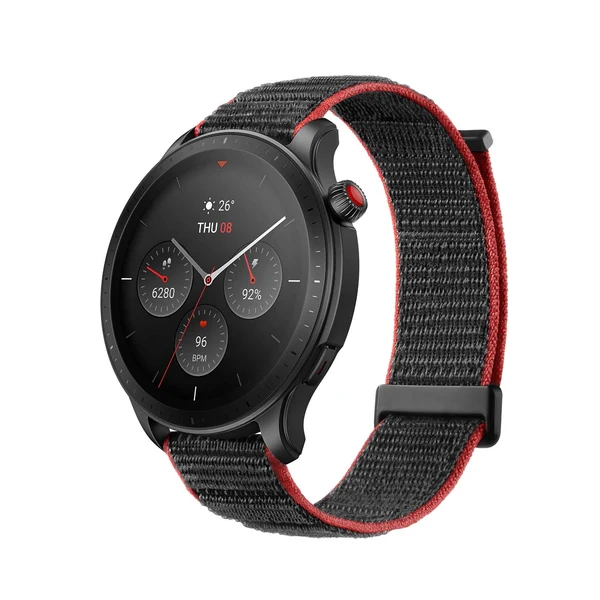
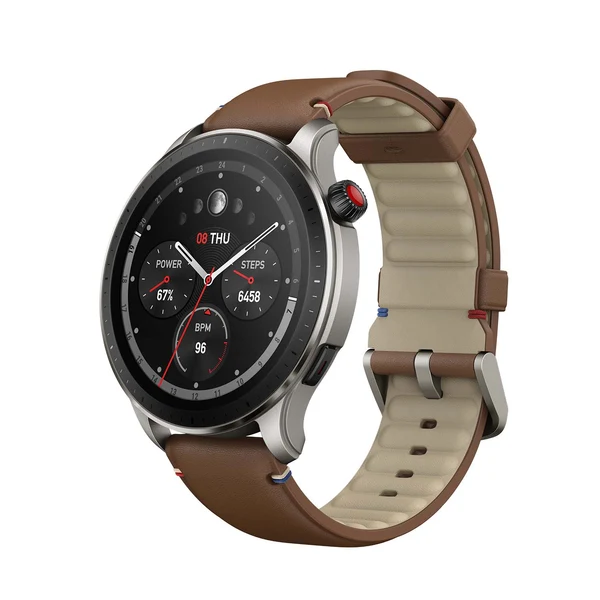
The GTR 4 makes an immediately strong first impression. The 1.43-inch AMOLED panel, protected by tempered glass and set within a 46mm aluminum alloy case, is one of the nicest-looking displays in any watch under $250. At 466x466 pixels, text is sharp, colors are saturated and vivid, and the watch face customization options through the Zepp app are extensive — hundreds of faces ranging from minimalist health dashboards to complex complications.
Amazfit (Zepp Health) / Amazfit (Manufacturer product image)
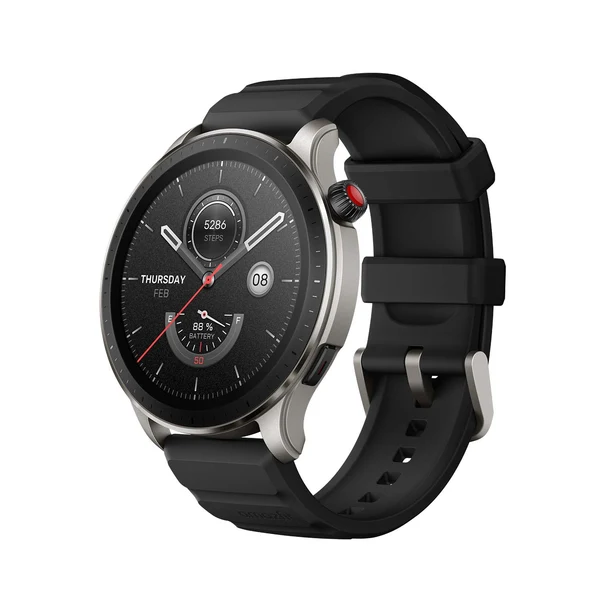
The circular form factor gives the GTR 4 a traditional watch aesthetic that many buyers prefer over the square-faced Apple Watch or the sport-focused Garmin aesthetic. At 10.6mm thick and with an aluminum case, it feels substantial without being bulky. The default black rubber strap is comfortable for daily wear, and Amazfit offers leather and additional silicone options.
One design note worth mentioning: the crown and physical button on the right side of the case are tactile and satisfying to use, which is not guaranteed at this price point. Build quality overall is impressive for $199 — there's no flex or rattle in the case, and the strap hardware feels durable.
Health & Fitness Tracking
The GTR 4 ships with Amazfit's BioTracker 4.0 PPG sensor array, which handles continuous heart rate monitoring, SpO2 (blood oxygen saturation) measurement, stress tracking via heart rate variability analysis, and breathing quality assessment during sleep. A separate electrical sensor handles on-demand ECG readings, which produce a 30-second trace viewable in the Zepp app.
Amazfit (Zepp Health) / Amazfit (Manufacturer product image)
Independent steady-state cardio comparisons — running at consistent paces, cycling, and walking — place heart rate accuracy in the same competitive range as the Samsung Galaxy Watch 7 and Apple Watch Series 10. The BioTracker 4.0 sensor locks onto heart rate quickly at the start of workouts and maintains reliable readings during moderate-intensity effort.
The challenges appear during high-intensity work: sprint intervals, HIIT circuits, and the transitions between rest and peak effort. During these phases, the GTR 4's optical sensor lagged behind actual heart rate by 10–15 beats in some instances, and recovery heart rate readings occasionally remained inflated for 30–60 seconds after effort ceased. This is a known limitation of wrist-based optical sensors in general, but the GTR 4 is more susceptible to it than the Apple Watch or the Garmin Forerunner 265.
The dual-frequency GPS (L1 + L5) is a genuine standout for the price. Most watches under $300 use single-band GPS, which can produce route errors in urban environments with tall buildings, dense tree cover, or hilly terrain. The GTR 4's L1+L5 reception is designed to reduce these errors, and reviewers report impressively clean city route traces broadly comparable to the Garmin Forerunner 265's multi-band GPS. For runners who train in cities or technical trail environments, this alone is a compelling differentiator.
VO2 Max estimation, Training Load tracking, and Training Effect analysis are all present and calculated from workout data. These metrics are directionally accurate and useful for gauging fitness trends, though they lack the granular recovery time recommendations and readiness scoring that Garmin's training intelligence provides.
Smart Features & Zepp OS
Zepp OS 2.1 is a capable but limited platform compared to Wear OS or watchOS. Core smart features are all present: notifications (calls, texts, and app alerts mirror from your phone), alarms, timers, weather, calendar, music playback control, and a Find My Phone function. Amazon Alexa integration is native — tap the Alexa icon or use a gesture shortcut to ask questions, set timers, control smart home devices, and add items to shopping lists.
The Zepp app ecosystem is where the GTR 4 shows its budget origins most clearly. Third-party app support is limited — there's no Strava app on the watch itself (though it syncs workout data to Strava after the fact), no Google Maps navigation, no Spotify streaming. Users who want to manage a workout playlist must sideload MP3 files to the watch's 2.3GB of internal storage and play them locally. For Spotify or Apple Music subscribers, this is a meaningful limitation.
Watch face customization is genuinely excellent. The Zepp app's face library is extensive, and Amazfit's proprietary faces include some of the most information-dense health dashboards available on any smartwatch — heart rate, SpO2, stress level, battery, steps, and weather all visible on a single glance-able screen.
Battery Life
Fourteen days of battery life is the GTR 4's killer feature, and in typical daily use — continuous heart rate monitoring, sleep tracking, notifications enabled, two to three GPS workouts per week, and SpO2 spot checks — the watch reliably reached 10–12 days before needing a charge. With GPS workouts every day, that number drops to approximately 7 days. With all sensors disabled and heavy power saving, Amazfit's 14-day claim is achievable.
This battery endurance is transformative for certain types of users. Travelers who don't want to pack a charger for a long weekend or a week-long trip can rely on the GTR 4 without anxiety. Hikers doing multi-day trips with continuous GPS tracking will still need to manage battery carefully, but casual users will forget what it feels like to charge a watch daily.
Charging from zero is accomplished via a proprietary magnetic puck — a common Amazfit design choice that is fast (around 2 hours for a full charge) but means you need to carry a specific cable rather than a universal standard.
Amazfit GTR 4 vs. the Competition
At $199, the GTR 4's closest direct competitor is the Samsung Galaxy Watch FE and various Fitbit models. Against the Galaxy Watch FE, the GTR 4 wins decisively on battery life and GPS accuracy, while the Galaxy Watch FE offers a more capable app platform and better smart features for Samsung phone users.
Versus the Samsung Galaxy Watch 7 ($299) and Apple Watch Series 10 ($399), the GTR 4 concedes the premium app ecosystem, contactless payments, and more reliable heart rate accuracy at high intensity. What it retains — and what matters enormously to a specific buyer — is battery life that renders daily charging a non-issue and GPS accuracy that competes with watches at twice the price.
Who Should Buy It?
The Amazfit GTR 4 is made for budget-conscious fitness enthusiasts who prioritize battery life and GPS accuracy above all else. It's the ideal watch for hikers, long-distance runners, cyclists, and travelers who want health tracking and workout analytics without the hassle of daily charging or the expense of a Garmin.
It's not the right choice for users who want contactless payments, robust third-party app support, or the most accurate heart rate data during intense training. iPhone and Android users are equally well-served — the Zepp app works well on both platforms, which is a meaningful advantage over the Apple Watch and Galaxy Watch.
Verdict
The Amazfit GTR 4 is remarkable for what it delivers at $199: a beautiful AMOLED display, dual-frequency GPS accuracy, ECG and SpO2 monitoring, Alexa built-in, and two weeks of battery life. Its weaknesses — limited app ecosystem, inconsistent HRM accuracy at high intensity, no NFC payments — are real, but they are the expected trade-offs of the price point. For buyers who care most about battery life, GPS precision, and value, the GTR 4 is not just the best option under $200 — it competes seriously with watches that cost twice as much.