Introduction
Most gaming keyboard debates center on switch type — linear versus tactile, clicky versus silent — as though the only meaningful variable in keyboard performance is the tactile feedback profile of the switch mechanism. The SteelSeries Apex Pro renders that debate obsolete. By replacing traditional mechanical switches with OmniPoint 2.0 Hall Effect magnetic sensors, the Apex Pro allows gamers to set actuation depth on a per-key basis anywhere from 0.1mm to 4.0mm. The result is a keyboard that can behave like a hair-trigger racing peripheral on your WASD cluster while maintaining a full-travel typing feel on your alphanumeric keys — simultaneously, on the same board.
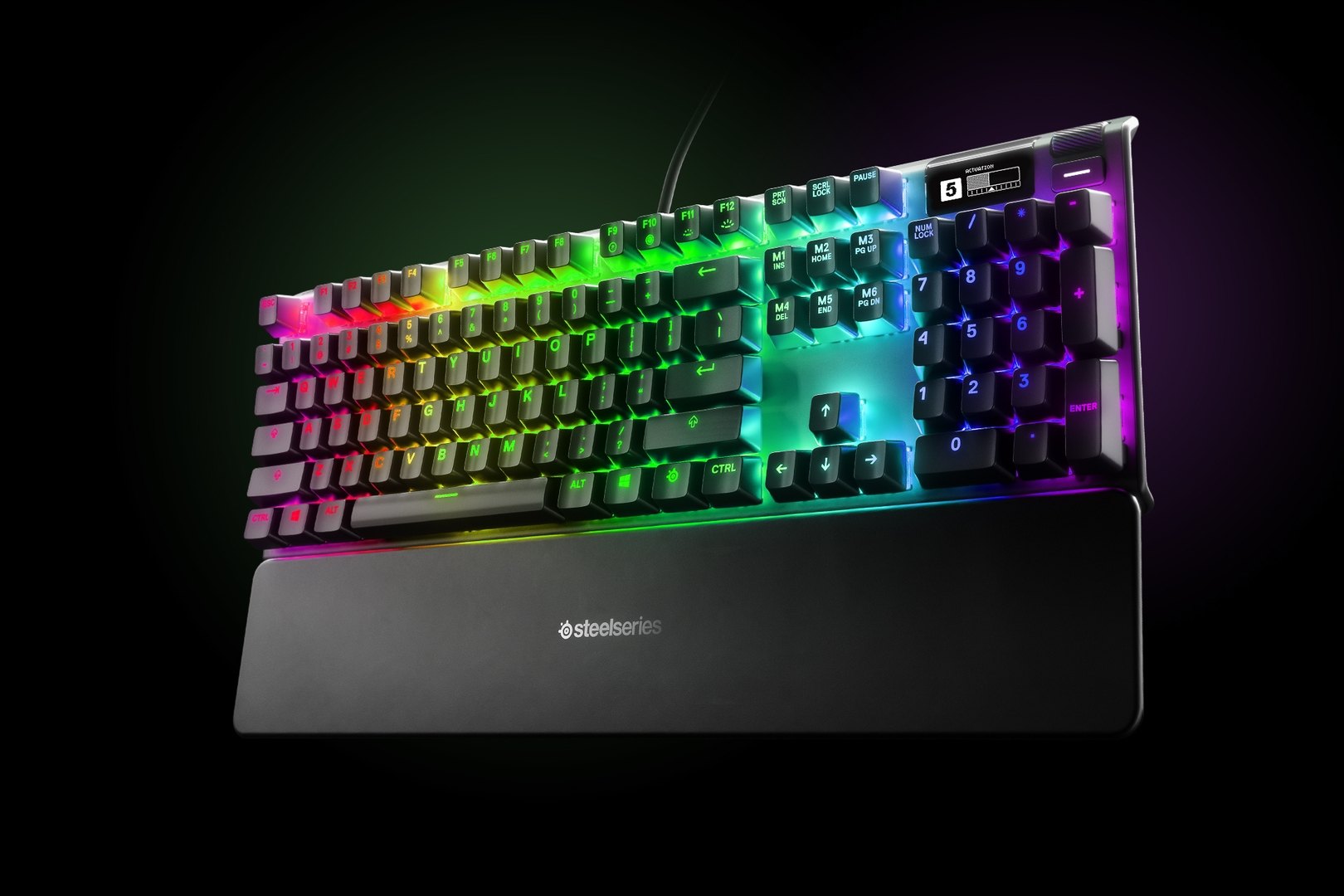
This is not a minor incremental improvement. Adjustable actuation fundamentally changes what a keyboard can be asked to do, and the Apex Pro TKL executes the concept with 8000Hz polling, a robust aluminum frame, an OLED Smart Display, and per-key RGB lighting that together constitute the most technically capable gaming keyboard currently available.
At $199, it commands a significant premium over keyboards with traditional mechanical switches. Whether the price is justified depends on how seriously you take the competitive performance advantages it offers — and for competitive FPS, battle royale, and rhythm game players, those advantages are measurable.
Typing Feel & Switches
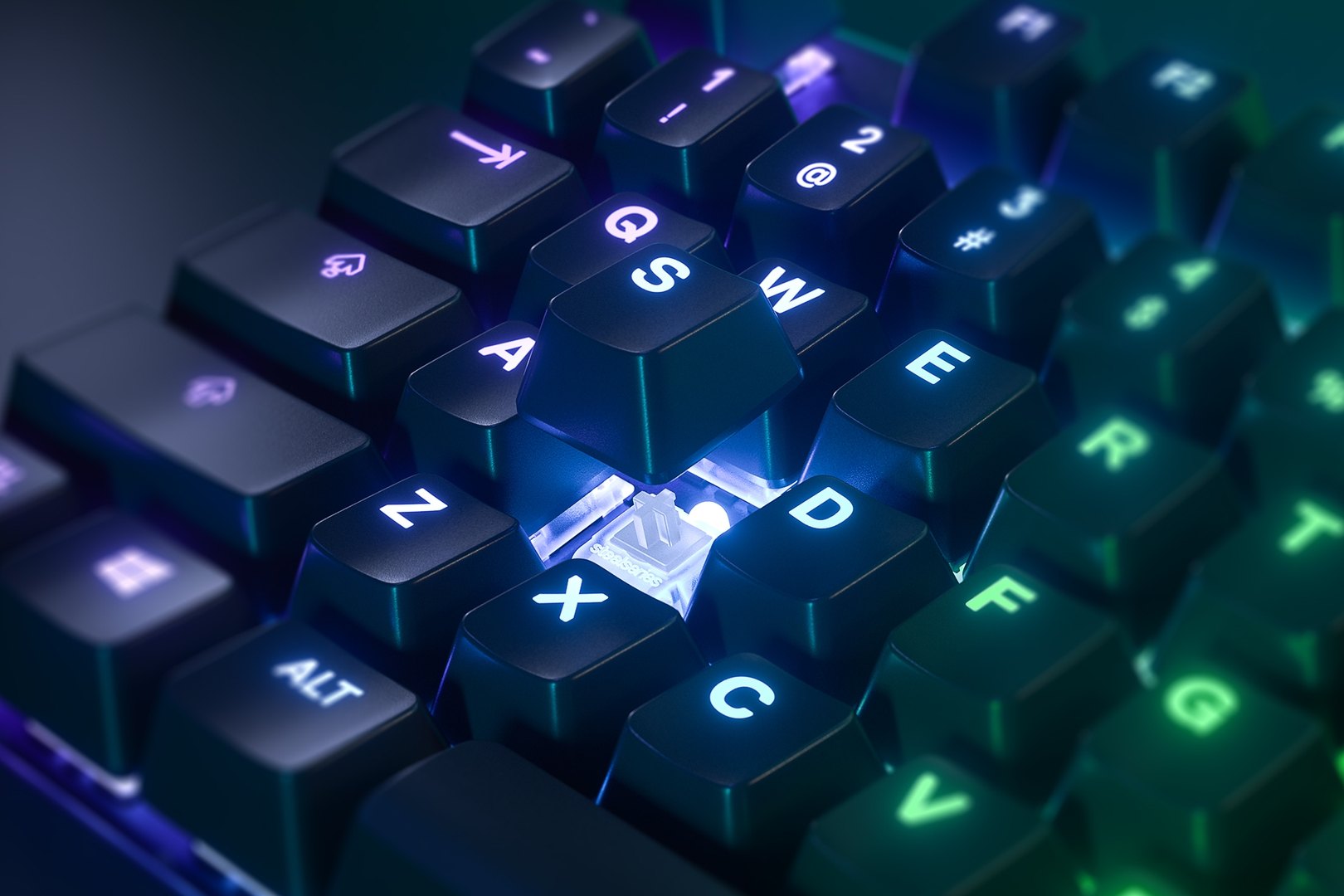
The OmniPoint 2.0 switch is a Hall Effect magnetic sensor, not a traditional mechanical switch. Instead of a physical contact that closes a circuit at a fixed actuation point, the switch uses a magnet passing a sensor to detect position continuously throughout its travel. This architecture enables two capabilities that traditional mechanical switches cannot replicate: per-key adjustable actuation and Rapid Trigger.
SteelSeries (Manufacturer product image)
Adjustable actuation works exactly as advertised. Using SteelSeries Engine software, every key on the board can be independently configured to any actuation point between 0.1mm and 4.0mm. In practice, the most common configuration is setting movement keys (WASD) to 0.4–0.8mm for the fastest possible input registration while setting the rest of the board to 1.5–2.0mm to preserve deliberate keystroke feedback. At 0.1mm, the switch will register from the slightest touch — genuinely hair-trigger. At 4.0mm, it requires full depression to actuate, effectively eliminating accidental inputs from resting fingers.
Rapid Trigger is the secondary advantage enabled by continuous position sensing. Traditional mechanical switches have debounce delays — a brief pause after actuation that prevents multiple registrations from switch bounce. These delays (typically 5–10ms) also delay reset recognition. Rapid Trigger eliminates this: the switch resets as soon as it physically rises 0.1mm from its actuation point, rather than waiting for full reset. In practice, this means faster repeated keypresses in scenarios like strafing, bunny hopping, or rapid spell casting — and it's genuinely detectable in competitive play.
The switch feel itself is linear: no tactile bump, no audible click. For pure gaming, this is optimal. For extended typing, preference splits between those who enjoy the smooth, consistent keystroke and those who prefer the feedback of a tactile bump. The Apex Pro is the better tool if gaming performance is the primary use case.
Gaming Performance
The 8000Hz polling rate is the Apex Pro's headline gaming specification. Standard gaming keyboards poll at 1000Hz, reporting position to the operating system 1000 times per second for a theoretical maximum input latency of 1ms. At 8000Hz, the keyboard reports 8000 times per second, reducing that ceiling to 0.125ms. In the context of modern competitive gaming where milliseconds of input latency are analyzed by professional players and coaches, this is a meaningful technical advantage.
SteelSeries (Manufacturer product image)
Combined with Rapid Trigger and per-key sub-millimeter actuation, the Apex Pro delivers input-to-registration latency that is measurably lower than any traditional mechanical switch keyboard in controlled testing. For competitive FPS titles, the combination of 0.4mm actuation on movement keys and 0.1mm reset on Rapid Trigger creates a strafe-switching speed that cannot be replicated on conventional hardware.
The full N-Key Rollover ensures all simultaneous keypresses are registered without ghosting — a baseline requirement for competitive gaming that the Apex Pro exceeds with its 8000Hz report frequency. SteelSeries Engine allows game-specific profiles that automatically load when a game is detected, preserving the optimized actuation settings without manual switching.
Build Quality
The aluminum alloy top plate is immediately perceptible — there is no flex, no give, and no acoustic hollow anywhere on the keyboard surface. Pressing with both palms produces the same rigid response as pushing against a desk. For a keyboard used in competitive gaming where sudden physical movements and bracing against the board are common, this structural integrity is functional, not merely cosmetic.
SteelSeries (Manufacturer product image)
The keycap set uses double-shot PBT construction with legends that are crisp, well-centered, and resistant to the shine and legend fade that affects ABS keycaps after extended use. The included USB-C cable is braided and detachable, which simplifies cable management and means the entire cable can be swapped without keyboard replacement if it sustains damage.
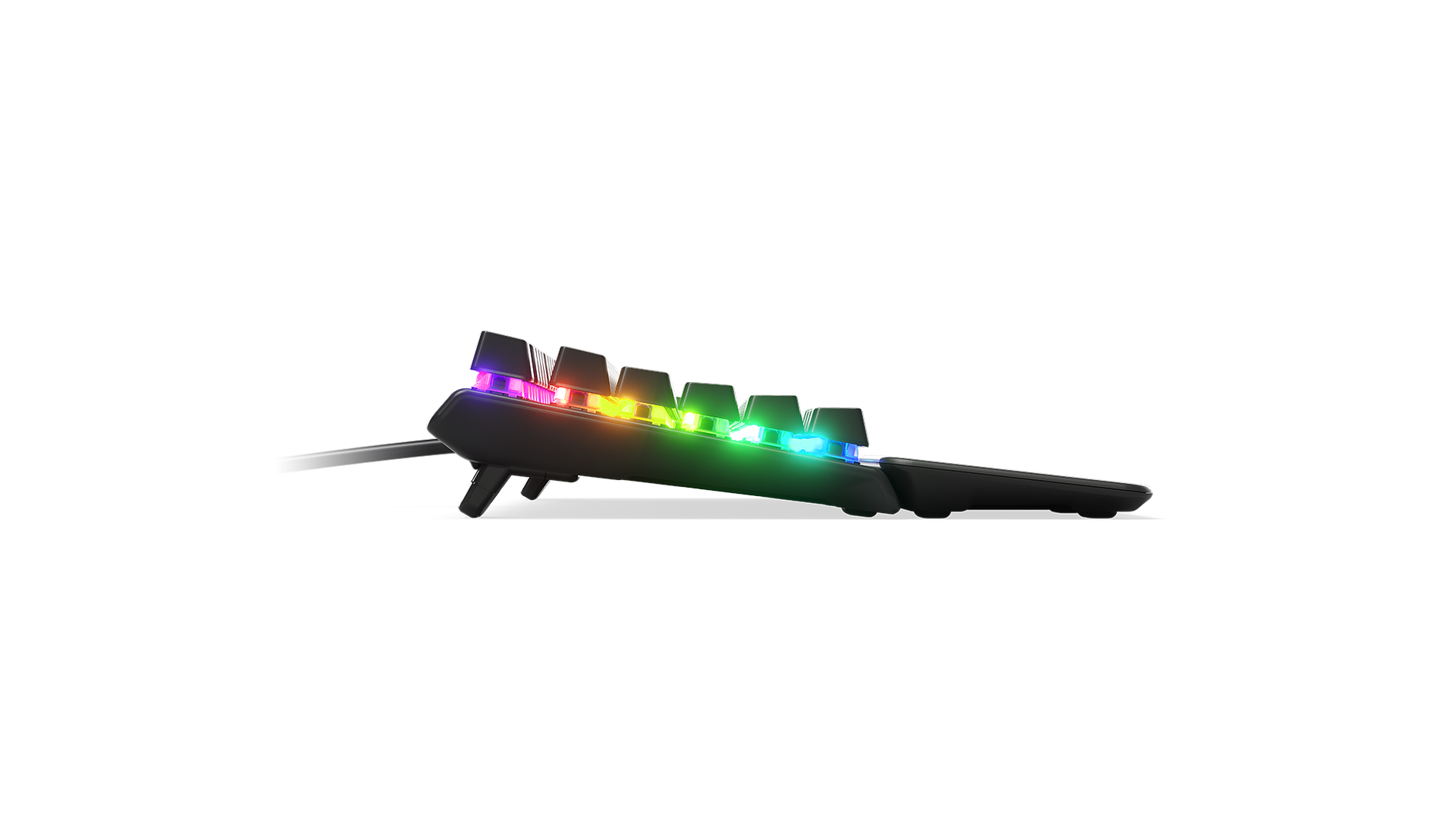
At 1350 grams, the Apex Pro TKL is heavy for a tenkeyless keyboard — the aluminum construction contributes meaningful mass. This weight keeps the board planted on a desk surface without additional padding, but it does make the keyboard less suited for frequent transport than lighter competitors.
RGB & Software
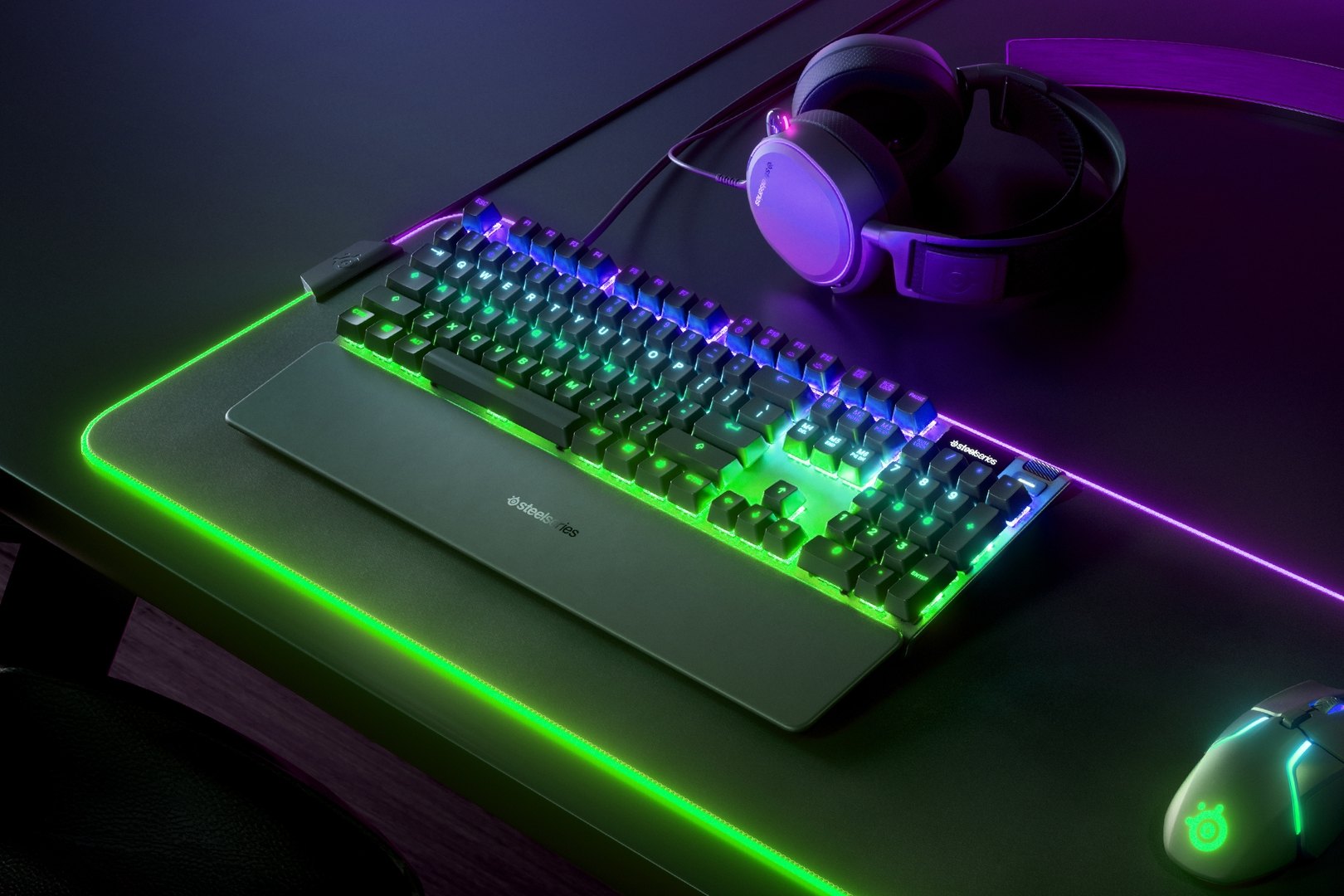
The per-key PRISM RGB system delivers accurate, even illumination across all 87 keys. Shine-through PBT keycaps allow the LEDs to project cleanly, and the range of available effects — reactive typing, wave animations, game-state integration, and static per-key color mapping — is competitive with the best RGB implementations in the industry.
SteelSeries (Manufacturer product image)
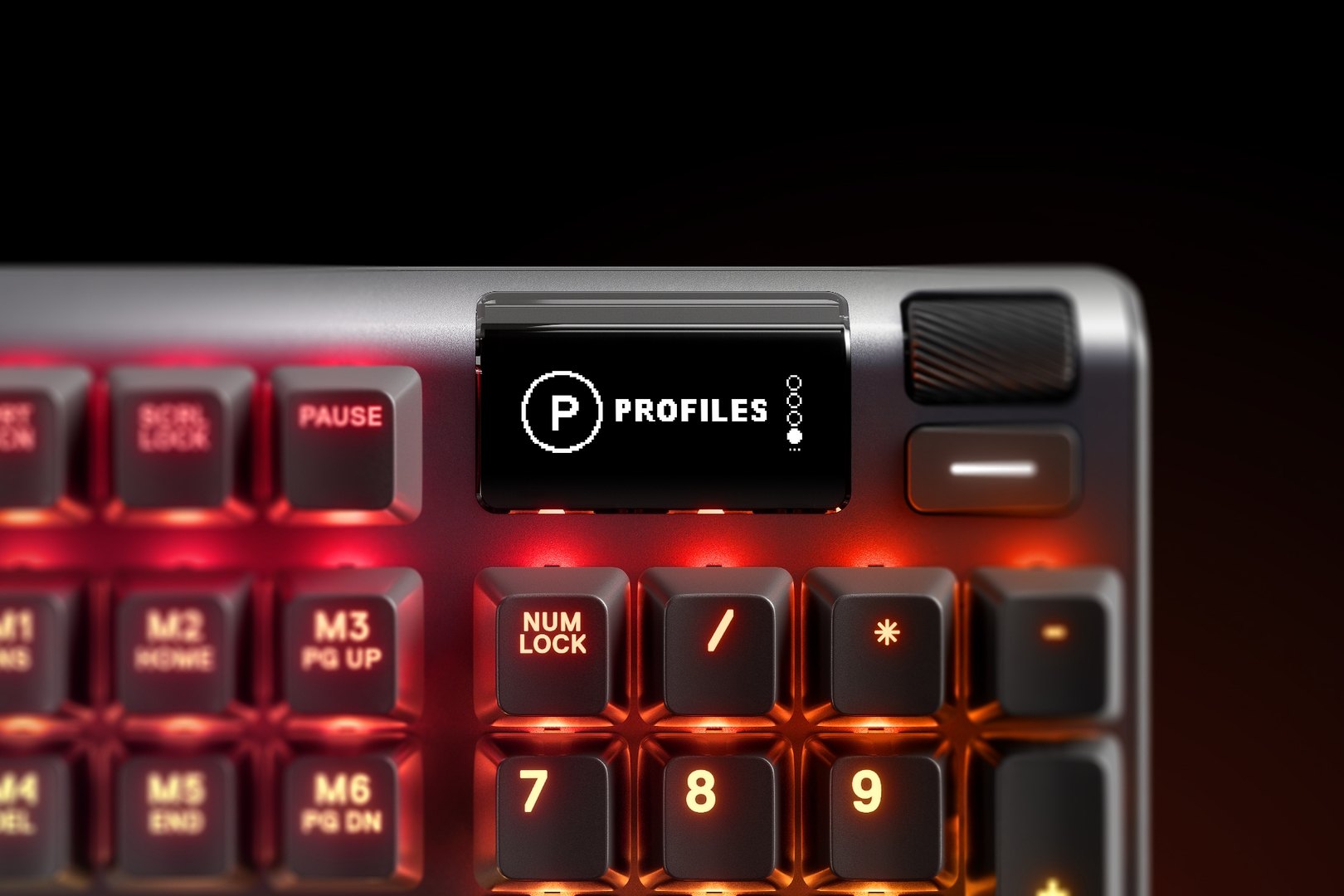
The OLED Smart Display is a 128x40 pixel screen positioned in the upper right of the keyboard. Out of the box it shows volume level and selected profile. With SteelSeries Engine configuration it can display Discord notifications, game-specific stats (kill count, health, ammo in integrated titles), currently playing track information, and custom GIF displays. It is genuinely useful rather than gimmicky, though configuration requires time investment to set up the integrations properly.
SteelSeries Engine software is comprehensive but has a steeper learning curve than Logitech G HUB or Razer Synapse for new users. The actuation configuration interface, once learned, is clear and allows the full range of per-key tuning. Onboard memory stores up to 5 profiles for use without the software running.
Who Should Buy It?
The Apex Pro TKL is the correct choice for:
- Competitive FPS and battle royale players who want the maximum possible mechanical input speed advantage from Rapid Trigger and sub-millimeter actuation
- Technically-minded gamers who want to understand and configure every variable of their input hardware to their exact preferences
- Enthusiast builders who value the aluminum construction, detachable cable, and OLED display as quality-of-life features worth paying for
- Professional and aspiring-professional players for whom marginal input performance advantages translate to real competitive outcomes
The Apex Pro is not the right choice for typists who strongly prefer tactile or clicky switch feedback, users who want hot-swap capability to experiment with different switch types, or buyers for whom $199 is difficult to justify when high-quality traditional mechanical boards can be found at $80–$120.
Verdict
The SteelSeries Apex Pro TKL is the most technically capable gaming keyboard currently available. Its per-key adjustable actuation, Rapid Trigger technology, and 8000Hz polling rate represent a genuine generational advance over traditional mechanical switch keyboards in the specific context of competitive gaming performance. The aluminum construction, OLED display, and detachable USB-C cable round out a package that justifies its premium positioning.
The primary limitations are cost and the absence of tactile switch options — but for the competitive gamer who takes input performance seriously, those are acceptable trade-offs for a keyboard that can be configured to perform in ways no fixed-actuation mechanical board can match.