Introduction
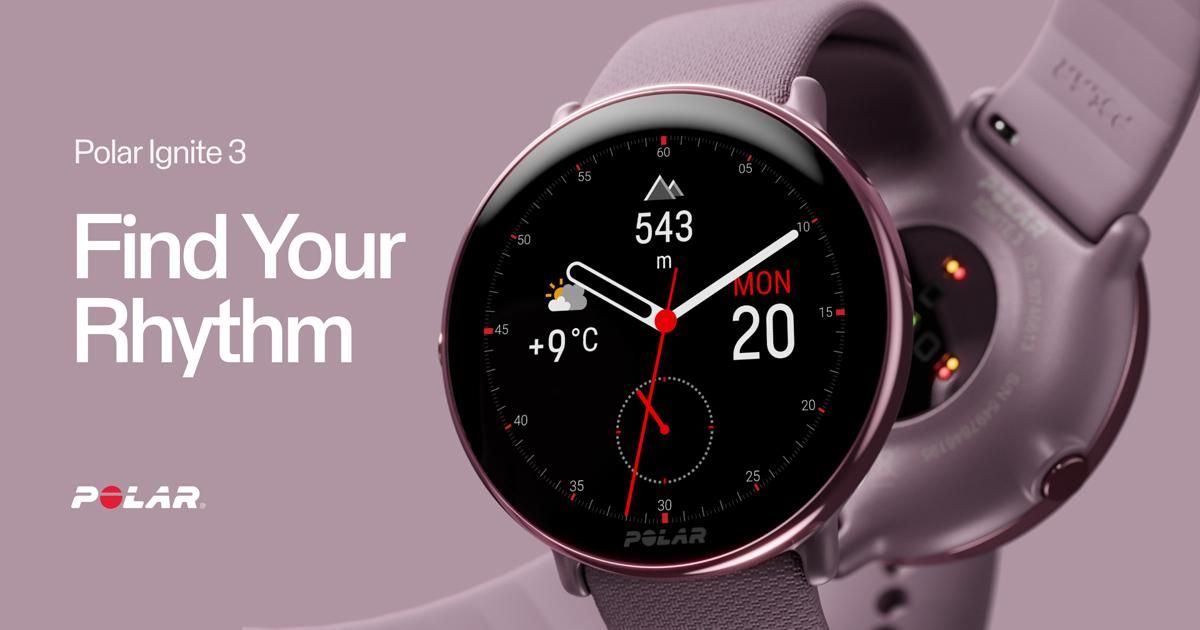
Polar is one of the founding companies of sports performance monitoring — the Finnish manufacturer's heart rate monitors were the tools of elite athletes and exercise physiologists long before "wearable" became a technology category. The Polar Ignite 3 distills decades of sports science expertise into a watch that weighs just 35 grams, displays its results on a vibrant 416x416 AMOLED screen, and applies AI-driven workout guidance to translate data into daily recommendations that are genuinely useful for recreational athletes.
Priced at $299, the Ignite 3 sits in a competitive mid-range tier occupied by the Google Pixel Watch 3, Garmin Venu 3 (at $449), and Garmin Forerunner 265 (at $449). Against these rivals, the Ignite 3 wins on weight, wins on display-to-price ratio, and offers FitSpark's uniquely actionable workout guidance. It trails on battery life, smartwatch features, and ecosystem depth.
For runners and cyclists who want a watch that helps them train smarter — not just measure what they do — the Ignite 3's combination of Nightly Recharge recovery assessment and FitSpark workout recommendations creates a surprisingly sophisticated coaching layer in a package that costs $150 less than comparable Garmin devices.
Design & Display
The Polar Ignite 3 prioritizes wearability above all else in its physical design. At 35 grams including the band, it is one of the lightest sports watches equipped with an AMOLED display available in any price category. The weight difference is palpable when you pick it up next to a Garmin Fenix 7 Pro (79g) or even a Samsung Galaxy Watch 6 Classic (59g). On the wrist for extended periods — all-day wear, overnight sleep tracking, long training sessions — the Ignite 3 genuinely disappears in a way that heavier watches don't.
The 43mm aluminum case with titanium-coated buttons has a premium build quality that defies its price point. The 1.28-inch AMOLED display runs at 416x416 pixels, producing sharp, colorful watch faces and crisp metric readouts. Polar's watch face designs tend toward clean, data-forward layouts that present training metrics legibly without visual clutter. The display's peak brightness isn't quite as intense as the Apple Watch Series 10 or Samsung Galaxy Watch 6's panels, but in practical outdoor use, readability is excellent.
Physical navigation uses a single side button for confirmations and a touchscreen swipe interface for menu navigation. The 5ATM water resistance supports swimming training and open-water activity. The proprietary band attachment uses Polar's standard connector, with third-party band options available from the Polar accessories ecosystem.
Health & Fitness Tracking
Polar's PolarPrecision Prime optical heart rate sensing technology is among the most accurate available in optical wrist-based sensors, combining six LEDs (green, red, and infrared) with ambient light cancellation to maintain accuracy during high-intensity intervals and wrist-motion-intensive activities. In independent testing against chest strap reference measurements, Polar consistently achieves among the lowest error rates of any optical wrist HR sensor — a meaningful advantage for athletes whose training plans are intensity-zone-dependent.
Nightly Recharge is Polar's flagship recovery metric, measuring how effectively your body recovers during sleep by analyzing autonomic nervous system status (via HRV measurement during sleep), sleep quality, and nightly heart rate data. The resulting Nightly Recharge status — ranging from Good to Compromised — provides a morning assessment of your recovery state that directly feeds into FitSpark workout recommendations. Reviewers using it over eight-week periods report close alignment with subjective morning energy levels and useful signals for high-quality workout performance.
FitSpark is Polar's AI-powered daily workout suggestion system. Based on your Nightly Recharge status, training history, fitness level, and accumulated training load (CardioLoad), FitSpark presents two to three daily workout suggestions calibrated to what your body is currently capable of and what type of training would be most beneficial. Suggestions are categorized by type (endurance run, strength, recovery walk) and include estimated workout duration. For athletes who train without a coach but want intelligent structure, FitSpark provides a degree of personalization that most wearable software doesn't attempt.
Hill Splitter is one of the Ignite 3's most distinctive features for trail runners and cyclists. The algorithm automatically detects transitions between uphill and downhill segments during outdoor activity and separately logs pace, heart rate, and elevation for each segment. This enables post-workout analysis of uphill efficiency — a key training metric for mountain runners — without requiring manual lap marking. Independent testing on variable terrain reports accurate grade-transition detection above approximately 4%, which covers the vast majority of meaningful elevation changes.
Sleep Plus Stages tracks all four sleep phases with a Sleep Charge score reflecting sleep quality. The continuous SpO2 monitoring during sleep detects blood oxygen desaturation patterns. Skin temperature tracking adds a nightly signal that Polar uses in its recovery modeling.
Battery Life
Five days of battery life is the Polar Ignite 3's clearest competitive limitation. With daily tracking, approximately 45 minutes of GPS workout, and standard sleep monitoring, reviewers commonly report 4.5–5.5 days before requiring a charge. GPS mode depletes the battery more aggressively, with 30 hours of continuous GPS tracking (the maximum the device supports) being sufficient for most endurance events but nowhere near the multi-day capability of Garmin's Fenix 7 Pro.
For context: the Garmin Venu 3 delivers 14 days (AOD off) in the same AMOLED display tier at $449. The Polar Ignite 3's shorter battery means a twice-weekly charging schedule rather than weekly — a noticeable difference for users who strongly prefer infrequent charging.
The 30-hour GPS mode is sufficient for Ironman triathlons (the current world record is approximately 8 hours; average age-groupers finish in 12–15 hours) and most ultra-trail events under two days. For mountain traverses or multi-day adventure racing requiring GPS beyond 30 hours, the Ignite 3 requires carrying a portable charger or accepting GPS tracking gaps.
Software & Polar Flow Ecosystem
Polar Flow — Polar's companion app and web platform — is the most thoughtfully designed training analysis tool in the consumer wearable ecosystem for pure sports performance. Where Garmin Connect provides breadth of data and Samsung Health focuses on holistic wellness, Polar Flow is built specifically to help athletes understand their training patterns, load, and progress over time.
The Training Load Pro feature plots both cardio and muscular training loads across a rolling 28-day window, flagging when accumulated load is within optimal training zone versus overreaching. The Orthostatic Test is Polar's gold-standard HRV measurement protocol — a morning lying-to-standing HR and HRV measurement that, tracked consistently, is one of the most reliable indicators of physiological stress and training adaptation available from consumer hardware.
Smart Coaching features include recovery time estimates after each workout, lactate threshold estimation from submaximal test workouts, and VO2 Max estimation. The Serene breathing exercise guides users through paced breathing for stress reduction, using the optical HR sensor to provide real-time biofeedback on heart rate.
The limitation of Polar's ecosystem is its relative insularity compared to Garmin. Third-party integrations exist (Strava, TrainingPeaks, MyFitnessPal) but are less extensive than Garmin Connect's partner network. There is no equivalent to Garmin's Connect IQ app store for third-party watch faces and apps.
Polar Ignite 3 vs Garmin Forerunner 265
The most competitive comparison for the Polar Ignite 3 is the Garmin Forerunner 265, which offers an AMOLED display, Garmin's deeper training analytics, 13-day battery (vs. 5 days), and Garmin Connect's richer ecosystem — at $449, which is $150 more. The Ignite 3's advantages are its lighter weight (35g vs. 47g), lower price, and FitSpark's arguably more accessible workout guidance for users who don't want to build structured training plans manually. The Forerunner 265's advantages are the dramatically longer battery, Garmin's Training Readiness score, and the broader Connect ecosystem.
For athletes who are serious about structured training plans and want Garmin's depth, the extra $150 for the Forerunner 265 is justified. For athletes who want smart workout guidance in a lighter, more affordable package, the Ignite 3 is a compelling alternative.
Who Should Buy It?
The Polar Ignite 3 is the ideal choice for recreational runners and cyclists who want intelligent training guidance — not just passive data logging — in the lightest possible package with a beautiful display. Athletes who run or cycle three to five times per week, who want to optimize their training load without following a rigid structured plan, and who prioritize wearability and display quality will find the Ignite 3's FitSpark and Nightly Recharge features uniquely valuable.
Serious endurance athletes preparing for long-course events who need multi-week battery life, deeper training analytics, or navigation capabilities should look at Garmin's Forerunner 955 or Fenix 7 Pro instead. Users who want NFC payments in their fitness watch should choose a device with Garmin Pay, Google Wallet, or Samsung Pay instead.
Verdict
The Polar Ignite 3 is the most elegant and wearable sports watch in its price category, delivering Polar's best display, its most sophisticated AI coaching platform, and a featherweight design that competing devices at similar prices can't match. FitSpark and Nightly Recharge represent genuine value-adds for athletes who want their watch to help them train smarter, not just measure harder.
The 5-day battery and absence of NFC payments are meaningful limitations at $299. But for the runner or cyclist who values accurate HR data, intelligent daily workout guidance, and a watch they'll forget they're wearing — the Polar Ignite 3 is the most compelling option at its price point.