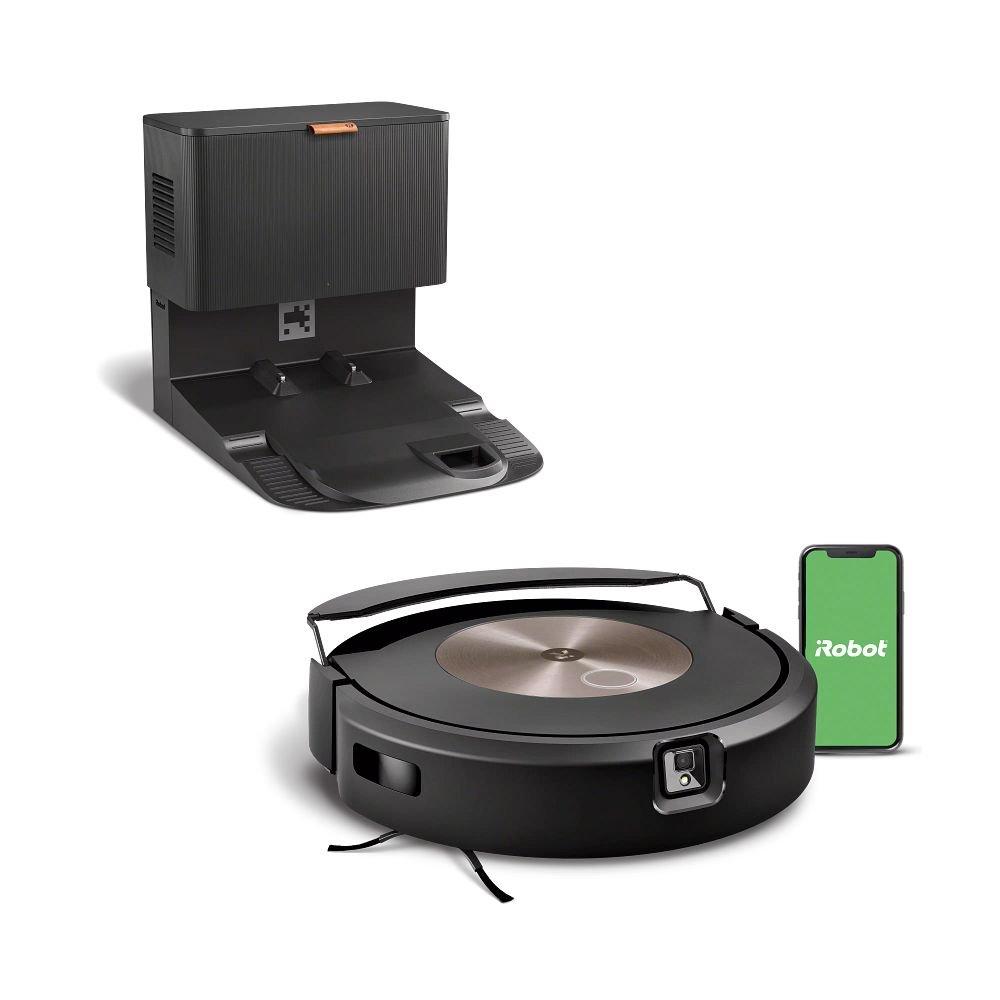
Overview: the combo Roomba with a useful bias
The Roomba Combo j9+ is the rare premium robot vacuum whose best idea is not more automation for its own sake, but a smarter compromise for mixed floors. At 999 USD, it asks a flagship price, yet its defining move is simple: the Smart Scrub mop pad retracts away from carpet so the robot can vacuum and mop in one run without turning every rug into a planning exercise.
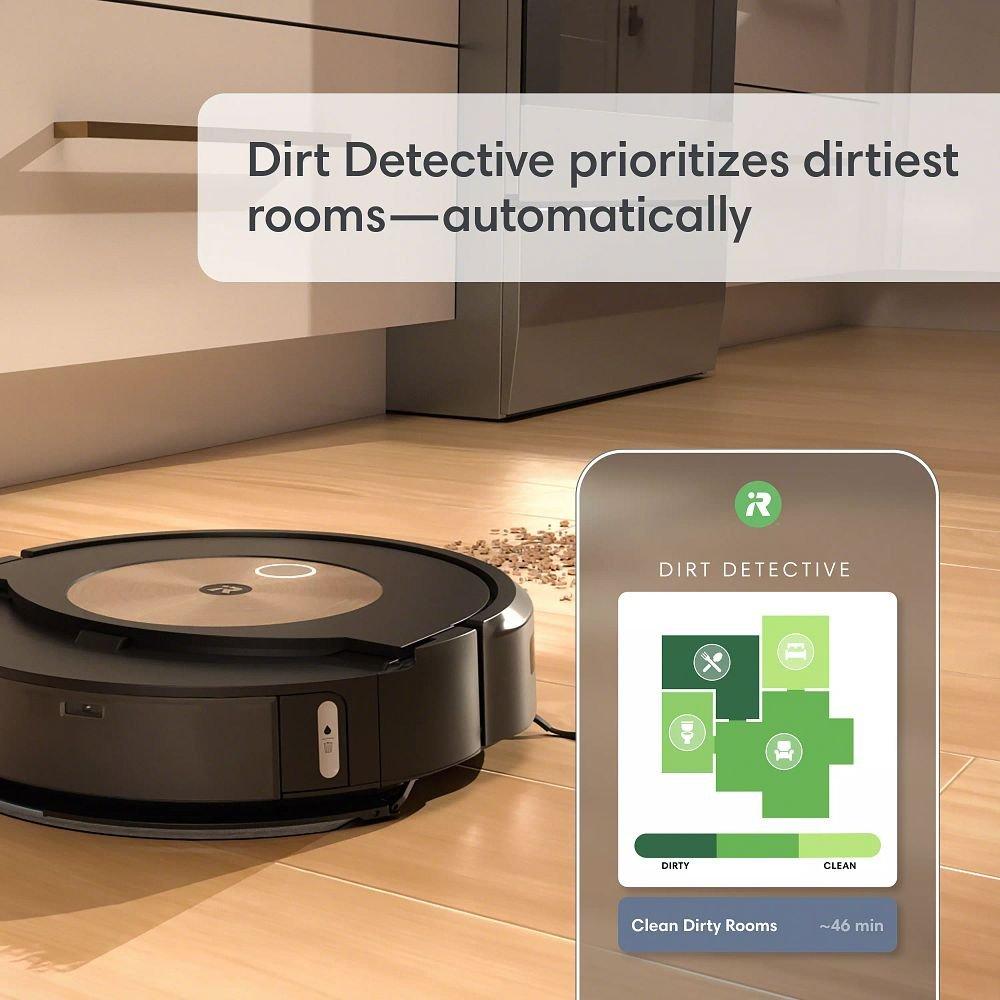
iRobot (Manufacturer product image)
That makes it a very specific recommendation. If you have pets, hard floors, and carpet in the same living space, the Combo j9+ solves one of the category's most annoying problems better than many more theatrical robots. If you want a dock that washes mop pads, refills the water tank, and removes nearly every chore from floor care, this Roomba is not that machine. Its Clean Base is excellent at auto-emptying debris for up to 60 days, but mopping still requires human attention.
The appeal is iRobot's judgment. The 10× Power Boost claim is relative to a baseline Roomba rather than a lab-style suction figure, but the product's actual strengths are easy to understand: dual rubber multi-surface brushes for hair, vSLAM visual mapping, PrecisionVision obstacle avoidance, Wi-Fi 2.4GHz plus Bluetooth setup, and a 75 minutes runtime that suits many homes but not every floor plan. It is a pet-and-carpet Roomba first, a convenience mop second, and a full-service floor-care appliance only if your expectations match that order.
Design, build, and setup in a lived-in home
The Combo j9+ looks and behaves like a premium Roomba rather than a generic robot with iRobot branding. The robot's low, round body carries the dual rubber brush system underneath, a side brush for edges, the retractable mop hardware, and the front-facing vision system that feeds PrecisionVision Navigation. The important design choice is not cosmetic. By lifting the mop pad into the body when carpet is detected, the robot avoids the worst failure mode of many vacuum-mop hybrids: dragging a damp pad across soft flooring because a zone was misdrawn or forgotten.
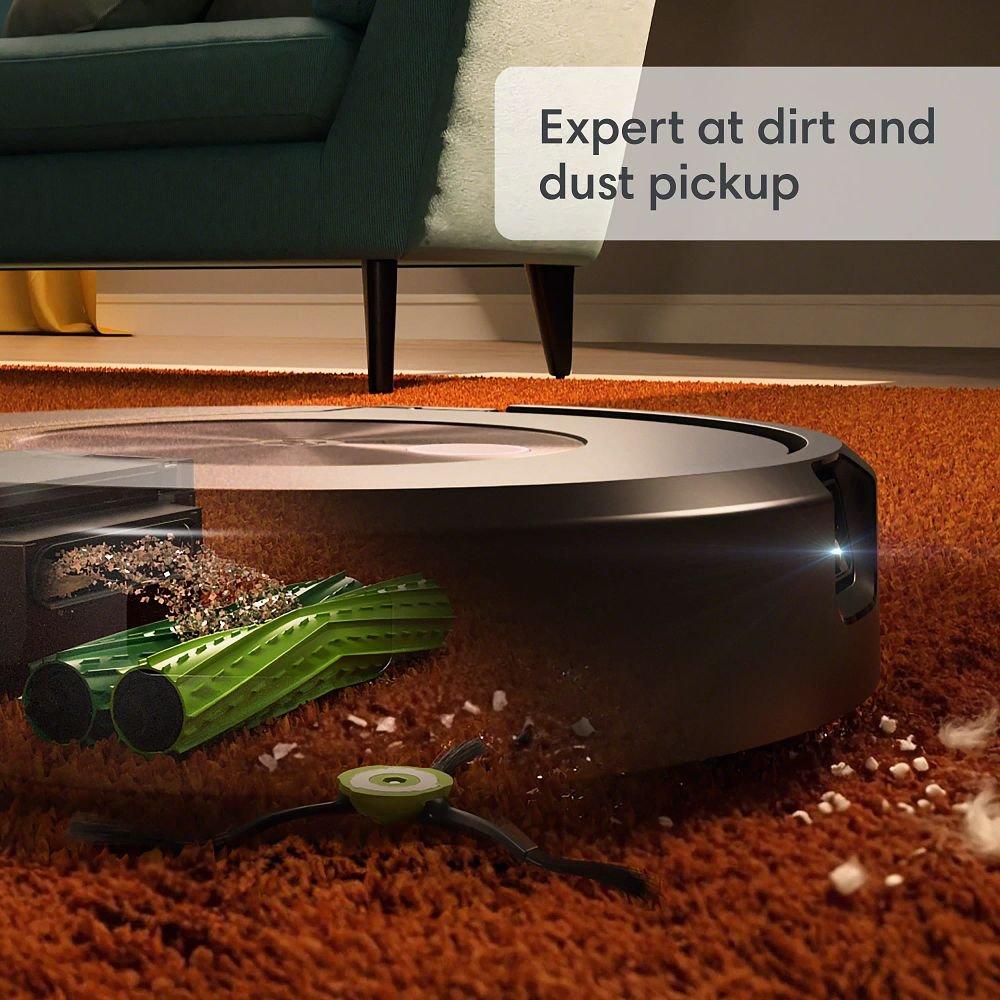
iRobot (Manufacturer product image)
Setup is friendlier than the feature list suggests. Pairing starts through Bluetooth, then the robot joins Wi-Fi 2.4GHz for normal control through the iRobot app. The app's first job is not to bury you in modes; it gets the robot connected, names the home, and sends it out to build a Smart Map. A first exploratory map is roughly a 30 minutes to 45 minutes job for a typical 1,500 to 2,500 sq ft home, which is the right expectation to carry into ownership: not instant, but not a weekend project.
Once the map exists, the iRobot OS experience is the main reason to choose this over cheaper hardware. Rooms can be named, no-go zones can be drawn, and cleaning preferences can be attached to specific areas. The map also improves as furniture moves. That matters if the living room changes, pet bowls migrate, or a chair that used to block a path is no longer there. A robot that treats the home as fixed becomes irritating quickly; the j9+ is better because it expects ordinary domestic disorder.
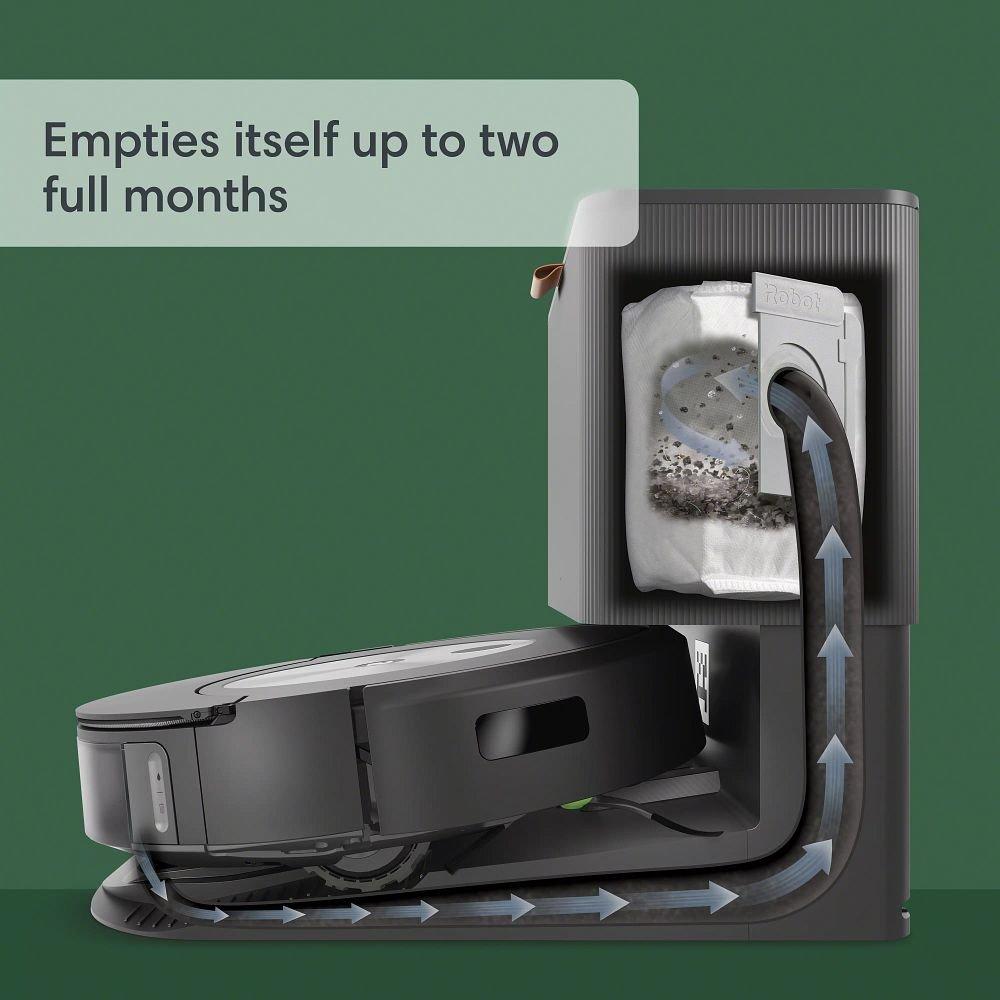
The Clean Base is the other major piece of the system. It automatically empties the robot's dustbin into a bag rated for up to 60 days of debris, which is the difference between using a robot vacuum daily and slowly abandoning it because the bin is always full. The dock is not small, and it is not a hidden object, but it earns its floor space if pet hair is the problem. What it does not do is wash the mop pad or refill the robot's water tank. That omission should be understood before buying, because it is the line between iRobot's version of convenience and the more elaborate Roborock or Dreame approach.
Cleaning, mopping, and real-world performance
The j9+ is strongest where many robot vacuums are most likely to disappoint: pet hair on carpet. iRobot's 10× Power Boost number is not directly comparable to the Pa ratings used by some competitors, so it should not be treated as a universal suction scoreboard. The practical story is the brush system. The dual rubber multi-surface rollers counter-rotate, flex against the floor, and resist the hair wrap that turns bristle brushes into maintenance projects. In a home with shedding pets, that design matters more than a single headline number.
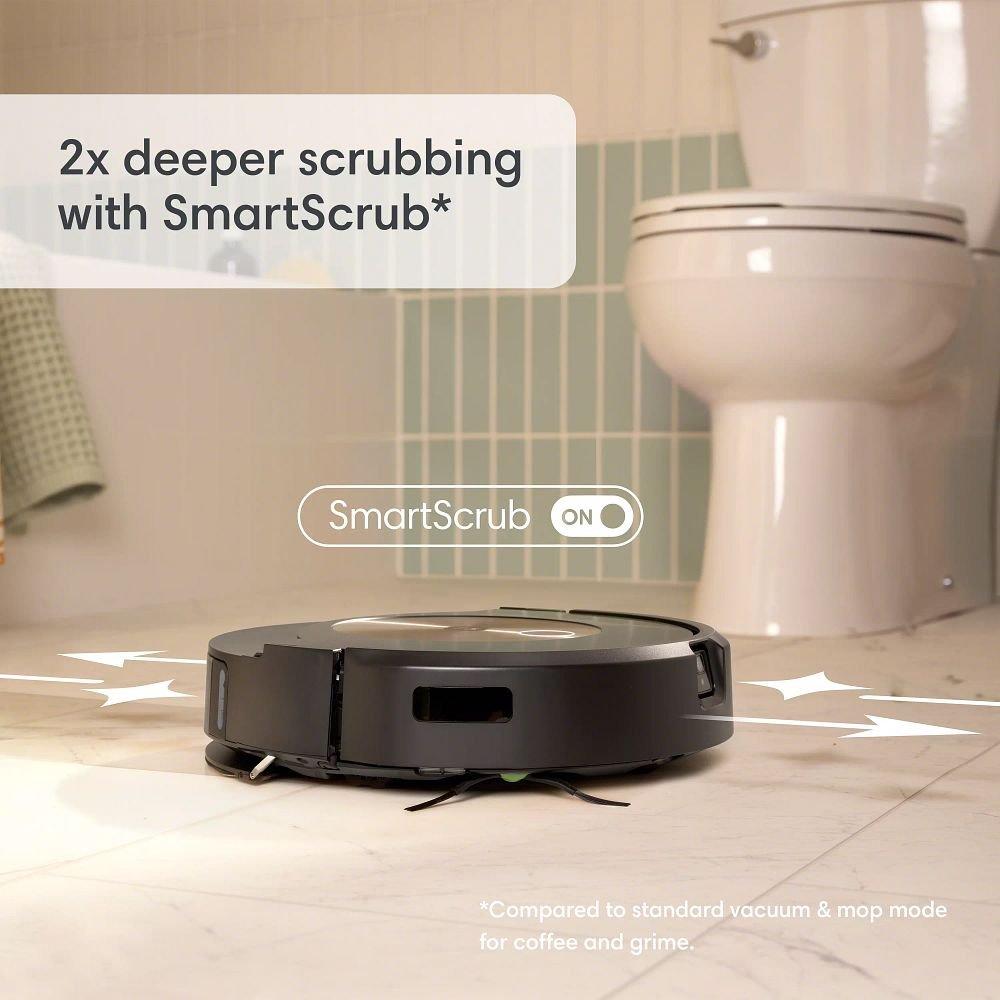
iRobot (Manufacturer product image)
On hard floors, the Roomba is a confident daily cleaner. Fine dust, crumbs, pet hair, and grit are the kinds of messes it is built to collect before they accumulate into something that requires a manual vacuum. The side brush helps with baseboards and chair legs, while the mapped cleaning pattern prevents the robot from wandering aimlessly after it has learned the rooms. It is not a substitute for deep cleaning every corner, but it reduces how often those deep cleans are necessary.
On low and medium carpet, the j9+ makes the best case for its price. The suction boost and rubber brushes work together to pull hair and fine debris from the surface and upper pile. It will not turn high-pile carpet into a freshly shampooed floor, and no circular robot reaches every corner perfectly, but the result is strong enough that pet owners can feel the benefit after regular runs. The limitation is runtime. A 75 minutes battery can be plenty for an apartment, a smaller house, or a targeted main-floor schedule. In a larger home, 75 minutes can mean more recharge-and-resume behavior or a need to divide cleaning by room.
The mop is useful, but it should be praised for the right reason. Smart Scrub improves hard-floor maintenance by adding a wet pass and scrubbing motion to kitchens, entries, and traffic lanes. It is good for dust film, paw prints, light kitchen residue, and the kind of dullness that appears between proper mopping sessions. It is not the most aggressive robot mopping system, and it is not self-cleaning. The mop pad needs to be removed, rinsed, and allowed to dry periodically. Buyers expecting the dock to solve mop hygiene will be happier with Dreame or Roborock.
The retractable pad changes the ownership experience. Instead of creating delicate no-mop zones around every rug, you can let the robot transition from hard floor to carpet and back again with less supervision. That does not mean every household can ignore mapping. Expensive rugs, very plush carpet, or rooms with unusual thresholds still deserve no-go or no-mop boundaries. But for ordinary mixed flooring, the automatic lift is the feature that makes combo cleaning feel normal rather than fragile.
PrecisionVision obstacle avoidance is a practical safety net, not a license to leave the floor chaotic. The camera-based system is designed to recognize objects such as cords, small shoes, and pet-related hazards, then navigate around them rather than simply bulldozing into the mess. Its weakness is lighting. Because it relies on a camera, it performs best when rooms are adequately lit. Night cleaning in dark rooms can make the robot more cautious, and a cautious robot may stop short of an area rather than risk a bad collision. If you want overnight cleaning, leave enough ambient light for the vision system to do its job.
Roomba Combo j9+ vs Roborock, Dreame, Eufy, and Shark alternatives
The Roborock S8 MaxV Ultra is the obvious alternative for buyers who want maximum automation. Roborock's pitch is a dock that empties, refills, washes, and dries, plus a very powerful vacuuming and mopping system. Against that, the Roomba Combo j9+ feels less complete on dock chores but more focused on the mixed-floor carpet problem. Choose Roborock if you want the dock to handle mop maintenance. Choose iRobot if you trust Roomba's pet-hair brushes, iRobot OS, and retractable mop behavior more than an all-in-one dock.
iRobot (Manufacturer product image)
The Dreame L20 Ultra is the value pressure point. It brings a highly automated dock, hot-water mop washing, dual spinning mop pads, LiDAR navigation, and a long runtime. It is the better choice for hard-floor-heavy homes where mopping hygiene and battery life matter more than iRobot's app polish. The Roomba is easier to recommend for pet owners who prioritize carpet behavior, brush maintenance, and a more familiar support ecosystem.
The Eufy RoboVac 11S is not a true feature rival, but it is a useful budget reality check. At 149 USD, Eufy's appeal is simplicity: a slim body, quiet cleaning, and basic vacuuming without mapping or mopping. It cannot match the j9+ on obstacle avoidance, mixed-floor automation, or pet-hair extraction, but it also does not ask for 999 USD. If your floors are mostly hard surface and your expectations are modest, Eufy may be the smarter buy.
Shark's self-emptying robot vacuums sit between those worlds. A Shark can make sense if you want an auto-empty dock at a lower price and do not need the j9+'s retractable mop system. The trade-off is usually less refined mapping, fewer iRobot OS learning behaviors, and a less elegant solution for mixed vacuum-and-mop runs. The j9+ is not the cheapest way to automate floors; it is the most persuasive Roomba for homes where pets and carpet make cheap automation feel cheap.
Who should buy the Roomba Combo j9+?
Buy it if pet hair is a daily problem and your home has both hard flooring and carpet. The j9+ is especially well suited to people who have tried lesser robots and found themselves constantly rescuing tangled brushes, redrawing no-mop zones, or emptying bins after every run. The 60-day Clean Base bag rating, the dual rubber brushes, and the retractable mop all attack those pain points directly.
It is also a good fit for buyers who value a polished app over a spec-heavy control panel. iRobot OS is not the most technically dense robot-vacuum software, but it is one of the better systems for room labels, cleaning preferences, and suggestions that ordinary owners will actually use. If you want the robot to fit into a schedule rather than become a hobby, that matters.
Do not buy it if your first priority is the most hands-off mopping system. The dock does not wash the pad, does not dry it, and does not refill the robot's water tank. Do not buy it for a very large home if a 75 minutes runtime will constantly interrupt whole-floor cleaning. Do not buy it if you prefer LiDAR mapping in total darkness, because PrecisionVision is happiest with light. And do not buy it if 999 USD stretches the budget; a cheaper vacuum-only robot may deliver more satisfaction than an expensive robot whose mop chores annoy you.
Bottom line verdict
The Roomba Combo j9+ is not the most automated robot vacuum and mop you can buy, but it may be the most sensible premium Roomba for messy mixed-floor homes. Its best features are the ones owners notice week after week: hair-resistant dual rubber brushes, a Clean Base that can hold up to 60 days of debris, a mop that gets out of the way on carpet, and iRobot OS mapping that improves with use.
The weaknesses are just as clear. A 75 minutes runtime is not class-leading, camera navigation needs light, and mop-pad maintenance remains manual. Those trade-offs keep it from being a universal flagship. For pet owners with rugs, carpet, and hard floors under one roof, though, the j9+ has a coherent point of view and enough discipline to justify its 999 USD price.