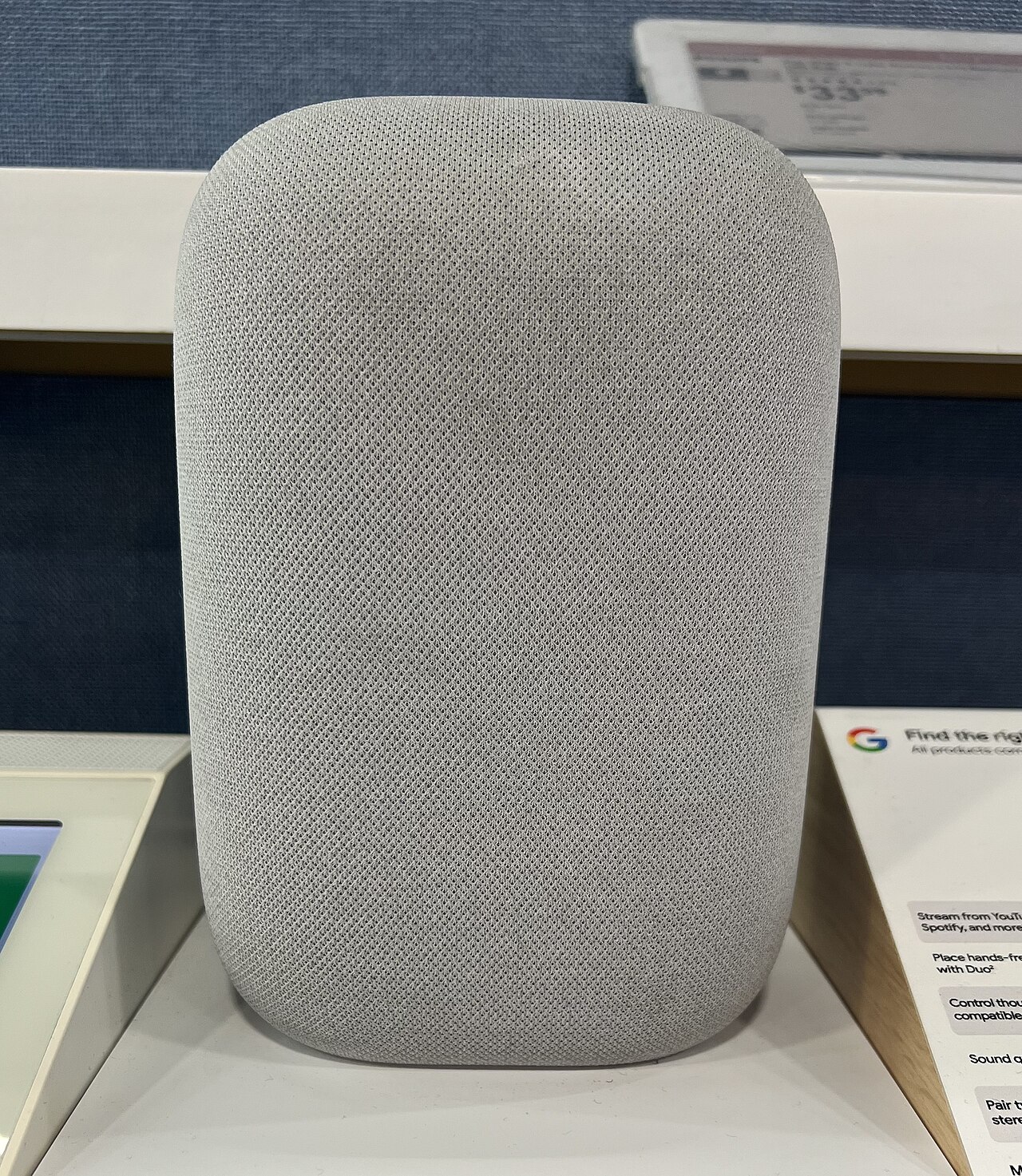
Overview: the Google speaker that sounds like it has priorities
The Google Nest Audio is the smart speaker to buy when the assistant matters as much as the music. At 99 USD, it is not trying to be the loudest speaker in the room or the most aggressive smart-home hub; it is trying to make Google Assistant, Google services, and credible everyday audio feel like one coherent household tool.
That focus is why it remains easy to recommend for Android and Google-centric homes. The hardware is straightforward but well judged: a 3.0 inches (75mm) woofer paired with a 0.75 inches tweeter; Adaptive Sound with ambient EQ; a 3-microphone far-field array; Wi-Fi 802.11b/g/n/ac; Bluetooth 5.0; Matter support through software; and an included AC adapter. The speaker is 6.89 inches tall, 4.89 inches wide, and 3.07 inches deep, so it has enough cabinet volume to sound more serious than a mini speaker while still fitting naturally on a kitchen shelf or bedroom table.
The catch is ecosystem fit. Nest Audio is excellent if your calendar, reminders, commute, searches, YouTube Music, Chromecast devices, and Android phone already live in Google's world. It is less convincing if your smart home depends on Zigbee accessories, Alexa skills, Thread border-router coverage, or Apple Home. The buying decision should start there. This is a polished Google room speaker, not a neutral hub for every possible home.
Design, build, and setup
Nest Audio is one of the more restrained pieces of smart-home hardware. The fabric-wrapped rounded rectangle has enough softness to avoid looking like office equipment, and the lack of visible controls helps it disappear into a room. It is larger and more grounded than a puck-style mini speaker, but the 6.89 inches by 4.89 inches by 3.07 inches footprint is still easy to place. It belongs on a counter, a shelf, or a nightstand rather than hidden behind a television.
The design serves the product's best use case: casual listening and frequent voice interaction. The speaker does not ask you to aim it precisely, and it does not advertise itself with a screen. The microphones listen for the wake phrase, the subtle lights confirm that it heard you, and touch controls handle the basic fallback tasks. In a kitchen or bedroom, that low-friction behavior matters more than a flashy industrial design.
Setup through the Google Home app is quick when your account and Wi-Fi are ready. Basic setup uses automatic detection through Bluetooth, Wi-Fi configuration, and Google Account linking in under 4 minutes, with voice match training taking about 2 minutes more. Those numbers are useful because they frame the real work: the speaker can be online quickly, but the experience becomes better after you choose default music services, assign rooms, connect smart devices, and invite household members.
Voice Match is important in a shared home. Nest Audio can provide different calendar, reminder, and commute responses to different recognized users, which is more than a novelty if several people use Google services. The 3-microphone array is not as numerically impressive as the 7-microphone array on an Amazon Echo 4th Gen, but it is adequate for normal rooms when the speaker is placed in the open rather than tucked behind clutter.
The absence of a built-in smart-home hub should be understood before purchase. Nest Audio can participate in a Google Home setup and control compatible devices, including Matter devices after the relevant software support, but it does not include a Zigbee hub and does not act as a Thread border router. If your lights, sensors, or locks need those radios, you will need other hardware in the system.
Sound performance and assistant behavior
Nest Audio's best surprise is how balanced it sounds for 99 USD. The 3.0 inches woofer gives voices and instruments enough body that music does not collapse into a thin smart-speaker tone, while the 0.75 inches tweeter keeps speech, cymbals, strings, and acoustic detail from turning cloudy. The 75mm woofer is not a substitute for a serious stereo, but it gives the speaker the warmth that small assistant devices often lack.
The tuning is strongest at the volumes people actually use around the house. Podcasts are clear, news briefings do not sound nasal, and playlists have enough bass presence to feel satisfying while cooking, cleaning, or working. Push any single compact speaker hard and the room will eventually expose its limits. Nest Audio is better treated as a high-quality everyday speaker for small and medium spaces than as a party speaker.
Adaptive Sound is the feature that makes the audio feel more finished. Rather than leaving one fixed EQ curve to fight every room, Nest Audio uses ambient EQ to adjust to the space. Heavy curtains, bare walls, carpet, counters, and nearby furniture all change how a small speaker is perceived. The adjustment is subtle, not magical, but it helps the speaker sound less wrong when moved from a bedroom to a kitchen.
A stereo pair is the smartest audio upgrade. Two Nest Audio speakers cost 198 USD together at 99 USD each, and the improvement is not merely louder playback. Stereo pairing creates separation, width, and a more stable center image for music. If music is a daily use case and you are choosing between one more expensive speaker or 2 Nest Audio units, the pair deserves serious consideration. If you mostly ask for timers, weather, and brief answers, one speaker is enough.
Google Assistant remains the main reason to choose Nest Audio over an Echo or HomePod mini. It is especially strong at knowledge queries, follow-up questions, local information, unit conversions, calendar checks, reminders, and anything that benefits from Google's search and account context. Ask about tomorrow's schedule, commute expectations, a recipe substitution, or a local business, and the answer usually feels closer to what you wanted than a generic voice response.
The trade-off appears in smart-home breadth and music-service friction. YouTube Music has the most natural integration. Spotify and Apple Music can work, but the setup path and voice behavior are not as effortless as Google's own service. Alexa still has broader third-party smart-home compatibility, and Apple still feels more native for Apple Music and HomeKit households. Nest Audio is the best assistant speaker for Google people, not the best default for everyone.
Nest Audio vs Amazon Echo, HomePod mini, Echo Dot, and Sonos alternatives
The Amazon Echo 4th Gen is the closest mainstream rival because it also sits at 99 USD. Echo has the stronger smart-home argument: built-in Zigbee, broader Alexa compatibility, and a mature routine engine. Nest Audio has the stronger information and Google-account argument. If you ask lots of open-ended questions, live by Google Calendar, and cast to Chromecast devices, choose Nest Audio. If your house is full of mixed smart devices and Alexa routines, choose Echo.
Apple HomePod mini is the better speaker for an Apple-first household even when Nest Audio has stronger general knowledge. HomePod mini integrates with iPhone setup, Apple Music, HomeKit, Thread, Intercom, and handoff in a way Nest Audio cannot reproduce. The Nest is better for Android users and Google services; the HomePod mini is better for people who want the smart speaker to behave like an Apple accessory.
Amazon Echo Dot 5th Gen is the budget alternative, not the equal audio rival. The Dot is cheaper, smaller, and useful as a secondary Alexa node. It is not the right comparison if music quality is the main reason for buying. Choose the Dot for a spare room, bedside alarms, or low-cost Alexa access. Choose Nest Audio when you want a real 3.0 inches woofer, a 0.75 inches tweeter, and better room sound.
Sonos Era 100 is the audio-first upgrade path. It is the better choice for buyers who care more about musical refinement than voice answers, but it moves the purchase into a different class. Nest Audio wins on Google Assistant integration and value at 99 USD. Sonos wins when the speaker is primarily a music system and assistant features are secondary.
Who should buy the Google Nest Audio?
Buy Nest Audio if your home already runs on Google. Android users, Google Calendar loyalists, Gmail users, YouTube Music subscribers, Chromecast owners, and households with Google Home devices will get the most from it. The speaker's greatest strength is not one isolated feature; it is the way ordinary requests become easier when the assistant already understands your services.
It is also a sensible buy for people who want a single room speaker that sounds better than a mini device without stepping into premium audio pricing. One Nest Audio at 99 USD is enough for a kitchen, office, or bedroom. A stereo pair at 198 USD is a strong low-cost music setup for a small living area.
Do not buy it if you need a built-in Zigbee hub, Thread border-router support, or the deepest routine automation. Do not buy it if your household is Apple-first and expects HomeKit and Apple Music to feel native. Do not buy it as a privacy statement against cloud assistants; Google provides controls, but the product's value comes from account-linked intelligence. And do not buy it if you mainly want the cheapest voice node, because an Echo Dot or Nest Mini-style speaker covers that lighter job for less.
Bottom line verdict
Google Nest Audio earns its place by being clear about what it is. It is a 99 USD Google Assistant speaker with a 75mm woofer, a 0.75 inches tweeter, Adaptive Sound, and enough physical size to make everyday music pleasant. It is not the most universal smart-home hub, and it is not the most flexible speaker for every streaming service.
For Google households, that trade-off is acceptable. The assistant is useful, the sound is warm, setup is quick, and a 198 USD stereo pair can outperform expectations for the money. For Alexa, Apple, or complex mixed-protocol homes, there are better fits. For the Android user who wants one speaker to answer well and sound good doing it, Nest Audio remains the right call.