Introduction
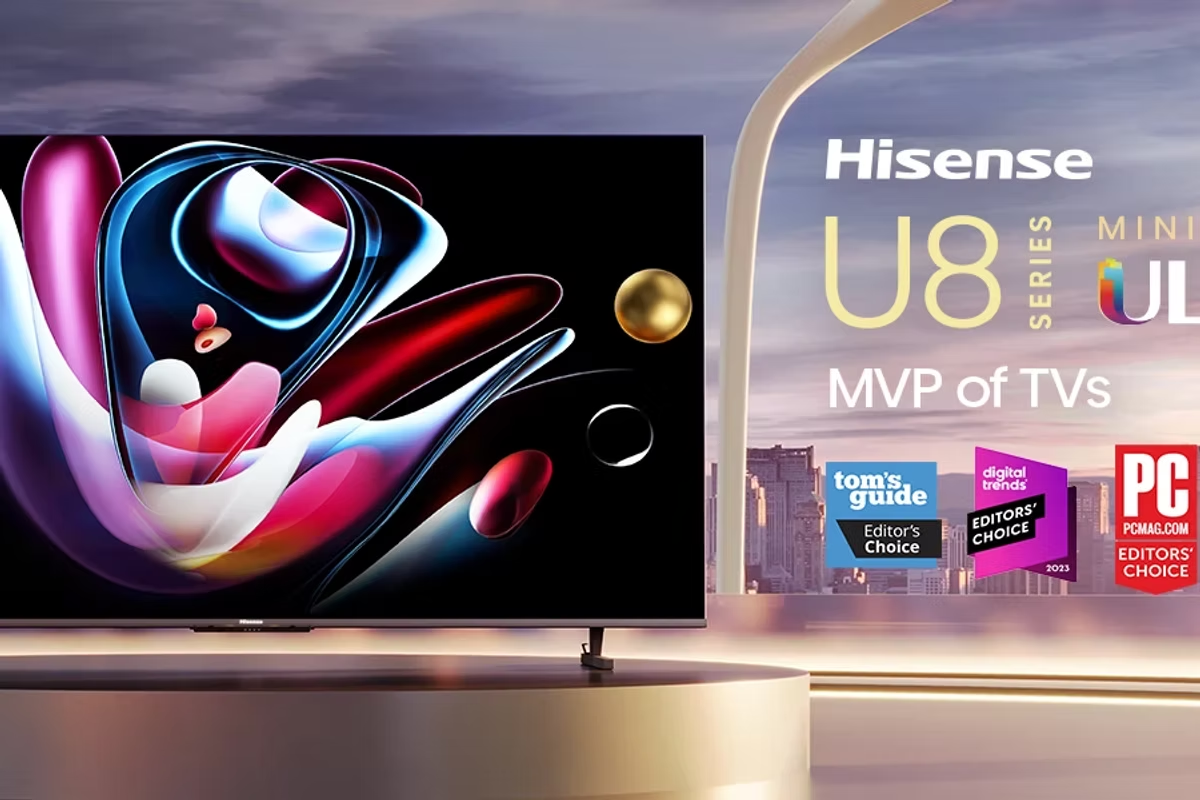
For years, the conventional wisdom was simple: if you wanted a truly great television, you had to spend over $1,000. The Hisense U8K is the most compelling argument yet that this calculus has fundamentally changed. At $699 for 55 inches, it delivers Mini-LED backlighting, a 144Hz panel, Dolby Vision IQ support, Google TV, and a built-in 2.1.2-channel audio system — a spec sheet that would have commanded $1,500 or more just two years ago.
Across bright living rooms and light-controlled viewing spaces, the 55-inch U8K55H has the specification set and independent feedback to challenge old assumptions at nearly every turn. This is not a "good for the price" television with asterisks — it is a genuinely good television that happens to cost $699.
The U8K competes directly with the Samsung QN90C and occupies the tier just below OLED. Whether that positioning is enough depends heavily on your viewing environment and priorities.
Picture Quality & HDR
The U8K's headline capability is its brightness. Hisense's Mini-LED backlight with local dimming pushes peak HDR output to approximately 1,500 nits on a bright window, according to reviewer measurements in the Filmmaker or HDR Vivid preset. In a living room with afternoon sun pouring through windows, this TV does not get washed out — a fundamental challenge for OLED panels.
Hisense USA (page since removed; image still hosted on Hisense's own CDN) (Manufacturer product image)
The full suite of HDR formats is present: Dolby Vision IQ, HDR10+ Adaptive, HDR10, HLG, and IMAX Enhanced. This is extraordinary at $699. The QN90C, at $1,499, does not support Dolby Vision. The Hisense does. Dolby Vision IQ uses the built-in ambient light sensor to dynamically adjust the tone map, so the picture remains balanced whether you're watching at noon or midnight.
Quantum Dot color filters expand the color gamut meaningfully beyond standard LED. Independent testing has put the U8K at 97% of the DCI-P3 color space and approximately 75% of Rec. 2020. Saturated HDR content — tropical landscapes, neon cityscapes, vibrant animation — looks richly colorful and engaging.
The VA panel delivers native contrast that LCD-IPS competitors cannot approach. Dark scenes maintain depth and shadow detail that IPS-based TVs typically struggle with. However, this same VA technology introduces the U8K's most significant picture quality limitation: viewing angle. Beyond 30 degrees off-axis, the image shifts noticeably — blacks turn gray, colors desaturate, and punch diminishes. Households where viewers sit at the sides of a wide sectional sofa will notice this.
Mini-LED blooming — faint halos of light bleeding around bright objects against dark backgrounds — is present under deliberate test conditions: white text on black, stars in space scenes, lamp posts at night. In practice, during normal film and TV content, it is rarely intrusive. But it is real and worth acknowledging.
Out-of-the-box calibration in the default Vivid picture mode oversaturates and over-sharpens. Switching to Filmmaker Mode or Cinema Day results in a substantially more accurate image, with Delta-E values under 3.5 — acceptable without a professional calibration.
Gaming Performance
The U8K is one of the most gaming-capable TVs at this price. A 144Hz native panel, HDMI 2.1 bandwidth for 4K/144Hz, AMD FreeSync Premium certification, HDMI Forum VRR, and ALLM are all present. The Gaming Bar — accessible via the remote during gameplay — provides a HUD overlay for VRR status, refresh rate, HDR mode, and black equalizer without leaving the game.

Hisense USA (page since removed; image still hosted on Hisense's own CDN) (Manufacturer product image)
Reviewers place input lag in Game Mode at approximately 14 milliseconds at 4K/120Hz. This is more than adequate for the overwhelming majority of gaming experiences — casual, cooperative, RPG, and even most competitive multiplayer. The 14ms figure is perceptibly higher than OLED's sub-2ms and the Samsung QN90C's ~4ms, and dedicated competitive FPS players who are sensitive to even slight delay may feel the difference.
The 144Hz ceiling is the U8K's strongest gaming credential. With a capable PC GPU via HDMI 2.1, 4K/144Hz with adaptive sync is a genuinely excellent gaming experience on this panel. The 65-inch configuration is particularly compelling as a large-format PC gaming display.
One meaningful port limitation: only two of four HDMI ports support HDMI 2.1 bandwidth. If you want to connect a PS5, Xbox Series X, and a gaming PC simultaneously at full 4K/120Hz, you will have one device on an HDMI 2.0b port, limiting it to 4K/60Hz. Plan your port allocation accordingly.
Smart TV & Interface
Google TV is a genuine strength. As the most content-rich smart TV platform available — with the Google Play Store's enormous app library, Chromecast built-in, and AirPlay 2 — the U8K essentially never has a "missing app" problem. Google TV's search bar aggregates results across all connected streaming services, and Google Assistant responds reliably to voice commands via the remote microphone.
Amazon Alexa integration is also available alongside Google Assistant. Chromecast built-in allows any phone, tablet, or laptop to cast content to the TV natively. For households deep in the Google or Android ecosystem, this platform integration is seamless.
The interface itself is clean, fast, and well-organized. Hisense has largely stayed out of the way of Google TV rather than layering heavy customization on top of it — a smart decision that results in a snappier experience than manufacturer-skinned alternatives.
Wi-Fi 6E support is a notable premium inclusion at this price tier. On a 6GHz capable router, the U8K streams 4K HDR content with no congestion or buffering even in apartments with crowded Wi-Fi environments.
Audio
The 2.1.2-channel built-in audio system is one of the most frequently praised aspects of the U8K in external reviews — and with good reason. The combination of a dedicated center channel, side-firing bass drivers, and upward-firing height channels creates a soundstage that is substantially wider and taller than a conventional flat speaker array. Dolby Atmos and DTS:X decoding are both supported, and object-based audio from streaming services actually has height channels to work with.
Dialogue clarity is strong. Action sequences have meaningful bass presence from the internal subwoofer drivers. For a mid-size living room at moderate volume, the U8K's built-in audio is genuinely usable — an increasingly rare claim for television speakers. It will not replace a 5.1 system or a premium soundbar in a large room, but it will not embarrass you in front of guests either.
eARC output is available via one of the HDMI 2.1 ports for lossless audio passthrough to a compatible soundbar or AV receiver.
Who Should Buy It?
The Hisense U8K represents exceptional value for a specific type of buyer:
- Budget-conscious home theater enthusiasts who want Mini-LED HDR performance and Dolby Vision without paying OLED prices
- Bright-room viewers who need 1,500+ nits to combat ambient light — this TV wins that battle at $699
- Gamers who want 4K/144Hz with adaptive sync and don't need sub-5ms competitive lag
- Google ecosystem users who want a seamless Chromecast and Google Assistant experience
- Families or households where excellent built-in audio reduces the immediate need for a soundbar purchase
The U8K is a harder sell for dark-room cinephiles who prioritize perfect blacks over brightness — OLED is still the correct answer in that context. It is also less suited to wide-angle seating arrangements or households with competitive esports players who demand sub-5ms input lag.
Verdict
The Hisense U8K does something genuinely impressive: it makes the $1,000+ television market feel overpriced. Its Mini-LED brightness, full HDR format support, 144Hz gaming credentials, and Google TV polish would justify $1,000. At $699, it is one of the best value propositions in consumer electronics.
It is not perfect — VA viewing angles and moderate input lag are real trade-offs, and Mini-LED blooming cannot be entirely eliminated by physics. But for the vast majority of viewers in a typical living room, the U8K delivers a television experience that would have cost significantly more money just two years ago.