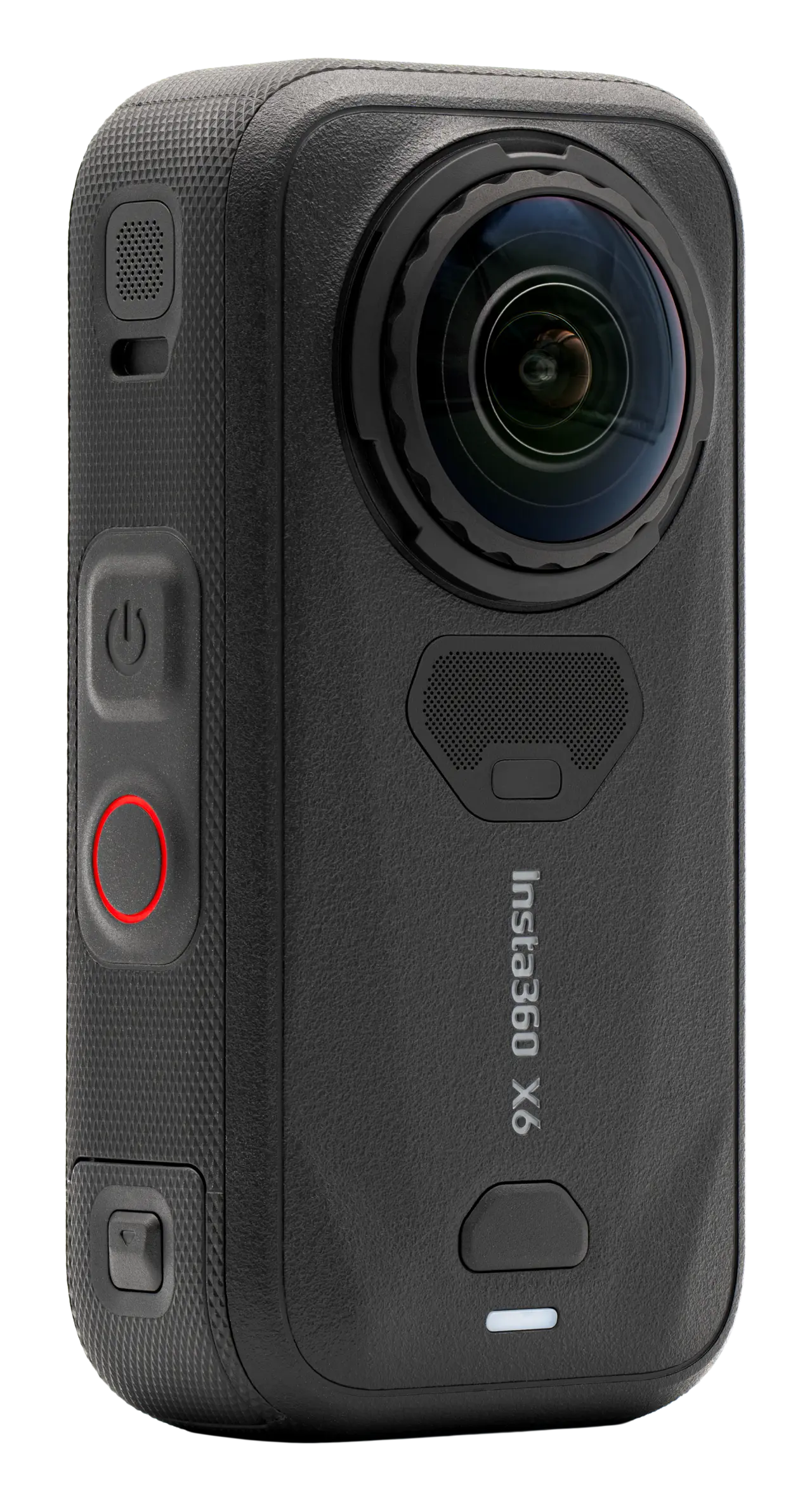
Overview: excellent capture isn't the same as an effortless finished video
The X6 is a confirmed product, not a future-model assumption. Insta360's announcement puts availability at August 12, 2026, starting at US$699.99 for the Standard Bundle. It introduces a more capable imaging system, built-in storage and a battery claim tied specifically to 8K/30fps. Those are substantial changes, even if your final social clip will not always reveal them.
The purchasing problem is the gap between the hardware and the editing promise. TechRadar's Sam Kieldsen found excellent images and persuasive battery performance, but repeatedly encountered mobile-app crashes on beta software. A desktop path worked better. That makes the X6 a stronger recommendation for a deliberate creator than for someone expecting a purchase to eliminate editing friction.
Verdict Hound has not tested an X6. This review attributes practical results to independent reporting and distinguishes them from manufacturer specifications. Our scores are judgments about the purchase as a whole, not copied test scores. In particular, our workflow and value assessments temper the hardware's strong showing.
Design and build: the sensor name needs decoding
Insta360 calls the system “1-inch 360 imaging,” while its announcement specifies two custom Sony 1/1.1-inch square sensors. The claim concerns usable panoramic coverage relative to a rectangular sensor, not a declaration that these are the same physical sensor type as the ONE RS 1-Inch 360 Edition. Keeping that distinction visible prevents an expensive buying decision based on a name.
The X6 is shorter and wider than the X5, with a 2.32-inch OLED display and a stated weight of 196g. Kieldsen found the hardware robust, though the pressure-sensitive screen controls did not add much practical benefit for him. We would treat those controls as an interface preference, not a reason to upgrade.
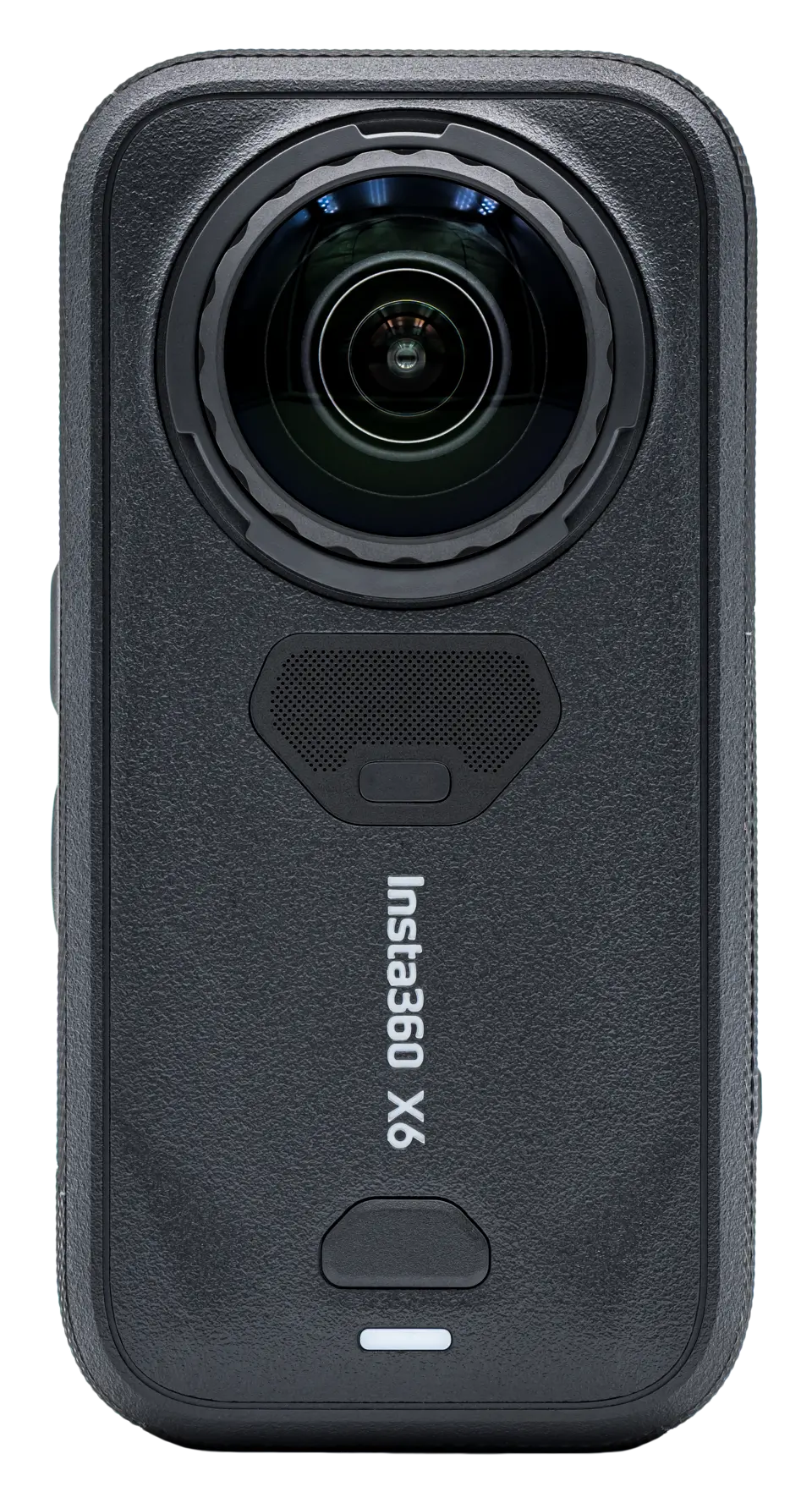
_Front view: PantheraLeo1359531 / Wikimedia Commons, CC BY-SA 4.0. Resized and converted to WebP; the derivative retains this license._

The body retains a tripod thread and magnetic-mount support. The manufacturer explicitly discusses compatibility with particular X5, X4 Air and Ace mounting accessories. That does not mean every battery, case or lens part crosses generations. Verify the exact accessory before reusing it; a fitting-looking item is not proof of correct sealing or clearance.
Its 64GB nominal internal storage has 47GB usable, with a microSD option for expansion. That distinction matters more than the nominal capacity. Built-in space is a useful backup for a forgotten card, but it is not enough reason to abandon routine offloads during sustained high-resolution shooting.
Image quality and performance: a premium that has an identifiable job
The official video headline is native 8K/50fps spherical capture, up from the X5's 8K/30fps. It also specifies 120MP spherical photos and 10-bit recording, with I-Log and Dolby Vision options. Those modes give creators choices in temporal smoothness and color delivery; they do not make every output simultaneously sharper, cleaner and easier to grade.
Kieldsen found the X6 strong in daylight and especially capable after dark. His assessment put it alongside or ahead of leading daylight competition while retaining Insta360's difficult-light strengths. That is an independently reported qualitative comparison, not a controlled measurement establishing universal superiority.
The manufacturer presents larger sensor area and major processing gains as explanations. We do not turn those percentages into a measured percentage improvement in exported video. Noise reduction, tone mapping, subject movement and how far you crop determine whether the advance is worth paying for.
For a creator producing travel pieces in changing light, the benefit is fewer compromises between daytime and evening material. For a buyer who only posts wide daylight clips, the X5 may already be sufficient. The X6 premium is easiest to justify when poor light repeatedly limits usable footage, not when your current camera merely looks older.
Active tone handling can retain a bright sky while preserving a shaded person, but processed images still need inspection. Look for transitions around moving subjects, fine-texture smoothing and inconsistent exposure as you reframe between lenses. A small camera display is a poor place to judge those issues.
Color, tracking and the difference between capture and delivery
Ten-bit recording is useful when pushing colors through a grade, especially where smooth tonal transitions matter. It is not an automatic cinematic setting. Select a profile according to the final edit and keep the pipeline consistent across cameras. Unmanaged HDR or log footage can look wrong on an ordinary delivery path despite containing more information.
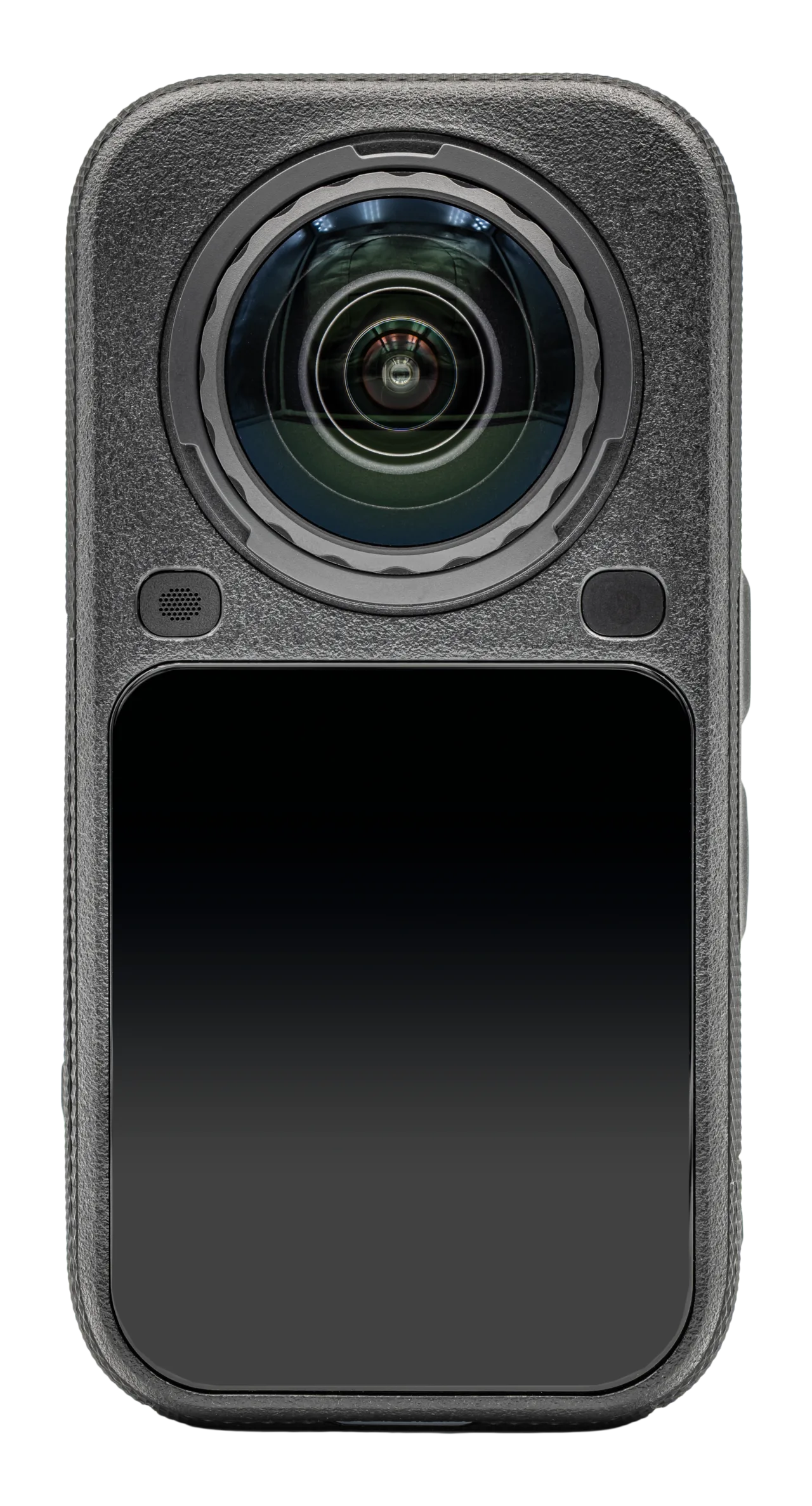
Rear view: PantheraLeo1359531 / Wikimedia Commons, CC BY-SA 4.0. Resized and converted to WebP; the derivative retains this license.

InstaFrame 2.0 is described by the manufacturer as a subject-tracking flat-output option. That can help a creator get a promptly shareable perspective without manually reframing everything. It also means asking the camera to choose the view at capture time. For irreplaceable moments, understand what spherical source is retained in the selected mode before treating tracking as a substitute for later choice.
Kieldsen reported promising tracking behavior, but the broader mobile editing experience was unreliable in his beta tests. Our recommendation is to separate the tracking feature you need from the marketing promise of an automatically completed day-long vlog. Test that specific workflow with your device and a representative file.
We exclude promised future editor integration from the score. The independent review describes forthcoming DaVinci Resolve compatibility it could not test. The camera's current local editing capability can be assessed without treating a future software release as delivered. Recheck the actual supported version if that integration is the main reason you want an X6.
Editing and storage: where the ownership cost appears
In the cited tests, the mobile beta app struggled on an iPhone 13 and also had issues on a OnePlus Pad. Editing and exporting demanding material could crash or fail. These are precisely scoped observations: they do not prove that released software on every compatible handset behaves identically, and we do not assert that a later update has fixed them.
The desktop Studio route on an M2 MacBook Air was notably more stable for Kieldsen. That is valuable because it offers a workable route to finished output, but it does not excuse checking your own computer requirements. A camera purchase may expose an editing bottleneck rather than solve it.
TechRadar describes roughly 1GB per minute for the tested 8K/30fps footage. This is a useful reported planning figure, not a universal encoding rate. Different modes and settings can change file size. Even so, the lesson is clear: internal storage and a phone's remaining space are consumable resources during a shoot.
Keep the original spherical file when possible. A flat export discards the freedom to choose another angle later. If you need both a vertical social edit and a horizontal project edit, decide where the originals will live before filling the camera and phone with duplicate intermediate files.
The manufacturer offers local desktop editing and optional cloud backup and editing products. We do not count cloud convenience as a required recurring fee for ordinary local reframing. Examine current service tiers separately, particularly if automatic backups and the advertised AI tools influence your budget or privacy preferences.
Battery and heat: unusually helpful independent evidence
The X6's official 2600mAh battery claim is 140 minutes of continuous 8K/30fps recording. TechRadar reports 136 minutes in its test, with no overheating shutdown during that run. That is meaningful corroboration of the specified workload and one of the clearest reasons to select the X6 over a cheaper model for longer capture.
It is not an 8K/50fps runtime result, a guarantee in enclosed mounts, or a promise about every hot climate. Higher frame rates increase the work, and environment changes the cooling. Our high recording score reflects the documented and reported 30fps performance without borrowing it for modes that were not measured.
The manufacturer specifies charging to 80% in 24 minutes with fast charging, and the independent review broadly corroborates that timing. A suitable charger and cable are part of that claim. The last portion of charging need not proceed at the same rate; do not calculate a full-charge time by simple division.
A sensible working kit still includes spare power and storage. Internal memory reduces a common forgotten-card failure, while extra battery capacity reduces another. Neither helps if the lens is dirty or the camera has recorded the wrong mode for an entire afternoon.
Durability, water and audio: protection still needs a routine
Insta360 gives the X6 a 20m body waterproof rating and specifies 60m with the Invisible Dive Case Pro. Those are manufacturer limits, not depths verified by our publication. Clean underwater stitching remains a separate optical issue; check the current case instructions instead of assuming a body rating guarantees usable panoramic images.
Replaceable Lenses 2.0 is a genuine repairability feature. The manufacturer's improved scratch-resistance and replacement-cost percentages are comparative claims under its own conditions, not measured evidence from this review. What we can recommend is the repair pathway itself: damage to exposed outer glass has a defined replacement process.
For sound, Kieldsen found wind filtering helpful but not complete. The official hidden engine microphone and motorcycle-oriented modes are interesting for that audience, but do not establish intelligible dialogue in every wind direction. Consider a supported worn microphone for important speech, and confirm the exact direct-connect arrangement you intend to use.
There is no need to buy every accessory at once. Prioritize the cap, suitable mount and recording supplies before specialized effects equipment. A compact but protected everyday kit is more useful than a large collection whose parts you rarely understand well enough to trust.
Alternatives: choosing among X5, DJI and the older specialist
The X5 keeps a strong balance of evening capability and lens repairability. It is our balanced adventure quick pick when current total pricing makes it materially cheaper. The X6's runtime, internal storage and imaging advantages are the reasons to pay more, not its generation number.
The Osmo 360 II brings native 8K/60fps, replaceable lenses and DJI microphone integration. Its shorter reported high-frame-rate indoor thermal run is important if that is your intended workload. The available reporting does not settle every X6-versus-DJI image-quality question, so ecosystem fit is more actionable than a blanket winner claim.
The X4 remains a daylight alternative when substantially discounted. It has smaller sensors and weaker difficult-light evidence, but an owner satisfied with its clips does not need to upgrade. A better camera is not always a better use of the available budget.
The ONE RS 1-Inch 360 Edition is a different proposition: physical dual 1-inch sensors in an older modular design with IPX3 protection. It is not the premium action substitute suggested by the shared “1-inch” wording. Compare the workflow and environment rather than assuming the same sensor label means the same product.
Who should buy it, and who should skip it
Buy the X6 if premium spherical capture and longer 8K/30fps endurance address your actual projects, and you have a capable, checked editing route. It is especially plausible for travel creators who mix bright exteriors with dimmer evening scenes and retain original files for multiple outputs.
Skip it if the entire value proposition depends on effortless editing on an older phone. Also skip it if your X5 already produces acceptable footage and the money would be better spent on audio, storage or the trip itself. The X6 earns its premium for particular work, not as a general obligation to stay current.
Verdict
The X6's capture hardware is compelling, with particularly useful independently reported runtime evidence. Its strongest buyer is someone who knows how the files will become finished work. Its weakest pitch is that paying flagship money automatically removes the software and storage chores of 360 production.
Choose it for premium imaging and recording headroom. Validate the current app and delivery workflow before relying on the automation promises.
FAQ
Is X6 a real released model?
Yes. Insta360's own announcement confirms availability from August 12, 2026 and a US$699.99 Standard-bundle launch price. This is not a speculative score for an unannounced camera.
Does it have physical 1-inch sensors?
The official announcement specifies dual 1/1.1-inch square sensors and describes their coverage as 1-inch-equivalent 360 imaging. That is different from the physical sensor designation of ONE RS 1-Inch 360 Edition.
Can it record 8K/60fps?
The official X6 spherical maximum is 8K/50fps. Do not substitute the Osmo 360 II's 60fps figure or confuse a special-effect mode with ordinary full-sphere capture.
Is the 136-minute result relevant at maximum frame rate?
It was reported at 8K/30fps. It should not be used as an 8K/50fps prediction. Select the mode needed by your output and plan spare power for conditions not covered by that test.
Is the mobile app now stable?
We cannot confirm that from the cited beta tests. Check current released software and supported devices. The independent desktop experience was more dependable, but that also needs a suitable computer.
Is 47GB enough for a day?
It depends on the amount and mode of footage. TechRadar's tested 8K files were large enough that internal space was a safety net rather than an all-day archive. Carry compatible storage and offload deliberately.
Does Dolby Vision remove the need to grade?
It offers a different delivery option, not universal compatibility. Decide how the footage will be edited and watched, and verify the export and viewing path before choosing HDR for important material.
Should I replace an X5?
Only for an identifiable need: improved imaging, internal storage, the higher spherical frame rate or longer relevant recording endurance. Otherwise, the X5's repairable lenses and difficult-light capability remain useful.
Image credits
The lead photograph is PantheraLeo1359531's focus-stacked X6 product view, via Wikimedia Commons, licensed CC BY-SA 4.0. Our resized WebP derivative remains under that license. These are third-party product photographs, not evidence of Verdict Hound testing or sample footage captured by this camera.
