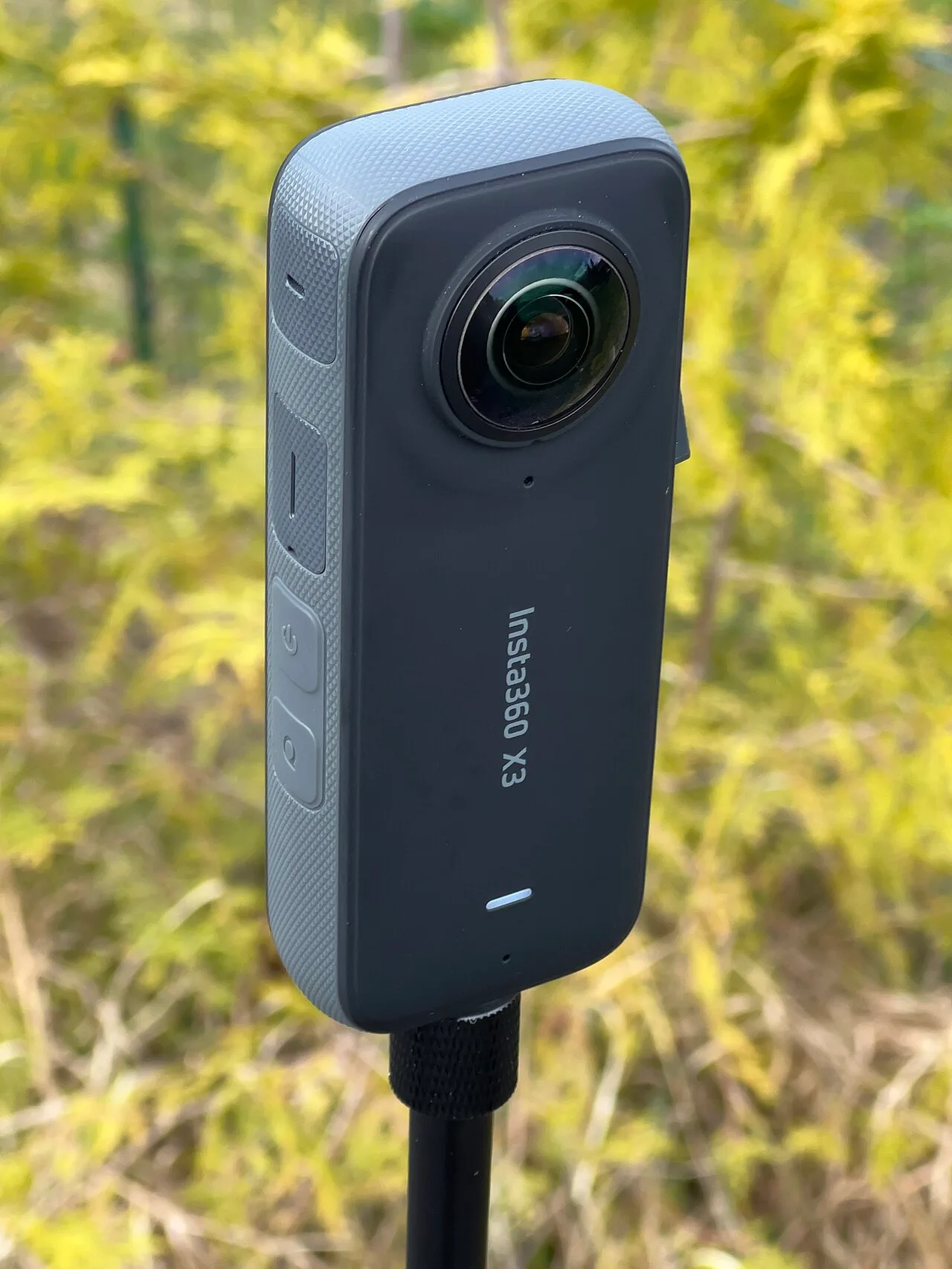
Overview: a first experiment needs a lower price, not lower expectations
An X3 can still show why a 360 camera is interesting: you record a scene without committing to one direction, then make the camera movement in an editor. That creative freedom is not obsolete. Its 5.7K ordinary spherical capture, difficult-light limitations and exposed older optics do make it a purchase that needs a convincing price and a careful condition check.
Andrew Williams's TechRadar review places the launch in September 2022 and reports a US$449 RRP. We do not present that as a current bargain. An X3 bought today should be evaluated against the complete cost of a clean X4 or X5, not against what flagship ownership meant at launch.
Verdict Hound has not tested the X3 hands-on. We use Insta360's official product information for modes and limits, and independently reported testing for practical performance. Our ratings reflect the older camera's present role in a dedicated 360 category, with uncertainty about current stock and individual used-unit condition left visible.
Design and build: approachable controls, unforgiving glass
The official body measures 114 × 46 × 33.1mm and weighs 180g. Its 2.29-inch touchscreen is a genuine usability strength in the independent review. You can change settings and check the intended recording mode without relying entirely on the phone. Physical controls also help when the camera is already positioned for a shot.
The lenses still dominate the handling routine. A dual-lens camera always has valuable glass facing outward, including the side you are not watching. Treat a transport cap as part of the everyday kit rather than an optional luxury. A camera placed carelessly on a rough surface can lose more value than a modest discount saves.
Protective guards are not a user-replaceable optical system. The X5 and X6 change that ownership equation; the X3 does not. Before buying used, inspect the underlying lenses for scratches and haze, the charging area for damage and the battery for obvious deterioration. We cannot infer a used unit's condition from the performance of a new review sample.
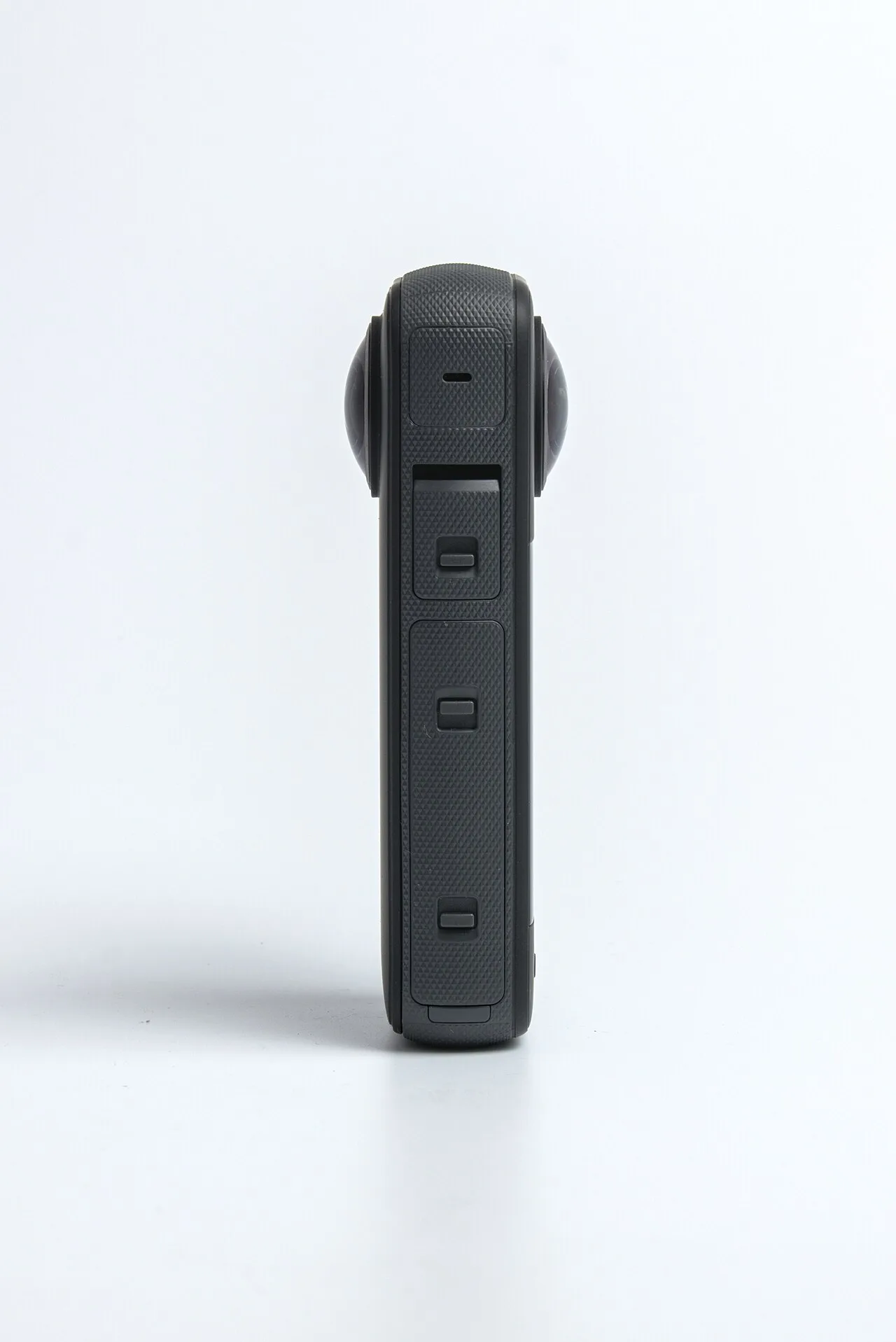
Side view: -stk / Wikimedia Commons, CC BY-SA 4.0. Resized and converted to WebP; the derivative retains this license.

The camera's tall form works well on an aligned stick because the stick can fall in the stitching region. That effect has limits. A hand too close to the lenses or a bulky off-axis mount can leave a visible obstruction. Use the invisible-stick idea to simplify the shot, not to assume every support will vanish.
Image quality: the 8K line is about timelapse
The X3 supports 5.7K/30fps ordinary spherical video and 72MP spherical photos. It also advertises 8K timelapse. That last specification does not turn it into an 8K real-time camera. If the listing or seller uses only “8K,” ask which mode it describes.
Williams found worthwhile daytime results but described processing artifacts in fine textures, with tight detail like gravel, leaves and old walls filled in by unnatural straight and horizontal patterns. With a relatively tight flat view, the available detail becomes more obviously limited. The camera is best understood as a wide-view storytelling tool rather than a way to crop distant subjects into close-ups.
This is why X4's 8K capture remains a meaningful comparison even for outputs far smaller than 8K. More whole-sphere detail can survive reframing better. It does not make X4 compulsory, but it is a more relevant upgrade than assuming a higher still-photo megapixel number determines video quality.
The X3's dual 1/2-inch sensors struggle when light falls. TechRadar found low-light results weak, with noise and processing taking away detail. The review also describes an unreadable low-light clip during its launch-era use. We do not claim that exact software fault persists today; the more durable issue is the limited evidence for good dim-scene imaging.
For an older camera, expectations should follow the scene. Use it in good daylight, keep the crop broad and avoid relying on it as the only record of an important dim event. An inexpensive tool is useful when assigned a suitable job; it becomes expensive if its limitations ruin the job you bought it for.
Active HDR and single-lens performance: convenience with trade-offs
TechRadar found Active HDR helpful for holding bright sky information while keeping darker parts of a scene readable. It also noted that the processing could produce artificial-looking tones and texture noise. We would choose that mode because the scene needs it, not because “HDR” sounds universally superior.
Inspect an exported representative clip on a larger screen. Look at moving leaves, fine ground texture and the transition between shaded and sunlit areas. Those details reveal processing more clearly than a tiny preview. This is a recommended check for buyers, not a procedure Verdict Hound performed.
Single-lens 4K/30fps is useful when you know the desired direction. TechRadar nevertheless found the footage softer than the headline resolution implies. It also describes a 2.7K/60fps option and the wider 170-degree MaxView framing. Wider coverage and faster motion do not give you full-sphere choice.
If forward-facing recording is your main purpose, do not buy an X3 solely because one device advertises both formats. Dedicated 360 lenses and a reframing workflow bring costs you may not use. Conventional action cameras belong outside this category because their fundamental capture method is different.
Stabilization and stitching: a strong creative foundation
FlowState stabilization and horizon control are among the best-supported reasons the X3 remains useful. Williams found the footage stable and the editing freedom valuable. A shot can look deliberately framed even when the person carrying the camera is focused on the activity rather than aiming it.
This does not eliminate every motion problem. A vibration-prone attachment can create distraction; an exposure in poor light can record motion blur that stabilization cannot undo. Good light and a secure mount help both image quality and apparent smoothness.
The lens join is another boundary to plan around. Close objects can look misaligned because each lens sees them from a different position. Position the important subject toward one lens if possible, and do not place the join through a face merely because the camera records in every direction.
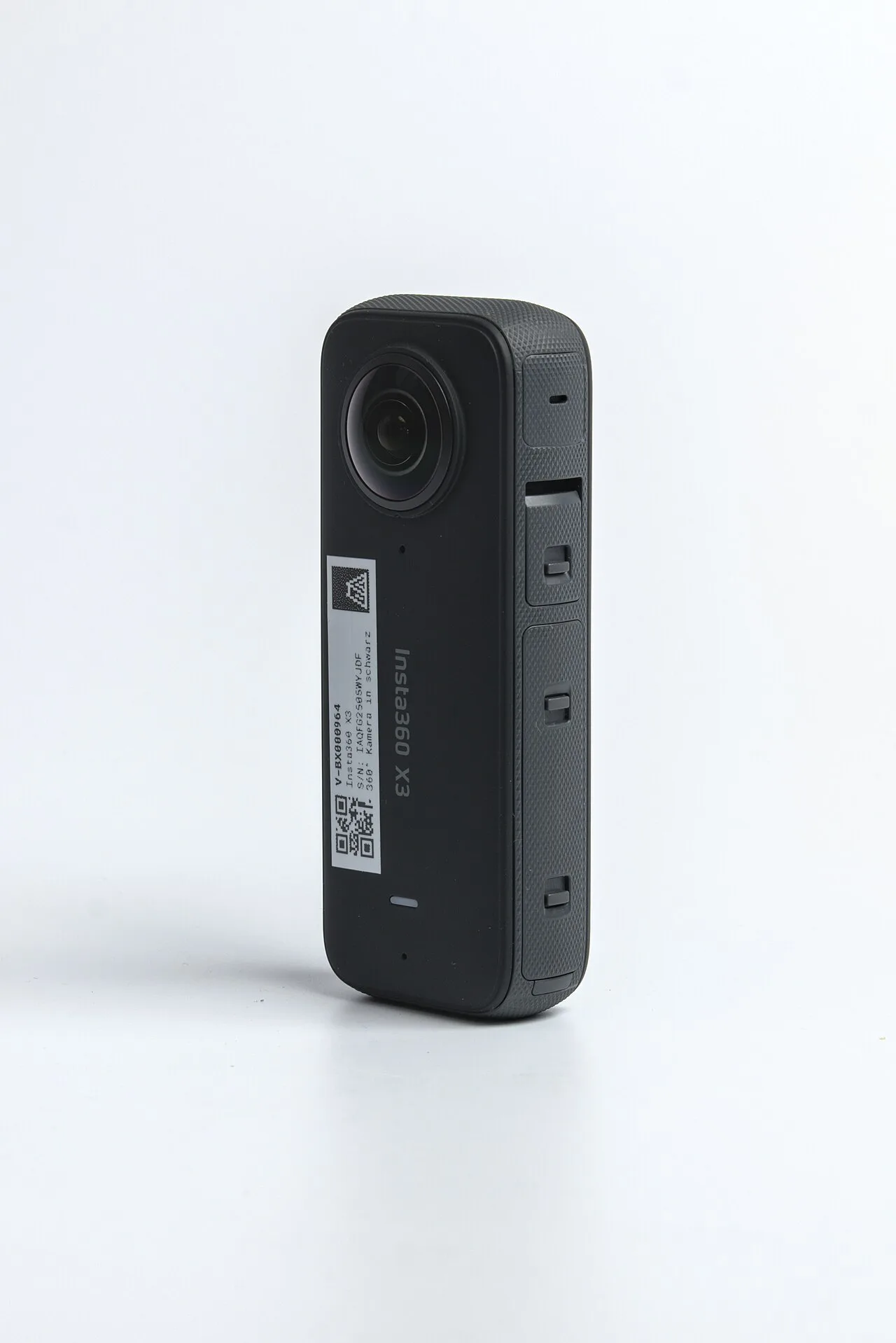
Rear view: -stk / Wikimedia Commons, CC BY-SA 4.0. Resized and converted to WebP; the derivative retains this license.

The official IPX8 body rating is 10m, with a specified Invisible Dive Case rated to 50m. Underwater stitching is a separate concern from surviving that depth. Follow Insta360's exact case guidance and seal-maintenance instructions; the number alone is not enough to choose a reliable underwater kit.
For a used camera, sealing confidence also depends on the actual unit's condition. We do not extend the new-product rating into a guarantee for damaged doors or an unknown service history. Check support and inspection options before making water use the central reason to buy an old body.
Editing and usability: learn the viewpoint before buying another camera
The X3's appeal is strongest when a buyer actually wants to edit. The app and desktop Studio let you choose viewing direction and export a flat clip. Save the spherical original if you want to create another aspect ratio or camera move later.
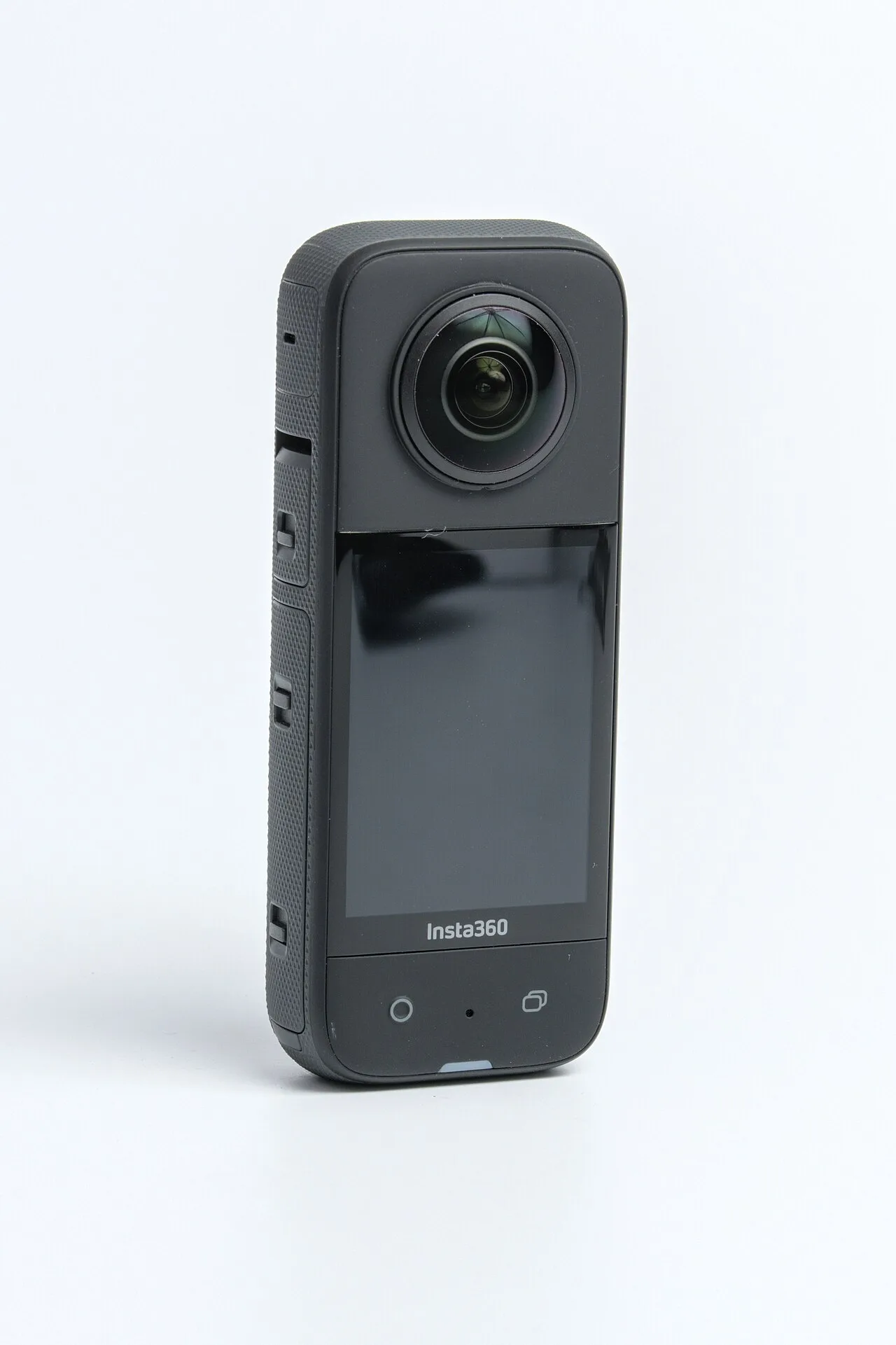
Screen-side view: -stk / Wikimedia Commons, CC BY-SA 4.0. Resized and converted to WebP; the derivative retains this license.

Williams found the software generally enjoyable and capable, with a few freezes in launch-era use. That reporting supports a practical workflow without proving present-day stability on every device. Confirm the current supported phone and operating-system requirements, particularly if you plan to use older hardware.
Start with simple edits. Set the view on the main subject, reveal the surroundings when they matter, and avoid constant rotations for their own sake. Spherical footage gives choices; the finished clip should make a clear choice. An audience does not need to see every direction just because you recorded it.
Mobile processing and storage remain part of the ownership cost. Keeping originals, app working data and exports consumes space. A low camera price does not remove the need to offload files or run a compatible editor. If your phone is already full, solve that bottleneck before ordering.
We do not assume a recurring cloud subscription is required for ordinary local reframing. Check optional services separately from the included local editing route. The useful starting question is whether you can complete a representative edit with the devices you already own.
Battery and recording: useful evidence, not a full-discharge guarantee
The camera uses an official 1800mAh battery, and the manufacturer claims an 81-minute runtime. TechRadar reports 45 minutes of 5.7K recording leaving a 49% displayed charge. Williams considered the manufacturer's number plausible, while noting that battery reporting is not necessarily linear.
That is not a measured 81-minute discharge run. Doubling the elapsed time because the indicator appears half full would imply precision the evidence does not support. Our recording score recognizes a usable result without turning it into a guaranteed event length.
The review did not see an overheating message during that recorded run. It does not establish indefinite recording in hotter conditions or while externally powered. Choose a mode and session length for the actual workload and keep spare power when a missed shot would matter.
Older batteries add another uncertainty. A several-year-old cell may not behave like TechRadar's new sample at launch. Factor replacement availability and cost into a used purchase, and verify the charger and accessory model rather than assuming all X-series batteries fit.
Alternatives: X4 detail, X5 difficult light and specialist stills
The X4 offers ordinary 8K/30fps spherical video and a larger battery. It is the clearer alternative for someone who finds the X3's tighter crops too soft while staying mostly in daylight. At a small total-price difference, the older camera's savings become difficult to defend.
The X5 adds more persuasive difficult-light performance and replaceable outer lenses. It costs more in launch context, but those advances solve distinct problems. Compare actual complete-kit offers before assuming the X3 is still the value leader.
The X6 is a premium generation with newer imaging and strong independently reported 8K/30fps endurance. Most beginner daylight experiments do not require it. Its launch-era mobile-app issues also show why better capture hardware does not automatically simplify every edit.
The ONE RS 1-Inch 360 Edition is an older specialist for controlled locations, not a weatherproof action upgrade. Its larger physical sensors and IPX3 protection pull it toward a different use case. Buyers interested in tours should compare actual output and workflow, not just generation or price.
The X3's moderate value score is intentionally not a claim that a current bargain exists. It represents a conditional low-cost role, constrained by capture detail, optical repair concerns and the alternatives now available.
Who should buy it, and who should skip it
Buy a clean, supported X3 for a materially cheaper introduction to daylight reframing, or keep one you already own if its output is good enough. Its creative flexibility is still real, and learning to use it well can be more useful than changing bodies immediately.
Skip it for regular night video, heavy cropping or a situation where damaged lenses would be a frequent risk. Also skip it if the difference to a comparable X4 or X5 is small after adding a battery, stick and protection. The complete cost determines whether the older camera is sensible.
Verdict
The X3 remains an approachable lesson in what spherical capture can do. It is no longer a broad recommendation at anything resembling its original flagship price, and “8K” without the word “timelapse” is a misleading way to describe it.
Choose it cheaply, in good condition, for wide daylight clips. If your needs exceed that role, the newer options address the limits more directly than optimistic spec reading will.
FAQ
Does X3 record ordinary 8K video?
No. Its ordinary spherical video maximum is 5.7K/30fps. The 8K mode is timelapse, which is a different recording method and output.
Are its 72MP photos equivalent to 72MP video frames?
No. Still-photo resolution and video modes are separate specifications. Neither tells you how much detail a narrow flat crop retains.
Is it suitable for night travel clips?
Not as our primary recommendation. TechRadar's Williams describes weak low-light detail and processing problems. Use good illumination or consider a newer difficult-light system.
Can I reframe after recording?
Yes, when you retain the spherical source and use a compatible editor. A finished flat export alone does not preserve all the original viewpoint choices.
Does the battery test prove 81 minutes?
No. The cited reviewer recorded 45 minutes and saw 49% remaining. That supports plausibility, not a measured full-runtime guarantee, particularly for an older battery.
Can I replace damaged lenses myself?
The X3 does not have the X5/X6 user-replaceable outer-lens system. Protective guards are different. Check service options for actual optical damage.
Will every selfie stick disappear?
No. Alignment, thickness and position matter. Keep the support in the appropriate stitching region, and inspect a representative shot before depending on the effect.
Is a used X3 better value than a new X4?
Only if the total saving is meaningful and the condition is good. Include battery health, missing accessories, warranty and clean optics in the comparison rather than comparing body-only prices.
Image credits
The lead photograph is Sebbog13's own X3 photographed on April 25, 2024, via Wikimedia Commons, licensed CC BY-SA 4.0. Our resized WebP derivative retains that license. These product images do not imply testing by Verdict Hound or illustrate recorded image quality.
