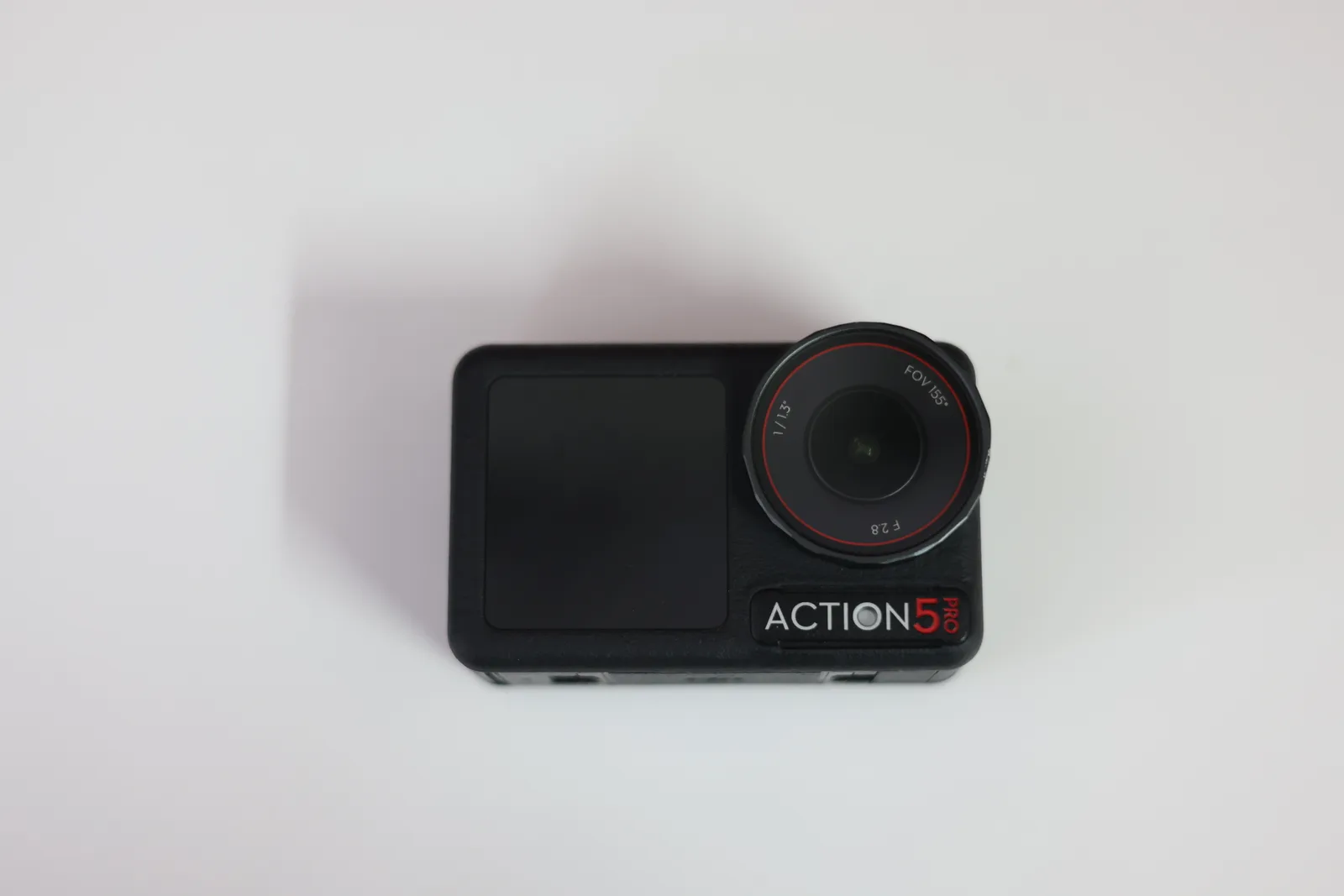
Overview: a battery-first recommendation
The Osmo Action 5 Pro is a particularly good fit for people who dislike interrupting a ride, hike or travel day to nurse a battery. Its most persuasive evidence is not DJI's four-hour advertising reference. It is Sam Kieldsen's independently reported run of almost two hours at 4K60 with RockSteady enabled. That result makes the camera worth considering even with the Action 6 available.
We have not performed hands-on tests. This review combines DJI's specifications with TechRadar's tested review. TechRadar dates the launch to September 19, 2024. Our score is an editorial synthesis, not a restatement of its star rating.
One supplied claim needs correcting immediately: this is a 1/1.3-inch 4:3 sensor, not the genuinely square sensor of the Action 6. You can record a tall frame and crop it, but DJI's newer square Custom format offers a different degree of reframing flexibility. Choose the camera for the files and runtime you need, rather than the word “Pro.”
Image quality and low-light performance
The fixed f/2.8 lens covers a 155° field of view. DJI supports 4K120, including 4:3 capture, and 40MP photographs. The still-image count is less important than how moving footage looks after stabilization and compression. A mountain-bike descent, for example, challenges fine foliage detail and exposure transitions far more than a static scene on a desk.
TechRadar found sharp, colorful daylight footage with good handling of bright and dark areas. DJI advertises up to 13.5 stops of dynamic range, but the independent source does not supply a measured stop chart proving that figure. We interpret the footage observations as evidence of useful exposure latitude, not a certified laboratory number.
Ten-bit D-Log M gives an editor more room to adjust color than an ordinary ready-to-share profile. It is useful if you are matching several cameras or want to retain a considered look across a trip. It also adds responsibility: a flat image that is never graded is not automatically more attractive.
SuperNight is a fallback rather than the main reason to buy. Kieldsen called the results only okay, and Action 6 testing subsequently identified greater dim-light potential from the newer lens and sensor. Current DJI specifications list SuperNight up to 4K60; launch coverage discussed a 30fps limit. That is a documentation-versus-review timing difference, not proof that the later mode has received the same independent evaluation.
For evening walks, consider how much the camera and subject move. Electronic stabilization can smooth a trajectory, but cannot remove a blurred exposure. A Pocket 3 may give a nicer result for dry-land talking footage; it is not an alternative for impacts or immersion.
Stabilization: read the resolution limits
TechRadar found RockSteady effective and also successfully stabilized suitable gyro-equipped, unstabilized Wide footage in Gyroflow. That offers a more involved editing route if you want control after capture. It does not mean every field of view, mode or already-stabilized recording contains the same useful information.
HorizonSteady is limited to 1080p or 2.7K at 60fps or below. HorizonBalancing can operate at supported 4K settings, also at 60fps or below. There is no reason to discover those limits during an event: set up the exact combination in advance.
For ordinary biking footage, retaining useful width can be more valuable than the strongest possible crop. A mount attached to a vibrating flexible surface can create problems software cannot fully solve. A rigid mount, sensible framing and a recording mode that supports EIS are the starting point. Dedicated Slow Motion is a separate mode without EIS, even though ordinary high-frame-rate recording offers other combinations.
Battery and thermal behavior
DJI's four-hour reference uses the removable 1950mAh battery at 25°C, 1080p24, RockSteady on, and screens and Wi-Fi off. These conditions are clearly specified and much lighter than continuous 4K120. The useful lesson is that the camera has good low-load endurance, not that every setting lasts 240 minutes.
Kieldsen's tests are more relevant to many buyers: nearly four hours at 1080p30 with EIS off, and almost two hours at 4K60 with RockSteady on, without thermal shutdown in the latter run. The review does not give a precise ambient temperature for that 4K60 result. It should therefore inform a purchase, not become a universal hot-weather guarantee.
Cold conditions, a continuously illuminated display and wireless connections can change the result. For a long day, an extra battery remains useful even on an efficient camera. For a stationary interview or stage recording, rehearse with the intended frame rate and airflow rather than assuming an outdoor action test transfers perfectly.
The Action 5 Pro's endurance score is high because there is a specific, independently reported 4K60 result. We do not assign an equally precise duration to 4K120, SuperNight or every horizon mode.
Build, screens and mounting
DJI lists 146g and housing-free waterproofing to 20m, extending to 60m with a dedicated case. These are manufacturer depth ratings that require correct sealing, not our independent pressure test. Inspect the doors and lens cover before using it in water, and follow DJI's instructions for prolonged or high-impact underwater use.
The front 1.46-inch and rear 2.5-inch OLED touchscreens are a meaningful convenience. You can frame a self-recorded clip and adjust settings without repeatedly turning the body around. TechRadar found the displays a welcome improvement, and their usefulness is easier to appreciate on a short travel commentary than in a specification table.
The magnetic quick-release system makes switching mounts less laborious. Its retention still depends on proper mechanical engagement. Budget for the mounts your activity requires, and confirm accessory compatibility rather than assuming every older DJI piece fits every newer camera.
Audio and storage workflow
The camera has 47GB of usable internal storage, within its nominal 64GB capacity. It provides a practical fallback when a microSD card is full or forgotten. It is not a replacement for offloading footage, nor does “internal” mean safer from losing the entire camera.
TechRadar tested direct DJI Mic 2 connection and found the 48kHz audio integration convenient. DJI also supports a two-transmitter setup. For travel conversation or outdoor narration, avoiding a separate receiver makes the rig less cumbersome. Wind, microphone placement and wireless reliability still deserve a short test before important recordings.
DJI Mimo is part of the mobile workflow; desktop editing remains a sensible choice for larger projects. A 10-bit file is useful only if your editor, transfer method and final delivery can handle it. Choose a simple profile for clips that will be posted immediately, and reserve D-Log M for work you will actually finish in an editing application.
Alternatives and price context
At launch, TechRadar recorded $349 / £329 / AU$599 for the Standard Combo and $449 for the US Adventure Combo. These are September 2024 references, not current sale prices. Our November 8, 2026 assessment treats value conditionally: a discounted Action 5 Pro is more compelling than one priced close to the newer model.
The Action 6 is worth the difference for square reframing and a brighter variable-aperture lens. The Action 4 is a reasonable older option when significantly cheaper, but loses internal storage, OLED displays and the newer endurance evidence. The HERO13 Black suits users who prioritize GPS or HB-Series optics, with weaker low-light performance reported in its independent review.
For a new buyer without expensive accessories already owned, Action 5 Pro remains a balanced choice. For an existing Action 4 owner happy with current results, calculate the upgrade against batteries and actual shooting limitations rather than buying another camera by habit.
Verdict: who should buy it?
Buy this model for independently supported recording endurance, direct wireless microphone use and convenient controls. Skip it for the most flexible aspect-ratio capture or if low-light detail is worth paying for the Action 6.
The six equally weighted criteria produce 4.4/5 through the site's existing score conversion. Stabilization, battery/thermal performance, build/mounting and value earn 9/10; image quality and audio/workflow earn 8.5/10. Value assumes a sensible price below the newer Action 6. The score does not imply that we measured 13.5 stops or tested every firmware mode.
FAQ: purchase and setup questions
Is the sensor square?
No. DJI lists 1/1.3-inch CMOS with 4:3 capture. The Action 6 is the square-sensor model with its dedicated Custom format.
Does it really record for four hours?
DJI's reference is a specified 1080p24 test. TechRadar reported nearly four hours at 1080p30 with EIS disabled, not at every resolution.
How long did stabilized 4K60 last?
TechRadar reported almost two hours without heat shutdown. The source does not identify the exact ambient temperature, so warmer environments can differ.
Can I lock the horizon in 4K?
Not with full HorizonSteady. HorizonBalancing supports certain 4K combinations; check DJI's current resolution and frame-rate table.
Is SuperNight limited to 30fps?
Launch testing described that limit. Current DJI specifications list 4K60, so firmware timing matters; we have not independently tested the later setting.
Can I shoot without a memory card?
Yes, using the 47GB usable internal storage. You still need a way to transfer and back up the files.
Is direct microphone pairing enough for two people?
DJI supports two compatible transmitters. Test the specific microphones, wind protection and recording arrangement before relying on it for an important conversation.
Should I buy this or the Action 6?
Choose the Action 5 Pro for value and endurance. Pay more for the Action 6 when its aperture and square capture solve a genuine shooting problem.